JEE Main 2026 — Mechanics
Physics Mechanics questions from JEE Main 2026.
Other Years
153 Mechanics Questions from 2026
A 4 kg mass moves under the influence of a force $\vec{F}=\left(4 t^{3} \hat{i}-3 t \hat{j}\right) \mathrm{N}$ where $t$ is the time in second. If mass starts from origin at $t=0$, the velocity and position after $t=2 \mathrm{~s}$ will be:
A ball of radius $r$ and density $\rho$ dropped through a viscous liquid of density $\sigma$ and viscosity $\eta$ attains its terminal velocity at time $t$, given by $t=A \rho^{a} r^{b} \eta^{\mathrm{c}} \sigma^{d}$, where $A$ is a constant and $a, b, c$ and $d$ are integers. The value of $\frac{b+c}{a+d}$ is $\_\_\_\_$.
A bead $P$ sliding on a frictionless semi-circular string $(A C B)$ and it is at point $S$ at $t =0$ and at this instant the horizontal component of its velocity is $v$. Another bead $Q$ of the same mass as $P$ is ejected from point $A$ at $t=0$ along the horizontal string $A B$, with the speed $v$, friction between the beads and the respective strings may be neglected in both cases. Let $t_{P}$ and $t_{Q}$ be the respective times taken by beads $P$ and $Q$ to reach the point $B$, then the relation between $t_{P}$ and $t_{Q}$ is 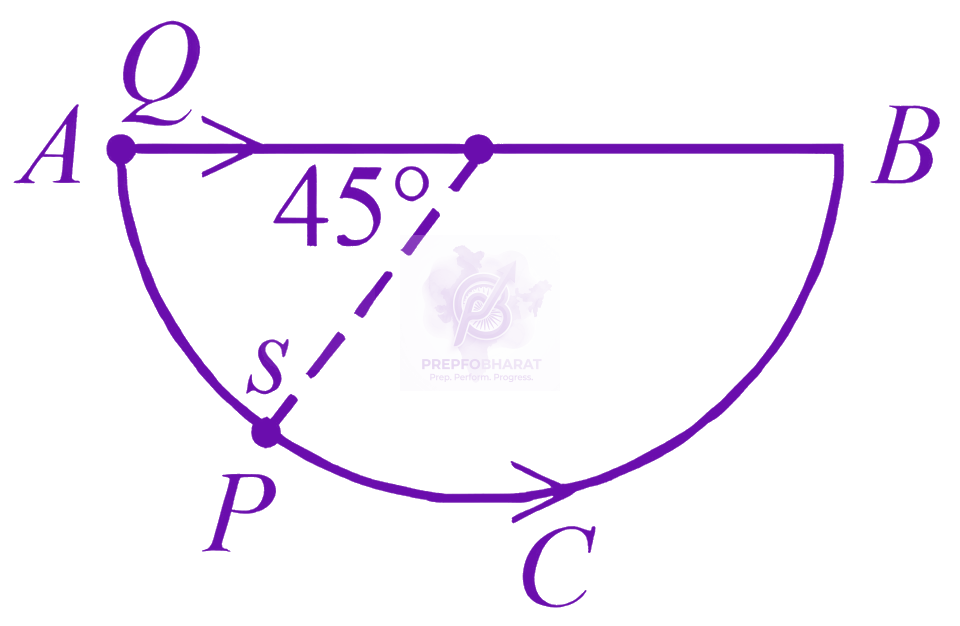
A block is sliding down on an inclined plane of slope $\theta$ and at an instant $t=0$ this block is given an upward momentum so that it starts moving up on the inclined surface with velocity $u$. The distance $(S)$ travelled by the block before its velocity become zero, is $\_\_\_\_$. ($g=$ gravitational acceleration)
A block of mass 5 kg is moving on an inclined plane which makes an angle of $30^{\circ}$ with the horizontal. Friction coefficient between the block and inclined plane surface is $\frac{\sqrt{3}}{2}$. The force to be applied on the block so that the block will move down without acceleration is $\_\_\_\_$ N. $\left(g=10 \mathrm{~m} / \mathrm{s}^{2}\right)$.
A block takes $t$ time to slide down a plane inclined at $45°$ to the horizontal. If the surface is made smooth (frictionless), the block takes time $\dfrac{t}{2}$ to slide down the plane. The coefficient of friction between the block and the inclined plane is $\left(\dfrac{\alpha}{100}\right)$. The value of $\alpha$ is __________.
A body of mass 14 kg initially at rest explodes and breaks into three fragments of masses in the ratio $2: 2: 3$. The two pieces of equal masses fly off perpendicular to each other with a speed of $18 \mathrm{~m} / \mathrm{s}$ each. The velocity of the heavier fragment is $\_\_\_\_$ $\mathrm{m} / \mathrm{s}$.
A body of mass 2 kg is moving along $x$-direction such that its displacement as function of time is given by $x(t)=\alpha t^{2}+\beta t+\gamma \mathrm{m}$, where $\alpha=1 \mathrm{~m} / \mathrm{s}^{2}, \beta=1 \mathrm{~m} / \mathrm{s}$ and $\gamma=1 \mathrm{~m}$. The work done on the body during the time interval $t=2 \mathrm{~s}$ to $t=3 \mathrm{~s}$, is $\_\_\_\_$ J.
A body of mass $m$ is taken from the surface of earth to a height equal to twice the radius of earth ($R_e$). The increase in potential energy will be _______. ($g$ is acceleration due to gravity at the surface of earth)
A body of mass $2$ kg begins to move under the influence of time dependent force $\vec{F} = (2t\hat{i} + 6t^2\hat{j})$ N, where $\hat{i}$ and $\hat{j}$ are unit vectors along $x$ and $y$-axis respectively. The power produced by the force at $t = 2$ s is _____ W.
A body of mass $1$ kg moves along a straight line with a velocity $v = 2x^2$. The work done by the body during displacement from $x = 0$ to $5$ m is __________ J.
A boy throws a ball into air at $45^{\circ}$ from the horizontal to land it on a roof of a building of height $H$. If the ball attains maximum height in 2 s and lands on the building in 3 s after launch, then value of $H$ is $\_\_\_\_$ m. $\left(\mathrm{g}=10 \mathrm{~m} / \mathrm{s}^{2}\right)$
A car moving with a speed of $54$ km/h takes a turn of radius $20$ m. A simple pendulum is suspended from the ceiling of the car. Determine the angle made by the string of the pendulum with the vertical during the turning. (Take $g=10$ m/s$^2$)
A circular disc has radius $R_{1}$ and thickness $T_{1}$. Another circular disc made of the same material has radius $R_{2}$ and thickness $T_{2}$. If the moment of inertia of both discs are same and $\frac{R_{1}}{R_{2}}=2$ then $\frac{T_{1}}{T_{2}}=\frac{1}{\alpha}$. The value of $\alpha$ is $\_\_\_\_$.
A copper wire of length $3\text{ m}$ is stretched by $3\text{ mm}$ by applying an external force. The volume of the wire is $600 \times 10^{-6}\text{ m}^3$. The elastic potential energy stored in the wire in stretched condition would be _______ J. (Given Young modulus of copper $= 1.1 \times 10^{11}\text{ N/m}^2$)
A cube has side length $5$ cm and modulus of rigidity $10^5$ N/m$^2$. The displacement produced by a force of $10$ N in the upper face of cube is _____ mm.
A cubical block of density $\rho_{b}=600 \mathrm{~kg} / \mathrm{m}^{3}$ floats in a liquid of density $\rho_{\mathrm{e}}=900 \mathrm{kg} / \mathrm{m}^{3}$. If the height of block is $H=8.0 \mathrm{~cm}$ then height of the submerged part is $\_\_\_\_$ cm.
A cylindrical vessel of $40$ cm radius is completely filled with water and its capacity is $528$ dm$^3$ (dm : decimeter). The vessel is placed on a solid block of exactly same height as vessel. If a small hole is made at $70$ cm below the top of water level, then horizontal range of water falling on the ground in the beginning is __________ cm.
A flexible chain of mass $m$ hangs between two fixed points at the same level. The inclination of the chain with the horizontal at the two points of support is $30^{\circ}$. Considering the equilibrium of each half of the chain, the tension of the chain at the lowest point is $\_\_\_\_$.
A fly wheel having mass 3 kg and radius 5 m is free to rotate about a horizontal axis. A string having negligible mass is wound around the wheel and the loose end of the string is connected to 3 kg mass. The mass is kept at rest initially and released. Kinetic energy of the wheel when the mass descends by 3 m is $\_\_\_\_$ $\mathrm{J}.\left(\mathrm{g}=10 \mathrm{~m} / \mathrm{s}^{2}\right)$
A gas balloon is going up with a constant velocity of $10$ m/s. When this balloon reached a height of $75$ m, a stone is dropped from it and balloon keeps moving up with the same velocity. The height of the balloon when the stone hits the ground is ________ m. (Take $g=10$ m/s$^2$)
A gun mounted on the ground fires bullets in all directions with same speed. The farthest distance the bullets could reach is $6.4$ m. The speed of the bullets from the gun is ______ m/s. (take $g=10$ m/s$^2$)
A $1$ kg block subjected to two simultaneous forces $(2\hat{i} + 3\hat{j} + 4\hat{k})$ N and $(3\hat{i} - \hat{j} - 2\hat{k})$ N is moved a distance of $25$ m along $(3\hat{i} - 4\hat{j})$ direction. The work done in this process is _____ J.
A $0.5$ kg mass is in contact against the inner wall of a cylindrical drum of radius $4$ m rotating about its vertical axis. The minimum rotational speed of the drum to enable the mass to remain stuck to the wall (without falling) is $5$ rad/s. The coefficient of friction between the drum's inner wall surface and mass is _______. (Take $g = 10$ m/s$^2$)
A large drum having radius $R$ is spinning around its axis with angular velocity $\omega$, as shown in figure. The minimum value of $\omega$ so that a body of mass $M$ remains stuck to the inner wall of the drum, taking the coefficient of friction between the drum surface and mass $M$ as $\mu$, is : 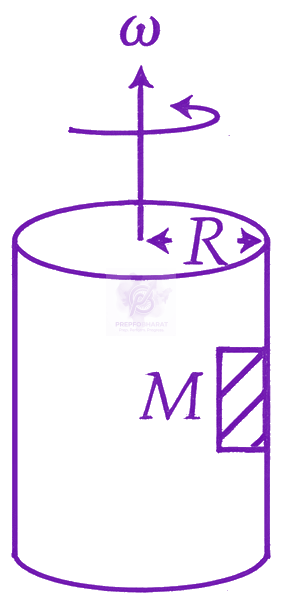
A lift of mass $1600$ kg is supported by thick iron wire. If the maximum stress which the wire can withstand is $4 \times 10^8$ N/m$^2$ and its radius is $4$ mm, then maximum acceleration the lift can take is _______ m/s$^2$. (take $g = 10$ m/s$^2$ and $\pi = 3.14$)
A liquid drop of diameter $2$ mm breaks into $512$ droplets. The change in surface energy is $\alpha \times 10^{-6}$ J. The value of $\alpha$ is _______. (Take surface tension of liquid $= 0.08$ N/m)
A liquid of density $600$ kg/m$^3$ flowing steadily in a tube of varying cross-section. The cross-section at a point $A$ is $1.0$ cm$^2$ and that at $B$ is $20$ mm$^2$. Both the points $A$ and $B$ are in same horizontal plane, the speed of the liquid at $A$ is $10$ cm/s. The difference in pressures at $A$ and $B$ points is ________ Pa.
A mass of $1\text{ kg}$ is kept on an inclined plane with $30°$ inclination with respect to horizontal plane and it is at rest initially. Then the whole assembly is moved up with constant velocity of $4\text{ m/s}$. The work done by the frictional force in time $2\text{ s}$ is _______ J. (Take $g = 10\text{ m/s}^2$)
A metal string $A$ is suspended from a rigid support and its free end is attached to a block of mass $M$. Second block having mass $2M$ is suspended at the bottom of the first block using a string $B$. The area of cross sections of strings $A$ and $B$ are same. The ratio of lengths of strings of $A$ to $B$ is $2$ and the ratio of their Young's moduli $(Y_A/Y_B)$ is $0.5$. The ratio of elongations in $A$ to $B$ is ______.
A new unit $(\alpha)$ of length is chosen such that it is equal to the speed of light in vacuum. What is the distance between Venus and Earth in terms of $\alpha$ units if light takes $6$ min. $40$ s to cover this distance?
A paratrooper jumps from an aeroplane and opens a parachute after 2 s of free fall and starts deaccelerating with $3 \mathrm{~m} / \mathrm{s}^{2}$. At 10 m height from ground, while descending with the help of parachute, the speed of paratrooper is $5 \mathrm{~m} / \mathrm{s}$. The initial height of the airplane is $\_\_\_\_$ m. $\left(\mathrm{g}=10 \mathrm{~m} / \mathrm{s}^{2}\right)$
A particle is rotating in a circular path and at any instant its motion can be described as $\theta = \dfrac{5t^4}{40} - \dfrac{t^3}{3}$. The angular acceleration of the particle after $10$ seconds is _______ rad/s$^2$.
A particle of mass $m$ falls from rest through a resistive medium having resistive force, $F=-k v$, where $v$ is the velocity of the particle and $k$ is a constant. Which of the following graphs represents velocity ($v$) versus time ($t$)?
A particle starts moving from time $t=0$ and its coordinate is given as $x(t)=4 t^{3}-3 t$ A. The particle returns to its original position (origin) 0.866 units later B. The particle is 1 unit away from origin at its turning point C. Acceleration of the particle is non-negative D. The particle is 0.5 units away from origin at its turning point E. Particle never turns back as acceleration is non-negative Choose the correct answer from the options given below :
A planet $(P_1)$ is moving around the star of mass $2M$ in the orbit of radius $R$. Another planet $(P_2)$ is moving around another star of mass $4M$ in a orbit of radius $2R$. Ratio of time periods of revolution of $P_2$ and $P_1$ is _______.
A projectile is thrown upward at an angle $60^{\circ}$ with the horizontal. The speed of the projectile is $20 \mathrm{~m} / \mathrm{s}$ when its direction of motion is $45^{\circ}$ with the horizontal. The initial speed of the projectile is $\_\_\_\_$ $\mathrm{m} / \mathrm{s}$.
A river of width 200 m is flowing from west to east with a speed of $18 \mathrm{~km} / \mathrm{h}$. A boat, moving with speed of $36 \mathrm{~km} / \mathrm{h}$ in still water, is made to travel one-round trip (bank to bank of the river). Minimum time taken by the boat for this journey and also the displacement along the river bank are $\_\_\_\_$ and $\_\_\_\_$ respectively.
A small block of mass $m$ slides down from the top of a frictionless inclined surface, while the inclined plane is moving towards left with constant acceleration $a_{0}$. The angle between the inclined plane and ground is $\theta$ and its base length is $L$. Assuming that initially the small block is at the top of the inclined plane, the time it takes to reach the lowest point of the inclined plane is $\_\_\_\_$. 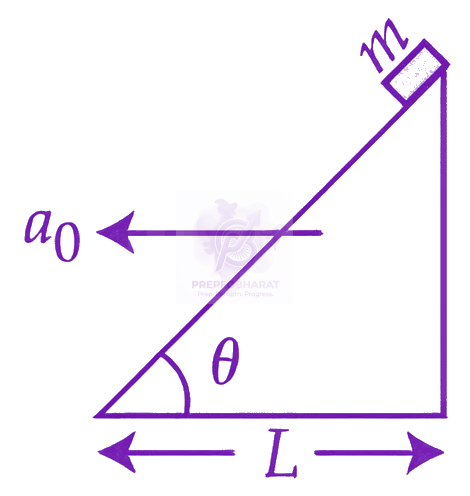
A small bob $A$ of mass $m$ is attached to a massless rigid rod of length 1 m pivoted at point $P$ and kept at an angle of $60^{\circ}$ with vertical as shown in figure. At distance of 1 m below point $P$, an identical bob $B$ is kept at rest on a smooth horizontal surface that extends to a circular track of radius $R$ as shown in figure. If bob $B$ just manages to complete the circular path of radius $R$ upto a point $Q$ after being hit elastically by $\operatorname{bob} A$, then radius $R$ is $\_\_\_\_$ m. 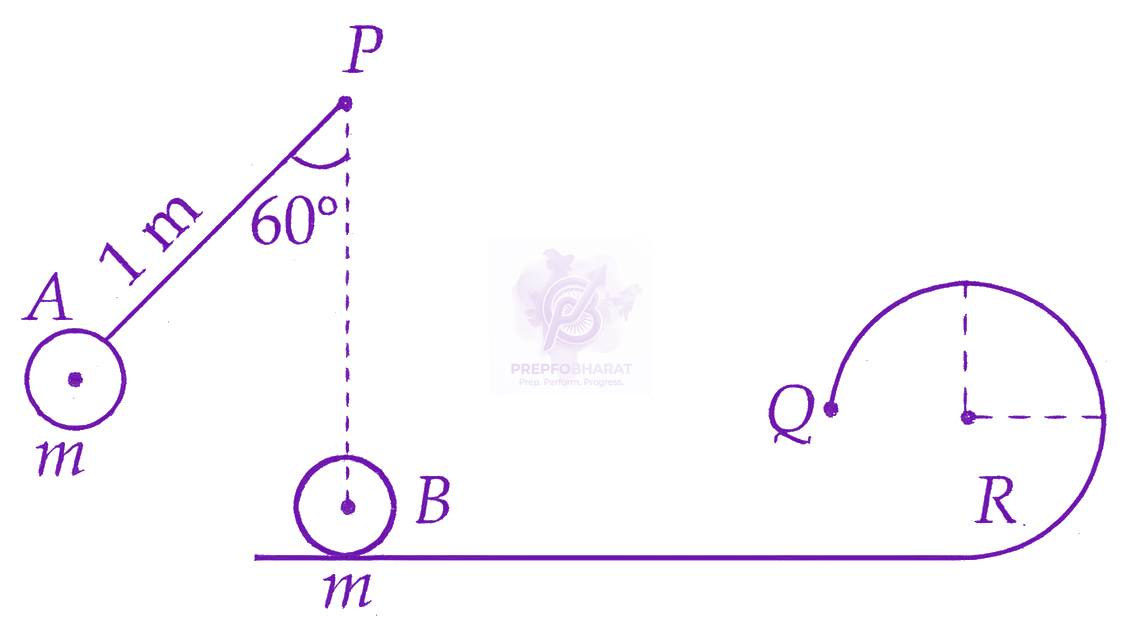
A small metallic sphere of diameter 2 mm and density $10.5 \mathrm{~g} / \mathrm{cm}^{3}$ is dropped in glycerine having viscosity 10 Poise and density $1.5 \mathrm{~g} / \mathrm{cm}^{3}$ respectively. The terminal velocity attained by the sphere is $\_\_\_\_$ $\mathrm{cm} / \mathrm{s}$. ($\pi=\frac{22}{7}$ and $g=10 \mathrm{~m} / \mathrm{s}^{2}$)
A smooth inclined plane ends in a vertical circular loop, as shown in the figure. A small body is released from height $h$ as shown. If the body exerts a force of three times its weight on the plane at the highest point of circle then the height $h = \alpha R$. The value of $\alpha$ is _______. 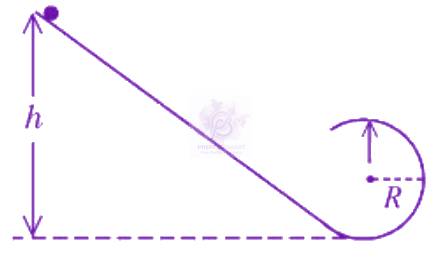
A soap bubble of surface tension $0.04 \mathrm{~N} / \mathrm{m}$ is blown to a diameter of 7 cm. If $(15000-x) \mu \mathrm{J}$ of work is done in blowing it further to make its diameter 14 cm, then the value of $x$ is $\_\_\_\_$. ($\pi=22 / 7$)
A solid cylinder having radius $R$ and length $L$ is slipping on a rough horizontal plane. At time $t=0$ the cylinder has a translational velocity $v_0=49$ m/s, perpendicular to its axis and a rotational velocity $v_0/4R$ about the centre. The time taken by the cylinder to start rolling is ________ seconds. (coefficient of kinetic friction $\mu_K=0.25$ and $g=9.8$ m/s$^2$)
A solid sphere of mass 5 kg and radius 10 cm is kept in contact with another solid sphere of mass 10 kg and radius 20 cm. The moment of inertia of this pair of spheres about the tangent passing through the point of contact is $\_\_\_\_$ $\mathrm{kg}. \mathrm{m}^{2}$.
A solid sphere ($A$) of mass $5m$ and a spherical shell ($B$) of mass $m$, both having same radius, are placed on a rough surface. When a force of same magnitude is applied tangentially at the highest points of $A$ and $B$, they start rolling without slipping with an acceleration of $a_A$ and $a_B$, respectively. The ratio of $a_A$ and $a_B$ is __________.
A solid sphere of mass $M$ and radius $R$ is divided into two unequal parts. The smaller part having mass $M/8$ is converted into a sphere of radius $r$ and the larger part is converted into a circular disc of thickness $t$ and radius $2R$. If $I_1$ is moment of inertia of a sphere having radius $r$ about an axis through its centre and $I_2$ is the moment of inertia of a disc about its diameter, the ratio of their moment of inertia $I_2/I_1 = $ _____.
A solid sphere of radius 10 cm is rotating about an axis which is at a distance 15 cm from its centre. The radius of gyration about this axis is $\sqrt{n} \mathrm{~cm}$. The value of $n$ is
A solid sphere of radius $4$ cm and mass $5$ kg is rotating (rotation axis is passing through the centre of the sphere) with an angular velocity of $1200$ rpm. It is brought to rest in $10$ s by applying a constant torque. The torque applied and the number of rotations it made before it comes to rest are _______ and _______ respectively.
A spherical ball of mass $2$ kg falls from a height of $10$ m and is brought to rest after penetrating $10$ cm into sand. The average force exerted by sand on the ball is _______ N. (Take $g = 10$ m/s$^2$)
A spherical body of radius $r$ and density $\sigma$ falls freely through a viscous liquid having density $\rho$ and viscosity $\eta$ and attains a terminal velocity $v_{0}$. Estimated maximum error in the quantity $\eta$ is : (Ignore errors associated with $\sigma, \rho$ and $g$, gravitational acceleration)
A spherical liquid drop of radius $R$ acquires the terminal velocity $v_1$ when falls through a gas of viscosity $\eta$. Now the drop is broken into $64$ identical droplets and each droplet acquires terminal velocity $v_2$ falling through the same gas. The ratio of terminal velocities $v_1/v_2$ is ________.
A spring of force constant $15 \mathrm{~N} / \mathrm{m}$ is cut into two pieces. If the ratio of their length is $1: 3$, then the force constant of smaller piece is $\_\_\_\_$ $\mathrm{N} / \mathrm{m}$.
A string $A$ of length $0.314$ m and Young's modulus $2 \times 10^{10}$ N/m$^2$ is connected to another string $B$ of length and Young's modulus both twice of those of $A$. This series combination of strings is then suspended from a rigid support and its free end is fixed to a load of mass $0.8$ kg. The net change in length of the combination is _____ mm. (radius of both the strings is $0.2$ mm and acceleration due to gravity $= 10$ m/s$^2$) (Mass of both strings is to be neglected as compared to the mass of load)
A thin uniform rod $(X)$ of mass $M$ and length $L$ is pivoted at a height $\left(\frac{L}{3}\right)$ as shown in the figure. The rod is allowed to fall from a vertical position and lie horizontally on the table. The angular velocity of this rod when it hits the table top, is $\_\_\_\_$. ($\mathrm{g}=$ gravitational acceleration) 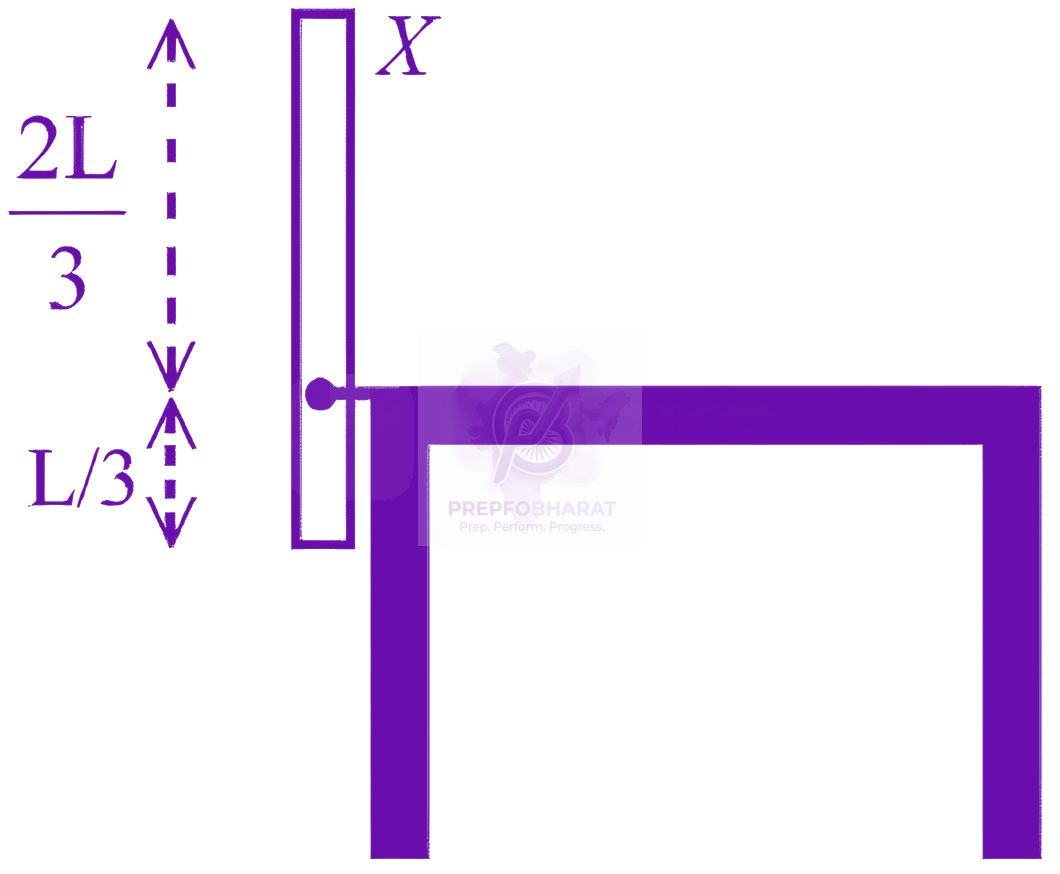
A tub is filled with water and a wooden cube $10$ cm $\times$ $10$ cm $\times$ $10$ cm is placed in the water. The wooden cube is found to float on the water with a part of it submerged in water. When a metal coin is placed on the wooden cube, the submerged part is increased by $3.87$ cm. The mass of the metal coin is _______ gram. (Take water density as $1$ g/cm$^3$ and density of wood as $0.4$ g/cm$^3$)
A uniform bar of length 12 cm and mass $20 m$ lies on a smooth horizontal table. Two point masses $m$ and $2 m$ are moving in opposite directions with same speed of $v$ and in the same plane as the bar, as shown in figure. These masses strike the bar simultaneously and get stuck to it. After collision the entire system is rotating with angular frequency $\omega$. The ratio of $v$ and $\omega$ is : 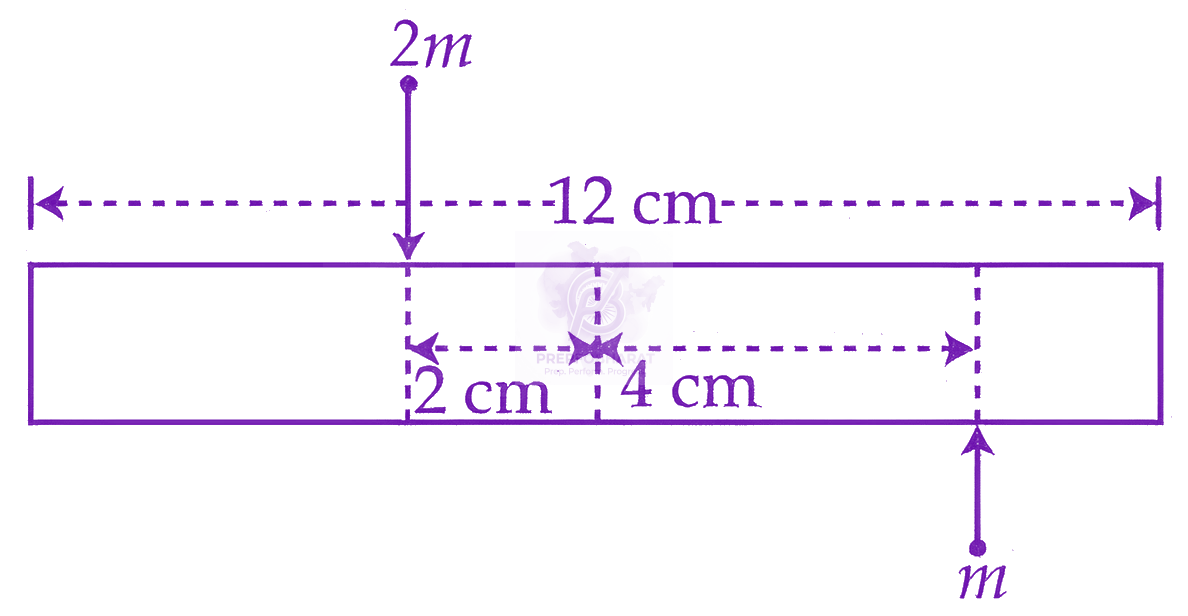
A uniform rod of mass $m$ and length $l$ suspended by means of two identical inextensible light strings as shown in figure. Tension in one string immediately after the other string is cut, is $\_\_\_\_$. $(g$ acceleration due to gravity) 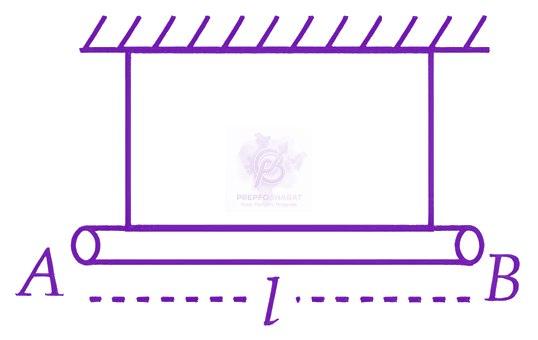
A uniform solid cylinder of length $L$ and radius $R$ has moment of inertia about its axis equal to $I_{1}$. A small co-centric cylinder of length $L / 2$ and radius $R / 3$ carved from this cylinder has moment of inertia about its axis equals to $I_{2}$. The ratio $I_{1} / I_{2}$ is $\_\_\_\_$.
A uniform wire of length $l$ of weight $w$ is suspended from the roof with a weight of $W$ at the other end. The stress in the wire at $\dfrac{l}{3}$ distance from the top is $\left(\dfrac{W}{A} + \dfrac{2}{\gamma}\dfrac{w}{A}\right)$, where, $A$ is the cross sectional area of the wire. The value of $\gamma$ is _______.
A water spray gun is attached to a hose of cross sectional area $30$ cm$^2$. The gun comprises of $10$ perforations each of cross sectional area $15$ mm$^2$. If the water flows in the hose with the speed of $50$ cm/s, calculate the speed at which the water flows out from each perforation. (Neglect any edge effects)
A wedge $Y$ with mass of $10$ kg and all frictionless surfaces and the inclined surface making $37°$ with horizontal. A block $X$ with mass $2$ kg is placed at the highest point of the wedge as shown in figure is at rest. At $t = 0$ wedge $(Y)$ is pulled toward right with constant force $(f)$ of $24$ N. Taking the block $X$ at rest at $t = 0$, the time taken by it to slide down $8.8$ m on the slope, while $Y$ is on the move, is _____ s. (take $\tan(37°) = 3/4$ and $g = 10$ m/s$^2$) 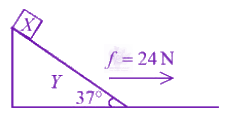
A wheel initially at rest is subjected to a uniform angular acceleration about its axis. In the first $2\text{ s}$ it rotates through an angle $\theta_1$ and in the next $2\text{ s}$ it rotates through an angle $\theta_2$. The ratio $\dfrac{\theta_2}{\theta_1}$ is _______.
An air bubble of volume $2.9 \mathrm{~cm}^{3}$ rises from the bottom of a swimming pool of 5 m deep. At the bottom of the pool water temperature is $17^{\circ} \mathrm{C}$. The volume of the bubble when it reaches the surface, where the water temperature is $27^{\circ} \mathrm{C}$, is $\_\_\_\_$ $\mathrm{cm}^{3}$. $\left(\mathrm{g}=10 \mathrm{~m} / \mathrm{s}^{2}\right.$, density of water $=10^{3} \mathrm{~kg} / \mathrm{m}^{3}$, and 1 atm pressure is $\left.10^{5} \mathrm{~Pa}\right)$
An object is projected with kinetic energy $K$ from a point $A$ at an angle $60^{\circ}$ with the horizontal. The ratio of the difference in kinetic energies at points $B$ and $C$ to that at point $A$ (see figure), in the absence of air friction is : 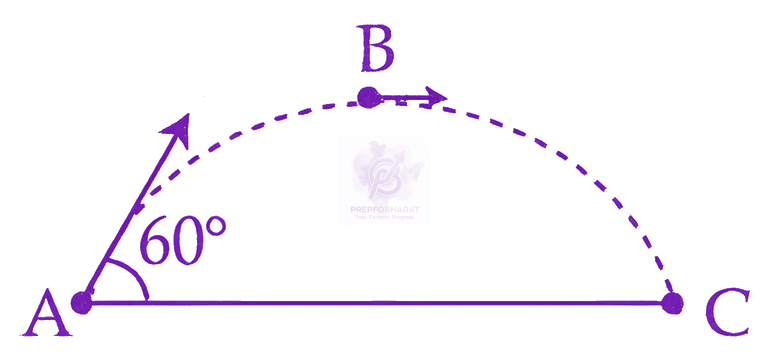
An object of uniform density rolls up the curved path with the initial velocity $v_0$ as shown in the figure. If the maximum height attained by an object is $\dfrac{7v_0^2}{10g}$ ($g$ = acceleration due to gravity), the object is a _______. 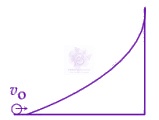
$L$, $C$ and $R$ represents physical quantities inductance, capacitance and resistance respectively. The dimensional formula $ML^2 T^{-4} A^{-2}$ corresponds to __________.
At $t=0$, a body of mass $100$ g starts moving under the influence of a force $(5\hat{i}+10\hat{j})$ N. After $2$ s its position is $(2x\hat{i}+5y\hat{j})$ m. The ratio $x:y$ is ______.
Consider a modified Bernoulli equation. $\left(\mathrm{P}+\frac{A}{B t^{2}}\right)+\rho g(h+B t)+\frac{1}{2} \rho V^{2}=$ constant If $t$ has the dimension of time then the dimensions of $A$ and $B$ are $\_\_\_\_$, $\_\_\_\_$ respectively.
Consider the equation $H = \dfrac{x^p \epsilon^q E^r}{t^s}$, where $H=$ magnetic field; $E=$ electric field, $\epsilon=$ permittivity, $x=$ distance, $t=$ time. The values of $p, q, r$ and $s$ respectively are:
Dimensions of universal gravitational constant $(G)$ in terms of Planck's constant $(h)$, distance $(L)$, mass $(M)$ and time $(T)$ are _______.
Eight mercury drops, each of radius $r$, coalesce to form a bigger drop. The surface energy released in this process is _______. ($S$ is the surface tension of mercury).
Figure represents the extension ($\Delta l$) of a wire of length $1$ meter, suspended from the ceiling of the room at one end with a load $W$ connected to the other end. If the cross-sectional area of the wire is $10^{-5}$ m$^2$ then the Young's modulus of the wire is __________ N/m$^2$. 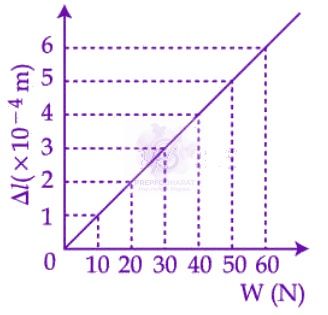
Four persons measure the length of a rod as $20.00 \mathrm{~cm}, 19.75 \mathrm{~cm}, 17.01 \mathrm{~cm}$ and 18.25 cm. The relative error in the measurement of average length of the rod is :
From $18$ m height above the ground a ball is dropped from rest. The height above the ground at which the magnitude of velocity equal to the magnitude of acceleration (in the same set of units) due to gravity is _____ m. (Take $g = 10$ m/s$^2$ and neglect the air resistance)
Given below are two statements: Statement I: A satellite is moving around earth in the orbit very close to the earth surface. The time period of revolution of satellite depends upon the density of earth. Statement II: The time period of revolution of the satellite is $T=2 \pi \sqrt{\frac{R_{e}}{g}}$ (for satellite very close to the earth surface), where $R_{\mathrm{e}}$ radius of earth and $g$ acceleration due to gravity. In the light of the above statements, choose the correct answer from the options given below :
Given below are two statements : Statement I: An object moves from position $r_{1}$ to position $r_{2}$ under a conservative force field $\vec{F}$. The work done by the force is $W=-\int_{r_{1}}^{r_{2}} \vec{F} \cdot \overrightarrow{d r}$. Statement II: Any object moving from one location to another location can follow infinite number of paths. Therefore, the amount of work done by the object changes with the path it follows for a conservative force. In the light of the above statements, choose the correct answer from the options given below :
Given below are two statements : Statement I: For a mechanical system of many particles total kinetic energy is the sum of kinetic energies of all the particles. Statement II: The total kinetic energy can be the sum of kinetic energy of the center of mass w.r.t to the origin and the kinetic energy of all the particles w.r.t. the center of mass as the reference. In the light of the above statements, choose the correct answer from the options given below :
Given below are two statements: Statement I: Pressure of a fluid is exerted only on a solid surface in contact as the fluid-pressure does not exist everywhere in a still fluid. Statement II: Excess potential energy of the molecules on the surface of a liquid, when compared to interior, results in surface tension. In the light of the above statements, choose the correct answer from the options given below
If a body of mass $1$ kg falls on the earth from infinity, it attains velocity $(v)$ and kinetic energy $(k)$ on reaching the surface of earth. The values of $v$ and $k$ respectively are _______. (Take radius of earth to be $6400$ km and $g = 9.8$ m/s$^2$)
If an air bubble of diameter $2$ mm rises steadily through a liquid of density $2000$ kg/m$^3$ at a rate of $0.5$ cm/s, then the coefficient of viscosity of liquid is _______ Poise. (Take $g = 10$ m/s$^2$)
If $x$ and $y$ coordinates of a projectile as a function of time $(t)$ are given as $24t$ and $43.6t-4.9t^2$, respectively, then the angle (in degrees) made by the projectile with horizontal when $t=2$ s is ______.
If $\epsilon, E$ and $t$ represent the free space permittivity, electric field and time respectively, then the unit of $\frac{\epsilon E}{t}$ will be :
In a perfectly inelastic collision, two spheres made of the same material with masses 15 kg and 25 kg, moving in opposite directions with speeds of $10 \mathrm{~m} / \mathrm{s}$ and $30 \mathrm{~m} / \mathrm{s}$, respectively, strike each other and stick together. The rise in temperature (in ${ }^{\circ} \mathrm{C}$), if all the heat produced during the collision is retained by these spheres, is : (specific heat of sphere material $31 \mathrm{cal} / \mathrm{kg}.{ }^{\circ} \mathrm{C}$ and $1 \mathrm{cal}=4.2 \mathrm{~J}$)
In a screw gauge the zero of main scale reference line coincides with the fifth division of the circular scale when two studs are in contact. There are $100$ divisions in circular scale and pitch of screw gauge is $0.1$ mm. When diameter of a sphere is measured, the reading of main scale is $5$ mm and $50^{\text{th}}$ division of circular scale coincides with the reference line of main scale. The diameter of sphere is _______ mm.
In a screw gauge, the zero of the circular scale lies 3 divisions above the horizontal pitch line when their metallic studs are brought in contact. Using this instrument thickness of a sheet is measured. If pitch scale reading is 1 mm and the circular scale reading is 51 then the correct thickness of the sheet is $\_\_\_\_$ mm. [Assume least count is 0.01 mm ]
In a screw gauge when the circular scale is given five complete rotations it moves linearly by $2.5$ mm. If the circular scale has $100$ divisions, the least count of screw gauge is _____ mm.
In a Vernier calipers, when both jaws touch each other, zero of the Vernier scale is shifted to the right of zero of the main scale and $7^{\text{th}}$ Vernier division coincides with a main scale reading. If the value of $1$ main scale division is $1$ mm and there are $10$ Vernier scale divisions, then the Vernier caliper has
In a vernier callipers, 50 vernier scale divisions are equal to 48 main scale divisions. If one main scale division $=0.05 \mathrm{~mm}$, then the least count of the vernier callipers is $\_\_\_\_$ mm.
In an experiment, a set of reading are obtained as follows - $1.24 \mathrm{~mm}, 1.25 \mathrm{~mm}, 1.23 \mathrm{~mm}$, 1.21 mm. The expected least count of the instrument used in recording these readings is $\_\_\_\_$ mm.
In an experiment the values of two spring constants were measured as $k_{1}=(10 \pm 0.2) \mathrm{N} / \mathrm{m}$ and $k_{2}=(20 \pm 0.3) \mathrm{N} / \mathrm{m}$. If these springs are connected in parallel, then the percentage error in equivalent spring constant is :
In case of vertical circular motion of a particle by a thread of length $r$ if the tension in the thread is zero at an angle $30^{\circ}$ shown in figure, the velocity at the bottom point $(A)$ of the circular path is ($g=$ gravitational acceleration) 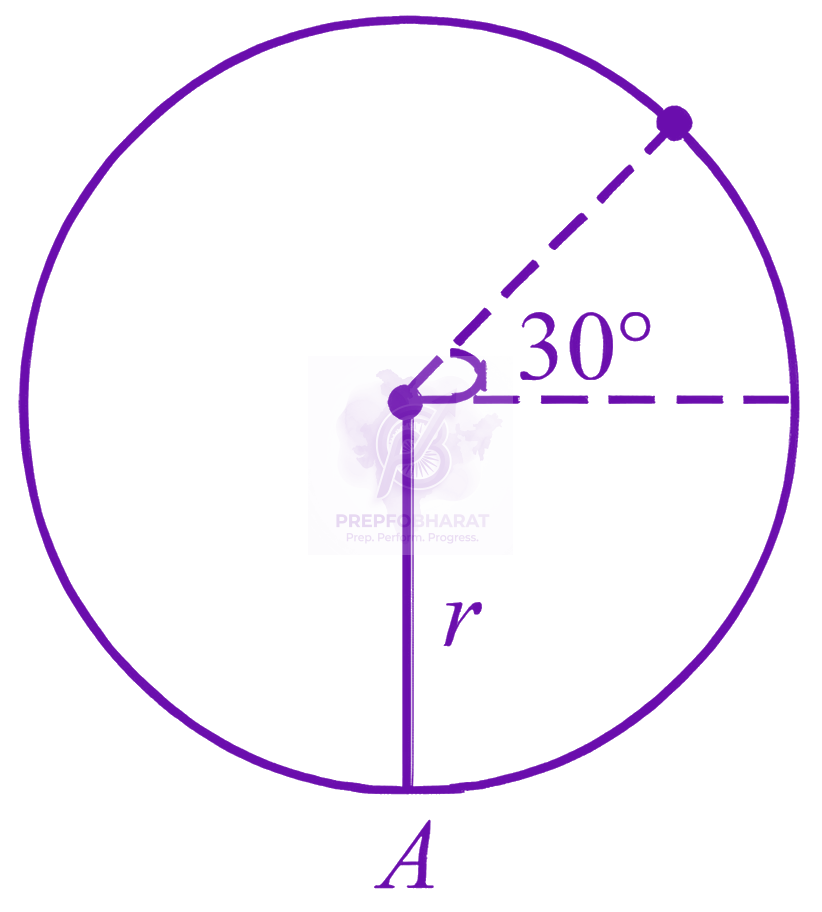
In the given figure the blocks $A, B$ and $C$ weigh $4 \mathrm{~kg}, 6 \mathrm{~kg}$ and 8 kg respectively. The co-efficient of sliding friction between any two surfaces is 0.5. The force $\vec{F}$ required to slide the block $C$ with constant speed is $\_\_\_\_$ N. (Use $g=10 \mathrm{~m} / \mathrm{s}^{2}$) 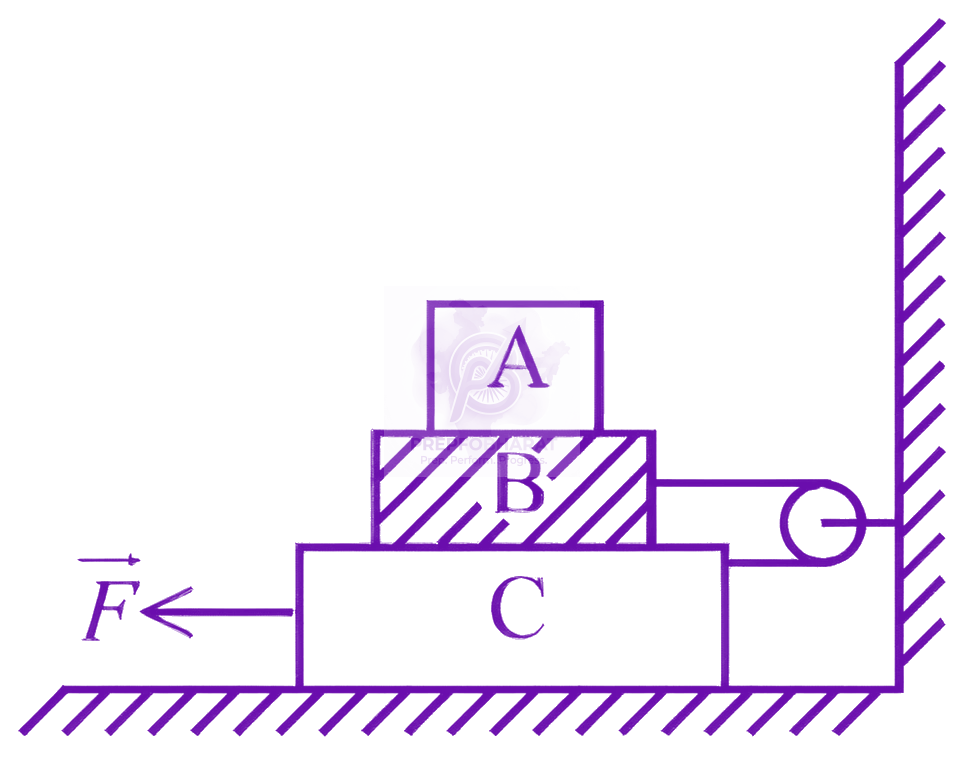
Initially a satellite of 100 kg is in a circular orbit of radius $1.5 \mathrm{R}_{\mathrm{E}}$. This satellite can be moved to a circular orbit of radius $3 R_{E}$ by supplying $\alpha \times 10^{6} \mathrm{~J}$ of energy. The value of $\alpha$ is $\_\_\_\_$. (Take Radius of Earth $R_{E}=6 \times 10^{6} \mathrm{~m}$ and $\mathrm{g}=10 \mathrm{~m} / \mathrm{s}^{2}$)
A particle of mass 2 kg is projected vertically upward with a speed of 30 m/s. The maximum height reached by the particle is (g = 10 m/s²):
Keeping the significant figures in view, the sum of the physical quantities $52.01 \mathrm{~m}, 153.2 \mathrm{~m}$ and 0.123 m is :
Match List - I with List - II. \(\begin{array}{llll} & \text{List - I} & & \text{List - II} \\ A. & \text{Coefficient of viscosity} & I. & [M L^{-1} T^{-1}] \\ B. & \text{Surface tension} & II. & [M L^{0} T^{-2}] \\ C. & \text{Pressure} & III. & [M L^{-1} T^{-2}] \\ D. & \text{Surface energy} & IV. & [M L^{2} T^{-2}] \end{array}\) Choose the correct answer from the options given below :
Match List - I with List - II.<table class="pyq-table"><tbody><tr><th>List - I</th><th>List - II</th></tr><tr><td>A. Boltzmann constant</td><td>I. $[M^{-1}L^3T^{-2}]$</td></tr><tr><td>B. Stefan's constant</td><td>II. $[ML^2T^{-1}]$</td></tr><tr><td>C. Planck's constant</td><td>III. $[ML^2T^{-2}K^{-1}]$</td></tr><tr><td>D. Gravitational constant</td><td>IV. $[ML^0T^{-3}K^{-4}]$</td></tr></tbody></table>Choose the correct answer from the options given below :
Match List-I with List-II. <table class="pyq-table"><tbody><tr><th>List-I</th><th>List-II</th></tr><tr><td>A. Meter (L)</td><td>I. $\sqrt{\dfrac{hc}{G}}$</td></tr><tr><td>B. Second (S)</td><td>II. $\sqrt{\dfrac{Gh}{c^5}}$</td></tr><tr><td>C. Kilogram (M)</td><td>III. $\sqrt{\dfrac{K^2L^2c^3}{Gh}}$</td></tr><tr><td>D. Kelvin (K)</td><td>IV. $\sqrt{\dfrac{Gh}{c^3}}$</td></tr></tbody></table> where $h$ (Planck's constant), $G$ (gravitational constant) and $c$ (speed of light in vacuum) as fundamental units. Choose the correct answer from the options given below :
Match the LIST-I with LIST-II \(\begin{array}{||c|l||c||l||} \hline & \textbf{List-I} & & \textbf{List-II} \\ \hline A. & \text{Spring constant} & I. & \mathrm{M L^{2} T^{-2} K^{-1}} \\ \hline B. & \text{Thermal conductivity} & II. & \mathrm{M L^{0} T^{-2}} \\ \hline C. & \text{Boltzmann constant} & III. & \mathrm{M L^{2} T^{-3} A^{-2}} \\ \hline D. & \text{Inductive reactance} & IV. & \mathrm{M L T^{-3} K^{-1}} \\ \hline \end{array}\) Choose the correct answer from the options given below:
Match the LIST-I with LIST-II \(\begin{array}{||c|l||c|l||} \hline & \text{List-I} & & \text{List-II} \\ \hline \text{A.} & \text{Magnetic induction} & \text{I.} & \mathrm{M\,L\,T^{-2}\,A^{-2}} \\ \hline \text{B.} & \text{Magnetic flux} & \text{II.} & \mathrm{M\,L^{2}\,T^{-2}\,A^{-2}} \\ \hline \text{C.} & \text{Magnetic permeability} & \text{III.} & \mathrm{M\,L^{0}\,T^{-2}\,A^{-1}} \\ \hline \text{D.} & \text{Self inductance} & \text{IV.} & \mathrm{M\,L^{2}\,T^{-2}\,A^{-1}} \\ \hline \end{array}\) Choose the correct answer from the options given below:
Moment of inertia about an axis $AB$ for a rod of mass $40$ kg and length $3$ m is same as that of a solid sphere of mass of $10$ kg and radius $R$ about an axis parallel to $AB$ axis with separation of $3$ m as shown in figure below. The value of $R$ is given as $\sqrt{\dfrac{\alpha}{2}}$. The value of $\alpha$ is _______. 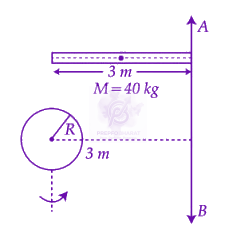
Net gravitational force at the center of a square is found to be $F_{1}$ when four particles having mass $M, 2 M, 3 M$ and $4 M$ are placed at the four corners of the square as shown in figure and it is $F_{2}$ when the positions of $3 M$ and $4 M$ are interchanged. The ratio $\frac{F_{1}}{F_{2}}$ is $\frac{\alpha}{\sqrt{5}}$. The value of $\alpha$ is $\_\_\_\_$. 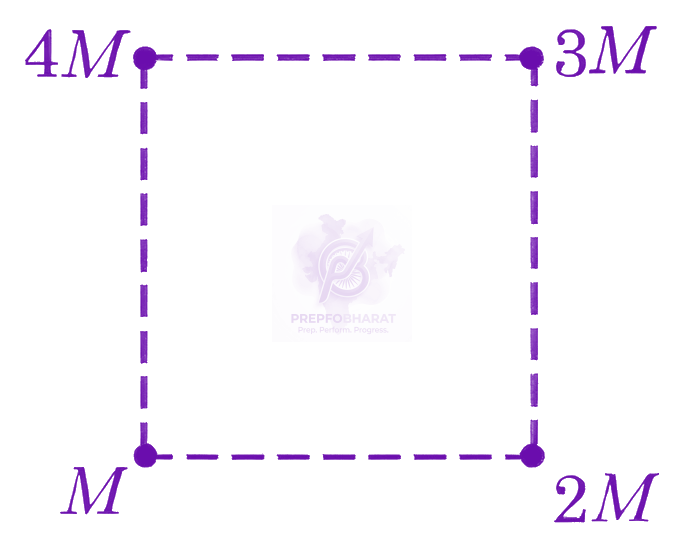
Potential energy ($V$) versus distance ($x$) is given by the graph. Rank various regions as per the magnitudes of the force (F) acting on a particle from high to low. 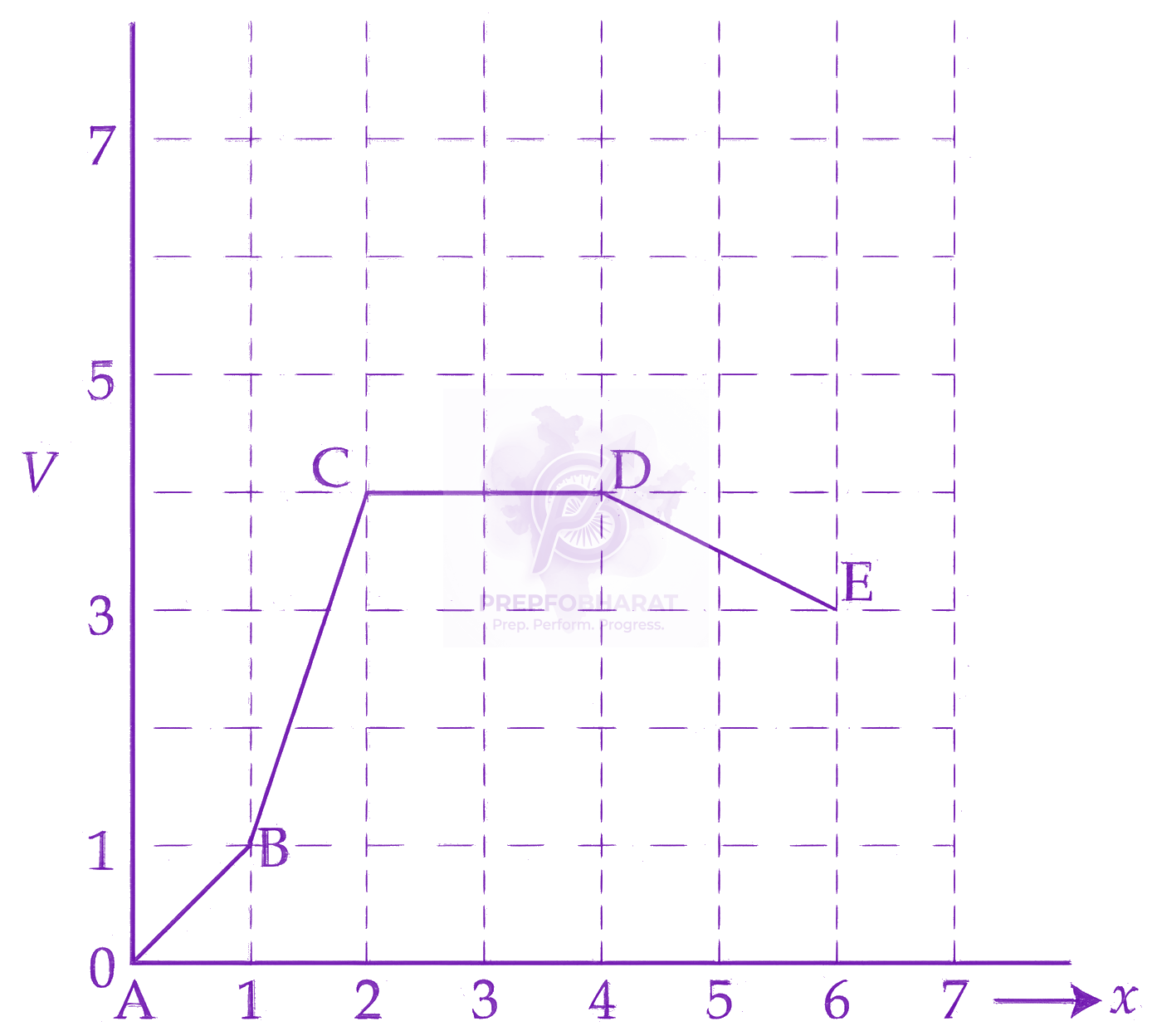
Sixty four rain drops of radius 1 mm each falling down with a terminal velocity of $10 \mathrm{~cm} / \mathrm{s}$ coalesce to form a bigger drop. The terminal velocity of bigger drop is $\_\_\_\_$ $\mathrm{cm} / \mathrm{s}$.
Suppose there is a uniform circular disc of mass $M \mathrm{~kg}$ and radius $r \mathrm{~m}$ shown in figure. The shaded regions are cut out from the disc. The moment of inertia of the remainder about the axis $A$ of the disc is given by $\frac{x}{256} M r^{2}$. The value of $x$ is $\_\_\_\_$. 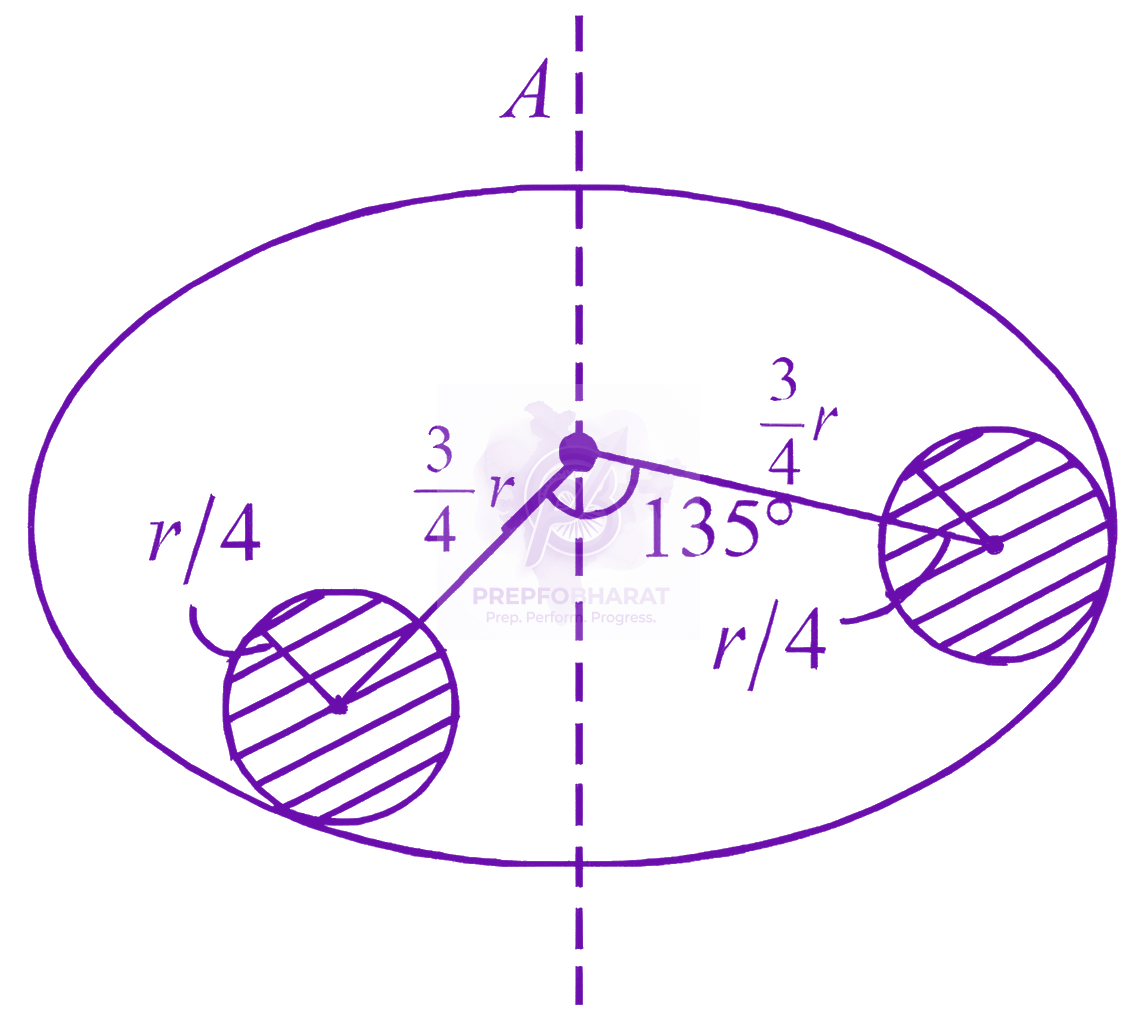
Surface tension of two liquids (having same densities), $T_{1}$ and $T_{2}$, are measured using capillary rise method utilizing two tubes with inner radii of $r_{1}$ and $r_{2}$ where $r_{1}>r_{2}$. The measured liquid heights in these tubes are $h_{1}$ and $h_{2}$ respectively. [Ignore the weight of the liquid about the lowest point of miniscus]. The heights $h_{1}$ and $h_{2}$ and surfaces tensions $T_{1}$ and $T_{2}$ satisfy the relation:
The density $\rho$ of a uniform cylinder is determined by measuring its mass $m$, length $l$ and diameter $d$. The measured values of $m$, $l$ and $d$ are $97.42 \pm 0.02$ g, $8.35 \pm 0.05$ mm and $20.20 \pm 0.02$ mm, respectively. Calculated percentage fractional error in $\rho$ is _______.
The diameter of a wire measured by a screw gauge of least count $0.001$ cm is $0.08$ cm. The length measured by a scale of least count $0.1$ cm is $150$ cm. When a weight of $100$ N is applied to the wire, the extension in length is $0.5$ cm, measured by a micrometer of least count $0.001$ cm. The error in the measured Young's modulus is $\alpha \times 10^9$ N/m$^2$. The value of $\alpha$ is _______. (Ignore the contribution of the load to Young's modulus error calculation)
The escape velocity from a spherical planet $A$ is $10 \mathrm{~km} / \mathrm{s}$. The escape velocity from another planet $B$ whose density and radius are $10 \%$ of those of planet $A$, is $\_\_\_\_$ $\mathrm{m} / \mathrm{s}$.
The height in terms of radius of the earth $(R)$, at which the acceleration due to gravity becomes $\dfrac{g}{9}$, where $g$ is acceleration due to gravity on earth's surface, is ______.
The increase in the pressure required to decrease the volume $(\Delta V)$ of water is $6.3 \times 10^7$ N/m$^2$. The percentage decrease in the volume is _____. (Bulk modulus of water $= 2.1 \times 10^9$ N/m$^2$.)
The moment of inertia of a square loop made of four uniform solid cylinders, each having radius $R$ and length $L(\mathrm{R}<\mathrm{L})$ about an axis passing through the mid points of opposite sides, is (Take the mass of the entire loop as $M$) :
The percentage error in the calculated volume of a sphere, if there is $2\%$ error in its diameter measurement, is __________.
The position of an object having mass $0.1$ kg as a function of time $t$ is given as $\vec{r} = \left(10t^2\hat{i} + 5t^3\hat{j}\right)$ m. At $t = 1$ s, which of the following statements are correct? A. The linear momentum $\vec{p} = \left(2\hat{i} + 1.5\hat{j}\right)$ kg·m/s. B. The force acting on the object $\vec{F} = \left(2\hat{i} + 3\hat{j}\right)$ N. C. The angular momentum of the object about its origin $\vec{L} = 15\hat{k}$ J·s. D. The torque acting on the object about its origin $\vec{\tau} = 20\hat{k}$ N·m. Choose the correct answer from the options given below :
The position of center of mass of three masses $2$ kg, $3$ kg and $15$ kg placed with respect to mid point ($p$) of normal bisector, as shown in the figure is _______. 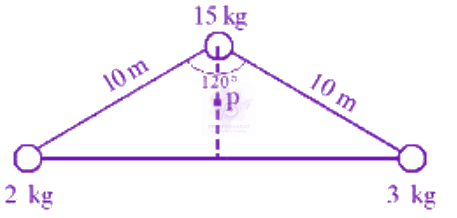
The potential energy of a particle changes with distance $x$ from a fixed origin as $V = \dfrac{A\sqrt{x}}{x + B}$, where $A$ and $B$ are constant with appropriate dimensions. The dimensions of $AB$ are _______.
The pulley shown in figure is made using a thin rim and two rods of length equal to diameter of the rim. The rim and each rod have a mass of $M$. Two blocks of mass of $M$ and $m$ are attached to two ends of a light string passing over the pulley, which is hinged to rotate freely in vertical plane about its center. The magnitudes of the acceleration experienced by the blocks is $\_\_\_\_$ (assume no slipping of string on pulley). 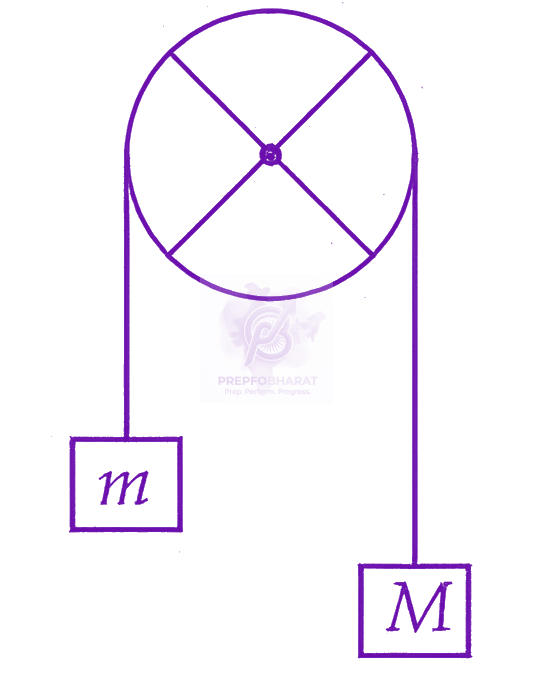
The rain drop of mass $1$ g, starts with zero velocity from a height of $1$ km. It hits the ground with a speed of $5$ m/s. The work done by the unknown resistive force is _______ J. (take $g = 10$ m/s$^2$)
The strain-stress plot for materials $A, B, C$ and $D$ is shown in the figure. Which material has the largest Young's modulus ? 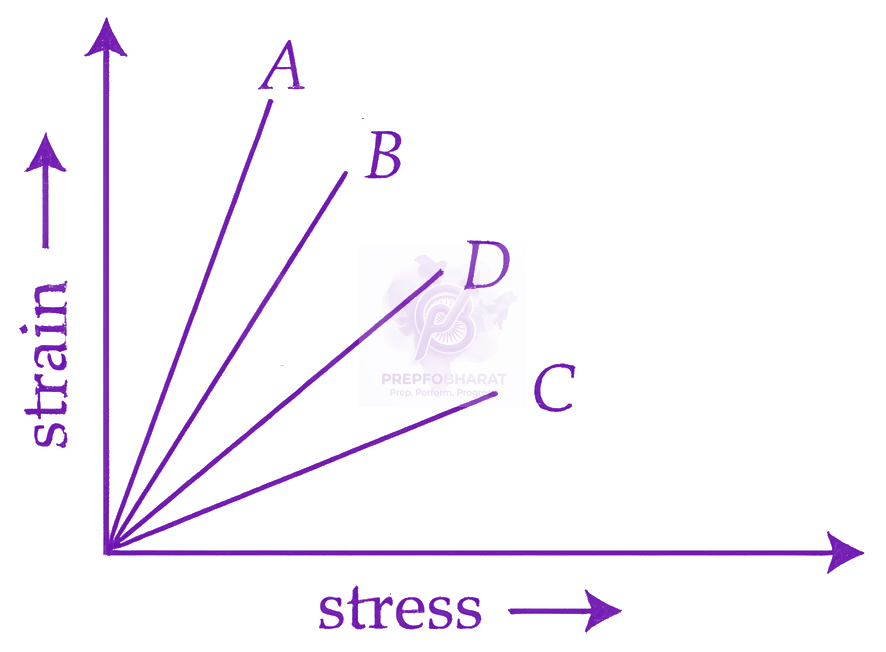
The surface tension of a soap bubble is $0.03$ N/m. The work done in increasing the diameter of bubble from $2$ cm to $6$ cm is $\alpha \pi \times 10^{-4}$ J. The value of $\alpha$ is _______. (Take $\pi = 3.14$)
The surface tension of a soap solution is $3.5 \times 10^{-2}$ N/m. The work required to increase the radius of a soap bubble from $1$ cm to $2$ cm is $\alpha \times 10^{-6}$ J. The value of $\alpha$ is _____. ($\pi = 22/7$)
The terminal velocity of a metallic ball of radius 6 mm in a viscous fluid is $20 \mathrm{~cm} / \mathrm{s}$. The terminal velocity of another ball of same material and having radius 3 mm in the same fluid will be $\_\_\_\_$ $\mathrm{cm} / \mathrm{s}$.
The time taken by a block of mass $m$ to slide down from the highest point to the lowest point on a rough inclined plane is $50\%$ more compared to the time taken by the same block on identical inclined smooth plane. Both inclined planes are at $45^\circ$ with the horizontal. The coefficient of kinetic friction between the rough inclined surface and block is _____.
The two wires $A$ and $B$ of equal cross-section but of different materials are joined together. The ratio of Young's modulus of wire $A$ and wire $B$ is $20/11$. When the joined wire is kept under certain tension the elongations in the wires $A$ and $B$ are equal. If the length of wire $A$ is $2.2$ m, then the length of wire $B$ is _______ m.
The velocity $(v)$ - Distance $(x)$ graph is shown in figure. Which graph represents acceleration $(a)$ versus distance $(x)$ variation of this system? 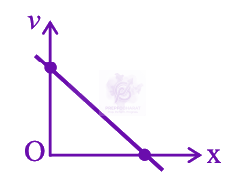
The velocity at which $6$ kg mass (shown in figure) strikes the ground when it is released from a height of $6$ m above the ground is __________ m/s. Assume pulley is massless and string is light and inextensible. (Take g $= 10$ m/s$^2$) 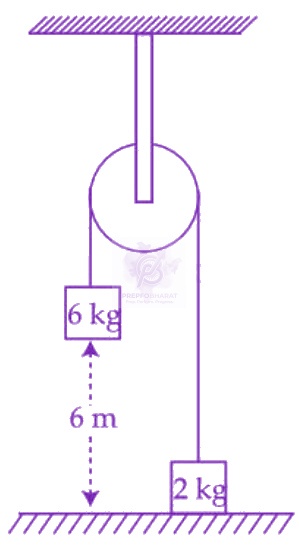
The velocity of a particle is given as $\vec{v} = -x\hat{i} + 2y\hat{j} - z\hat{k}$ m/s. The magnitude of acceleration at point $(1, 2, 4)$ is _______ m/s$^2$.
The velocity ($v$) versus time ($t$) plot of a particle is shown in the figure, for a time interval of $40\text{ s}$. The total distance travelled by the particle and the average velocity during this period are, respectively _______. 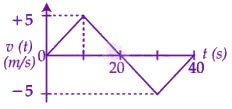
The Young's modulus of steel wire of radius $r$ and length $L$ is $Y$. If the radius $r$ and length $L$ of the wire are doubled then the value of $Y$
Three masses $200 \mathrm{~kg}, 300 \mathrm{~kg}$ and 400 kg are placed at the vertices of an equilateral triangle with sides 20 m. They are rearranged on the vertices of a bigger triangle of side 25 m and with the same centre. The work done in this process $\_\_\_\_$ J. (Gravitational constant $\mathrm{G}=6.7 \times 10^{-11} \mathrm{~N} \mathrm{~m}^{2} / \mathrm{kg}^{2}$)
Three masses $m_1 = 4$ kg, $m_2 = 4$ kg and $m_3 = 6$ kg are suspended from a fixed smooth frictionless pulley as shown in the figure below. The value of $T_1/T_2$ is _____. (take $g = 10$ m/s$^2$) 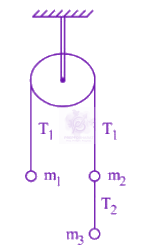
Two blocks ($P$ and $Q$) with respectively masses $2$ kg and $1.5$ kg are joined by a massless thread. These blocks are mounted on a frictionless pulley which is fixed on the edge of a cube ($S$), as shown in the figure below. Block $P$ is positioned on the top surface which has no friction and block $Q$ is in contact with side-surface, having coefficient friction $\mu$. The cube ($S$) moves towards the right with acceleration of $\dfrac{g}{2}$, where $g$ is gravitational acceleration. During this movement the block $P$ and $Q$ remain stationary. The value of $\mu$ is _______. (take $g = 10$ m/s$^2$) 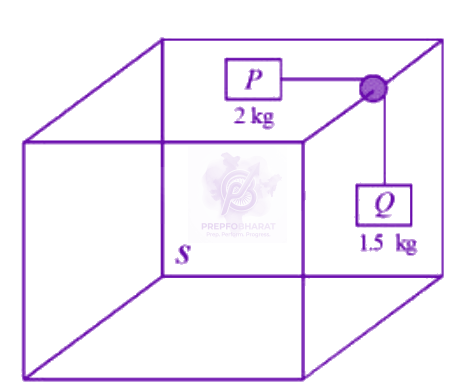
Two blocks of masses $2$ kg and $1$ kg respectively, are tied to the ends of a string which passes over a light frictionless pulley as shown in the figure below. The masses are held at rest at the same horizontal level and then released. The distance traversed by the centre of mass in $2$ s is _______ m. (Take $g = 10$ m/s$^2$) 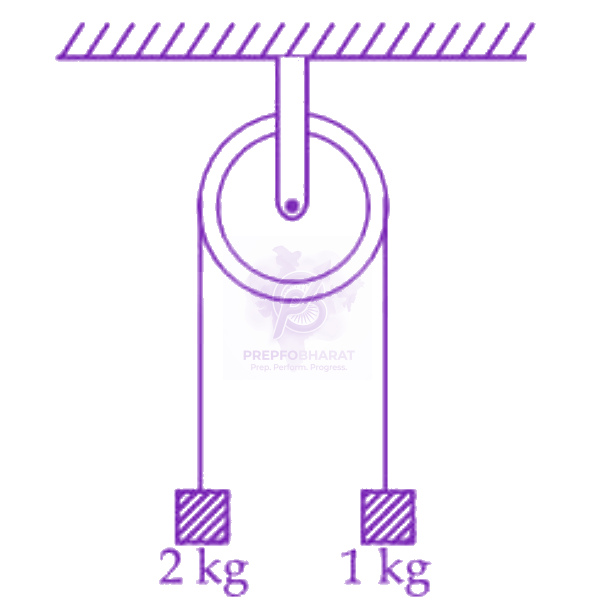
Two cars $A$ and $B$ are moving in the same direction along a straight line with speeds $100$ km/h and $80$ km/h, respectively such that car $A$ is moving ahead of car $B$. A person in car $B$ throws a stone with a speed $v$ so that it hits the car $A$ with a speed of $5$ m/s. The value of $v$ is ______ km/h.
Two cars $A$ and $B$ each of mass $10^{3} \mathrm{~kg}$ are moving on parallel tracks separated by a distance of 10 m, in same direction with speeds $72 \mathrm{~km} / \mathrm{h}$ and $36 \mathrm{~km} / \mathrm{h}$. The magnitude of angular momentum of $\operatorname{car} A$ with respect to $\operatorname{car} B$ is $\_\_\_\_$ J.s.
Two circular discs of radius each 10 cm are joined at their centres by a rod of length 30 cm and mass 600 gm as shown in figure. If the mass of each disc is 600 gm and applied torque between two discs is $43 \times 10^{5}$ dyne. cm, the angular acceleration of the discs about the given axis $A B$ is $\_\_\_\_$ $\mathrm{rad} / \mathrm{s}^{2}$. 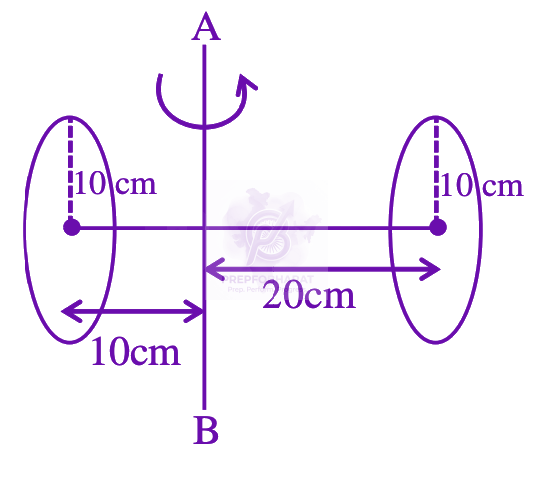
Two identical bodies $A$ and $B$ of equal masses have initial velocities $\vec{v_1} = 4\hat{i}$ m/s and $\vec{v_2} = 4\hat{j}$ m/s respectively. The body $A$ has acceleration $\vec{a_1} = 6\hat{i} + 6\hat{j}$ m/s$^2$ while the acceleration of the other body $B$ is zero. The centre of mass of the two bodies moves in __________ path.
Two identical bodies, projected with the same speed at two different angles cover the same horizontal range $R$. If the time of flight of these bodies are $5$ s and $10$ s, respectively, then the value of $R$ is ________ m. (Take $g=10$ m/s$^2$)
Two identical thin rods of mass $M \mathrm{~kg}$ and length $L \mathrm{~m}$ are connected as shown in figure. Moment of inertia of the combined rod system about an axis passing through point $P$ and perpendicular to the plane of the rods is $\frac{x}{12} \mathrm{ML}^{2} \mathrm{~kg} \mathrm{~m}^{2}$. The value of $x$ is $\_\_\_\_$. 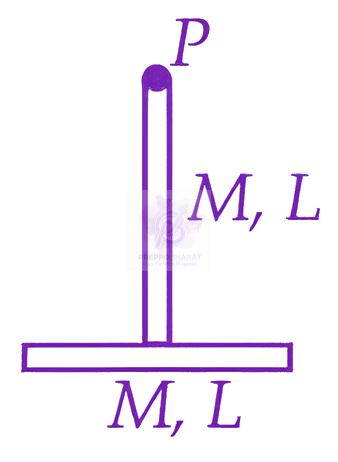
Two masses 400 g and 350 g are suspended from the ends of a light string passing over a heavy pulley of radius 2 cm. When released from rest the heavier mass is observed to fall 81 cm in 9 s. The rotational inertia of the pulley is $\_\_\_\_$ $\mathrm{kg} \cdot \mathrm{m}^{2}$. $\left(\mathrm{g}=9.8 \mathrm{~m} / \mathrm{s}^{2}\right)$
Two masses $m$ and 2 m are connected by a light string going over a pulley (disc) of mass 30 m with radius $r=0.1 \mathrm{~m}$. The pulley is mounted in a vertical plane and it is free to rotate about its axis. The 2 m mass is released from rest and its speed when it has descended through a height of 3.6 m is $\_\_\_\_$ $\mathrm{m} / \mathrm{s}$. (Assume string does not slip and $\mathrm{g}=10 \mathrm{~m} / \mathrm{s}^{2}$)
Two masses of $3.4$ kg and $2.5$ kg are accelerated from an initial speed of $5$ m/s and $12$ m/s, respectively. The distances traversed by the masses in the $5^\text{th}$ second are $104$ m and $129$ m, respectively. The ratio of their momenta after $10$ s is $\dfrac{x}{8}$. The value of $x$ is ________.
Two projectiles are projected with the same initial velocities at the $15^\circ$ and $30^\circ$ with respect to the horizontal. The ratio of their ranges is $1:x$. The value of $x$ is:
Two small balls with masses $m$ and 2 m are attached to both ends of a rigid rod of length $d$ and negligible mass. If angular momentum of this system is $L$ about an axis ($A$) passing through its centre of mass and perpendicular to the rod then angular velocity of the system about $A$ is :
Two wires $A$ and $B$ made of different materials of lengths 6.0 cm and 5.4 cm, respectively and area of cross sections $3.0 \times 10^{-5} \mathrm{~m}^{2}$ and $4.5 \times 10^{-5} \mathrm{~m}^{2}$, respectively are stretched by the same magnitude under a given load. The ratio of the Young's modulus of $A$ to that of $B$ is $x: 3$. The value of $x$ is $\_\_\_\_$.
Two wires as shown in the figure below, made of steel and have breaking stress of $12 \times 10^8$ N/m$^2$. Area of cross-section of upper wire is $0.008$ cm$^2$ and of lower wire is $0.004$ cm$^2$. The maximum mass that can be added to pan without breaking any wire is _____ kg. (take $g = 10$ m/s$^2$) 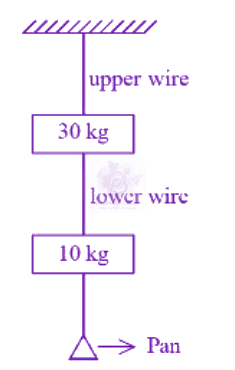
Water drops fall from a tap on the floor, 5 m below, at regular intervals of time, the first drop strikes the floor when the sixth drop begins to fall. The height at which the fourth drop will be from ground, at the instant when the first drop strikes the ground is $\_\_\_\_$ m. $\left(\mathrm{g}=10 \mathrm{~m} / \mathrm{s}^{2}\right)$
Water flows through a horizontal tube as shown in the figure. The difference in height between the water columns in vertical tubes is 5 cm and the area of cross-sections at $A$ and $B$ are $6 \mathrm{~cm}^{2}$ and $3 \mathrm{~cm}^{2}$ respectively. The rate of flow will be $\_\_\_\_$ $\mathrm{cm}^{3} / \mathrm{s}$. (take $g=10 \mathrm{~m} / \mathrm{s}^{2}$) 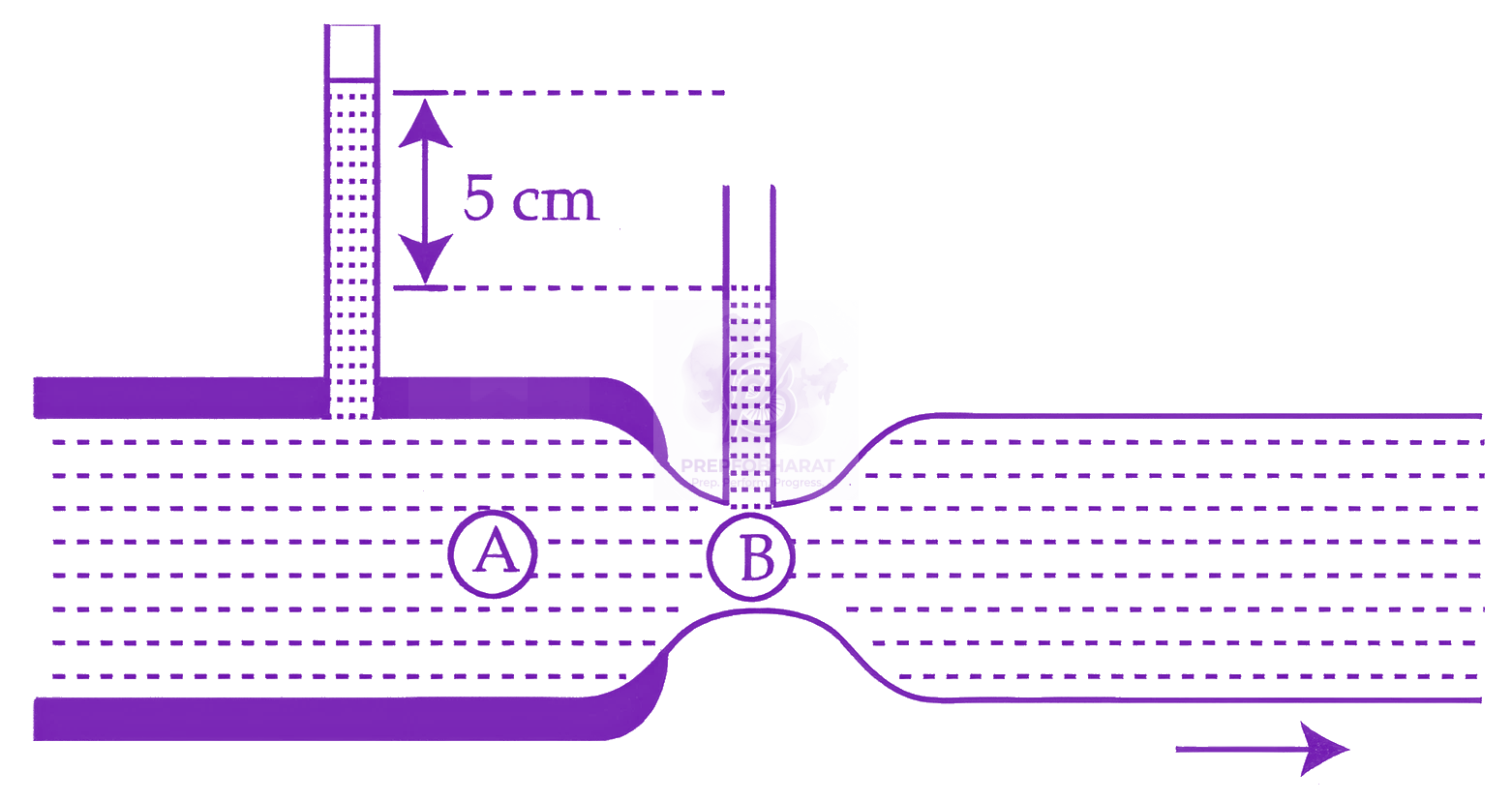
When a part of a straight capillary tube is placed vertically in a liquid, the liquid raises upto certain height $h$. If the inner radius of the capillary tube, density of the liquid and surface tension of the liquid decrease by $1 \%$ each, then the height of the liquid in the tube will change by $\%$.
When both jaws of vernier callipers touch each other, zero mark of the vernier scale is right to zero mark of main scale, $4^{\text {th }}$ mark on vernier scale coincides with certain mark on the main scale. While measuring the length of a cylinder, observer observes 15 divisions on main scale and $5^{\text {th }}$ division of vernier scale coincides with a main scale division. Measured length of cylinder is $\_\_\_\_$ mm. (Least count of Vernier calliper $=0.1 \mathrm{~mm}$)
When one moves from a point $16$ km below the earth's surface to a point $16$ km above the earth's surface. The change in $g$ is approximately $\alpha$ %. The value of $\alpha$ is _____. (Take radius of the earth $= 6400$ km.)
When the position vector $\vec{r}=x \hat{i}+y \hat{j}+z \hat{k}$ changes sign as $-\vec{r}$, which one of the following vector will not flip under sign change ?