JEE Main 2021 — Mechanics
Physics Mechanics questions from JEE Main 2021.
Other Years
283 Mechanics Questions from 2021
A particle is moving with uniform speed along the circumference of a circle of radius $R$ under the action of a central fictitious force $F$ which is inversely proportional to ${R}^{3}$. Its time period of revolution will be given by :
A steel block of $10\mathrm{kg}$ rests on a horizontal floor as shown. When three iron cylinders are placed on it as shown, the block and cylinders go down with an acceleration $0.2m{s}^{-2}.$ The normal reaction ${R}^{'}$ by the floor if mass of the iron cylinders are equal and of $20\mathrm{kg}$ each is $(\text{in}N)$, [Take $g=10m{s}^{-2}$ and ${\mu }_{s}=0.2]$ 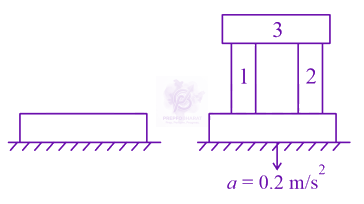
The magnitude of vectors $\vec{\mathrm{OA}},\vec{\mathrm{OB}}$ and $\vec{\mathrm{OC}}$ in the given figure are equal. The direction of $\vec{\mathrm{OA}}+\vec{\mathrm{OB}}-\vec{\mathrm{OC}}$ with $x-$axis will be:<br><img src="https://prepforbharat.s3.ap-south-1.amazonaws.com/exam/615f0e999476412f48314daf/Physics/images/Mathematics_in_Physics/648b5a6b417cc3fb48d673be/question_1__q_648b5a6b417cc3fb48d673be__cdn-question-pool.getmarks.app__f958ec96-79f7-46ca-804b-4243d3868bea-image__8fc9b51105_final_ppt_sync.png" alt="JEE Main 2021 Physics, Mathematics in Physics — question figure">
A block of mass m slides down an inclined plane of inclination θ with uniform speed. The coefficient of friction between the block and the plane is:
A ball is thrown vertically upward with velocity 20 m/s from a tower of height 25 m. The speed with which it hits the ground is (g = 10 m/s²):
The angle between vector $(\vec{A})$ and $(\vec{A}-\vec{B})$ is :<br><img src="https://prepforbharat.s3.ap-south-1.amazonaws.com/exam/615f0e999476412f48314daf/Physics/images/Mathematics_in_Physics/648b5a6b417cc3fb48d67413/question_1__q_648b5a6b417cc3fb48d67413__cdn-question-pool.getmarks.app__d50634a7-afb5-4efa-b069-eae20a8bec04-image__3ec37d0b87_final_ppt_sync.png" alt="JEE Main 2021 Physics, Mathematics in Physics — question figure">
If $\vec{P}\times \vec{Q}=\vec{Q}\times \vec{P}$, the angle between $\vec{P}$ and $\vec{Q}$ is $\theta (0^{\circ}<\theta <360^{\circ})$. The value of $\theta$ will be ___$^{\circ}$.
A stone of mass $20g$ is projected from a rubber catapult of length $0.1m$ and area of cross section ${10}^{-6}{m}^{2}$ stretched by an amount $0.04m.$ The velocity of the projected stone is $m{s}^{-1}.$ (Young's modulus of rubber $=0.5\times {10}^{9}N{m}^{-2}$)
Wires ${W}_{1}$ and ${W}_{2}$ are made of same material having the breaking stress of $1.25\times {10}^{9}N{m}^{-2}.{W}_{1}$ and ${W}_{2}$ have cross-sectional area of $8\times {10}^{-7}{m}^{2}$ and $4\times {10}^{-7}{m}^{2}$, respectively. Masses of $20\mathrm{kg}$ and $10\mathrm{kg}$ hang from them as shown in the figure. The maximum mass that can be placed in the pan without breaking the wires is _____$\mathrm{kg}$ (Use $g=10m{s}^{-2})$ 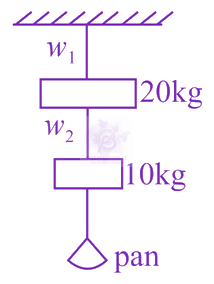
If one wants to remove all the mass of the earth to infinity in order to break it up completely. The amount of energy that needs to be supplied will be $\frac{x}{5}\frac{G{M}^{2}}{R}$ where $x$ is ________. (Round off to the Nearest Integer) ($M$ is the mass of earth, $R$ is the radius of earth, $G$ is the gravitational constant)
The time period of a satellite in a circular orbit of the radius $R$ is $T.$ The period of another satellite in a circular orbit of the radius $9R$ is:
Angular momentum of a single particle moving with constant speed along circular path :
In Millikan's oil drop experiment, what is viscous force acting on an uncharged drop of radius $2.0\times {10}^{-5}m$ and density $1.2\times {10}^{3}\mathrm{kg}{m}^{-3}$? Take viscosity of liquid $=1.8\times {10}^{-5}Ns{m}^{-2}.$ (Neglect buoyancy due to air).
A solid disc of radius $a$ and mass $m$ rolls down without slipping on an inclined plane making an angle $\theta$ with the horizontal. The acceleration of the disc will be $\frac{2}{b}g\mathrm{sin}\theta$, where $b$ is _______. (Round off to the Nearest Integer) ($g=$ acceleration due to gravity) ($\theta =$ angle as shown in figure) 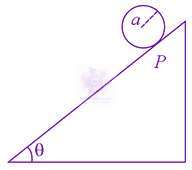
A triangular plate is shown. A force $\vec{F}=4\hat{i}-3\hat{j}$ is applied at point $P.$ The torque at point $P$ with respect to point $O$ and $Q$ are: 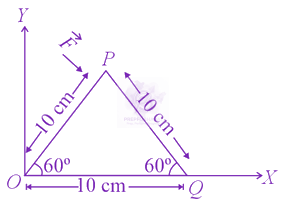
The angular speed of truck wheel is increased from $900\mathrm{rpm}$ to $2460\mathrm{rpm}$ in $26$ seconds. The number of revolutions by the truck engine during this time is ______. (Assuming the acceleration to be uniform).
The coefficient of static friction between two blocks is $0.5$ and the table is smooth. The maximum horizontal force that can be applied to move the blocks together is _______$N$ (take $g=10{ms}^{-2})$ 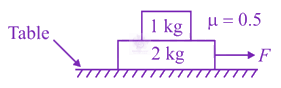
Two satellites $A$ and $B$ of masses $200\mathrm{kg}$ and $400\mathrm{kg}$ are revolving round the earth at height of $600\mathrm{km}$ and $1600\mathrm{km}$ respectively. If ${T}_{A}$ and ${T}_{B}$ are the time periods of $A$ and $B$ respectively then the value of ${T}_{B}-{T}_{A}$ :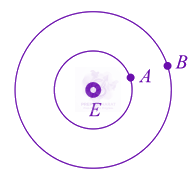 [ Given : radius of earth $=6400\mathrm{km},$ mass of earth $=6\times {10}^{24}\mathrm{kg}$ ]
A ball is thrown up with a certain velocity so that it reaches a height $h.$ Find the ratio of the two different times of the ball reaching $\frac{h}{3}$ in both the directions.
Consider a uniform wire of mass $M$ and length $L$. It is bent into a semicircle. Its moment of inertia about a line perpendicular to the plane of the wire passing through the centre is :
The normal density of a material is $\rho$ and its bulk modulus of elasticity is $K$. The magnitude of increase in density of material, when a pressure $P$ is applied uniformly on all sides, will be :
The force is given in terms of time $t$ and displacement $x$ by the equation $F=A\mathrm{cos}Bx+C\mathrm{sin}Dt$ The dimensional formula of $\frac{AD}{B}$ is:
A light cylindrical vessel is kept on a horizontal surface. Area of the base is $A.$ A hole of cross-sectional area $a$ is made just at its bottom side. The minimum coefficient of friction necessary to prevent sliding the vessel due to the impact force of the emerging liquid is 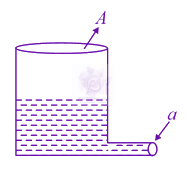
A player kicks a football with an initial speed of $25{ms}^{-1}$ at an angle of $45^{\circ}$ from the ground. What are the maximum height and the time taken by the football to reach at the highest point during motion? (Take $g=10{ms}^{-2}$)
A body weighs $49N$ on a spring balance at the north pole. What will be its weight recorded on the same weighing machine, if it is shifted to the equator? [Use $g=\frac{GM}{{R}^{2}}=9.8m{s}^{-2}$ and radius of earth, $R=6400\mathrm{km}.$]
Four identical particles of equal masses $1\mathrm{kg}$ made to move along the circumference of a circle of radius $1m$ under the action of their own mutual gravitational attraction. The speed of each particle will be:
A particle of mass $M$ originally at rest is subjected to a force whose direction is constant but magnitude varies with time according to the relation $F={F}_{0}[1-{(\frac{t-T}{T})}^{2}]$ where ${F}_{0}$ and $T$ are constants. The force acts only for the time interval $2T$. The velocity $v$ of the particle after time $2T$ is:
The diameter of a spherical bob is measured using a vernier callipers. $9$ divisions of the main scale, in the vernier callipers, are equal to $10$ divisions of vernier scale. One main scale division is $1\mathrm{mm}.$ The main scale reading is $10\mathrm{mm}$ and ${8}^{\mathrm{th}}$ division of vernier scale was found to coincide exactly with one of the main scale division. If the given vernier callipers has positive zero error of $0.04\mathrm{cm},$ then the radius of the bob is _____________ $\times {10}^{-2}\mathrm{cm}.$
A force $\vec{F}=4\hat{i}+3\hat{j}+4\hat{k}$ is applied on an intersection point of $x=2$ plane and $x$-axis. The magnitude of torque of this force about a point $(2,3,4)$ is ________. (Round off to the Nearest Integer)
A particle is projected with velocity ${v}_{0}$ along $x$-axis. A damping force is acting on the particle which is proportional to the square of the distance from the origin i.e. $ma=-\alpha {x}^{2}.$ The distance at which the particle stops:
The pressure acting on a submarine is $3\times {10}^{5}\mathrm{Pa}$ at a certain depth. If the depth is doubled, the percentage increase in the pressure acting on the submarine would be: (Assume that atmospheric pressure is $1\times {10}^{5}\mathrm{Pa}$ density of water is ${10}^{3}\mathrm{kg}{m}^{-3},g=10{\mathrm{ms}}^{-2}$)
If ${R}_{E}$ be the radius of Earth, then the ratio between the acceleration due to gravity at a depth $r$ below and a height $r$ above the earth surface is: (Given : $r<{R}_{E}$)
In a Screw Gauge, fifth division of the circular scale coincides with the reference line when the ratchet is closed. There are $50$ divisions on the circular scale, and the main scale moves by $0.5\mathrm{mm}$ on a complete rotation. For a particular observation the reading on the main scale is $5\mathrm{mm}$ and the ${20}^{\text{th }}$ division of the circular scale coincides with reference line. Calculate the true reading.
A bullet of mass $0.1\mathrm{kg}$ is fired on a wooden block to pierce through it, but it stops after moving a distance of $50\mathrm{cm}$ into it. If the velocity of the bullet before hitting the wood is $10m{s}^{-1}$ and, it slows down with uniform deceleration, then the magnitude of effective retarding force on the bullet is $xN.$ The value of $x$ to the nearest integer is,
The work done by a gas molecule in an isolated system is given by, $W=\alpha {\beta }^{2}{e}^{-\frac{{x}^{2}}{\alpha kT}},$ where $x$ is the displacement, $k$ is the Boltzmann constant and $T$ is the temperature. $\alpha$ and $\beta$ are constants. Then the dimensions of $\beta$ will be:
Consider a binary star system of star $A$ and star $B$ with masses ${m}_{A}$ and ${m}_{B}$ revolving in a circular orbit of radii ${r}_{A}$ and ${r}_{B},$ respectively. If ${T}_{A}$ and ${T}_{B}$ are the time period of star $A$ and star $B,$ respectively, then:
A ball of mass $4\mathrm{kg}$, moving with a velocity of $10{ms}^{-1}$, collides with a spring of length $8m$ and force constant $100N{m}^{-1}$. The length of the compressed spring is $xm$. The value of $x$, to the nearest integer, is ___ .
Given below is the plot of a potential energy function $U(x)$ for a system, in which a particle is in one dimensional motion, while a conservative force $F(x)$ acts on it. Suppose that ${E}_{\text{mech }}=8J$, the incorrect statement for this system is : 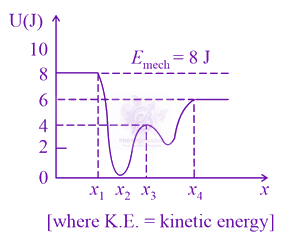
Consider a frame that is made up of two thin massless rods $AB$ and $AC$ as shown in the figure. A vertical force $\vec{P}$ of magnitude $100N$ is applied at point $A$ of the frame. 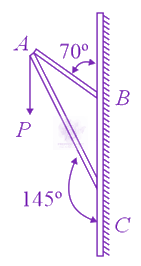 Suppose the force is $\vec{P}$ resolved parallel to the arms $AB$ and $AC$ of the frame. The magnitude of the resolved component along the arm $AC$ is $xN$. The value of $x$, to the nearest integer, is ________. [Given : $\mathrm{sin}(35^{\circ})=0.573,\mathrm{cos}(35^{\circ})=0.819,\mathrm{sin}(110^{\circ})=0.939,\mathrm{cos}(110^{\circ})=-0.342$]
A ball of mass $10\mathrm{kg}$ moving with a velocity $10\sqrt{3}m{s}^{-1}$ along the $x$ -axis, hits another ball of mass $20\mathrm{kg}$ which is at rest. After the collision, first ball comes to rest while the second ball disintegrates into two equal pieces. One piece starts moving along $y$ -axis with a speed of $10m{s}^{-1}.$ The second piece starts moving at an angle of $30^{\circ}$ with respect to the $x$ -axis. The velocity of the ball moving at $30^{\circ}$ with $x$ -axis is $xm{s}^{-1}.$ The configuration of pieces after the collision is shown in the figure below. The value of $x$ to the nearest integer is 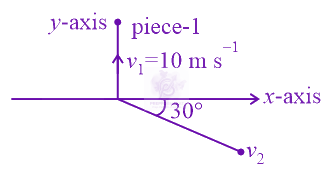
A raindrop with radius $R=0.2\mathrm{mm}$ falls from a cloud at a height $h=2000m$ above the ground. Assume that the drop is spherical throughout its fall and the force of buoyance may be neglected, then the terminal speed attained by the raindrop is : [Density of water ${f}_{w}=1000\mathrm{kg}{m}^{-3}$ and Density of air ${f}_{a}=1.2\mathrm{kg}{m}^{-3},g=10m/{s}^{2}$ Coefficient of viscosity of air $=1.8\times {10}^{-5}Ns{m}^{-2}]$
The resultant of these forces $\vec{OP},\vec{OQ},\vec{OR},\vec{OS}$ and $\vec{OT}$ is approximately ______$N.$<br>[Take $\sqrt{3}=1.7,\sqrt{2}=1.4$ Given $\hat{i}$ and $\hat{j}$ unit vectors along $x,y$ axis]<br><img src="https://prepforbharat.s3.ap-south-1.amazonaws.com/exam/615f0e999476412f48314daf/Physics/images/Mathematics_in_Physics/648b5a6b417cc3fb48d67529/question_1__q_648b5a6b417cc3fb48d67529__cdn-question-pool.getmarks.app__7f3ed2a8-48d6-47b2-87ba-1dfc91732126-image__0e34012255_final_ppt_sync.png" alt="JEE Main 2021 Physics, Mathematics in Physics — question figure">
The time period of a simple pendulum is given by $T=2\pi \sqrt{\frac{l}{g}}.$ The measured value of the length of the pendulum is $10\mathrm{cm}$ known to a $1\mathrm{mm}$ accuracy. The time for $200$ oscillations of the pendulum is found to be $100$ second using a clock of $1s$ resolution. The percentage accuracy in the determination of $g$ using this pendulum is $x.$ The value of $x$ to the nearest integer is:-
In order to determine the Young's Modulus of a wire of radius $0.2\mathrm{cm}$ (measured using a scale of least count $=0.001\mathrm{cm}$) and length $1m$ (measured using a scale of least count $=1\mathrm{mm}$), a weight of mass $1\mathrm{kg}$ (measured using a scale of least count $=1g$ ) was hanged to get the elongation of $0.5\mathrm{cm}$ (measured using a scale of least count $0.001\mathrm{cm}$). What will be the fractional error in the value of Young's Modulus determined by this experiment?
Match List - I with List - II : <table class="pyq-table"><tbody><tr><td></td><td>$\mathrm{List}-I$</td><td></td><td>$\mathrm{List}-\mathrm{II}$</td></tr><tr><td>$(a)$</td><td>$h$ (Planck's constant)</td><td>$(i)$</td><td>$[{\mathrm{MLT}}^{-1}]$</td></tr><tr><td>$(b)$</td><td>$E$ (kinetic energy)</td><td>$(\mathrm{ii})$</td><td>$[{\mathrm{ML}}^{2}{T}^{-1}]$</td></tr><tr><td>$(c)$</td><td>$V$ (electric potential)</td><td>$(\mathrm{iii})$</td><td>$[{\mathrm{ML}}^{2}{T}^{-2}]$</td></tr><tr><td>$(d)$</td><td>$P$ (linear momentum)</td><td>$(\mathrm{iv})$</td><td>$[{\mathrm{ML}}^{2}{I}^{-1}{T}^{-3}]$</td></tr></tbody></table>Choose the correct answer from the options given below:
A particle is moving with constant acceleration $a.$ Following graph shows ${v}^{2}$ versus $x$ (displacement) plot. The acceleration of the particle is _________ $m{s}^{-2}.$ 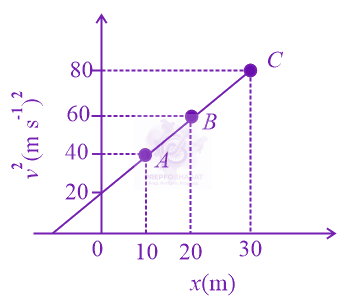
If the velocity of a body related to displacement $x$ is given by $v=\sqrt{5000+24x}m{s}^{-1},$ then the acceleration of the body is _________ $m{s}^{-2}.$
The velocity of a particle is $v=({v}_{0}+gt+F{t}^{2})m{s}^{-1}$. Its position is $x=0$ at $t=0;$ then its displacement after time $(t=1s)$ is :
A person standing on a spring balance inside a stationary lift measures $60\mathrm{kg}$. The weight of that person if the lift descends with uniform downward acceleration of $1.8m{s}^{-2}$ will be $N$. $[g=10m{s}^{-2}]$
A huge circular arc of length $4.4\mathrm{ly}$ subtends an angle $4s$ at the centre of the circle. How long it would take for a body to complete $4$ revolution if its speed is $8\mathrm{AU}$ per second? Given : $1\mathrm{ly}=9.46\times {10}^{15}m$ $1\mathrm{AU}=1.5\times {10}^{11}m$
A wire of $1\Omega$ has a length of $1m$. It is stretched till its length increases by $25%$. The percentage change in resistance to the nearest integer is :
If the angular velocity of earth's spin is increased such that the bodies at the equator start floating, the duration of the day would be approximately : (Take : $g=10{\mathrm{ms}}^{-2}$, the radius of earth, $R=6400\times {10}^{3}m$, Take $\pi =3.14$)
A sphere of mass $2\mathrm{kg}$ and radius $0.5m$ is rolling with an initial speed of $1{ms}^{-1}$ goes up an inclined plane which makes an angle of $30^{\circ}$ with the horizontal plane, without slipping. How low will the sphere take to return to the starting point $A$? 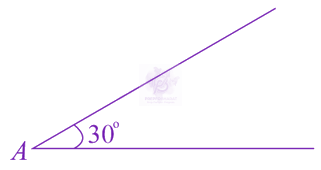
Two vectors $\vec{X}$ and $\vec{Y}$ have equal magnitude. The magnitude of $(\vec{X}-\vec{Y})$ is $n$ times the magnitude of $(\vec{X}+\vec{Y})$. The angle between $\vec{X}$ and $\vec{Y}$ is :
The vernier scale used for measurement has a positive zero error of $0.2\mathrm{mm}.$ If while taking a measurement it was noted that $0$ on the vernier scale lies between $8.5\mathrm{cm}$ and $8.6\mathrm{cm}$. Vernier coincidence is $6,$ then the correct value of measurement is $\mathrm{cm}.$ (least count$=0.01\mathrm{cm}$)
A body of mass $m$ is launched up on a rough inclined plane making an angle of $30^{\circ}$ with the horizontal. The coefficient of friction between the body and plane is $\frac{\sqrt{x}}{5}$ if the time of ascent is half of the time of descent. The value of $x$ is
An inclined plane making an angle of $30^{\circ}$ with the horizontal is placed in a uniform horizontal electric field $200\frac{N}{C}$ as shown in the figure. A body of mass $1\mathrm{kg}$ and charge $5\mathrm{mC}$ is allowed to slide down from rest at a height of $1m$. If the coefficient of friction is $0.2,$ find the time taken by the body to reach the bottom. $[g=9.8m{s}^{-2};\mathrm{sin}30^{\circ}=\frac{1}{2};\mathrm{cos}30^{\circ}=\frac{\sqrt{3}}{2}]$ 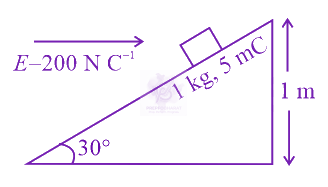
A system consists of two identical spheres each of mass $1.5\mathrm{kg}$ and radius $50\mathrm{cm}$ at the ends of a light rod. The distance between the centres of the two spheres is $5m.$ What will be the moment of inertia of the system about an axis perpendicular to the rod passing through its midpoint?
A body of mass $m$ dropped from a height $h$ reaches the ground with a speed of $0.8\sqrt{gh}.$ The value of work done by the air-friction is:
$\mathrm{Assertion}A:$ If $A,B,C,D$ are four points on a semi-circular arc with a centre at $O$ such that $|\vec{AB}|=|\vec{BC}|=|\vec{CD}|.$ Then, $\vec{AB}+\vec{AC}+\vec{AD}=4\vec{AO}+\vec{OB}+\vec{OC}$<br>$\mathrm{Reason}R:$ Polygon law of vector addition yields $\vec{AB}+\vec{BC}+\vec{CD}+\vec{AD}=2\vec{AO}$<br><img src="https://prepforbharat.s3.ap-south-1.amazonaws.com/exam/615f0e999476412f48314daf/Physics/images/Mathematics_in_Physics/648b5a6b417cc3fb48d675d5/question_1__q_648b5a6b417cc3fb48d675d5__cdn-question-pool.getmarks.app__ca64fd8d-ea77-4c07-93d2-d3ab941483f5-image__17d06709a1_final_ppt_sync.png" alt="JEE Main 2021 Physics, Mathematics in Physics — question figure"><br>In the light of the above statements, choose the most appropriate answer from the options given below.
Consider a water tank as shown in the figure. It's cross-sectional area is $0.4{m}^{2}$. The tank has an opening $B$ near the bottom whose cross-section area is $1{\mathrm{cm}}^{2}$. A load of $24\mathrm{kg}$ is applied on the water at the top when the height of the water level is $40\mathrm{cm}$ above the bottom, the velocity of water coming out the opening $B$ is $vm{s}^{-1}$. The value of $v$, to the nearest integer, is ___ .[Take the value of $g$ to be $10{ms}^{-2}$] 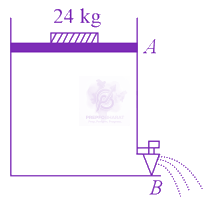
Find the gravitational force of attraction between the ring and sphere as shown in the diagram, where the plane of the ring is perpendicular to the line joining the centres. If $\sqrt{8}R$ is the distance between the centres of a ring (of mass $m$) and a sphere (mass $M$) where both have equal radius $R$ 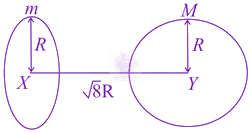
Four particles each of mass $M,$ move along a circle of radius $R$ under the action of their mutual gravitational attraction as shown in figure. The speed of each particle is : 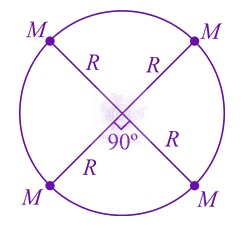
The angle between vector $(\vec{A})$ and $(\vec{A}-\vec{B})$ is : 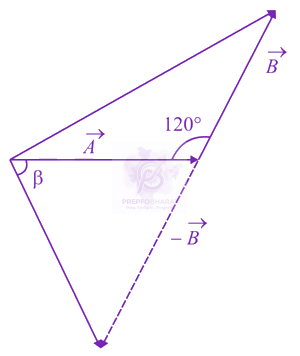
Four identical hollow cylindrical columns of mild steel support a big structure of mass $50\times {10}^{3}\mathrm{kg}.$ The inner and outer radii of each column are $50\mathrm{cm}$ and $100\mathrm{cm}$ respectively. Assuming uniform local distribution, calculate the compression strain of each column. [use $Y=2.0\times {10}^{11}\mathrm{Pa},g=9.8m{s}^{-2}$]
A body at rest is moved along a horizontal straight line by a machine delivering a constant power. The distance moved by the body in time $t$ is proportional to:
Three students ${S}_{1},{S}_{2}$ and ${S}_{3}$ perform an experiment for determining the acceleration due to gravity $(g)$ using a simple pendulum. They use different lengths of pendulum and record time for different number of oscillations. The observations are as shown in the table. <table class="pyq-table"><tbody><tr><td>Student No.</td><td>Length of pendulum $(\mathrm{cm})$</td><td>Number of oscillations $(n)$</td><td>Total time for $n$ oscillations</td><td>Time period $(s)$</td></tr><tr><td>$1.$</td><td>$64.0$</td><td>$8$</td><td>$128.0$</td><td>$16.0$</td></tr><tr><td>$2.$</td><td>$64.0$</td><td>$4$</td><td>$64.0$</td><td>$16.0$</td></tr><tr><td>$3.$</td><td>$20.0$</td><td>$4$</td><td>$36.0$</td><td>$9.0$</td></tr></tbody></table>(Least count of length $=0.1m$, least count for time $=0.1s$) If ${E}_{1},{E}_{2}$ and ${E}_{3}$ are the percentage errors in $g$ for students $1,2$ and $3$, respectively, then the minimum percentage error is obtained by student no $.$
Two discs have moments of intertia ${I}_{1}$ and ${I}_{2}$ about their respective axes perpendicular to the plane and passing through the centre. They are rotating with angular speeds, ${\omega }_{1}$ and ${\omega }_{2}$ respectively and are brought into contact face to face with their axes of rotation coaxial. The loss in kinetic energy of the system in the process is given by:
The solid cylinder of length $80\mathrm{cm}$ and mass $M$ has a radius of $20\mathrm{cm}.$ Calculate the density of the material used if the moment of inertia of the cylinder about an axis $CD$ parallel to $AB$ as shown in figure is $2.7\mathrm{kg}{m}^{2}$. 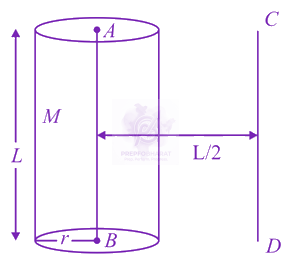
A circular hole of radius $(\frac{a}{2})$ is cut out of a circular disc of radius $a$ as shown in figure. The centroid of the remaining circular portion with respect to point $O$ will be: 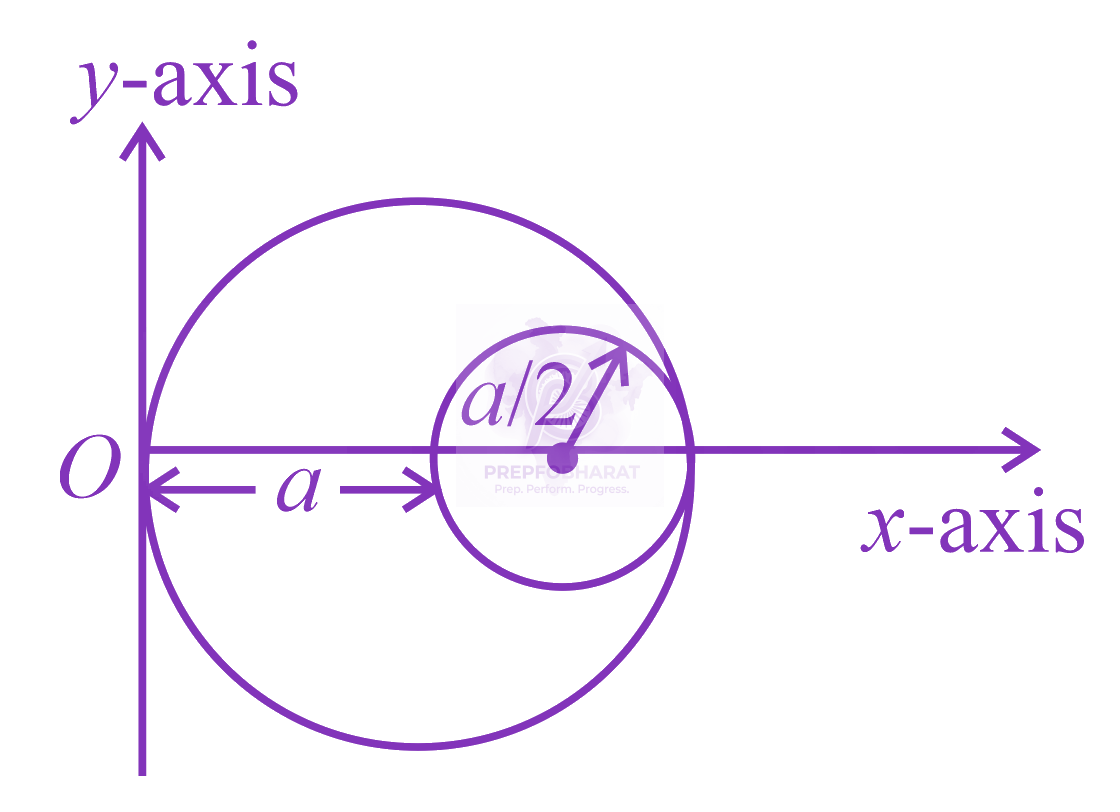
A thin circular ring of mass $M$ and radius $r$ is rotating about its axis with an angular speed $\omega .$ Two particles having mass $m$ each are now attached at diametrically opposite points. The angular speed of the ring will become:
A ball of mass $10\mathrm{kg}$ moving with a velocity $10\sqrt{3}{ms}^{-1}$ along $X$-axis, hits another ball of mass $20\mathrm{kg}$ which is at rest. After the collision, the first ball comes to rest and the second one disintegrates into two equal pieces. One of the pieces starts moving along $Y$-axis at a speed of $10m{s}^{-1}$. The second piece starts moving at a speed of $20m{s}^{-1}$ at an angle $\theta$ (degree) with respect to the $X$-axis. The configuration of pieces after the collision is shown in the figure. The value of $\theta$ to the nearest integer is _________. 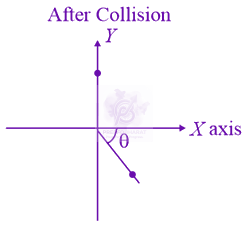
A soap bubble of the radius $3\mathrm{cm}$ is formed inside another soap bubble of radius, $6\mathrm{cm}$. The radius of an equivalent soap bubble that has the same excess pressure as inside the smaller bubble with respect to the atmospheric pressure is____$\mathrm{cm}.$
If $\vec{A}$ and $\vec{B}$ are two vectors satisfying the relation $\vec{A}\cdot \vec{B}=|\vec{A}\times \vec{B}|$. Then the value of $|\vec{A}-\vec{B}|$ will be:
Student $A$ and student $B$ used two screw gauges of equal pitch and $100$ equal circular divisions to measure the radius of a given wire. The actual value of the radius of the wire is $0.322\mathrm{cm}$. The absolute value of the difference between the final circular scale readings observed by the students $A$ and $B$ is _______. [Figure shows position of reference $O$ when jaws of screw gauge are closed] Given pitch $=0.1\mathrm{cm}$. 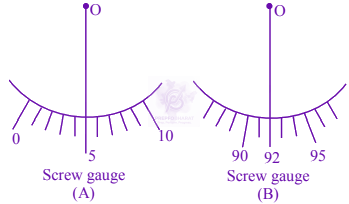
The resistance $R=\frac{V}{I}$, where $V=(50\pm 2)V$ and $I=(20\pm 0.2)A$. The percentage error in $R$ is $x$ $%$. The value of $x$ to the nearest integer is ________.
The resultant of these forces $\vec{OP},\vec{OQ},\vec{OR},\vec{OS}$ and $\vec{OT}$ is approximately ______$N.$ [Take $\sqrt{3}=1.7,\sqrt{2}=1.4$ Given $\hat{i}$ and $\hat{j}$ unit vectors along $x,y$ axis] 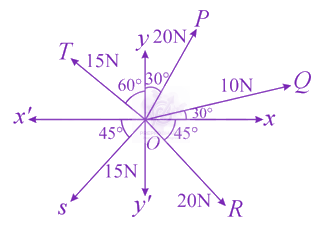
A block of mass $m$ slides along a floor while a force of magnitude $F$ is applied to it at an angle $\theta$ as shown in figure. The coefficient of kinetic friction is ${\mu }_{K}$. Then, the block's acceleration $a$ is given by : ($g$ is acceleration due to gravity) 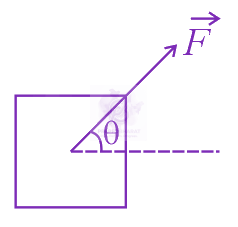
A student determined Young's Modulus of elasticity using the formula $Y=\frac{Mg{L}^{3}}{4{\mathrm{bd}}^{3}\delta }.$ The value of $g$ is taken to be $9.8m{s}^{-2}$ without any significant error, his observations are as following. <table class="pyq-table"><tbody><tr><td>Physical Quantity</td><td>Least count of the Equipment used for measurement</td><td>Observed Value</td></tr><tr><td>Mass $(M)$</td><td>$1g$</td><td>$2\mathrm{kg}$</td></tr><tr><td>Length of bar $(L)$</td><td>$1\mathrm{mm}$</td><td>$1m$</td></tr><tr><td>Breadth of bar $(b)$</td><td>$0.1\mathrm{mm}$</td><td>$4\mathrm{cm}$</td></tr><tr><td>Thickness of bar $(d)$</td><td>$0.01\mathrm{mm}$</td><td>$0.4\mathrm{cm}$</td></tr><tr><td>Depression $(\delta )$</td><td>$0.01\mathrm{mm}$</td><td>$5\mathrm{mm}$</td></tr></tbody></table>Then the fractional error in the measurement of $Y$ is :
A body rolls down an inclined plane without slipping. The kinetic energy of rotation is $50%$ of its translational kinetic energy. The body is:
The resistance $R=\frac{V}{I}$, where $V=(50\pm 2)V$ and $I=(20\pm 0.2)A$. The percentage error in $R$ is $x$ $%$. The value of $x$ to the nearest integer is ________.
If the length of the pendulum in pendulum clock increases by $0.1%$, then the error in time per day is:
The initial mass of a rocket is $1000\mathrm{kg}$. Calculate at what rate the fuel should be burnt so that the rocket is given an acceleration of, $20{ms}^{-2}$. The gases come out at a relative speed of $500{ms}^{-1}$, with respect to the rocket: $[\text{Use}g=10m{s}^{-2}]$
A mass $M$ hangs on a massless rod of length $l$ which rotates at a constant angular frequency. The mass $M$ moves with steady speed in a circular path of constant radius. Assume that the system is in steady circular motion with constant angular velocity $\omega .$ The angular momentum of $M$ about point $A$ is ${L}_{A}$ which lies in the positive $z$ direction and the angular momentum of $M$ about $B$ is ${L}_{B}.$ The correct statement for this system is: 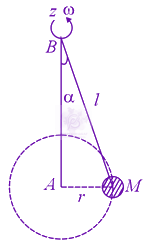
A particle of mass $m$ is moving in time $t$ on a trajectory given by, $\vec{r}=10\alpha {t}^{2}\hat{i}+5\beta (t-5)\hat{j}$ where $\alpha$ and $\beta$ are dimensional constants. The angular momentum of the particle becomes the same as it was for $t=0$ at time $t=$_____ seconds.
In order to determine the Young's Modulus of a wire of radius $0.2\mathrm{cm}$ (measured using a scale of least count $=0.001\mathrm{cm}$) and length $1m$ (measured using a scale of least count $=1\mathrm{mm}$), a weight of mass $1\mathrm{kg}$ (measured using a scale of least count $=1g$ ) was hanged to get the elongation of $0.5\mathrm{cm}$ (measured using a scale of least count $0.001\mathrm{cm}$). What will be the fractional error in the value of Young's Modulus determined by this experiment?
Consider two satellites ${S}_{1}$ and ${S}_{2}$ with periods of revolution $1\mathrm{hr}$ and $8\mathrm{hr}$ respectively revolving around a planet in circular orbits. The ratio of angular velocity of satellite ${S}_{1}$ to the angular velocity of satellite ${S}_{2}$ is:
If $\vec{A}$ and $\vec{B}$ are two vectors satisfying the relation $\vec{A}\cdot \vec{B}=|\vec{A}\times \vec{B}|$. Then the value of $|\vec{A}-\vec{B}|$ will be:
Match List I with List II. <table class="pyq-table"><tbody><tr><td colspan="2" rowspan="1">List I</td><td colspan="2" rowspan="1">List II</td></tr><tr><td>(a)</td><td>$\vec{C}-\vec{A}-\vec{B}=0$</td><td>(i)</td><td><img src="https://prepforbharat.s3.ap-south-1.amazonaws.com/exam/615f0e999476412f48314daf/Physics/images/Mathematics_in_Physics/648b5a6a417cc3fb48d67301/question_1__q_648b5a6a417cc3fb48d67301__cdn-question-pool.getmarks.app__b6c349fb-53c1-4e10-b1fe-828e32653b15-image__3b91df2772_final_ppt_sync.png" alt="JEE Main 2021 Physics, Mathematics in Physics — question figure 1"></td></tr><tr><td>(b)</td><td>$\vec{A}-\vec{C}-\vec{B}=0$</td><td>(ii)</td><td><img src="https://prepforbharat.s3.ap-south-1.amazonaws.com/exam/615f0e999476412f48314daf/Physics/images/Mathematics_in_Physics/648b5a6a417cc3fb48d67301/question_2__q_648b5a6a417cc3fb48d67301__cdn-question-pool.getmarks.app__8dcfe9df-eb9f-48ba-8cc4-cfd2b2c16819-image__2f6e4b06d3_final_ppt_sync.png" alt="JEE Main 2021 Physics, Mathematics in Physics — question figure 2"></td></tr><tr><td>(c)</td><td>$\vec{B}-\vec{A}-\vec{C}=0$</td><td>(iii)</td><td><img src="https://prepforbharat.s3.ap-south-1.amazonaws.com/exam/615f0e999476412f48314daf/Physics/images/Mathematics_in_Physics/648b5a6a417cc3fb48d67301/question_3__q_648b5a6a417cc3fb48d67301__cdn-question-pool.getmarks.app__e1726169-6520-4d6a-92bb-b0147017581e-image__8def3f0e02_final_ppt_sync.png" alt="JEE Main 2021 Physics, Mathematics in Physics — question figure 3"></td></tr><tr><td>(d)</td><td>$\vec{A}+\vec{B}=-\vec{C}$</td><td>(iv)</td><td><img src="https://prepforbharat.s3.ap-south-1.amazonaws.com/exam/615f0e999476412f48314daf/Physics/images/Mathematics_in_Physics/648b5a6a417cc3fb48d67301/question_4__q_648b5a6a417cc3fb48d67301__cdn-question-pool.getmarks.app__1019a326-88c2-4ad4-8b38-ec52abb6bdc9-image__957699a43d_final_ppt_sync.png" alt="JEE Main 2021 Physics, Mathematics in Physics — question figure 4"></td></tr></tbody></table>Choose the correct answer from the options given below:
The acceleration due to gravity is found up to an accuracy of $4%$ on a planet. The energy supplied to a simple pendulum of known mass $m$ to undertake oscillations of time period $T$ is being estimated. If time period is measured to an accuracy of $3%$, the accuracy to which $E$ is known as ________$%$
A student determined Young's Modulus of elasticity using the formula $Y=\frac{Mg{L}^{3}}{4{\mathrm{bd}}^{3}\delta }.$ The value of $g$ is taken to be $9.8m{s}^{-2}$ without any significant error, his observations are as following.<br><table class="pyq-table"><tbody><tr><td>Physical Quantity</td><td>Least count of the Equipment used for measurement</td><td>Observed Value</td></tr><tr><td>Mass $(M)$</td><td>$1g$</td><td>$2\mathrm{kg}$</td></tr><tr><td>Length of bar $(L)$</td><td>$1\mathrm{mm}$</td><td>$1m$</td></tr><tr><td>Breadth of bar $(b)$</td><td>$0.1\mathrm{mm}$</td><td>$4\mathrm{cm}$</td></tr><tr><td>Thickness of bar $(d)$</td><td>$0.01\mathrm{mm}$</td><td>$0.4\mathrm{cm}$</td></tr><tr><td>Depression $(\delta )$</td><td>$0.01\mathrm{mm}$</td><td>$5\mathrm{mm}$</td></tr></tbody></table>Then the fractional error in the measurement of $Y$ is :
The acceleration due to gravity is found up to an accuracy of $4%$ on a planet. The energy supplied to a simple pendulum of known mass $m$ to undertake oscillations of time period $T$ is being estimated. If time period is measured to an accuracy of $3%$, the accuracy to which $E$ is known as ________$%$
If $Y,K$ and $\eta$ are the values of Young's modulus, bulk modulus and modulus of rigidity of any material respectively. Choose the correct relation for these parameters.
Statement I: If three forces ${\vec{F}}_{1},{\vec{F}}_{2}$ and ${\vec{F}}_{3}$ are represented by three sides of a triangle and $\vec{{F}_{1}}+\vec{{F}_{2}}=-{\vec{F}}_{3},$ then these three forces are concurrent forces and satisfy the condition for equilibrium. Statement II: A triangle made up of three forces $\vec{{F}_{1}},\vec{{F}_{2}}$ and $\vec{{F}_{3}}$ as its sides were taken in the same order, satisfies the condition for translatory equilibrium. In the light of the above statements, choose the most appropriate answer from the options given below:
The normal reaction $N$ for a vehicle of $800\mathrm{kg}$ mass, negotiating a turn on a $30^{\circ}$ banked road at maximum possible speed without skidding is ____ $\times {10}^{3}\mathrm{kg}m{s}^{-2}$.
A physical quantity $y$ is represented by the formula $y={m}^{2}{r}^{-4}{g}^{x}{l}^{-\frac{3}{2}}$ If the percentage errors found in $y,m,r,l$ and $g$ are $18,1,0.5,4$ and $p$ respectively, then find the value of $x$ and $p$.
Three particles $P,Q$ and $R$ are moving along the vectors $\vec{A}=\hat{i}+\hat{j},\vec{B}=\hat{j}+\hat{k}$ and $\vec{C}=-\hat{i}+\hat{j}$, respectively. They strike on a point and start to move in different directions. Now particle $P$ is moving normal to the plane which contains vector $\vec{A}$ and $\vec{B}.$ Similarly particle $Q$ is moving normal to the plane which contains vector $\vec{A}$ and $\vec{C}.$ The angle between the direction of motion of $P$ and $Q$ is ${\mathrm{cos}}^{-1}(\frac{1}{\sqrt{x}}).$ Then the value of $x$ is $.$
The minimum and maximum distances of a planet revolving around the Sun are ${x}_{1}$ and ${x}_{2}$. If the minimum speed of the planet on its trajectory is ${v}_{0}$, then its maximum speed will be:
Statement-I : Two forces $(\vec{P}+\vec{Q})$ and $(\vec{P}-\vec{Q})$ where $\vec{P}\perp \vec{Q},$ when act at an angle ${\theta }_{1}$ each other, the magnitude of their resultant is $\sqrt{3({P}^{2}+{Q}^{2})},$ when they act at an angle ${\theta }_{2},$ the magnitude of their resultant becomes $\sqrt{2({P}^{2}+{Q}^{2})}.$ This is possible only when ${\theta }_{1}<{\theta }_{2}.$<br>Statement-II : In the situation given above.<br>${\theta }_{1}=60^{\circ}$ and ${\theta }_{2}=90^{\circ}$<br>In the light of the above statement, choose the most appropriate answer from the options given below :
A boy pushes a box of mass $2\mathrm{kg}$ with a force $\vec{F}=(20\hat{i}+10\hat{j})N$ on a frictionless surface. If the box was initially at rest, then _______ $m$ is displacement along the $x$-axis after $10s$
A large number of water drops, each of radius $r$, combine to have a drop of radius $R$. If the surface tension is $T$ and mechanical equivalent of heat is $J$, the rise in heat energy per unit volume will be:
Three particles $P,Q$ and $R$ are moving along the vectors $\vec{A}=\hat{i}+\hat{j},\vec{B}=\hat{j}+\hat{k}$ and $\vec{C}=-\hat{i}+\hat{j}$, respectively. They strike on a point and start to move in different directions. Now particle $P$ is moving normal to the plane which contains vector $\vec{A}$ and $\vec{B}.$ Similarly particle $Q$ is moving normal to the plane which contains vector $\vec{A}$ and $\vec{C}.$ The angle between the direction of motion of $P$ and $Q$ is ${\mathrm{cos}}^{-1}(\frac{1}{\sqrt{x}}).$ Then the value of $x$ is $.$
The coefficient of static friction between a wooden block of mass $0.5\mathrm{kg}$ and a vertical rough wall is $0.2.$ The magnitude of the horizontal force that should be applied on the block to keep it adhere to the wall will be______$N$. $⌈g=10m{s}^{-2}]$
A rubber ball is released from a height of $5m$ above the floor. It bounces back repeatedly, always rising to $\frac{81}{100}$ of the height through which it falls. Find the average speed of the ball. (Take $g=10{ms}^{-2}$)
If the length of the pendulum in pendulum clock increases by $0.1%$, then the error in time per day is:
Two separate wires $A$ and $B$ are stretched by $2\mathrm{mm}$ and $4\mathrm{mm}$ respectively, when they are subjected to a force of $2N.$ Assume that both the wires are made up of same material and the radius of wire $B$ is $4$ times that of the radius of wire $A.$ The length of the wires $A$ and $B$ are in the ratio of $a:b.$ Then $\frac{a}{b}$ can be expressed as $\frac{1}{x}$, where $x$ is _____.
The area of cross-section of a railway track is $0.01{m}^{2}.$ The temperature variation is $10^{\circ}C.$ Coefficient of linear expansion of material of track is ${10}^{-5}C-1\circ .$ The energy stored per meter in the track is $J{m}^{-1}.$ (Young's modulus of material of track is ${10}^{11}N{m}^{-2}$)
The radius of a sphere is measured to be $(7.50\pm 0.85)\mathrm{cm}$. Suppose the percentage error in its volume is $x$. The value of $x$, to the nearest $x$, is ___ .
A force of $F=(5y+20)\hat{j}N$ acts on a particle. The work done by this force when the particle is moved from $y=0m$ to $y=10m$ is ________$J$.
If $\vec{P}\times \vec{Q}=\vec{Q}\times \vec{P}$, the angle between $\vec{P}$ and $\vec{Q}$ is $\theta (0^{\circ}<\theta <360^{\circ})$. The value of $\theta$ will be ___$^{\circ}$.
A block moving horizontally on a smooth surface with a speed of $40m{s}^{-1}$ splits into two parts with masses in the ratio of $1:2.$ If the smaller part moves at $60m{s}^{-1}$ in the same direction, then the fractional change in kinetic energy is :
Two wires of same length and radius are joined end to end and loaded. The Young's moduli of the materials of the two wires are ${Y}_{1}$ and ${Y}_{2}$. The combination behaves as a single wire then its Young's modulus is:
A porter lifts a heavy suitcase of mass $80\mathrm{kg}$ and at the destination lowers it down by a distance of $80\mathrm{cm}$ with a constant velocity. Calculate the work done by the porter in lowering the suitcase. (take $g=9.8{\mathrm{ms}}^{-2}$ )
A rod of mass $M$ and length $L$ is lying on a horizontal frictionless surface. A particle of mass $m$ travelling along the surface hits at one end of the rod with a velocity $u$ in a direction perpendicular to the rod. The collision is completely elastic. After collision, particle comes to rest. The ratio of masses $(\frac{m}{M})$ is $\frac{1}{x}.$ The value of $x$ will be
Two persons $A$ and $B$ perform same amount of work in moving a body through a certain distance $d$ with application of forces acting at angles $45^{\circ}$ and $60^{\circ}$ with the direction of displacement respectively. The ratio of force applied by person $A$ to the force applied by person $B$ is $\frac{1}{\sqrt{x}}.$ The value of $x$ is _________.
A car is moving on a plane inclined at $30^{\circ}$ to the horizontal with an acceleration of $10{ms}^{-2}$ parallel to the plane upward. A bob is suspended by a string from the roof of the car. The angle in degrees which the string makes with the vertical is (Take $g=10{ms}^{-2}$)
A uniform chain of length $3m$ and mass $3\mathrm{kg}$ overhangs a smooth table with $2m$ laying on the table. If $K$ is the kinetic energy of the chain in $J$ as it completely slips off the table, then the value of $K$ is $(\text{Take }g=10m{s}^{-2})$
The period of oscillation of a simple pendulum is $T=2\pi \sqrt{\frac{L}{g}}.$ Measured value of $L$ is $1.0m$ from meter scale having a minimum division of $1\mathrm{mm}$ and time of one complete oscillation is $1.95s$ measured from stopwatch of $0.01s$ resolution. The percentage error in the determination of $'g'$ will be:
Given below are two statements : one is labelled as Assertion $A$ and the other is labelled as Reason $R$. Assertion $A$ : The escape velocities of planet $A$ and $B$ are same. But $A$ and $B$ are of unequal mass. Reason $R$: The product of their mass and radius must be same. ${M}_{1}{R}_{1}={M}_{2}{R}_{2}$ In the light of the above statements, choose the most appropriate answer from the options given below :
Four equal masses, $m$ each are placed at the corners of a square of length $(l)$ as shown in the figure. The moment of inertia of the system about an axis passing through $A$ and parallel to $DB$ would be : 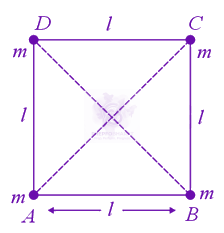
A boy reaches the airport and finds that the escalator is not working. He walks up the stationary escalator in time ${t}_{1}.$ If he remains stationary on a moving escalator then the escalator takes him up in time ${t}_{2}.$ The time taken by him to walk up on the moving escalator will be:
Consider a $20\mathrm{kg}$ uniform circular disk of radius $0.2m$. It is pin supported at its center and is at rest initially. The disk is acted upon by a constant force $F=20N$ through a massless string wrapped around its periphery as shown in the figure. 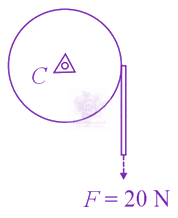 Suppose the disk makes $n$ number of revolutions to attain an angular speed of $50\mathrm{rad}{s}^{-1}$. The value of $n$, to the nearest integer, is _______ . [Given : In one complete revolution, the disk rotates by $6.28\mathrm{rad}$]
The velocity-displacement graph describing the motion of a bicycle is shown in the figure. 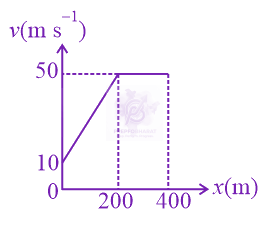 The acceleration-displacement graph of the bicycle's motion is best described by :
If the kinetic energy of a moving body becomes four times its initial kinetic energy, then the percentage change in its momentum will be:
A butterfly is flying with a velocity $4\sqrt{2}m{s}^{-1}$ in north-east direction. Wind is slowly blowing at $1m{s}^{-1}$ from north to south. The resultant displacement of the butterfly in $3$ seconds is:
Suppose two planets (spherical in shape) of radii $R$ and $2R,$ but mass $M$ and $9M$ respectively have a centre to centre separation $8R$ as shown in the figure. A satellite of mass $m$ is projected from the surface of the planet of mass $M$ directly towards the centre of the second planet. The minimum speed $v$ required for the satellite to reach the surface of the second planet is $\sqrt{\frac{a}{7}\frac{GM}{R}}$, then the value of $a$ is [Given : The two planets are fixed in their position] 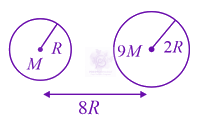
An object of mass ${m}_{1}$ collides with another object of mass ${m}_{2}$, which is at rest. After the collision the objects move with equal speeds in opposite direction. The ratio of the masses ${m}_{2}:{m}_{1}$ is :
The potential energy $(U)$ of a diatomic molecule is a function dependent on $r$ (interatomic distance) as $U=\frac{\alpha }{{r}^{10}}-\frac{\beta }{{r}^{5}}-3$ where, $\alpha$ and $\beta$ are positive constants. The equilibrium distance between two atoms will be ${(\frac{2\alpha }{\beta })}^{\frac{a}{b}},$ where $a=$______ .
A physical quantity $y$ is represented by the formula $y={m}^{2}{r}^{-4}{g}^{x}{l}^{-\frac{3}{2}}$ If the percentage errors found in $y,m,r,l$ and $g$ are $18,1,0.5,4$ and $p$ respectively, then find the value of $x$ and $p$.
An engine of a train, moving with uniform acceleration, passes the signal-post with velocity $u$ and the last compartment with velocity $v$. The velocity with which middle point of the train passes the signal post is :
A solid sphere of radius $R$ gravitationally attracts a particle placed at $3R$ from its centre with a force ${F}_{1}.$ Now a spherical cavity of radius $(\frac{R}{2})$ is made in the sphere (as shown in figure) and the force becomes ${F}_{2}$. The value of ${F}_{1}:{F}_{2}$ is: 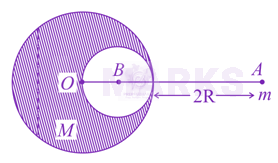
A large block of wood of mass $M=5.99\mathrm{kg}$ is hanging from two long massless cords. A bullet of mass $m=10g$ is fired into the block and gets embedded in it. The (block $+$ bullet) then swing upwards, their center of mass rising a vertical distance $h=9.8\mathrm{cm}$ before the (block $+$ bullet) pendulum comes momentarily to rest at the end of its arc. The speed of the bullet just before the collision is: (Take $g=9.8{ms}^{-2}$) 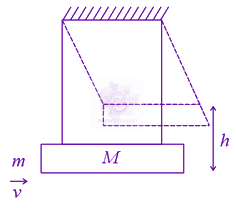
As shown in the figure, a particle of mass $10\mathrm{kg}$ is placed at a point $A.$ When the particle is slightly displaced to its right, it starts moving and reaches the point $B.$ The speed of the particle at $B$ is $xm{s}^{-1}$. (Take $g=10m{s}^{-2})$ The value of $x$ to the nearest integer is 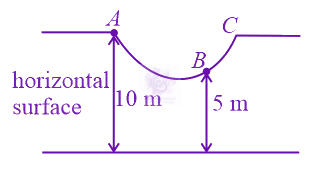
The position, velocity and acceleration of a particle moving with a constant acceleration can be represented by :
A cord is wound round the circumference of wheel of radius $r$, The axis of the wheel is horizontal and the moment of inertia about it is $I$. A weight $mg$ is attached to the cord at the end. The weight falls from rest. After falling through a distance $h,$ the square of angular velocity of wheel will be
Two vectors $\vec{P}$ and $\vec{Q}$ have equal magnitudes. If the magnitude of $\vec{P}+\vec{Q}$ is $n$ times the magnitude of $\vec{P}-\vec{Q},$ then angle between $\vec{P}$ and $\vec{Q}$ is
A satellite is launched into a circular orbit of radius $R$ around earth, while a second satellite is launched into a circular orbit of radius $1.02R.$ The percentage difference in the time periods of the two satellites is:
A particle of mass $m$ is suspended from a ceiling through a string of length $L$. The particle moves in a horizontal circle of radius $r$ such that $r=\frac{L}{\sqrt{2}}$. The speed of particle will be :
Match List-$(I)$ with List-$(\mathrm{II})$. <table class="pyq-table"><tbody><tr><td></td><td>List-$(I)$</td><td></td><td>List-$(\mathrm{II})$</td></tr><tr><td>a</td><td>${R}_{H}$ (Rydberg constant)</td><td>i</td><td>$\mathrm{kg}{m}^{-1}{s}^{-1}$</td></tr><tr><td>b</td><td>$h$ (Planck's constant)</td><td>ii</td><td>$\mathrm{kg}{m}^{2}{s}^{-1}$</td></tr><tr><td>c</td><td>${\mu }_{B}$ (Magnetic field energy density)</td><td>iii</td><td>${m}^{-1}$</td></tr><tr><td>d</td><td>$\eta$ (coefficient of viscosity)</td><td>iv</td><td>$\mathrm{kg}{\text{m}}^{-1}{s}^{-2}$</td></tr></tbody></table>Choose the most appropriate answer from the options given below:
Which of the following is not a dimensionless quantity?
The period of oscillation of a simple pendulum is $T=2\pi \sqrt{\frac{L}{g}}.$ Measured value of $L$ is $1.0m$ from meter scale having a minimum division of $1\mathrm{mm}$ and time of one complete oscillation is $1.95s$ measured from stopwatch of $0.01s$ resolution. The percentage error in the determination of $'g'$ will be:
Two blocks of masses $3\mathrm{kg}$ and $5\mathrm{kg}$ are connected by a metal wire going over a smooth pulley. The breaking stress of the metal is $\frac{24}{\pi }\times {10}^{2}N{m}^{-2}$. What is the minimum radius of the wire ? ( take $g=10{ms}^{-2})$ 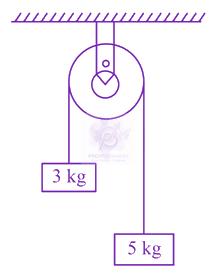
Four identical solid spheres each of mass $m$ and radius $a$ are placed with their centres on the four corners of a square of side $b$. The moment of inertia of the system about one side of square where the axis of rotation is parallel to the plane of the square is :
What will be the projection of vector $\vec{A}=\hat{i}+\hat{j}+\hat{k}$ on vector $\vec{B}=\hat{i}+\hat{j}?$
The magnitude of vectors $\vec{\mathrm{OA}},\vec{\mathrm{OB}}$ and $\vec{\mathrm{OC}}$ in the given figure are equal. The direction of $\vec{\mathrm{OA}}+\vec{\mathrm{OB}}-\vec{\mathrm{OC}}$ with $x-$axis will be: 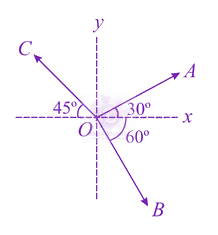
Given below are two statements: one is labelled as Assertion A and the other is labelled as Reason R. Assertion A : Body $P$ having mass $M$ moving with speed $u$ has head-on collision elastically with another body $Q$ having mass $m$ initially at rest. If $m\ll M$, body $Q$ will have a maximum speed equal to $2u$ after collision. Reason R : During elastic collision, the momentum and kinetic energy are both conserved. In the light of the above statements, choose the most appropriate answer from the options given below:
A person is swimming with a speed of $10m{s}^{-1}$ at an angle of $120^{\circ}$ with the flow and reaches to a point directly opposite on the other side of the river. The speed of the flow is $xm{s}^{-1}.$ The value of $x$ to the nearest integer is ______.
A force $\vec{F}=(40\hat{i}+10\hat{j})N$ acts on a body of mass $5\mathrm{kg}$. If the body starts from rest, its position vector $\vec{r}$ at time $t=10s$ will be
A swimmer can swim with velocity of $12\mathrm{km}/h$ in still water. Water flowing in a river has velocity $6\mathrm{km}/h$. The direction with respect to the direction of flow of river water he should swim in order to reach the point on the other bank just opposite to his starting point is ________$^{\circ}$. (Round off to the Nearest Integer) (find the angle in degree)
The angular momentum of a planet of mass $M$ moving around the sun in an elliptical orbit is $\vec{L}$. The magnitude of the areal velocity of the planet is :
Two vectors $\vec{X}$ and $\vec{Y}$ have equal magnitude. The magnitude of $(\vec{X}-\vec{Y})$ is $n$ times the magnitude of $(\vec{X}+\vec{Y})$. The angle between $\vec{X}$ and $\vec{Y}$ is :
<table class="pyq-table"><tbody><tr><td>List-$I$</td><td>List-$\mathrm{II}$</td></tr><tr><td>$(a)$ $MI$ of the rod (length $L,$ Mass $M,$ about an axis $\perp$ to the rod passing through the midpoint)</td><td>$(i)$ $\frac{8M{L}^{2}}{3}$</td></tr><tr><td>$(b)$ $MI$ of the rod (length $L,$ Mass $2M,$ about an axis $\perp$ to the rod passing through one of its end)</td><td>$(\mathrm{ii})$ $\frac{M{L}^{2}}{3}$</td></tr><tr><td>$(c)$ $MI$ of the rod (length $2L,$ Mass $M,$ about an axis $\perp$ to the rod passing through its midpoint)</td><td>$(\mathrm{iii})$ $\frac{M{L}^{2}}{12}$</td></tr><tr><td>$(d)$ $MI$ of the rod (Length $2L,$ Mass $2M,$ about an axis $\perp$ to the rod passing through one of its end)</td><td>$(\mathrm{iv})$ $\frac{2M{L}^{2}}{3}$</td></tr></tbody></table>Choose the correct answer from the options given below:
A block of mass $m$ slides on the wooden wedge, which in turn slides backward on the horizontal surface. The acceleration of the block with respect to the wedge is: Given $m=8\mathrm{kg},M=16\mathrm{kg}$ Assume all the surfaces shown in the figure to be frictionless. 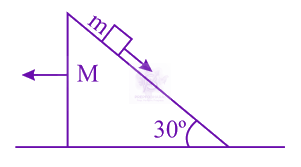
A particle of mass $m$ moves in a circular orbit under the central potential field, $U(r)=\frac{-C}{r}$, where $C$ is a positive constant. The correct radius - velocity graph of the particle's motion is :
An engine is attached to a wagon through a shock absorber of length $1.5m.$ The system with a total mass of $40,000\mathrm{kg}$ is moving with a speed of $72\mathrm{km}{h}^{-1}$ when the brakes are applied to bring it to rest. In the process of the system being brought to rest, the spring of the shock absorber gets compressed by $1.0m$. If $90%$ of energy of the wagon is lost due to friction, the spring constant is $_________\times {10}^{5}N{m}^{-1}.$
A uniform metallic wire is elongated by $0.04m$ when subjected to a linear force $F.$ The elongation, if its length and diameter is doubled and subjected to the same force will be _________ $\mathrm{cm}.$
Statement-I : Two forces $(\vec{P}+\vec{Q})$ and $(\vec{P}-\vec{Q})$ where $\vec{P}\perp \vec{Q},$ when act at an angle ${\theta }_{1}$ each other, the magnitude of their resultant is $\sqrt{3({P}^{2}+{Q}^{2})},$ when they act at an angle ${\theta }_{2},$ the magnitude of their resultant becomes $\sqrt{2({P}^{2}+{Q}^{2})}.$ This is possible only when ${\theta }_{1}<{\theta }_{2}.$ Statement-II : In the situation given above. ${\theta }_{1}=60^{\circ}$ and ${\theta }_{2}=90^{\circ}$ In the light of the above statement, choose the most appropriate answer from the options given below :
A glass tumbler having inner depth of $17.5\mathrm{cm}$ is kept on a table. A student starts pouring water $(\mu =\frac{4}{3})$ into it while looking at the surface of water from the above. When he feels that the tumbler is half filled, he stops pouring water. Up to what height, the tumbler is actually filled ?
If $E$ and $H$ represents the intensity of electric field and magnetizing field respectively, then the unit of $\frac{E}{H}$ will be:
A body is projected vertically upwards from the surface of earth with a velocity sufficient enough to carry it to infinity. The time taken by it to reach height $h$ is $S.$
An automobile of mass $m$ accelerates starting from the origin and initially at rest, while the engine supplies constant power $P$. The position is given as a function of time by:
Moment of inertia $(M.I.)$ of four bodies, having same mass and radius, are reported as; ${I}_{1}=M.I.$ of thin circular ring about its diameter, ${I}_{2}=M.I.$ of circular disc about an axis perpendicular to disc and going through the centre, ${I}_{3}=M.I.$ of solid cylinder about its axis and ${I}_{4}=M.I.$ of solid sphere about its diameter. Then:
Two identical blocks $A$ and $B$ each of mass $m$ resting on the smooth horizontal floor are connected by a light spring of natural length $L$ and spring constant $K$. A third block $C$ of mass $m$ moving with a speed $v$ along the line joining $A$ and $B$ collides with $A$.The maximum compression in the spring is 
A solid cylinder of mass $m$ is wrapped with an inextensible light string and, is placed on a rough inclined plane as shown in the figure. The frictional force acting between the cylinder and the inclined plane is: 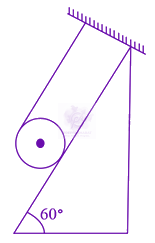 [The coefficient of static friction, ${\mu }_{s}$, is $0.4$ ]
Suppose you have taken a dilute solution of oleic acid in such a way that its concentration becomes $0.01{\mathrm{cm}}^{3}$ of oleic acid per ${\mathrm{cm}}^{3}$ of the solution. Then you make a thin film of this solution (monomolecular thickness) of area $4{\mathrm{cm}}^{2}$ by considering $100$ spherical drops of radius ${(\frac{3}{40\pi })}^{\frac{1}{3}}\times {10}^{-3}\mathrm{cm}.$ Then the thickness of oleic acid layer will be $x\times {10}^{-14}m$. Where $x$ is ________ .
The length of metallic wire is ${l}_{1}$ when tension in it is ${T}_{1}$. It is ${l}_{2}$ when the tension is ${T}_{2}$. The original length of the wire will be :
If two similar springs each of spring constant ${K}_{1}$ are joined in series, the new spring constant and time period would be changed by a factor:
The centre of a wheel rolling on a plane surface moves with a speed ${v}_{0}.$ A particle on the rim of the wheel at the same level as the centre will be moving at a speed $\sqrt{x}{v}_{0}.$ Then the value of $x$ is $.$
A scooter accelerates from rest for time ${t}_{1}$ at constant rate ${a}_{1}$ and then retards at constant rate ${a}_{2}$ for time ${t}_{2}$ and comes to rest. The correct value of $\frac{{t}_{1}}{{t}_{2}}$ will be :
Two stars of masses $m$ and $2m$ at a distance $d$ rotate about their common centre of mass in free space. The period of revolution is
The motion of a mass on a spring, with spring constant $K$ is as shown in figure. 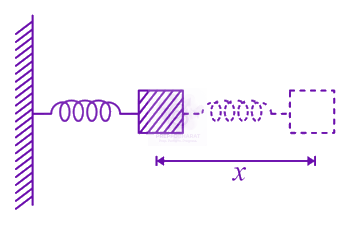 The equation of motion is given by, $x(t)=A\mathrm{sin}\omega t+$$B\mathrm{cos}\omega t$ with $\omega =\sqrt{\frac{K}{m}}$. Suppose that at time $t=0,$the position of mass is $x(0)$ and velocity $v(0),$ then its displacement can also be represented as $x(t)=C\mathrm{cos}(\omega t-\phi ),$ where $C$ and $\phi$ are
A balloon was moving upwards with a uniform velocity of $10m{s}^{-1}$. An object of finite mass is dropped from the balloon when it was at a height of $75m$ from the ground level. The height of the balloon from the ground when object strikes the ground was around: (takes the value of $g$ as $10m{s}^{-2}$)
The maximum and minimum distances of a comet from the Sun are $1.6\times {10}^{12}m$ and $8.0\times {10}^{10}m$ respectively. If the speed of the comet at the nearest point is $6\times {10}^{4}{ms}^{-1}$, the speed at the farthest point is
Three objects $A,B$ and $C$ are kept in a straight line on a frictionless horizontal surface. The masses of $A,B$ and $C$ are $m,2m$ and $2m$ respectively. $A$ moves towards $B$ with a speed of $9m{s}^{-1}$ and makes an elastic collision with it. Thereafter $B$ makes a completely inelastic collision with $C.$ All motions occur along the same straight line. The final speed of $C$ is : 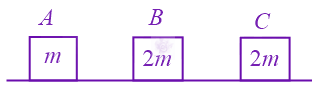
A body of mass $2\mathrm{kg}$ moving with a speed of $4m{s}^{-1}$ makes an elastic collision with another body at rest and continues to move in the original direction but with one fourth of its initial speed. The speed of the two body centre of mass is $x/10$. Find the value of x.
If $E,L,M$ and $G$ denote the quantities as energy, angular momentum, mass and constant of gravitation respectively, then the dimensions of $P$ in the formula $P=E{L}^{2}{M}^{-5}{G}^{-2}$ are:
Consider a situation in which a ring, a solid cylinder and a solid sphere roll down on the same inclined plane without slipping. Assume that they start rolling from rest and having identical diameter. The correct statement for this situation is
When a body slides down from rest along a smooth inclined plane making an angle of $30^{\circ}$ with the horizontal, it takes time $T.$ When the same body slides down from the rest along a rough inclined plane making the same angle and through the same distance, it takes time $\alpha T,$ where $\alpha$ is a constant greater than $1.$ The co-efficient of friction between the body and the rough plane is $\frac{1}{\sqrt{x}}(\frac{{\alpha }^{2}-1}{{\alpha }^{2}})$ where $x=__________.$
A modern grand-prix racing car of mass $m$ is travelling on a flat track in a circular arc of radius $R$ with a speed $v.$ If the coefficient of static friction between the tyres and the track is ${\mu }_{s},$ then the magnitude of negative lift ${F}_{L}$ acting downwards on the car is: 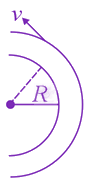
The water is filled up to a height of $12m$ in a tank having vertical sidewalls. A hole is made in one of the walls at a depth $h$ below the water level. The value of $h$ for which the emerging stream of water strikes the ground at the maximum range is _____ $m$.
A bullet of $4g$ mass is fired from a gun of mass $4\mathrm{kg}.$ If the bullet moves with the muzzle speed of $50{\mathrm{ms}}^{1},$ the impulse imparted to the gun and velocity of recoil of gun are
The figure shows two solid discs with radius $R$ and $r$ respectively. If mass per unit area is the same for both, what is the ratio of $MI$ of bigger disc around axis $AB$ (Which is $\perp$ to the plane of the disc and passing through its centre) of $MI$ of smaller disc around one of its diameters lying on its plane? Given $M$ is the mass of the larger disc. ($MI$ stands for a moment of inertia) 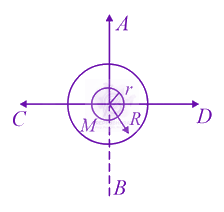
Two small drops of mercury each of radius $R$ coalesce to form a single large drop. The ratio of total surface energy before and after the change is
If time $(t),$ velocity $(v),$ and angular momentum $(l)$ are taken as the fundamental units. Then the dimension of mass $(m)$ in terms of $t,v$ and $l$ is:
If force (F), length (L) and time (T) are taken as the fundamental quantities. Then what will be the dimension of density:
Electric field of a plane electromagnetic wave propagating through a non-magnetic medium is given by $E=20\mathrm{cos}(2\times {10}^{10}t-200x)V{m}^{-1}.$ The dielectric constant of the medium is equal to: (Take ${\mu }_{r}=1)$
In the given figure, two wheels $P$ and $Q$ are connected by a belt $B$. The radius of $P$ is three times that of $Q$. In the case of the same rotational kinetic energy, the ratio of rotational inertias $(\frac{{I}_{1}}{{I}_{2}})$ will be $x:1.$ The value of $x$ will be ______. 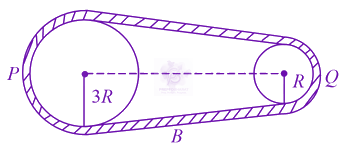
A body of mass $1\mathrm{kg}$ rests on a horizontal floor with which it has a coefficient of static friction $\frac{1}{\sqrt{3}}$. It is desired to make the body move by applying the minimum possible force $FN$. The value of $F$ will be _______.(Round off to the Nearest Integer) [Take $g=10{ms}^{-2}$ ]
Two masses $A$ and $B$, each of mass $M$ are fixed together by a massless spring, A force acts on the mass $B$ as shown in figure. If the mass $A$ starts moving away from mass $B$ with acceleration $a$, then the acceleration of mass $B$ will be : 
Two identical particles of mass $1\mathrm{kg}$ each go round a circle of radius $R$, under the action of their mutual gravitational attraction. The angular speed of each particle is:
Two billiard balls of equal mass $30g$ strike a rigid wall with same speed of $108\mathrm{kmph}$ (as shown) but at different angles. If the balls get reflected with the same speed, then the ratio of the magnitude of impulses imparted to ball $a$ and ball $b$ by the wall along $X$ direction is: 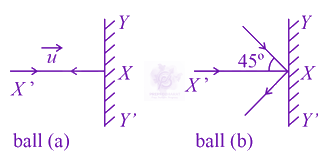
A swimmer wants to cross a river from point $A$ to point $B$. Line AB makes an angle of $30^{\circ}$ with the flow of the river. The magnitude of the velocity of the swimmer is the same as that of the river. The angle $\theta$ with the line $AB$ should be _______$^{\circ}$, so that the swimmer reaches point $B$. 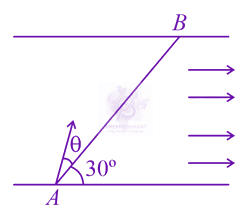
The value of tension in a long thin metal wire has been changed from ${T}_{1}$ to ${T}_{2}$. The lengths of the metal wire at two different values of tension ${T}_{1}$ and ${T}_{2}$ are ${\ell }_{1}$ and ${\ell }_{2}$, respectively. The actual length of the metal wire is:
The velocity-displacement graph of a particle is shown in the figure. 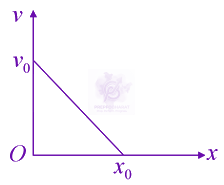 The acceleration-displacement graph of the same particle is represented by :
If velocity $[V]$ time $[T]$ and force $[F]$ are chosen as the base quantities, the dimensions of the mass will be :
A uniform heavy rod of weight $10\mathrm{kg}{ms}^{-2},$ cross-sectional area $100{\mathrm{cm}}^{2}$ and length $20\mathrm{cm}$ is hanging from a fixed support. Young modulus of the material of the rod is $2\times {10}^{11}N{m}^{-2}.$ Neglecting the lateral contraction, find the elongation of rod due to its own weight:
Consider a planet in some solar system that has a mass double the mass of earth and density equal to the average density of the earth. If the weight of an object on earth is $W$, the weight of the same object on that planet will be:
A constant power delivering machine has towed a box, which was initially at rest, along a horizontal straight line. The distance moved by the box in time $t$ is proportional to :-
A mosquito is moving with a velocity $\vec{v}=0.5{t}^{2}\hat{i}+3t\hat{j}+9\hat{k}m{s}^{-1}$ and accelerating in uniform conditions. What will be the direction of mosquitoes after $2s$ ?
In an octagon $ABCDEFGH$ of equal side, what is the sum of $\vec{AB}+\vec{AC}+\vec{AD}+\vec{AE}+\vec{AF}+\vec{AG}+\vec{AH},$ if, $\vec{\mathrm{AO}}=2\hat{i}+3\hat{j}-4\hat{k}$ 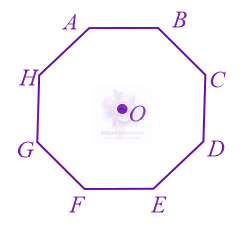
$\mathrm{Assertion}A:$ If in five complete rotations of the circular scale, the distance travelled on the main scale of the screw gauge is $5\mathrm{mm}$ and there are $50$ total divisions on a circular scale, then the least count is $0.001\mathrm{cm}.$ $\mathrm{Reason}R:$ Least Count $=\frac{\text{ Pitch }}{\text{ Total divisions on circular scale }}$ In the light of the above statements, choose the most appropriate answer from the options given below.
Match List I with List II. <table class="pyq-table"><tbody><tr><td></td><td>List-I</td><td></td><td>List-II</td></tr><tr><td>a</td><td>Capacitance, C</td><td>i</td><td>${M}^{1}{L}^{1}{T}^{-3}{A}^{-1}$</td></tr><tr><td>b</td><td>Permittivity of free space, ${\epsilon }_{0}$</td><td>ii</td><td>${M}^{-1}{L}^{-3}{T}^{4}{A}^{2}$</td></tr><tr><td>c</td><td>Permeability of free space, ${\mu }_{0}$</td><td>iii</td><td>${M}^{-1}{L}^{-2}{T}^{4}{A}^{2}$</td></tr><tr><td>d</td><td>Electric field, E</td><td>iv</td><td>${M}^{1}{L}^{1}{T}^{-2}{A}^{-2}$</td></tr></tbody></table>Choose the correct answer from the options given below
In a typical combustion engine the workdone by a gas molecule is given by $W={\alpha }^{2}\beta {e}^{\frac{-\beta {x}^{2}}{kT}}$, where $x$ is the displacement, $k$ is the Boltzmann constant and $T$ is the temperature. If $\alpha$ and $\beta$ are constants, dimensions of $\alpha$ will be:
Water drops are falling from a nozzle of a shower onto the floor from a height of $9.8m$. The drops fall at a regular interval of time. When the first drop strikes the floor, at that instant, the third drop begins to fall. Locate the position of second drop from the floor when the first drop strikes the floor.
If $e$ is the electronic charge, $c$ is the speed of light in free space and $h$ is Planck's constant, the quantity $\frac{1}{4\pi {\epsilon }_{0}}\frac{{|e|}^{2}}{hc}$ has dimensions of :
In the reported figure of earth, the value of acceleration due to gravity is same at point $A$ and $C$ but it is smaller than that of its value at point $B$ (surface of the earth). The value of $OA:AB$ will be $x:5$. The value of $x$ is 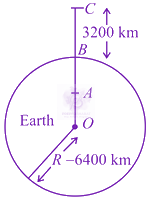
The projectile motion of a particle of mass $5g$ is shown in the figure. 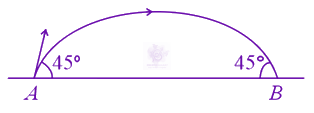 The initial velocity of the particle is $5\sqrt{2}{\mathrm{ms}}^{-1}$ and the air resistance is assumed to be negligible. The magnitude of the change in momentum between the points $A$ and $B$ is $x\times {10}^{-2}{\mathrm{kgms}}^{-1}$. The value of $x$, to the nearest integer, is ___ .
The initial velocity ${v}_{i}$ required to project a body vertically upward from the surface of the earth to reach a height of $10R$, where $R$ is the radius of the earth, may be described in terms of escape velocity ${v}_{e}$ such that ${v}_{i}=\sqrt{\frac{x}{y}}\times {v}_{e}$. The value of $x$ will be
If the velocity-time graph has the shape $\mathrm{AMB},$ what would be the shape of the corresponding acceleration-time graph? 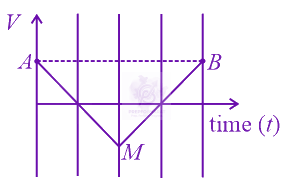
Given below are two statements: one is labelled as Assertion A and the other is labelled as Reason R. Assertion A: Moment of inertia of a circular disc of mass $M$ and radius $R$ about $X,Y$ axes (passing through its plane) and Z-axis which is perpendicular to its plane were found to be ${I}_{x},{I}_{y}$ and ${I}_{z}$, respectively. The respective radii of gyration about all the three axes will be the same. Reason R: A rigid body making rotational motion has fixed mass and shape. In the light of the above statements, choose the most appropriate answer from the options given below:
A block moving horizontally on a smooth surface with a speed of $40{ms}^{-1}$ splits into two equal parts. If one of the parts moves at $60{ms}^{-1}$ in the same direction, then the fractional change in the kinetic energy will be $x:4$ where $x=$ ________.
A body of mass $2\mathrm{kg}$ moves under a force of $(2\hat{i}+3\hat{j}+5\hat{k})N$ It starts from rest and was at the origin initially. After $4s$, its new coordinates are $(8,b,20)$. The value of $b$ is ______. (Round off to the Nearest Integer)
A circular disc reaches from top to bottom of an inclined plane of length $L.$ When it slips down the plane, it takes time ${t}_{1}$. When it rolls down the plane, it takes time ${t}_{2}$. The value of $\frac{{t}_{2}}{{t}_{1}}$ is $\sqrt{\frac{3}{x}}$. The value of $x$ will be
A bullet of $10g$, moving with velocity $v$, collides head-on with the stationary bob of a pendulum and recoils with velocity $100m{s}^{-1}$. The length of the pendulum is $0.5m$ and mass of the bob is $1\mathrm{kg}$. The minimum value of $v\text{in}m{s}^{-1}$, so that the pendulum describes a circle. (Assume the string to be inextensible and $g=10m{s}^{-2}$ ) 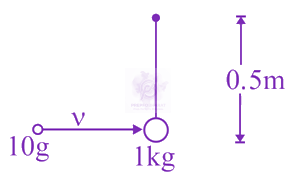
In an octagon $ABCDEFGH$ of equal side, what is the sum of $\vec{AB}+\vec{AC}+\vec{AD}+\vec{AE}+\vec{AF}+\vec{AG}+\vec{AH},$ if, $\vec{\mathrm{AO}}=2\hat{i}+3\hat{j}-4\hat{k}$<br><img src="https://prepforbharat.s3.ap-south-1.amazonaws.com/exam/615f0e999476412f48314daf/Physics/images/Mathematics_in_Physics/648b5a6a417cc3fb48d6724d/question_1__q_648b5a6a417cc3fb48d6724d__cdn-question-pool.getmarks.app__6d57eb30-500d-4e69-80b2-34a8f26821c1-image__2302001706_final_ppt_sync.png" alt="JEE Main 2021 Physics, Mathematics in Physics — question figure">
A boy of mass $4\mathrm{kg}$ is standing on a piece of wood having mass $5\mathrm{kg}$. If the coefficient of friction between the wood and the floor is $0.5,$ the maximum force that the boy can exert on the rope so that the piece of wood does not move from its place is _______ $N$. (Round off to the Nearest Integer) [Take $g=10{ms}^{-2}]$ 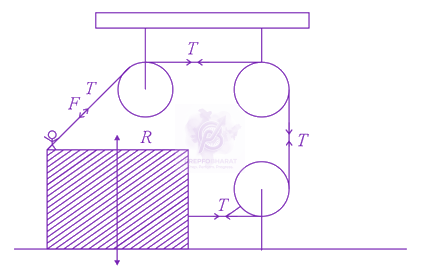
What will be the projection of vector $\vec{A}=\hat{i}+\hat{j}+\hat{k}$ on vector $\vec{B}=\hat{i}+\hat{j}?$
A solid disc of radius $20\mathrm{cm}$ and mass $10\mathrm{kg}$ is rotating with an angular velocity of $600\mathrm{rpm}$, about an axis normal to its circular plane and passing through its centre of mass. The retarding torque required to bring the disc at rest in $10s$ is _________$\pi \times {10}^{-1}Nm$
The following bodies, $(1)$ a ring $(2)$ a disc $(3)$ a solid cylinder $(4)$ a solid sphere, of same mass $m$ and radius $R$ are allowed to roll down without slipping simultaneously from the top of the inclined plane. The body which will reach first at the bottom of the inclined plane is [Mark the body as per their respective numbering given in the question] 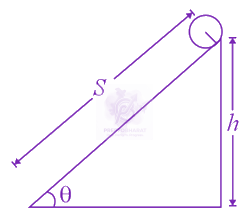
When two soap bubbles of radii $a$ and $b$$(b>a)$ coalesce, the radius of curvature of common surface is:
Consider a badminton racket with length scales as shown in the figure. 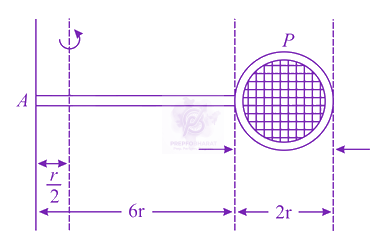 If the mass of the linear and circular portions of the badminton racket are same ($M$) and the mass of the threads are negligible, the moment of inertia of the racket about an axis perpendicular to the handle and in the plane of the ring at, $\frac{r}{2}$ distance from the end $A$ of the handle will be ______$M{r}^{2}$.
A person whose mass is $100\mathrm{kg}$ travels from Earth to Mars in a spaceship. Neglect all other objects in sky and take acceleration due to gravity on the surface of the Earth and Mars as $10m{s}^{-2}$ and $4m{s}^{-2}$, respectively. Identify from the below figures, the curve that fits best for the weight of the passenger as a function of time. 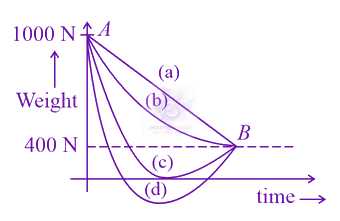
Water droplets are coming from an open tap at a particular rate. The spacing between a droplet observed at ${4}^{\mathrm{th}}$ second after its fall to the next droplet is $34.3m$. At what rate the droplets are coming from the tap ? (Take $g=9.8m{s}^{-2}$)
The length of a metal wire is ${\ell }_{1},$ when the tension in it is ${T}_{1}$ and is ${\ell }_{2}$ when the tension is ${T}_{2}.$ The natural length of the wire is:
If $C$ and $V$ represent capacity and voltage respectively then what are the dimensions of $\lambda$ where $C/V=\lambda$ ?
The radius of a sphere is measured to be $(7.50\pm 0.85)\mathrm{cm}$. Suppose the percentage error in its volume is $x$. The value of $x$, to the nearest $x$, is ___ .
A ball with a speed of $9m{s}^{-1}$ collides with another identical ball at rest. After the collision, the direction of each ball makes an angle of $30^{\circ}$ with the original direction. If the ratio of velocities of the balls after the collision is $x:y$, then what is the value of $x$?
A sphere of radius $a$ and mass $m$ rolls along a horizontal plane with constant speed ${v}_{0}$. It encounters an inclined plane at angle $\theta$ and climbs upward. Assuming that it rolls without slipping, how far up the sphere will travel? 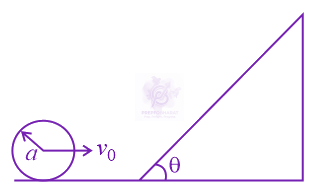
A wire of $1\Omega$ has a length of $1m$. It is stretched till its length increases by $25%$. The percentage change in resistance to the nearest integer is :
Statement I: A cyclist is moving on an unbanked road with a speed of $7\mathrm{km}{h}^{-1}$ and takes a sharp circular turn along a path of the radius of $2m$ without reducing the speed. The static friction coefficient is $0.2$. The cyclist will not slip and pass the curve $(g=9.8m{s}^{-2})$ Statement II : If the road is banked at an angle of $45^{\circ}$, cyclist can cross the curve of $2m$ radius with the speed of $18.5\mathrm{km}{h}^{-1}$ without slipping. In the light of the above statements, choose the correct answer from the options given below.
An object is located at $2\mathrm{km}$ beneath the surface of the water. If the fractional compression $\frac{\Delta V}{V}$ is $1.36%$, the ratio of hydraulic stress to the corresponding hydraulic strain will be ______[Given: density of water is $1000\mathrm{kg}{m}^{-3}$ and $g=9.8{ms}^{-2}.$
A boy is rolling a $0.5\mathrm{kg}$ ball on the frictionless floor with the speed of $20{ms}^{-1}.$ The ball gets deflected by an obstacle on the way. After deflection it moves with $5%$ of its initial kinetic energy. What is the speed of the ball now?
A body of mass $M$ moving at speed ${V}_{0}$ collides elastically with a mass $m$ at rest. After the collision, the two masses move at angles ${\theta }_{1}$ and ${\theta }_{2}$ with respect to the initial direction of motion of the body of mass $M.$. The largest possible value of the ratio $\frac{M}{m},$ for which the angles ${\theta }_{1}$ and ${\theta }_{2}$ will be equal, is :
Match List - I with List - II : <table class="pyq-table"><tbody><tr><td></td><td>List - I</td><td></td><td>List - II</td></tr><tr><td>a</td><td>Magnetic induction</td><td>i</td><td>${\mathrm{ML}}^{2}{T}^{-2}{A}^{-1}$</td></tr><tr><td>b</td><td>Magnetic flux</td><td>ii</td><td>${M}^{0}{L}^{-1}A$</td></tr><tr><td>c</td><td>Magnetic permeability</td><td>iii</td><td>${\mathrm{MT}}^{-2}{A}^{-1}$</td></tr><tr><td>d</td><td>Magnetization</td><td>iv</td><td>${\mathrm{MLT}}^{-2}{A}^{-2}$</td></tr></tbody></table>Choose the most appropriate answer from the options given below :
A bomb is dropped by a fighter plane flying horizontally. To an observer sitting in the plane, the trajectory of the bomb is a :
Three students ${S}_{1},{S}_{2}$ and ${S}_{3}$ perform an experiment for determining the acceleration due to gravity $(g)$ using a simple pendulum. They use different lengths of pendulum and record time for different number of oscillations. The observations are as shown in the table.<br><table class="pyq-table"><tbody><tr><td>Student No.</td><td>Length of pendulum $(\mathrm{cm})$</td><td>Number of oscillations $(n)$</td><td>Total time for $n$ oscillations</td><td>Time period $(s)$</td></tr><tr><td>$1.$</td><td>$64.0$</td><td>$8$</td><td>$128.0$</td><td>$16.0$</td></tr><tr><td>$2.$</td><td>$64.0$</td><td>$4$</td><td>$64.0$</td><td>$16.0$</td></tr><tr><td>$3.$</td><td>$20.0$</td><td>$4$</td><td>$36.0$</td><td>$9.0$</td></tr></tbody></table>(Least count of length $=0.1m$, least count for time $=0.1s$)<br>If ${E}_{1},{E}_{2}$ and ${E}_{3}$ are the percentage errors in $g$ for students $1,2$ and $3$, respectively, then the minimum percentage error is obtained by student no $.$
The trajectory of a projectile in a vertical plane is $y=\alpha x-\beta {x}^{2},$ where $\alpha$ and $\beta$ are constants and $x&y$ are respectively the horizontal and vertical distances of the projectile from the point of projection. The angle of projection $\theta$ and the maximum height attained $H$ are respectively given by
The time period of a simple pendulum is given by $T=2\pi \sqrt{\frac{l}{g}}.$ The measured value of the length of the pendulum is $10\mathrm{cm}$ known to a $1\mathrm{mm}$ accuracy. The time for $200$ oscillations of the pendulum is found to be $100$ second using a clock of $1s$ resolution. The percentage accuracy in the determination of $g$ using this pendulum is $x.$ The value of $x$ to the nearest integer is:-
In a spring gun having spring constant $100N{m}^{-1}$ a small ball $B$ of mass $100g$ is put in its barrel (as shown in figure) by compressing the spring through $0.05m$. There should be a box placed at a distance $d$ on the ground so that the ball falls in it. If the ball leaves the gun horizontally at a height of $2m$ above the ground. The value of $d$ is $m$. $(g=10m{s}^{-2})$ 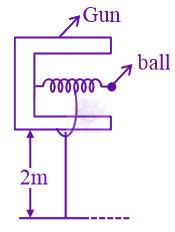
The masses and radii of the earth and moon are $({M}_{1},{R}_{1})$ and $({M}_{2},{R}_{2})$ respectively. Their centres are at a distance $r$ apart. Find the minimum escape velocity for a particle of mass $m$ to be projected from the middle of these two masses :
An inclined plane is bent in such a way that the vertical cross-section is given by $y=\frac{{x}^{2}}{4}$ where $y$ is in vertical and $x$ in horizontal direction. If the upper surface of this curved plane is rough with coefficient of friction $\mu =0.5,$ the maximum height in $\mathrm{cm}$ at which a stationary block will not slip downward is________$\mathrm{cm}.$
Two vectors $\vec{P}$ and $\vec{Q}$ have equal magnitudes. If the magnitude of $\vec{P}+\vec{Q}$ is $n$ times the magnitude of $\vec{P}-\vec{Q},$ then angle between $\vec{P}$ and $\vec{Q}$ is
Statement I: If three forces ${\vec{F}}_{1},{\vec{F}}_{2}$ and ${\vec{F}}_{3}$ are represented by three sides of a triangle and $\vec{{F}_{1}}+\vec{{F}_{2}}=-{\vec{F}}_{3},$ then these three forces are concurrent forces and satisfy the condition for equilibrium.<br>Statement II: A triangle made up of three forces $\vec{{F}_{1}},\vec{{F}_{2}}$ and $\vec{{F}_{3}}$ as its sides were taken in the same order, satisfies the condition for translatory equilibrium.<br>In the light of the above statements, choose the most appropriate answer from the options given below:
A mass of $50\mathrm{kg}$ is placed at the center of a uniform spherical shell of mass $100\mathrm{kg}$ and radius $50m$. If the gravitational potential at a point, $25m$ from the center is $V\mathrm{kg}{m}^{-1}$. The value of $V$ is:
A body rotating with an angular speed of $600\mathrm{rpm}$ is uniformly accelerated to $1800\mathrm{rpm}$ in $10\mathrm{sec}.$ The number of rotations made in the process is
A body having specific charge $8\mu C{g}^{-1}$ is resting on a frictionless plane at a distance $10\mathrm{cm}$ from the wall (as shown in the figure). It starts moving towards the wall when a uniform electric field of $100V{m}^{-1}$ is applied horizontally towards the wall. If the collision of the body with the wall is perfectly elastic, then the time period of the motion will be $____s.$ 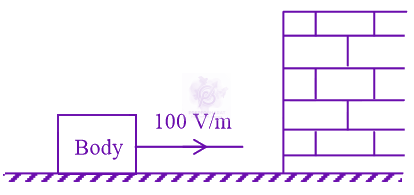
A block of $200g$ mass moves with a uniform speed in a horizontal circular groove, with vertical side walls of radius $20\mathrm{cm}$. If the block takes $40s$ to complete one round, the normal force by the side walls of the groove is:
The pitch of the screw gauge is $1\mathrm{mm}$ and there are $100$ divisions on the circular scale. When nothing is put in between the jaws, the zero of the circular scale lies $8$ divisions below the reference line. When a wire is placed between the jaws, the first linear scale division is clearly visible while ${72}^{\text{nd }}$ division on circular scale coincides with the reference line. The radius of the wire is
$\mathrm{Assertion}A:$ If $A,B,C,D$ are four points on a semi-circular arc with a centre at $O$ such that $|\vec{AB}|=|\vec{BC}|=|\vec{CD}|.$ Then, $\vec{AB}+\vec{AC}+\vec{AD}=4\vec{AO}+\vec{OB}+\vec{OC}$ $\mathrm{Reason}R:$ Polygon law of vector addition yields $\vec{AB}+\vec{BC}+\vec{CD}+\vec{AD}=2\vec{AO}$ 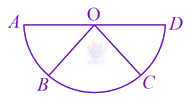 In the light of the above statements, choose the most appropriate answer from the options given below.
An object of mass $m$ is being moved with a constant velocity under the action of an applied force of $2N$ along a frictionless surface with following surface profile. 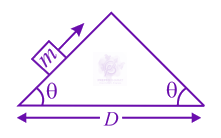 The correct applied force vs distance graph will be :
The planet Mars has two moons, if one of them has a period $7$ hours, $30$ minutes and an orbital radius of $9.0\times {10}^{3}\mathrm{km}.$ Find the mass of Mars. ${$ Given $\frac{4{\pi }^{2}}{G}=6\times {10}^{11}{N}^{-1}{m}^{-2}{\mathrm{kg}}^{2}}$
Two blocks ($m=0.5\mathrm{kg}$ and $M=4.5\mathrm{kg}$) are arranged on a horizontal frictionless table as shown in the figure. The coefficient of static friction between the two blocks is $\frac{3}{7}.$ Then the maximum horizontal force that can be applied on the larger block so that the blocks move together is $N.$ (Round off to the Nearest Integer) [Take $g$ as $9.8m{s}^{-2}$] 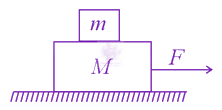
A helicopter is flying horizontally with a speed $v$ at an altitude $h$ has to drop a food packet for a man on the ground. What is the distance of helicopter from the man when the food packet is dropped ?
A stone is dropped from the top of a building. When it crosses a point $5m$ below the top, another stone starts to fall from a point $25m$ below the top. Both stones reach the bottom of building simultaneously. The height of the building is :
Match List I with List II.<br><table class="pyq-table"><tbody><tr><td colspan="2" rowspan="1">List I</td><td colspan="2" rowspan="1">List II</td></tr><tr><td>(a)</td><td>$\vec{C}-\vec{A}-\vec{B}=0$</td><td>(i)</td><td><img src="https://prepforbharat.s3.ap-south-1.amazonaws.com/exam/615f0e999476412f48314daf/Physics/images/Mathematics_in_Physics/648b5a6a417cc3fb48d67301/question_1__q_648b5a6a417cc3fb48d67301__cdn-question-pool.getmarks.app__b6c349fb-53c1-4e10-b1fe-828e32653b15-image__3b91df2772_final_ppt_sync.png" alt="JEE Main 2021 Physics, Mathematics in Physics — question figure 1"></td></tr><tr><td>(b)</td><td>$\vec{A}-\vec{C}-\vec{B}=0$</td><td>(ii)</td><td><img src="https://prepforbharat.s3.ap-south-1.amazonaws.com/exam/615f0e999476412f48314daf/Physics/images/Mathematics_in_Physics/648b5a6a417cc3fb48d67301/question_2__q_648b5a6a417cc3fb48d67301__cdn-question-pool.getmarks.app__8dcfe9df-eb9f-48ba-8cc4-cfd2b2c16819-image__2f6e4b06d3_final_ppt_sync.png" alt="JEE Main 2021 Physics, Mathematics in Physics — question figure 2"></td></tr><tr><td>(c)</td><td>$\vec{B}-\vec{A}-\vec{C}=0$</td><td>(iii)</td><td><img src="https://prepforbharat.s3.ap-south-1.amazonaws.com/exam/615f0e999476412f48314daf/Physics/images/Mathematics_in_Physics/648b5a6a417cc3fb48d67301/question_3__q_648b5a6a417cc3fb48d67301__cdn-question-pool.getmarks.app__e1726169-6520-4d6a-92bb-b0147017581e-image__8def3f0e02_final_ppt_sync.png" alt="JEE Main 2021 Physics, Mathematics in Physics — question figure 3"></td></tr><tr><td>(d)</td><td>$\vec{A}+\vec{B}=-\vec{C}$</td><td>(iv)</td><td><img src="https://prepforbharat.s3.ap-south-1.amazonaws.com/exam/615f0e999476412f48314daf/Physics/images/Mathematics_in_Physics/648b5a6a417cc3fb48d67301/question_4__q_648b5a6a417cc3fb48d67301__cdn-question-pool.getmarks.app__1019a326-88c2-4ad4-8b38-ec52abb6bdc9-image__957699a43d_final_ppt_sync.png" alt="JEE Main 2021 Physics, Mathematics in Physics — question figure 4"></td></tr></tbody></table>Choose the correct answer from the options given below:
Two spherical balls having equal masses with radius of $5\mathrm{cm}$ each are thrown upwards along the same vertical direction at an interval of $3s$ with the same initial velocity of $35m{s}^{-1}$, then these balls collide at a height of _____$m$, (take $g=10m{s}^{-2}$)
A planet revolving in elliptical orbit has : A. a constant velocity of revolution. B. has the least velocity when it is nearest to the sun. C. its areal velocity is directly proportional to its velocity. D. areal velocity is inversely proportional to its velocity. E. to follow a trajectory such that the areal velocity is constant. Choose the correct answer from the options given below:
A small block slides down from the top of hemisphere of radius $R=3m$ as shown in the figure. The height $h$ at which the block will lose contact with the surface of the sphere is $m$. (Assume there is no friction between the block and the hemisphere) 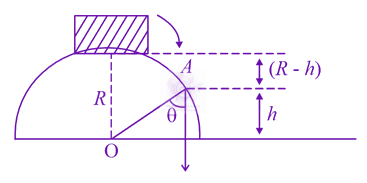
The height of victoria's falls is $63m$. What is the difference in the temperature of water at the top and at the bottom of the fall? [Given $1\mathrm{cal}=4.2J$ and specific heat of water $=1\mathrm{cal}{g}^{-1}{C\circ }^{-1}]$
The ranges and heights for two projectiles projected with the same initial velocity at angles $42^{\circ}$ and $48^{\circ}$ with the horizontal are ${R}_{1},{R}_{2}$ and ${H}_{1},{H}_{2}$ respectively. Choose the correct option:
Match List - I with List - II.<table class="pyq-table"><tbody><tr><td></td><td>List - I</td><td></td><td>List - II</td></tr><tr><td>a</td><td>Torque</td><td>i</td><td>${\mathrm{MLT}}^{-1}$</td></tr><tr><td>b</td><td>Impulse</td><td>ii</td><td>${\mathrm{MT}}^{-2}$</td></tr><tr><td>c</td><td>Tension</td><td>iii</td><td>${\mathrm{ML}}^{2}{T}^{-2}$</td></tr><tr><td>d</td><td>Surface Tension</td><td>iv</td><td>${\mathrm{MLT}}^{-2}$</td></tr></tbody></table>Choose the most appropriate answer from the option given below :
Inside a uniform spherical shell : (a) The gravitational field is zero. (b) The gravitational potential is zero. (c) The gravitational field is the same everywhere. (d) The gravitation potential is the same everywhere. (e) All the above. Choose the most appropriate answer from the options given below:
Which of the following equations is dimensionally incorrect? Where $t=$time, $h=$height, $s=$surface tension, $\theta =$angle, $\rho =$density $,a,r=$radius, $g=$ the acceleration due to gravity, $V=$volume, $p=$pressure, $W=$work done, $\tau =$torque, $\epsilon =$permittivity, $E=$electric field, $J=$current density, $L=$length.
A body of mass $(2M)$ splits into four masses ${m,M-m,m,M-m},$ which are rearranged to form a square as shown in the figure. The ratio of $\frac{M}{m}$ for which, the gravitational potential energy of the system becomes maximum is $x:1.$ The value of $x$ is ________. 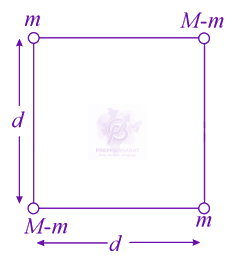
Two narrow bores of diameter $5.0\mathrm{mm}$ and $8.0\mathrm{mm}$ are joined together to form a $U-$shaped tube open at both ends. If this $U-$tube contains water, what is the difference in the level of two limbs of the tube. [Take surface tension of water $T=7.3\times {10}^{-2}N{m}^{-1}$, angle of contact $=0,g=10{ms}^{-2}$ and density of water$=1.0\times {10}^{3}\mathrm{kg}{m}^{-3}]$
One main scale division of a vernier callipers is $a$ $\mathrm{cm}$ and ${n}^{\mathrm{th}}$ division of the vernier scale coincide with ${(n-1)}^{\mathrm{th}}$ division of the main scale. The least count of the callipers in $\mathrm{mm}$ is :
The relation between time $t$ and distance $x$ for a moving body is given as $t=m{x}^{2}+nx$, where $m$ and $n$ are constants. The retardation of the motion is: (When $v$ stands for velocity)
A uniform thin bar of mass $6\mathrm{kg}$ and length $2.4$ meter is bent to make an equilateral hexagon. The moment of inertia about an axis passing through the centre of mass and perpendicular to the plane of hexagon is ___________ $\times {10}^{-1}\mathrm{kg}{m}^{2}.$
A geostationary satellite is orbiting around an arbitrary planet $P$ at a height of $11R$ above the surface of $P$, $R$ being the radius of $P$. The time period of another satellite in hours at a height of $2R$ from the surface of $P$ is ________ has the time period of $24\mathrm{hours}.$
The instantaneous velocity of a particle moving in a straight line is given as $v=\alpha t+\beta {t}^{2}$, where $\alpha$ and $\beta$ are constants. The distance travelled by the particle between $1s$ and $2s$ is:
When a rubber ball is taken to a depth of _______ $m$ in deep sea, its volume decreases by $0.5%$ (The bulk modulus of rubber $=9.8\times {10}^{8}N{m}^{-2}$ Density of sea water $={10}^{3}\mathrm{kg}{m}^{-3}$,$g=9.8m{s}^{-2}$)
The average translational kinetic energy of ${N}_{2}$ gas molecules at $_________C\circ$ becomes equal to the $K.E.$ of an electron accelerated from rest through a potential difference of $0.1\mathrm{volt}.$ (Given ${k}_{B}=1.38\times {10}^{-23}J{K}^{-1})$ (Fill the nearest integer).
A car accelerates from rest at a constant rate $\alpha$ for some time after which it decelerates at a constant rate $\beta$ to come to rest. If the total time elapsed is t seconds, the total distance travelled is:
Two solids $A$ and $B$ of mass $1\mathrm{kg}$ and $2\mathrm{kg}$ respectively are moving with equal linear momentum. The ratio of their kinetic energies ${(K.E.)}_{A}:{(K.E.)}_{B}$ will be $\frac{A}{1},$ so the value of $A$ will be _________.
Moment of inertia of a square plate of side $l$ about the axis passing through one of the corner and perpendicular to the plane of square plate is given by:
The position of the centre of mass of a uniform semi-circular wire of radius $R$ placed in $x-y$ plane with its centre at the origin and the line joining its ends as $x-$axis is given by, $(0,\frac{xR}{\pi }).$ Then, the value of $|x|$ is $.$
A small bob tied at one end of a thin string of length $1m$ is describing a vertical circle so that the maximum and minimum tension in the string is in the ratio $5:1$. The velocity of the bob at the highest position is ______ $m{s}^{-1}$. (Take $g=10m{s}^{-2}$)
Two particles having masses $4g$ and $16g$ respectively are moving with equal kinetic energies. The ratio of the magnitudes of their linear momentum is $n:2$. The value of $n$ will be ___.
The disc of mass $M$ with uniform surface mass density $\sigma$ is shown in the figure. The center of mass of the quarter disc (the shaded area) is at the position $(\frac{xa}{3\pi },\frac{xa}{3\pi })$ where $x$ is _______ . (Round off to the Nearest Integer) [$a$ is an area as shown in the figure] 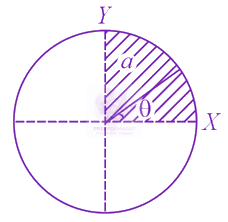
Two bodies, a ring and a solid cylinder of same material are rolling down without slipping an inclined plane. The radii of the bodies are same. The ratio of velocity of the centre of mass at the bottom of the inclined plane of the ring to that of the cylinder is $\frac{\sqrt{x}}{2}.$ Then, the value of $x$ is
The radius in kilometer to which the present radius of earth $(R=6400\mathrm{km})$ to be compressed so that the escape velocity is increased $10$ time is _______.
A hydraulic press can lift $100\mathrm{kg}$ when a mass $m$ is placed on the smaller piston. It can lift kg when the diameter of the larger piston is increased by $4$ times and that of the smaller piston is decreased by $4$ times keeping the same mass $m$ on the smaller piston.
The boxes of masses $2\mathrm{kg}$ and $8\mathrm{kg}$ are connected by a massless string passing over smooth pulleys. Calculate the time taken by box of mass $8\mathrm{kg}$ to strike the ground starting from rest. $(g=10m{s}^{-2})$