JEE Main 2025 — Mechanics
Physics Mechanics questions from JEE Main 2025.
Other Years
167 Mechanics Questions from 2025
A 3 m long wire of radius 3 mm shows an extension of 0.1 mm when loaded vertically by a mass of 50 kg in an experiment to determine Young's modulus. The value of Young's modulus of the wire as per this experiment is $\mathrm{P} \times 10^{11} \mathrm{Nm}^{-2}$, where the value of P is: (Take $\left.\mathrm{g}=3 \pi \mathrm{~m} / \mathrm{s}^2\right)$
A 400 g solid cube having an edge of length 10 cm floats in water. How much volume of the cube is outside the water ? (Given : density of water $=1000 \mathrm{~kg} \mathrm{~m}^{-3}$ )
A ball having kinetic energy KE, is projected at an angle of $60^{\circ}$ from the horizontal. What will be the kinetic energy of ball at the highest point of its flight ?
A ball of mass 100 g is projected with velocity $20 \mathrm{~m} / \mathrm{s}$ at $60^{\circ}$ with horizontal. The decrease in kinetic energy of the ball during the motion from point of projection to highest point is
A balloon and its content having mass $M$ is moving up with an acceleration ' $a$ '. The mass that must be released from the content so that the balloon starts moving up with an acceleration ' $3 a^{\prime}$ will be (Take ' g ' as acceleration due to gravity)
A bead of mass ' $m$ ' slides without friction on the wall of a vertical circular hoop of radius ' $R$ ' as shown in figure. The bead moves under the combined action of gravity and a massless spring ( k ) attached to the bottom of the hoop. The equilibrium length of the spring is ' $R$ '. If the bead is released from top of the hoop with (negligible) zero initial speed, velocity of bead, when the length of spring becomes ' R ', would be (spring constant is ' k ', g is accleration due to gravity) 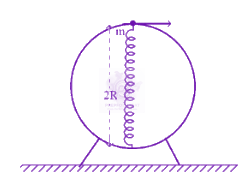
A block of mass 1 kg , moving along x with speed $\mathrm{v}_{\mathrm{i}}=10 \mathrm{~m} / \mathrm{s}$ enters a rough region ranging from $\mathrm{x}=0.1 \mathrm{~m}$ to $\mathrm{x}=1.9 \mathrm{~m}$. The retarding force acting on the block in this range is $\mathrm{F}_{\mathrm{r}}=-\mathrm{kx} \mathrm{N}$, with $\mathrm{k}=10 \mathrm{~N} / \mathrm{m}$. Then the final speed of the block as it crosses rough region is
A block of mass 2 kg is attached to one end of a massless spring whose other end is fixed at a wall. The spring-mass system moves on a frictionless horizontal table. The spring's natural length is 2 m and spring constant is $200 \mathrm{~N} / \mathrm{m}$. The block is pushed such that the length of the spring becomes 1 m and then released. At distance $\mathrm{x} \mathrm{m}(\mathrm{x} \lt 2)$ from the wall. the speed of the block will be :
A block of mass 25 kg is pulled along a horizontal surface by a force at an angle $45^{\circ}$ with the horizontal. The friction coefficient between the block and the surface is 0.25. The displacement of 5 m of the block is:
A bob of mass $m$ is suspended at a point $O$ by a light string of length $l$ and left to perform vertical motion (circular) as shown in figure. Initially, by applying horizontal velocity $v_0$ at the point ' A ', the string becomes slack when, the bob reaches at the point ' D '. The ratio of the kinetic energy of the bob at the points $B$ and $C$ is ______ -. 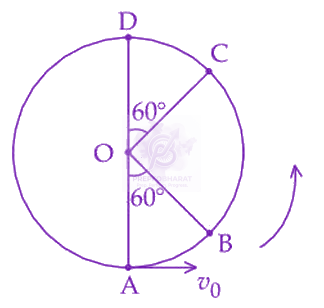
A body of mass 100 g is moving in circular path of radius 2 m on vertical plane as shown in figure. The velocity of the body at point $A$ is $10 \mathrm{~m} / \mathrm{s}$. The ratio of its kinetic energies at point $B$ and $C$ is : 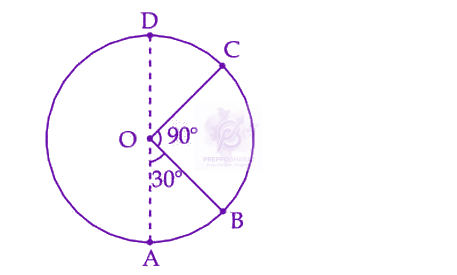 (Take acceleration due to gravity as $10 \mathrm{~m} / \mathrm{s}^2$ )
A body of mass 2 kg moving with velocity of $\overrightarrow{\mathrm{v}}_{\mathrm{in}}=3 \hat{\mathrm{i}}+4 \hat{\mathrm{j}} \mathrm{ms}^{-1}$ enters into a constant force field of 6 N directed along positive z -axis. If the body remains in the field for a period of $\frac{5}{3}$ seconds, then velocity of the body when it emerges from force field is
A body of mass 4 kg is placed on a plane at a point P having coordinate $(3,4) \mathrm{m}$. Under the action of force $\overrightarrow{\mathrm{F}}=(2 \hat{i}+3 \hat{j}) \mathrm{N}$, it moves to a new point Q having coordinates $(6,10) \mathrm{m}$ in 4 sec . The average power and instanteous power at the end of 4 sec are in the ratio of :
A body of mass $m$ is suspended by two strings making angles $\theta_1$ and $\theta_2$ with the horizontal ceiling with tensions $T_1$ and $T_2$ simultaneously. $T_1$ and $T_2$ are related by $T_1=\sqrt{3} T_2$. the angles $\theta_1$ and $\theta_2$ are
A body of mass ' \(m\) ' connected to a massless and unstretchable string goes in verticle circle of radius ' \(R\) 'under gravity \(g\). The other end of the string is fixed at the center of circle. If velocity at top of circular path is \(n \sqrt{g R}\), where, \(n \geqslant 1\), then ratio of kinetic energy of the body at bottom to that at top of the circle is
A capillary tube of radius 0.1 mm is partly dipped in water (surface tension $70 \mathrm{dyn} / \mathrm{cm}$ and glass water contact angle $\simeq 0^{\circ}$) with $30^{\circ}$ inclined with vertical. The length of water risen in the capillary is ________ cm. $\left(\right.$ Take $\left.\mathrm{g}=9.8 \mathrm{~m} / \mathrm{s}^2\right)$
A car of mass ' $m$ ' moves on a banked road having radius ' $r$ ' and banking angle $\theta$. To avoid slipping from banked road, the maximum permissible speed of the car is $v_0$. The coefficient of friction $\mu$ between the wheels of the car and the banked road is
A circular disk of radius R meter and mass M kg is rotating around the axis perpendicular to the disk. An external torque is applied to the disk such that $\theta(t)=5 t^2-8 t$, where $\theta(t)$ is the angular position of the rotating disc as a function of time $t$. How much power is delivered by the applied torque, when $t=2 \mathrm{~s}$ ?
A circular ring and a solid sphere having same radius roll down on an inclined plane from rest without slipping. The ratio of their velocities when reached at the bottom of the plane is $\sqrt{\frac{x}{5}}$ where $\mathrm{x}=$ _____
A cord of negligible mass is wound around the rim of a wheel supported by spokes with negligible mass. The mass of wheel is 10 kg and radius is 10 cm and it can freely rotate without any friction. Initially the wheel is at rest. If a steady pull of 20 N is applied on the cord, the angular velocity of the wheel, after the cord is unwound by 1 m , would be : 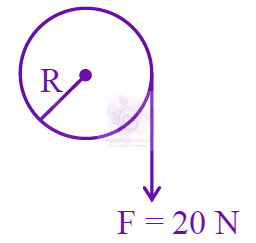
A cube having a side of 10 cm with unknown mass and 200 gm mass were hung at two ends of an uniform rigid rod of 27 cm long. The rod along with masses was placed on a wedge keeping the distance between wedge point and 200 gm weight as 25 cm. Initially the masses were not at balance. A beaker is placed beneath the unknown mass and water is added slowly to it. At given point the masses were in balance and half volume of the unknown mass was inside the water. (Take the density of unknown mass is more than that of the water, the mass did not absorb water and water density is $1 \mathrm{gm} / \mathrm{cm}^3$.) The unknown mass is ________ kg.
A cubic block of mass $m$ is sliding down on an inclined plane at $60^{\circ}$ with an acceleration of $\frac{\mathrm{g}}{2}$, the value of coefficient of kinetic friction is
A cylindrical rod of length 1 m and radius 4 cm is mounted vertically. It is subjected to a shear force of $10^5 \mathrm{~N}$ at the top. Considering infinitesimally small displacement in the upper edge, the angular displacement $\theta$ of the rod axis from its original position would be : (shear moduli, $\left.\mathrm{G}=10^{10} \mathrm{~N} / \mathrm{m}^2\right)$
A force $\mathrm{f}=\mathrm{x}^2 \mathrm{y} \hat{\mathrm{i}}+\mathrm{y}^2 \hat{\mathrm{j}}$ acts on a particle in a plane $\mathrm{x}+\mathrm{y}=10$. The work done by this force during a displacement from $(0,0)$ to $(4 \mathrm{~m}, 2 \mathrm{~m})$ is $\qquad$ Joule (round off to the nearest integer)
A force $\mathrm{F}=\alpha+\beta \mathrm{x}^2$ acts on an object in the x -direction. The work done by the force is 5 J when the object is displaced by 1 m . If the constant $\alpha=1 \mathrm{~N}$ then $\beta$ will be
A force $\overrightarrow{\mathrm{F}}=2 \hat{i}+\mathrm{b} \hat{j}+\hat{k}$ is applied on a particle and it undergoes a displacement $\hat{i}-2 \hat{j}-\hat{k}$. What will be the value of $b$, if work done on the particle is zero.
A force of 49 N acts tangentially at the highest point of a sphere (solid) of mass 20 kg , kept on a rough horizontal plane. If the sphere rolls without slipping, then the acceleration of the center of the sphere is 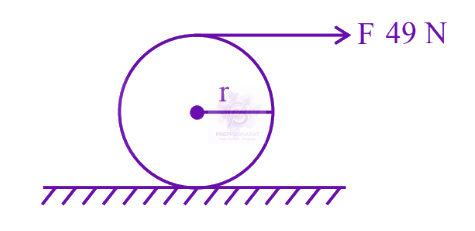
A helicopter flying horizontally with a speed of $360 \mathrm{~km} / \mathrm{h}$ at an altitude of 2 km , drops an object at an instant. The object hits the ground at a point O , 20 s after it is dropped. Displacement of ' O ' from the position of helicopter where the object was released is : (use acceleration due to gravity $\mathrm{g}=10 \mathrm{~m} / \mathrm{s}^2$ and neglect air resistance)
A massless spring gets elongated by amount $x_1$ under a tension of 5 N . Its elongation is $x_2$ under the tension of 7 N . For the elongation of $\left(5 x_1-2 x_2\right)$, the tension in the spring will be,
A particle is projected at an angle of $30^{\circ}$ from horizontal at a speed of $60 \mathrm{~m} / \mathrm{s}$. The height traversed by the particle in the first second is $\mathrm{h}_0$ and height traversed in the last second, before it reaches the maximum height, is $h_1$. The ratio $h_0: h_1$ is _________ [Take, $\mathrm{g}=10 \mathrm{~m} / \mathrm{s}^2$ ]
A particle is projected with velocity $u$ so that its horizontal range is three times the maximum height attained by it. The horizontal range of the projectile is given as $\frac{n u^2}{25 g}$, where value of $n$ is : (Given ' $g$ ' is the acceleration due to gravity).
A particle is released from height $S$ above the surface of the earth. At certain height its kinetic energy is three times its potential energy. The height from the surface of the earth and the speed of the particle at that instant are respectively.
A particle moves along the $x$-axis and has its displacement $x$ varying with time $t$ according to the equation $\mathrm{x}=\mathrm{c}_0\left(\mathrm{t}^2-2\right)+\mathrm{c}(\mathrm{t}-2)^2$ where $c_0$ and $c$ are constants of appropriate dimensions. Then, which of the following statements is correct?
A person measures mass of 3 different particles as $435.42 \mathrm{~g}, 226.3 \mathrm{~g}$ and 0.125 g. According to the rules for arithmetic operations with significant figures, the additions of the masses of 3 particles will be.
A person travelling on a straight line moves with a uniform velocity $\mathrm{v}_1$ for a distance x and with a uniform velocity $\mathrm{v}_2$ for the next $\frac{3}{2} \mathrm{x}$ distance. The average velocity in this motion is $\frac{50}{7} \mathrm{~m} / \mathrm{s}$. If $\mathrm{v}_1$ is $5 \mathrm{~m} / \mathrm{s}$ then $\mathrm{v}_2=$ _________ $\mathrm{m} / \mathrm{s}$.
A physical quantity C is related to four other quantities $\mathrm{p}, \mathrm{q}, \mathrm{r}$ and s as follows $\mathrm{C}=\frac{\mathrm{pq}^2}{\mathrm{r}^3 \sqrt{\mathrm{~s}}}$<br>The percentage errors in the measurement of $\mathrm{p}, \mathrm{q}, \mathrm{r}$ and s are $1 \%, 2 \% 3 \%$ and $2 \%$ respectively.<br>The percentage error in the measurement of C will be _____$\%$.
A physical quantity $Q$ is related to four observables $a, b, c, d$ as follows : $\mathrm{Q}=\frac{\mathrm{ab}{ }^4}{\mathrm{~cd}}$ where, $\mathrm{a}=(60 \pm 3) \mathrm{Pa} ; \mathrm{b}=(20 \pm 0.1) \mathrm{m} ; \mathrm{c}=(40 \pm 0.2) \mathrm{Nsm}^{-2}$ and $\mathrm{d}=(50 \pm 0.1) \mathrm{m}$, then the percentage error in Q is $\frac{x}{1000}$, where $x=$ ________ .
A piston of mass $M$ is hung from a massless spring whose restoring force law goes as $\mathrm{F}=-\mathrm{kx}^3$, where k is the spring constant of appropriate dimension. The piston separates the vertical chamber into two parts, where the bottom part is filled with ' $n$ ' moles of an ideal gas. An external work is done on the gas isothermally (at a constant temperature T) with the help of a heating filament (with negligible volume) mounted in lower part of the chamber, so that the piston goes up from a height $\mathrm{L}_0$ to $\mathrm{L}_1$, the total energy delivered by the filament is (Assume spring to be in its natural length before heating) 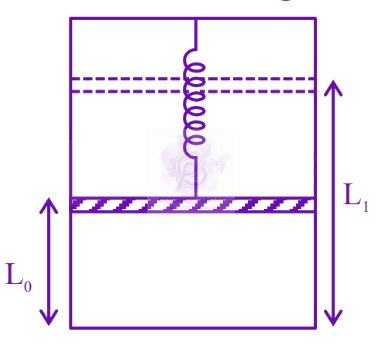
A quantity Q is formulated as $\mathrm{X}^{-2} \mathrm{Y}^{+\frac{3}{2}} \mathrm{Z}^{-\frac{2}{5}} \cdot \mathrm{X}, \mathrm{Y}$ and Z are independent parameters which have fractional errors of $0.1,0.2$ and 0.5 , respectively in measurement. The maximum fractional error of Q is
A river is flowing from west to east direction with speed of $9 \mathrm{~km} \mathrm{~h}^{-1}$. If a boat capable of moving at a maximum speed of $27 \mathrm{~km} \mathrm{~h}^{-1}$ in still water, crosses the river in half a minute, while moving with maximum speed at an angle of $150^{\circ}$ to direction of river flow, then the width of the river is :
A rod of length 5 L is bent right angle keeping one side length as 2 L. 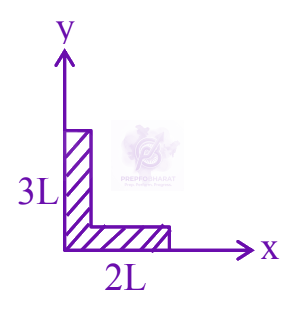 The position of the centre of mass of the system: (Consider $\mathrm{L}=10 \mathrm{~cm}$)
A rod of linear mass density ' $\lambda$ ' and length ' $L$ ' is bent to form a ring of radius 'R'. Moment of inertia of ring about any of its diameter is :
A sample of a liquid is kept at 1 atm. It is compressed to 5 atm which leads to change of volume of $0.8 \mathrm{~cm}^3$. If the bulk modulus of the liquid is 2 GPa , the initial volume of the liquid was _______ litre. $\left(\right.$ Take $\left.1 \mathrm{~atm}=10^5 \mathrm{~Pa}\right)$
A sand dropper drops sand of mass $m(t)$ on a conveyer belt at a rate proportional to the square root of speed $(v)$ of the belt, i.e. $\frac{\mathrm{dm}}{\mathrm{dt}} \propto \sqrt{v}$. If P is the power delivered to run the belt at constant speed then which of the following relationship is true?
A satellite is launched into a circular orbit of radius ' R ' around the earth. A second satellite is launched into an orbit of radius 1.03 R . The time period of revolution of the second satellite is larger than the first one approximately by
A satellite of mass 1000 kg is launched to revolve around the earth in an orbit at a height of 270 km from the earth's surface. Kinetic energy of the satellite in this orbit is ______ $\times 10^{10} \mathrm{~J}$. (Mass of earth $=6 \times 10^{24} \mathrm{~kg}$, Radius of earth $=$ $6.4 \times 10^6 \mathrm{~m}$, Gravitational constant $=$ $\left.6.67 \times 10^{-11} \mathrm{Nm}^2 \mathrm{~kg}^{-2}\right)$
A satellite of mass $\frac{M}{2}$ is revolving around earth in a circular orbit at a height of $\frac{R}{3}$ from earth surface. The angular momentum of the satellite is $M \sqrt{\frac{G M R}{x}}$. The value of $x$ is ______ , where $M$ and $R$ are the mass and radius of earth, respectively. ( G is the gravitational constant)
A small point of mass $m$ is placed at a distance $2 R$ from the centre ' $O^{\prime}$ of a big uniform solid sphere of mass M and radius R . The gravitational force on ' m ' due to M is $\mathrm{F}_1$. A spherical part of radius $\mathrm{R} / 3$ is removed from the big sphere as shown in the figure and the gravitational force on m due to remaining part of M is found to be $\mathrm{F}_2$. The value of ratio $\mathrm{F}_1: \mathrm{F}_2$ is 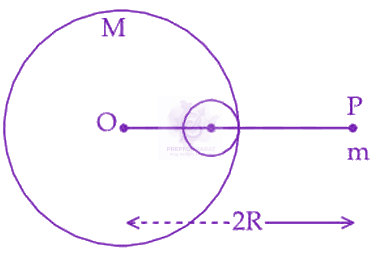
A small rigid spherical ball of mass M is dropped in a long vertical tube containing glycerine. The velocity of the ball becomes constant after some time. If the density of glycerine is half of the density of the ball, then the viscous force acting on the ball will be (consider g as acceleration due to gravity)
A solid sphere and a hollow sphere of the same mass and of same radius are rolled on an inclined plane. Let the time taken to reach the bottom by the solid sphere and the hollow sphere be $t_1$ and $t_2$, respectively, then
A solid sphere is rolling without slipping on a horizontal plane. The ratio of the linear kinetic energy of the centre of mass of the sphere and rotational kinetic energy is :
A solid sphere of mass ' $m$ ' and radius ' $r$ ' is allowed to roll without slipping from the highest point of an inclined plane of length ' $L$ ' and makes an angle $30^{\circ}$ with the horizontal. The speed of the particle at the bottom of the plane is $v_1$. If the angle of inclination is increased to $45^{\circ}$ while keeping $L$ constant. Then the new speed of the sphere at the bottom of the plane is $v_2$. The ratio $v_1^2: v_2^2$ is
A solid sphere with uniform density and radius R is rotating initially with constant angular velocity $\left(\omega_1\right)$ about its diameter. After some time during the rotation its starts loosing mass at a uniform rate, with no change in its shape. The angular velocity of the sphere when its radius become $R / 2$ is $x \omega_1$. The value of $x$ is ________
A solid steel ball of diameter 3.6 mm acquired terminal velocity $2.45 \times 10^{-2} \mathrm{~m} / \mathrm{s}$ while falling under gravity through an oil of density $925 \mathrm{~kg} \mathrm{~m}^{-3}$. Take density of steel as $7825 \mathrm{~kg} \mathrm{~m}^{-3}$ and g as 9.8 $\mathrm{m} / \mathrm{s}^2$. The viscosity of the oil in SI unit is
A sportsman runs around a circular track of radius $r$ such that he traverses the path $A B A B$. The distance travelled and displacement, respectively, are 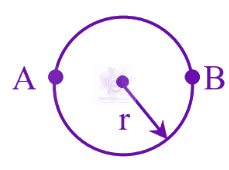
A square Lamina OABC of length 10 cm is pivoted at 'O'. Forces act at Lamina as shown in figure. If Lamina remains stationary, then the magnitude of F is : 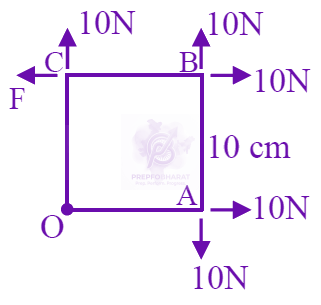
A steel wire of length 2 m and Young's modulus $2.0 \times 10^{11} \mathrm{Nm}^{-2}$ is stretched by a force. If Poisson ratio and transverse strain for the wire are 0.2 and $10^{-3}$ respectively, then the elastic potential energy density of the wire is _______ $\times 10^5$ (in SI units)
A thin solid disk of 1 kg is rotating along its diameter axis at the speed of 1800 rpm. By applying an external torque of $25 \pi \mathrm{Nm}$ for 40 s, the speed increases to 2100 rpm. The diameter of the disk is ________ m.
A thin transparent film with refractive index 1.4 , is held on circular ring of radius 1.8 cm . The fluid in the film evaporates such that transmission through the film at wavelength 560 nm goes to a minimum every 12 seconds. Assuming that the film is flat on its two sides, the rate of evaporation is ____ $\pi \times 10^{-13} \mathrm{~m}^3 / \mathrm{s}$.
A tiny metallic rectangular sheet has length and breadth of 5 mm and 2.5 mm , respectively. Using a specially designed screw gauge which has pitch of 0.75 mm and 15 divisions in the circular scale, you are asked to find the area of the sheet. In this measurement, the maximum fractional error will be $\frac{x}{100}$ where $x$ is _________.
A tube of length 1 m is filled completely with an ideal liquid of mass 2 M , and closed at both ends. The tube is rotated uniformly in horizontal plane about one of its ends. If the force exerted by the liquid at the other end is F then angular velocity of the tube is $\sqrt{\frac{\mathrm{F}}{\alpha \mathrm{M}}}$ in SI unit. The value of $\alpha$ is __________.
A uniform circular disc of radius ' R ' and mass ' M ' is rotating about an axis perpendicular to its plane and passing through its centre. A small circular part of radius $\mathrm{R} / 2$ is removed from the original disc as shown in the figure. Find the moment of inertia of the remaining part of the original disc about the axis as given above. 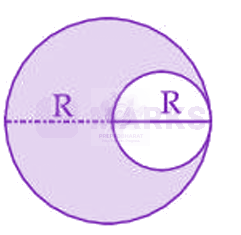
A uniform rod of mass 250 g having length 100 cm is balanced on a sharp edge at 40 cm mark. A mass of 400 g is suspended at 10 cm mark. To maintain the balance of the rod, the mass to be suspended at 90 cm mark, is
A uniform solid cylinder of mass ' $m$ ' and radius ' $r$ ' rolls along an inclined rough plane of inclination $45^{\circ}$. If it starts to roll from rest from the top of the plane then the linear acceleration of the cylinder's axis will be
A vessel with square cross-section and height of 6 m is vertically partitioned. A small window of $100 \mathrm{~cm}^2$ with hinged door is fitted at a depth of 3 m in the partition wall. One part of the vessel is filled completely with water and the other side is filled with the liquid having density $1.5 \times 10^3 \mathrm{~kg} / \mathrm{m}^3$. What force one needs to apply on the hinged door so that it does not get opened ? (Acceleration due to gravity $=10 \mathrm{~m} / \mathrm{s}^2$)
A wheel is rolling on a plane surface. The speed of a particle on the highest point of the rim is $8 \mathrm{~m} / \mathrm{s}$. The speed of the particle on the rim of the wheel at the same level as the centre of wheel, will be :
Acceleration due to gravity on the surface of earth is ' $g$ '. If the diameter of earth is reduced to one third of its original value and mass remains unchanged, then the acceleration due to gravity on the surface of the earth is $\ldots\ldots$ g.
An air bubble of radius 0.1 cm lies at a depth of 20 cm below the free surface of a liquid of density $1000 \mathrm{~kg} / \mathrm{m}^3$. If the pressure inside the bubble is $2100 \mathrm{~N} / \mathrm{m}^2$ greater than the atmospheric pressure, then the surface tension of the liquid in SI unit is (use $\mathrm{g}=10 \mathrm{~m} / \mathrm{s}^2$ )
An air bubble of radius 1.0 mm is observed at a depth of 20 cm below the free surface of a liquid having surface tension $0.095 \mathrm{~J} / \mathrm{m}^2$ and density $10^3 \mathrm{~kg} / \mathrm{m}^3$. The difference between pressure inside the bubble and atmospheric pressure is _____ $\mathrm{N} / \mathrm{m}^2$. (Take $\mathrm{g}=10 \mathrm{~m} / \mathrm{s}^2$ )
An object is kept at rest at a distance of 3 R above the earth's surface where R is earth's radius. The minimum speed with which it must be projected so that it does not return to earth is : (Assume $\mathrm{M}=$ mass of earth, $\mathrm{G}=$ Universal gravitational constant)
An object of mass 1000 g experiences a time dependent force $\vec{F}=\left(2 t \hat{i}+3 t^2 \hat{j}\right) N$. The power generated by the force at time $t$ is :
An object of mass ' m ' is projected from origin in a vertical $x y$ plane at an angle $45^{\circ}$ with the x axis with an initial velocity $\mathrm{v}_0$. The magnitude and direction of the angular momentum of the object with respect to origin, when it reaches at the maximum height, will be [ g is acceleration due to gravity]
An object with mass 500 g moves along x -axis with speed $v=4 \sqrt{x} \mathrm{~m} / \mathrm{s}$. The force acting on the object is :
$\mathrm{A}, \mathrm{B}$ and C are disc, solid sphere and spherical shell respectively with same radii and masses. These masses are placed as shown in figure. 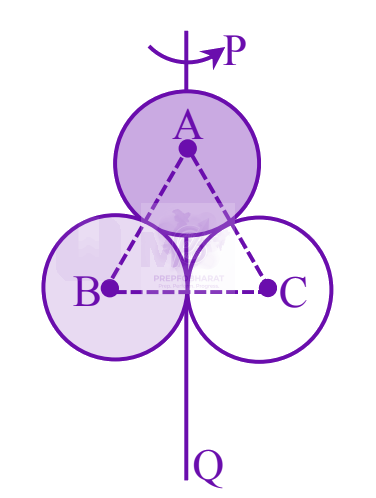 The moment of inertia of the given system about $P Q$ is $\frac{X}{15} I$, where $I$ is the moment of inertia of the disc about its diameter. The value of x is _______.
As shown below, bob \(A\) of a pendulum having massless string of length ' \(R\) ' is released from \(60^{\circ}\) to the vertical. It hits another bob \(B\) of half the mass that is at rest on a friction less table in the center. Assuming elastic collision, the magnitude of the velocity of bob A after the collision will be (take g as acceleration due to gravity.) 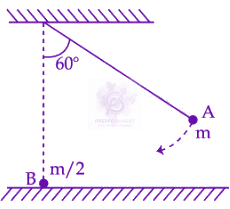
Consider a circular disc of radius 20 cm with centre located at the origin. A circular hole of radius 5 cm is cut from this disc in such a way that the edge of the hole touches the edge of the disc. The distance of centre of mass of residual or remaining disc from the origin will be
Consider a completely full cylindrical water tank of height 1.6 m and cross-sectional area $0.5 \mathrm{~m}^2$. It has a small hole in its side at a height 90 cm from the bottom. Assume, the cross-sectional area of the hole to be negligibly small as compared to that of the water tank. If a load 50 kg is applied at the top surface of the water in the tank then the velocity of the water coming out at the instant when the hole is opened is : $\left(\mathrm{g}=10 \mathrm{~m} / \mathrm{s}^2\right)$
Consider following statements: A. Surface tension arises due to extra energy of the molecules at the interior as compared to the molecules at the surface, of a liquid. B. As the temperature of liquid rises, the coefficient of viscosity increases. C. As the temperature of gas increases, the coefficient of viscosity increases D. The onset of turbulence is determined by Reynold's number. E. In a steady flow two stream lines never intersect. Choose the correct answer from the options given below:
Earth has mass 8 times and radius 2 times that of a planet. If the escape velocity from the earth is $11.2 \mathrm{~km} / \mathrm{s}$, the escape velocity in $\mathrm{km} / \mathrm{s}$ from the planet will be :
For an experimental expression $y=\frac{32.3 \times 1125}{27.4}$, where all the digits are significant. Then to report the value of $y$ we should write
For an experimental expression $y=\frac{32.3 \times 1125}{27.4}$, where all the digits are significant. Then to report the value of $y$ we should write
For the determination of refractive index of glass slab, a travelling microscope is used whose main scale contains 300 equal divisions equals to 15 cm. The vernier scale attached to the microscope has 25 divisions equals to 24 divisions of main scale. The least count (LC) of the travelling microscope is (in cm) :
Given a charge $q$, current I and permeability of vacuum $\mu_0$. Which of the following quantity has the dimension of momentum?
Given below are two statements: one is labelled as Assertion $\mathbf{A}$ and the other is labelled as Reason $\mathbf{R}$ Assertion A: In a central force field, the work done is independent of the path chosen. Reason R: Every force encountered in mechanics does not have an associated potential energy. In the light of the above statements, choose the most appropriate answer from the options given below
Given below are two statements: one is labelled as Assertion (A) and the other is labelled as Reason (R). Assertion (A) : The radius vector from the Sun to a planet sweeps out equal areas in equal intervals of time and thus areal velocity of planet is constant. Reason (R) : For a central force field the angular momentum is a constant. In the light of the above statements, choose the most appropriate answer from the options given below :
Given below are two statements. One is labelled as Assertion (A) and the other is labelled as Reason (R). Assertion (A) : 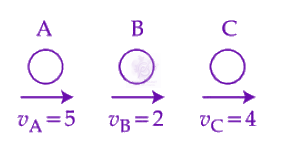 Three identical spheres of same mass undergo one dimensional motion as shown in figure with initial velocities $v_{\mathrm{A}}=5 \mathrm{~m} / \mathrm{s}, v_{\mathrm{B}}=2 \mathrm{~m} / \mathrm{s}, v_{\mathrm{C}}=4 \mathrm{~m} / \mathrm{s}$. If we wait sufficiently long for elastic collision to happen, then $v_{\mathrm{A}}=4 \mathrm{~m} / \mathrm{s}, v_{\mathrm{B}}=2 \mathrm{~m} / \mathrm{s}$, $v_{\mathrm{C}}=5 \mathrm{~m} / \mathrm{s}$ will be the final velocities. Reason (R): In an elastic collision between identical masses, two objects exchange their velocities. In the light of the above statements, choose the correct answer from the options given below :
Given below are two statements: one is labelled as Assertion $\mathrm{A}$ and the other is labelled as Reason $\mathrm{R}$ Assertion A : The kinetic energy needed to project a body of mass m from earth surface to infinity is $\frac{1}{2} \mathrm{mgR}$, where R is the radius of earth. Reason $\mathrm{R}$ : The maximum potential energy of a body is zero when it is projected to infinity from earth surface. In the light of the above statements, choose the correct answer from the option given below
Given below are two statements : Statement I : In a vernier callipers, one vernier scale division is always smaller than one main scale division. Statement II : The vernier constant is given by one main scale division multiplied by the number of vernier scale divisions. In the light of the above statements, choose the correct answer from the options given below.
Given below are two statements : Statement (I) : The dimensions of Planck's constant and angular momentum are same. Statement (II) : In Bohr's model electron revolve around the nucleus only in those orbits for which angular momentum is integral multiple of Planck's constant. In the light of the above statements, choose the most appropriate answer from the options given below :
Given below are two statements: Statement I: The hot water flows faster than cold water Statement II: Soap water has higher surface tension as compared to fresh water. In the light above statements, choose the correct answer from the options given below
If a satellite orbiting the Earth is 9 times closer to the Earth than the Moon, what is the time period of rotation of the satellite? Given rotational time period of Moon $=27$ days and gravitational attraction between the satellite and the moon is neglected.
If $\mu_0$ and $\varepsilon_0$ are the permeability and permittivity of free space, respectively, then the dimension of $\left(\frac{1}{\mu_0 \varepsilon_0}\right)$ is :
If $\overrightarrow{\mathrm{L}}$ and $\overrightarrow{\mathrm{P}}$ represent the angular momentum and linear momentum respectively of a particle of mass ' m ' having position vector $\overrightarrow{\mathrm{r}}=\mathrm{a}(\hat{\mathrm{i}} \cos \omega \mathrm{t}+\hat{\mathrm{j}} \sin \omega \mathrm{t})$. The direction of force is
If $\epsilon_0$ denotes the permittivity of free space and $\Phi_{\mathrm{E}}$ is the flux of the electric field through the area bounded by the closed surface, then dimension of $\left(\epsilon_0 \frac{\mathrm{~d} \phi_{\mathrm{E}}}{\mathrm{dt}}\right)$ are that of :
If $B$ is magnetic field and $\mu_0$ is permeability of free space, then the dimensions of $\left(B / \mu_0\right)$ is
In a hydraulic lift, the surface area of the input piston is \(6 \mathrm{~cm}^2\) and that of the output piston is \(1500 \mathrm{~cm}^2\). If 100 N force is applied to the input piston to raise the output piston by 20 cm, then the work done is _______ kJ.
In a measurement, it is asked to find modulus of elasticity per unit torque applied on the system. The measured quantity has dimension of $\left[M^a L^b T^c\right]$. If $b=-3$, the value of $c$ is ________
In an electromagnetic system, a quantity defined as the ratio of electric dipole moment and magnetic dipole moment has dimension of $\left[M^P L^{\circ} \mathrm{T}^{\mathrm{R}} \mathrm{A}^{\mathrm{S}}\right]$. The value of P and Q are :
In an electromagnetic system, the quantity representing the ratio of electric flux and magnetic flux has dimension of $\mathrm{M}^{\mathrm{P}} \mathrm{L}^{\mathrm{Q}} \mathrm{T}^{\mathrm{R}} \mathrm{A}^{\mathrm{S}}$, where value of ' Q ' and ' R ' are
In the experiment for measurement of viscosity ' $\eta$ ' of given liquid with a ball having radius $R$, consider following statements. A. Graph between terminal velocity V and R will be a parabola. B. The terminal velocities of different diameter balls are constant for a given liquid. C. Measurement of terminal velocity is dependent on the temperature. D. This experiment can be utilized to assess the density of a given liquid. E. If balls are dropped with some initial speed, the value of $\eta$ will change. Choose the correct answer from the options given below:
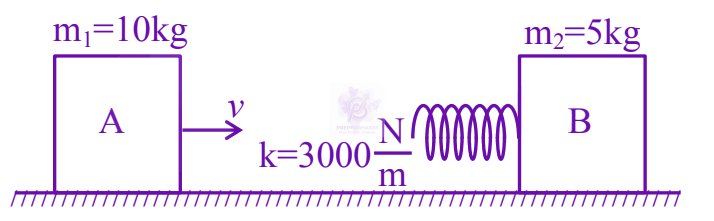 Consider two blocks A and B of masses $m_1=10 \mathrm{~kg}$ and $m_2=5 \mathrm{~kg}$ that are placed on a frictionless table. The block A moves with a constant speed $v=3 \mathrm{~m} / \mathrm{s}$ towards the block B kept at rest. A spring with spring constant $\mathrm{k}=3000 \mathrm{~N} / \mathrm{m}$ is attached with the block B as shown in the figure. After the collision, suppose that the blocks A and B, along with the spring in constant compression state, move together, then the compression in the spring is, (Neglect the mass of the spring)
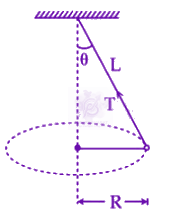 A string of length $L$ is fixed at one end and carries a mass of $M$ at the other end. The mass makes $\left(\frac{3}{\pi}\right)$ rotations per second about the vertical axis passing through end of the string as shown. The tension in the string is $\ldots\ldots$ ML.
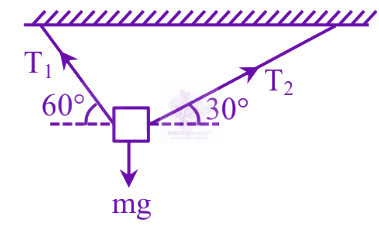 A body of mass 1 kg is suspended with the help of two strings making angles as shown in figure. Magnitude of tensions $T_1$ and $T_2$, respectively, are (in N) :
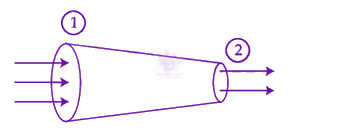 A tube of length $L$ is shown in the figure. The radius of cross section at the point (1) is 2 cm and at the point (2) is 1 cm , respectively. If the velocity of water entering at point (1) is $2 \mathrm{~m} / \mathrm{s}$, then velocity of water leaving the point (2) will be
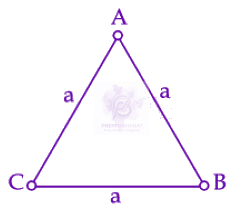 Three equal masses $m$ are kept at vertices (A, B, C) of an equilateral triangle of side a in free space. At $t=0$, they are given an initial velocity $\vec{V}_A=V_0 \overrightarrow{A C}, \vec{V}_B=V_0 \overrightarrow{B A}$ and $\vec{V}_C=V_0 \overrightarrow{C B}$. Here, $\overrightarrow{A C}, \overrightarrow{C B}$ and $\overrightarrow{B A}$ are unit vectors along the edges of the triangle. If the three masses interact gravitationally, then the magnitude of the net angular momentum of the system at the point of collision is :
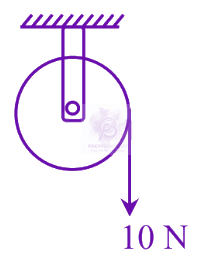 A wheel of radius 0.2 m rotates freely about its center when a string that is wrapped over its rim is pulled by force of 10 N as shown in figure. The established torque produces an angular acceleration of $2 \mathrm{~rad} / \mathrm{s}^2$. Moment of inertia of the wheel is _____ $\mathrm{kg} \mathrm{m}^2$. (Acceleration due to gravity $=10 \mathrm{~m} / \mathrm{s}^2$)
The range of a projectile launched with initial velocity u at angle θ with horizontal is given by:
M and R be the mass and radius of a disc. A small disc of radius $R / 3$ is removed from the bigger disc as shown in figure. The moment of inertia of remaining part of bigger disc about an axis AB passing through the centre O and perpendicular to the plane of disc is $\frac{4}{x} M R^2$. The value of $x$ is ________. 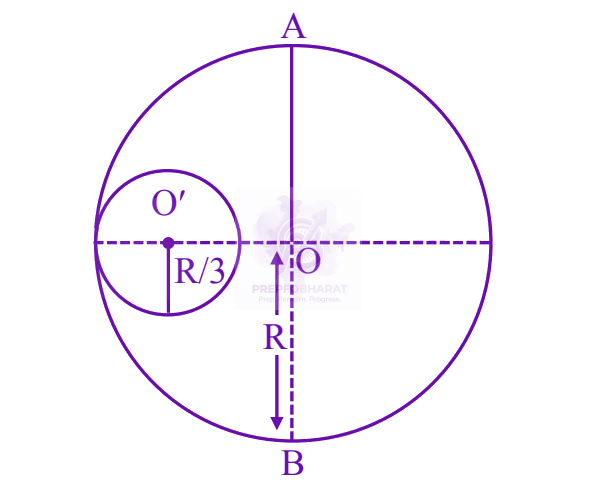
Match List - I with List - II. 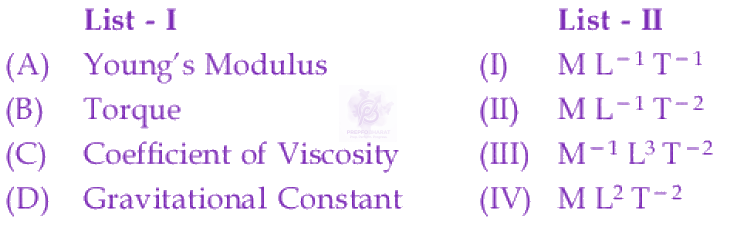 Choose the correct answer from the options given below :
Match List - I with List - II. $$ \begin{array}{llll} & \text { List - I } & & \text { List - II } \\ \text { (A) } & \text { Permeability of free space } & \text { (I) }\left[\mathrm{M} \mathrm{~L}^2 \mathrm{~T}^{-2}\right] \\ \text { (B) } & \text { Magnetic field } & \text { (II) }\left[\mathrm{M} \mathrm{~T}^{-2} \mathrm{~A}^{-1}\right] \\ \text { (C) } & \text { Magnetic moment } & \text { (III) }\left[\mathrm{M} \mathrm{~L} \mathrm{~T}^{-2} \mathrm{~A}^{-2}\right] \\ \text { (D) } & \text { Torsional constant } & \text { (IV) }\left[\mathrm{L}^2 \mathrm{~A}\right] \end{array} $$ Choose the correct answer from the options given below :
Match List - I with List - II. 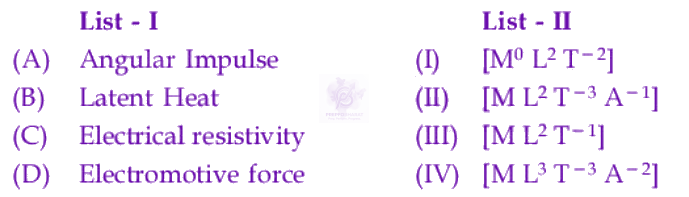
Match List - I with List - II. 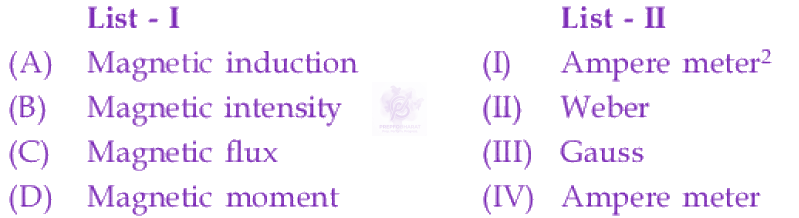 Choose the correct answer from the options given below :
Match List-I with List-II. $\begin{array}{|l|l|l|l|} \hline & \text{List-I} & & \text{List-II} \\ \hline \text{(A)} & \text{Mass density} & \text{(I)} & {\left[\mathrm{ML}^2 \mathrm{~T}^{-3}\right]} \\ \hline \text{(B)} & \text{Impulse} & \text{(II)} & {\left[\mathrm{MLT}^{-1}\right]} \\ \hline \text{(C)} & \text{Power} & \text{(III)} & {\left[\mathrm{ML}^2 \mathrm{~T}^0\right]} \\ \hline \text{(D)} & \text{Moment of inertia} & \text{(IV)} & {\left[\mathrm{ML}^{-3} \mathrm{~T}^0\right]} \\ \hline\end{array}$ Choose the correct answer from the options given below :
Match List-I with List-II. $\begin{array}{ll} \text{List-I} & \text{List-II} \\ \text{(A) Coefficient of viscosity} & \text{(I) } \left[\mathrm{ML}^0 \mathrm{~T}^{-3}\right] \\ \text{(B) Intensity of wave} & \text{(II) } \left[\mathrm{ML}^{-2} \mathrm{~T}^{-2}\right] \\ \text{(C) Pressure gradient} & \text{(III) } \left[\mathrm{M}^{-1} \mathrm{LT}^2\right] \\ \text{(D) Compressibility} & \text{(IV) } \left[\mathrm{ML}^{-1} \mathrm{~T}^{-1}\right]\end{array}$ Choose the correct answer from the options given below :
Match List-I with List-II. $\begin{array}{ll} \text{List-I} & \text{List-II} \\ \text{(A) Heat capacity of body} & \text{(I) } \mathrm{J} \mathrm{kg}^{-1} \\ \text{(B) Specific heat capacity of body} & \text{(II) } \mathrm{JK}^{-1} \\ \text{(C) Latent heat} & \text{(III) } \mathrm{J} \mathrm{kg}^{-1} \mathrm{~K}^{-1} \\ \text{(D) Thermal conductivity} & \text{(IV) } \mathrm{Jm}^{-1} \mathrm{~K}^{-1} \mathrm{~s}^{-1} \end{array}$ Choose the correct answer from the options given below :
Match the LIST-I with LIST-II $\begin{array}{|l|l|l|l|}\hline & \text{LIST-I} & & \text{LIST-II} \\ \hline \text{A.} & \text{Gravitational constant} & \text{I.} & {\left[\mathrm{LT}^{-2}\right]} \\ \hline \text{B.} & \begin{array}{l} \text{Gravitational potential} \\ \text{energy} \end{array} & \text{II.} & {\left[\mathrm{L}^2 \mathrm{~T}^{-2}\right]} \\ \hline \text{C.} & \text{Gravitational potential} & \text{III.} & {\left[\mathrm{ML}^2 \mathrm{~T}^{-2}\right]} \\ \hline \text{D.} & \begin{array}{l} \text{Acceleration due to} \\ \text{gravity} \end{array} & \text{IV.} & {\left[\mathrm{M}^{-1} \mathrm{~L}^3 \mathrm{~T}^{-2}\right]} \\ \hline \end{array}$ Choose the correct answer from the options given below :
Match the LIST-I withLIST-II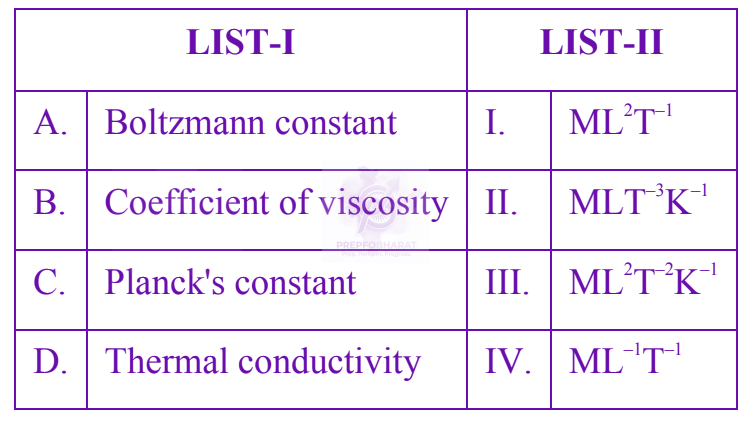 Choose the correct answer from the options given below :
Moment of inertia of a rod of mass ' M ' and length 'L' about an axis passing through its center and normal to its length is ' $\alpha$ '. Now the rod is cut into two equal parts and these parts are joined symmetrically to form a cross shape. Moment of inertia of cross about an axis passing through its center and normal to plane containing cross is :
The amount of work done to break a big water drop of radius ' $R$ ' into 27 small drops of equal radius is 10 J . The work done required to break the same big drop into 64 small drops of equal radius will be
The angle of projection of a particle is measured from the vertical axis as $\phi$ and the maximum height reached by the particle is $h_m$. Here $h_m$ as function of $\phi$ can be presented as
The center of mass of a thin rectangular plate (fig - x ) with sides of length $a$ and $b$, whose mass per unit area $(\sigma)$ varies as $\sigma=\frac{\sigma_0 x}{a b}$ (where $\sigma_0$ is a constant), would be $\qquad$ 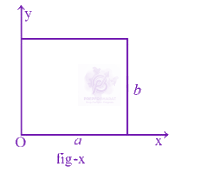
The coordinates of a particle with respect to origin in a given reference frame is \((1,1,1)\) meters. If a force of \(\overrightarrow{\mathrm{F}}=\hat{i}-\hat{j}+\hat{k}\) acts on the particle, then the magnitude of torque (with respect to origin) in z-direction is ______.
The dimension of $\sqrt{\frac{\mu_0}{\epsilon_0}}$ is equal to that of : ( $\mu_0=$ Vacuum permeability and $\epsilon_0=$ Vacuum permittivity)
The displacement x versus time graph is shown below. 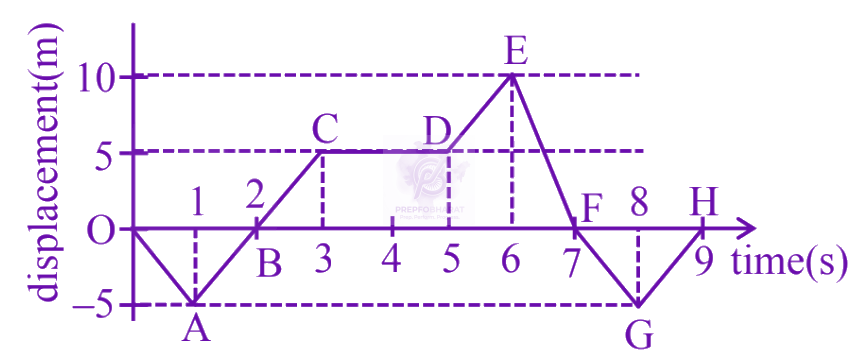 (A) The average velocity during 0 to 3 s is $10 \mathrm{~m} / \mathrm{s}$ (B) The average velocity during 3 to 5 s is $0 \mathrm{~m} / \mathrm{s}$ (C) The instantaneous velocity at $\mathrm{t}=2 \mathrm{~s}$ is $5 \mathrm{~m} / \mathrm{s}$ (D) The average velocity during 5 to 7 s and instantaneous velocity at $\mathrm{t}=6.5 \mathrm{~s}$ are equal (E) The average velocity from $t=0$ to $t=9 \mathrm{~s}$ is zero Choose the correct answer from the options given below:
The electric flux is $\phi=\alpha \sigma+\beta \lambda$ where $\lambda$ and $\sigma$ are linear and surface charge density, respectively. $\left(\frac{\alpha}{\beta}\right)$ represents
The energy of a system is given as $\mathrm{E}(\mathrm{t})=\alpha^3 \mathrm{e}^{-\beta t}$, where t is the time and $\beta=0.3 \mathrm{~s}^{-1}$. The errors in the measurement of $\alpha$ and $t$ are $1.2 \%$ and $1.6 \%$, respectively. At $t=5 \mathrm{~s}$, maximum percentage error in the energy is :
The energy of a system is given as $\mathrm{E}(\mathrm{t})=\alpha^3 \mathrm{e}^{-\beta t}$, where t is the time and $\beta=0.3 \mathrm{~s}^{-1}$. The errors in the measurement of $\alpha$ and $t$ are $1.2 \%$ and $1.6 \%$, respectively. At $t=5 \mathrm{~s}$, maximum percentage error in the energy is :
The equation for real gas is given by $\left(\mathrm{P}+\frac{\mathrm{a}}{\mathrm{V}^2}\right)(\mathrm{V}-\mathrm{b})=\mathrm{RT}$, where $\mathrm{P}, \mathrm{V}, \mathrm{T}$ and R are the pressure, volume, temperature and gas constant, respectively. The dimension of $\mathrm{ab}^{-2}$ is equivalent to that of :
The excess pressure inside a soap bubble A in air is half the excess pressure inside another soap bubble B in air. If the volume of the bubble A is $n$ times the volume of the bubble $B$, then, the value of $n$ is ___.
The expression given below shows the variation of velocity \((v)\) with time (t), \(v=\mathrm{At}^2+\frac{\mathrm{Bt}}{\mathrm{C}+\mathrm{t}}\). The dimension of ABC is :
The fractional compression \(\left(\frac{\Delta \mathrm{V}}{\mathrm{V}}\right)\) of water at the depth of 2.5 km below the sea level is ______ \(\%\). Given, the Bulk modulus of water \(=2 \times 10^9 \mathrm{~N} \mathrm{~m}^{-2}\), density of water \(=10^3\) \(\mathrm{kg} \mathrm{m}^{-3}\), acceleration due to gravity \(=\mathrm{g}=10 \mathrm{~m} \mathrm{~s}^{-2}\).
The increase in pressure required to decrease the volume of a water sample by $0.2 \%$ is $\mathrm{P} \times 10^5 \mathrm{Nm}^{-2}$. Bulk modulus of water is $2.15 \times 10^9 \mathrm{Nm}^{-2}$. The value of P is $\ldots\ldots$
The least count of a screw guage is 0.01 mm . If the pitch is increased by $75 \%$ and number of divisions on the circular scale is reduced by $50 \%$, the new least count will be _____ $\times 10^{-3} \mathrm{~mm}$
The length of a light string is 1.4 m when the tension on it is 5 N. If the tension increases to 7 N , the length of the string is 1.56 m. The original length of the string is _____ m.
The maximum percentage error in the measurment of density of a wire is [Given, mass of wire $=(0.60 \pm 0.003) \mathrm{g}$ radius of wire $=(0.50 \pm 0.01) \mathrm{cm}$ length of wire $=(10.00 \pm 0.05) \mathrm{cm}]$
The maximum percentage error in the measurment of density of a wire is [Given, mass of wire $=(0.60 \pm 0.003) \mathrm{g}$ radius of wire $=(0.50 \pm 0.01) \mathrm{cm}$ length of wire $=(10.00 \pm 0.05) \mathrm{cm}]$
The maximum speed of a boat in still water is \(27 \mathrm{~km} / \mathrm{h}\). Now this boat is moving downstream in a river flowing at \(9 \mathrm{~km} / \mathrm{h}\). A man in the boat throws a ball vertically upwards with speed of \(10 \mathrm{~m} / \mathrm{s}\). Range of the ball as observed by an observer at rest on the river bank, is _______ cm. (Take \(\mathrm{g}=10 \mathrm{~m} / \mathrm{s}^2\))
The moment of inertia of a circular ring of mass $M$ and diameter r about a tangential axis lying in the plane of the ring is :
The moment of inertia of a solid disc rotating along its diameter is 2.5 times higher than the moment of inertia of a ring rotating in similar way. The moment of inertia of a solid sphere which has same radius as the disc and rotating in similar way, is $n$ times higher than the moment of inertia of the given ring. Here, $\mathrm{n}=$_________ Consider all the bodies have equal masses.
The motion of an airplane is represented by velocity-time graph as shown below. The distance covered by airplane in the first 30.5 second is _______ km . 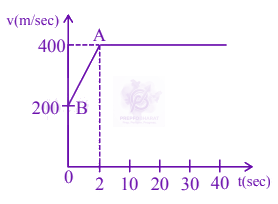
The pair of physical quantities not having same dimensions is :
The position of a particle moving on $x$-axis is given by $x(t)=A \sin t+B \cos ^2 t+C t^2+D$, where $t$ is time. The dimension of $\frac{A B C}{D}$ is
The position vector of a moving body at any instant of time is given as $\vec{r}=\left(5 t^2 \hat{i}-5 t \hat{j}\right) \mathrm{m}$. The magnitude and direction of velocity at $t=2 \mathrm{~s}$ is,
The position vectors of two 1 kg particles, (A) and (B), are given by $\overrightarrow{\mathrm{r}}_{\mathrm{A}}=\left(\alpha_1 \mathrm{t}^2 \hat{i}+\alpha_2 \mathrm{t} \hat{j}+\alpha_3 \mathrm{t} \hat{k}\right) \mathrm{m}$ and $\overrightarrow{\mathrm{r}}_{\mathrm{B}}=\left(\beta_1 \mathrm{t} \hat{i}+\beta_2 \mathrm{t}^2 \hat{j}+\beta_3 \mathrm{t} \hat{k}\right) \mathrm{m}$, respectively; $\left(\alpha_1=1 \mathrm{~m} / \mathrm{s}^2, \alpha_2=3 \mathrm{n} \mathrm{m} / \mathrm{s}, \alpha_3=2 \mathrm{~m} / \mathrm{s}, \beta_1=2 \mathrm{~m} / \mathrm{s}, \beta_2=-1 \mathrm{~m} / \mathrm{s}^2, \beta_3=4 \mathrm{pm} / \mathrm{s}\right)$, where t is time, n and p are constants. At $t=1 \mathrm{~s},\left|\overrightarrow{V_A}\right|=\left|\vec{V}_B\right|$ and velocities $\vec{V}_A$ and $\vec{V}_B$ of the particles are orthogonal to each other. At $t=1 \mathrm{~s}$, the magnitude of angular momentum of particle (A) with respect to the position of particle (B) is $\sqrt{\mathrm{L}} \mathrm{kgm}^2 \mathrm{~s}^{-1}$. The value of L is _______ .
The torque due to the force $(2 \hat{i}+\hat{j}+2 \hat{k})$ about the origin, acting on a particle whose position vector is $(\hat{i}+\hat{j}+\hat{k})$, would be
The velocity-time graph of an object moving along a straight line is shown in figure. What is the distance covered by the object between $t=0$ to $t=4 \mathrm{~s}$ ? 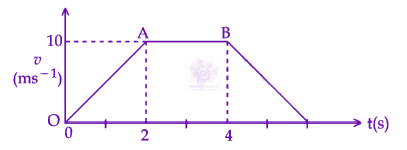
The volume contraction of a solid copper cube of edge length 10 cm , when subjected to a hydraulic pressure of $7 \times 10^6 \mathrm{~Pa}$, would be ____ $\mathrm{mm}^3$. (Given bulk modulus of copper $=1.4 \times 10^{11} \mathrm{~N} \mathrm{~m}^{-2}$ )
Three identical spheres of mass m , are placed at the vertices of an equilateral triangle of length a. When released, they interact only through gravitational force and collide after a time $\mathrm{T}=4$ seconds. If the sides of the triangle are increased to length 2 a and also the masses of the spheres are made 2 m , then they will collide after _____ seconds.
Two balls with same mass and initial velocity, are projected at different angles in such a way that maximum height reached by first ball is 8 times higher than that of the second ball. $T_1$ and $T_2$ are the total flying times of first and second ball, respectively, then the ratio of $T_1$ and $T_2$ is :
Two cars $P$ and $Q$ are moving on a road in the same direction. Acceleration of car $P$ increases linearly with time whereas car $Q$ moves with a constant acceleration. Both cars cross each other at time $t=0$, for the first time. The maximum possible number of crossing(s) (including the crossing at $t=0)$ is ________.
Two cylindrical vessels of equal cross sectional area of $2 \mathrm{~m}^2$ contain water up to height 10 m and 6 m , respectively. If the vessels are connected at their bottom then the work done by the force of gravity is : (Density of water is $10^3 \mathrm{~kg} / \mathrm{m}^3$ and $\mathrm{g}=10 \mathrm{~m} / \mathrm{s}^2$)
Two iron solid discs of negligible thickness have radii $R_1$ and $R_2$ and moment of intertia $I_1$ and $I_2$, respectively. For $R_2=2 R_1$, the ratio of $I_1$ and $I_2$ would be $1 / x$, where $\mathrm{x}=$ ________ -
Two liquids A and B have $\theta_{\mathrm{A}}$ and $\theta_{\mathrm{B}}$ as contact angles in a capillary tube. If $K=\cos \theta_A / \cos \theta_B$. then identify the correct statement:
Two particles are located at equal distance from origin. The position vectors of those are represented by $\bar{A}=2 \hat{i}+3 n \hat{j}+2 \hat{k}$ and $\bar{B}=2 \hat{i}-2 \hat{j}+4 p \hat{k}$, respectively. If both the vectors are at right angle to each other, the value of $\mathrm{n}^{-1}$ is _____ .
Two particles are located at equal distance from origin. The position vectors of those are represented by $\bar{A}=2 \hat{i}+3 n \hat{j}+2 \hat{k}$ and $\bar{B}=2 \hat{i}-2 \hat{j}+4 p \hat{k}$, respectively. If both the vectors are at right angle to each other, the value of $\mathrm{n}^{-1}$ is _____ .
Two planets, $A$ and $B$ are orbiting a common star in circular orbits of radii $R_A$ and $R_B$, respectively, with $R_B=2 R_A$. The planet $B$ is $4 \sqrt{2}$ times more massive than planet $A$. The ratio $\left(\frac{L_B}{L_A}\right)$ of angular momentum $\left(L_B\right)$ of planet $B$ to that of planet $A\left(L_A\right)$ is closest to integer ________.
Two projectiles are fired from ground with same initial speeds from same point at angles $\left(45^{\circ}+\alpha\right)$ and $\left(45^{\circ}-\alpha\right)$ with horizontal direction. The ratio of their times of flights is
Two projectiles are fired with same initial speed from same point on ground at angles of \(\left(45^{\circ}-\alpha\right)\) and \(\left(45^{\circ}+\alpha\right)\), respectively, with the horizontal direction. The ratio of their maximum heights attained is :
Two slabs with square cross section of different materials $(1,2)$ with equal sides $(l)$ and thickness $\mathrm{d}_1$ and $\mathrm{d}_2$ such that $\mathrm{d}_2=2 \mathrm{~d}_1$ and $l \gt \mathrm{d}_2$. Considering lower edges of these slabs are fixed to the floor, we apply equal shearing force on the narrow faces. The angle of deformation is $\theta_2=2 \theta_1$. If the shear moduli of material 1 is $4 \times 10^9 \mathrm{~N} / \mathrm{m}^2$, then shear moduli of material 2 is $\mathrm{x} \times 10^9 \mathrm{~N} / \mathrm{m}^2$, where value of $x$ is ________.
Two soap bubbles of radius 2 cm and 4 cm , respectively, are in contact with each other. The radius of curvature of the common surface, in cm , is ______ .
Two water drops each of radius 'r' coalesce to from a bigger drop. If ' T ' is the surface tension, the surface energy released in this process is :
Two wires A and B are made of same material having ratio of lengths $\frac{L_A}{L_B}=\frac{1}{3}$ and their diameters ratio $\frac{d_A}{d_B}=2$. If both the wires are stretched using same force, what would be the ratio of their respective elongations?
Water flows in a horizontal pipe whose one end is closed with a valve. The reading of the pressure gauge attached to the pipe is $P_1$. The reading of the pressure gauge falls to $P_2$ when the valve is opened. The speed of water flowing in the pipe is proportional to
Which of the following are correct expression for torque acting on a body? B. $\vec{\tau}=\frac{\mathrm{d}}{\mathrm{dt}}(\overrightarrow{\mathrm{r}} \times \overrightarrow{\mathrm{p}})$ C. $\vec{\tau}=\overrightarrow{\mathrm{r}} \times \frac{\mathrm{d} \mathrm{p}}{\mathrm{dt}}$ D. $\vec{\tau}=\mathrm{I} \vec{\alpha}$ E. $\vec{\tau}=\overrightarrow{\mathrm{r}} \times \overrightarrow{\mathrm{F}}$ ( $\overrightarrow{\mathrm{r}}=$ position vector; $\overrightarrow{\mathrm{p}}=$ linear momentum; $\overrightarrow{\mathrm{L}}=$ angular momentum; $\vec{\alpha}=$ angular acceleration; $I=$ moment of inertia; $\vec{F}=$ force; $t=$ time) Choose the correct answer from the options given below :
Which of the following curves possibly represent one-dimensional motion of a particle? 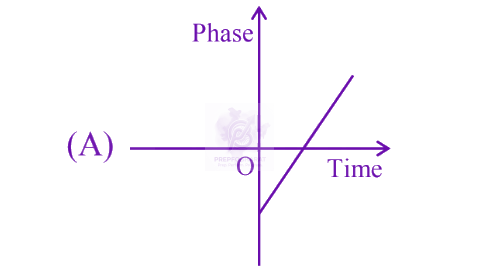 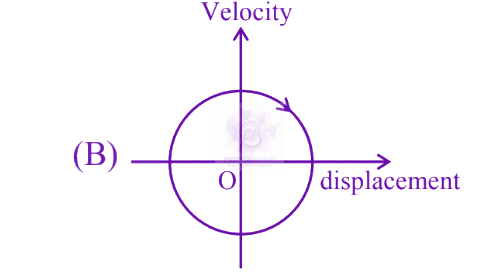 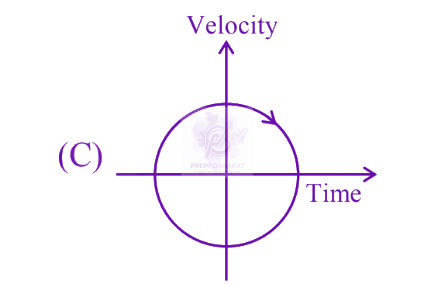 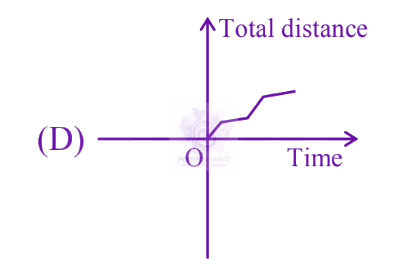 Choose the correct answer from the options given below :
Which one of the following forces cannot be expressed in terms of potential energy?
Which one of the following is the correct dimensional formula for the capacitance in F ? $\mathrm{M}, \mathrm{L}, \mathrm{T}$ and C stand for unit of mass, length, time and charge,