JEE Main 2023 — Mechanics
Physics Mechanics questions from JEE Main 2023.
Other Years
258 Mechanics Questions from 2023
A body of mass $1\mathrm{kg}$ begins to move under the action of a time dependent force $\vec{F}=(t\hat{i}+3{t}^{2}\hat{j})N$, where $\hat{i}$ and $\hat{j}$ are the unit vectors along $x$ and $y$ axis. The power developed by above force, at the time $t=2s$, will be _______$W$.
A car is moving with a constant speed of $20m{s}^{-1}$ in a circular horizontal track of radius $40m$. A bob is suspended from the roof of the car by a massless string. The angle made by the string with the vertical will be : (Take $g=10m{s}^{-2}$)
The weight of a body at the surface of earth is $18N$. The weight of the body at an altitude of $3200\mathrm{km}$ above the earth's surface is (given, radius of earth ${R}_{e}=6400\mathrm{km}$)
Match List I with List II <table class="pyq-table"><tbody><tr><td></td><td>List-I</td><td></td><td>List-II</td></tr><tr><td>A</td><td>Spring constant</td><td>I</td><td>$[{T}^{–1}]$</td></tr><tr><td>B</td><td>Angular speed</td><td>II</td><td>$[M{T}^{–2}]$</td></tr><tr><td>C</td><td>Angular momentum</td><td>III</td><td>$[M{L}^{2}]$</td></tr><tr><td>D</td><td>Moment of Inertia</td><td>IV</td><td>$[M{L}^{2}{T}^{–1}]$</td></tr></tbody></table>Choose the correct answer from the options given below:
Two projectiles $A$ and $B$ are thrown with initial velocities of $40m{s}^{-1}$ and $60m{s}^{-1}$ at angles $30^{\circ}$ and $60^{\circ}$ with the horizontal respectively. The ratio of their ranges respectively is $(g=10m{s}^{-2})$
A body is moving with constant speed, in a circle of radius $10m$. The body completes one revolution in $4s$. At the end of $3rd$ second, the displacement of body (in $m$) from its starting point is:
When two resistance ${R}_{1}$ and ${R}_{2}$ connected in series and introduced into the left gap of a meter bridge and a resistance of $10\Omega$ is introduced into the right gap, a null point is found at $60\mathrm{cm}$ from left side. When ${R}_{1}$ and ${R}_{2}$ are connected in parallel and introduced into the left gap, a resistance of $3\Omega$ is introduced into the right-gap to get null point at $40\mathrm{cm}$ from left end. The product of ${R}_{1}{R}_{2}$ is ______ ${\Omega }^{2}$
Given below are two statements : Statement-I: Acceleration due to gravity is different at different places on the surface of earth. Statement-II: Acceleration due to gravity increases as we go down below the earth's surface. In the light of the above statements, choose the correct answer from the options given below
$64$ identical drops each charged upto potential of $10\mathrm{mV}$ are combined to form a bigger drop. The potential of the bigger drop will be _____ $\mathrm{mV}$.
If $R,{X}_{L}\text{and}{X}_{C}$ represent resistance, inductive reactance and capacitive reactance. Then which of the following is dimensionless:
A particle of mass $10g$moves in a straight line with retardation $2x,$ where $x$ is the displacement in $\mathrm{SI}$ units. Its loss of kinetic energy for above displacement is ${(\frac{10}{x})}^{-n}J.$ The value of $n$ will be $________.$
The elastic potential energy stored in a steel wire of length $20m$ stretched through $2\mathrm{cm}$ is $80J.$ The cross sectional area of the wire is _____ ${\mathrm{mm}}^{2}.$ (Given, $Y=2.0\times {10}^{11}N{m}^{–2}$)
A block of $\sqrt{3}\mathrm{kg}$ is attached to a string whose other end is attached to the wall. An unknown force $F$ is applied so that the string makes an angle of $30^{\circ}$ with the wall. The tension $T$ is : (Given g $=10m{s}^{–2}$) 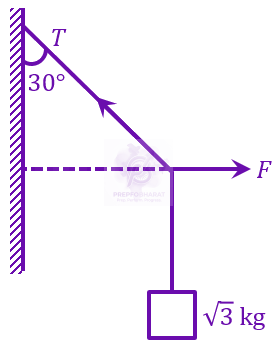
An object moves at a constant speed along a circular path in a horizontal plane with centre at the origin. When the object is at $x=+2m$, its velocity is $-4\hat{j}m{s}^{-1}$ . The object’s velocity $(v)$ and acceleration $(a)$ at $x=–2m$ will be
A mass $m$ is attached to two springs as shown in figure. The spring constants of two springs are ${K}_{1}$ and ${K}_{2}.$ For the frictionless surface, the time period of oscillation of mass $m$ is 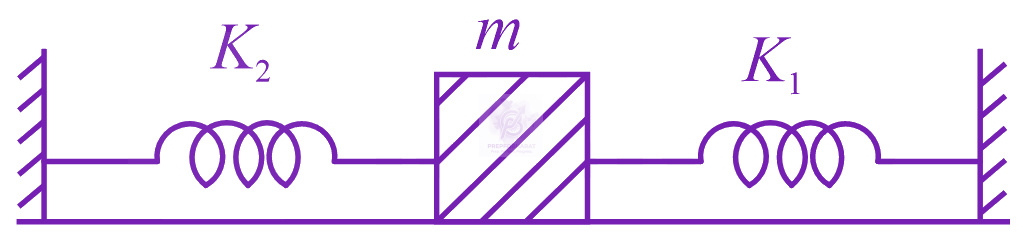
Given below are two statements: Statement I: If$E$be the total energy of a satellite moving around the earth, then its potential energy will be $\frac{E}{2}$. Statement II: The kinetic energy of a satellite revolving in an orbit is equal to the half the magnitude of total energy $E$. In the light of the above statements, choose the most appropriate answer from the options given below.
The weight of a body on the surface of the earth is $100N$. The gravitational force on it when taken at a height, from the surface of earth, equal to one-fourth the radius of the earth is:
The maximum vertical height to which a man can throw a ball is $136m$. The maximum horizontal distance upto which he can throw the same ball is
An aluminium rod with Young’s modulus $Y=7.0\times {10}^{10}N{m}^{-2}$ undergoes elastic strain of $0.04%$. The energy per unit volume stored in the rod in $\mathrm{SI}$ unit
A bullet of mass $0.1\mathrm{kg}$ moving horizontally with speed $400m{s}^{-1}$ hits a wooden block of mass $3.9\mathrm{kg}$ kept on a horizontal rough surface. The bullet gets embedded into the block and moves $20m$ before coming to rest. The coefficient of friction between the block and the surface is _______.
Given below are two statements: Statement I : Rotation of the earth shows effect on the value of acceleration due to gravity $(g)$. Statement II : The effect of rotation of the earth on the value of $g$ at the equator is minimum and that at the pole is maximum. In the light of the above statements, choose the correct answer from the options given below
The height of liquid column raised in a capillary tube of certain radius when dipped in liquid $A$ vertically is, $5\mathrm{cm}$. If the tube is dipped in a similar manner in another liquid $B$ of surface tension and density double the values of liquid $A$, the height of liquid column raised in liquid B would be ______ $m$.
A block of mass $10\mathrm{kg}$ is moving along $x$-axis under the action of force $F=5xN$. The work done by the force in moving the block from $x=2m$ to $4m$ will be _______ $J$.
The velocity-time graph of a body moving in a straight line is shown in figure. 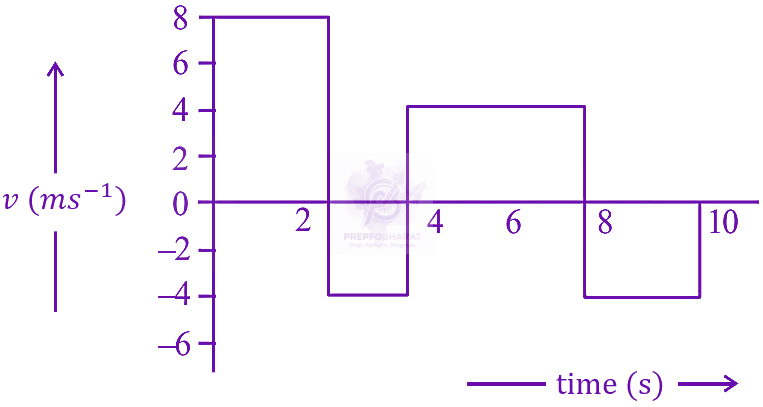 The ratio of displacement and distance travelled by the body in time $0$ to $10s$ is
Under isothermal condition, the pressure of a gas is given by $P=a{V}^{–3},$ where $a$ is a constant and $V$ is the volume of the gas. The bulk modulus at constant temperature is equal to
A particle moves in a straight line with retardation proportional to its displacement. Its loss of kinetic energy for any displacement x is proportional to:
A fully loaded boeing aircraft has a mass of $5.4\times {10}^{5}\mathrm{kg}$. Its total wing area is $500{m}^{2}$. It is in level flight with a speed of $1080\mathrm{km}{h}^{-1}$. If the density of air $\rho$ is $1.2\mathrm{kg}{m}^{–3}$, the fractional increase in the speed of the air on the upper surface of the wing relative to the lower surface in percentage will be ($g=10m{s}^{-2}$)
The moment of inertia of a semicircular ring about an axis, passing through the center and perpendicular to the plane of ring, is$\frac{1}{x}{\mathrm{MR}}^{2}$, where $R$ is the radius and $M$ is the mass of the semicircular ring. The value of $x$ will be $_______$.
A lift of mass $M=500\mathrm{kg}$ is descending with speed of $2m{s}^{-1}$. Its supporting cable begins to slip thus allowing it to fall with a constant acceleration of $2m{s}^{-2}$. The kinetic energy of the lift at the end of fall through to a distance of $6m$ will be ______ $\mathrm{kJ}$.
The Young's modulus of a steel wire of length $6m$ and cross-sectional area $3{\mathrm{mm}}^{2}$, is $2\times {11}^{11}N/{m}^{2}$ . The wire is suspended from its support on a given planet. A block of mass $4\mathrm{kg}$ is attached to the free end of the wire. The acceleration due to gravity on the planet is $\frac{1}{4}$ of its value on the earth. The elongation of wire is (Take $g$ on the earth $=10m/{s}^{2}$ ):
In an experiment with vernier callipers of least count $0.1\mathrm{mm}$, when two jaws are joined together the zero of vernier scale lies right to the zero of the main scale and ${6}^{\mathrm{th}}$ division of vernier scale coincides with the main scale division. While measuring the diameter of a spherical bob, the zero of vernier scale lies in between $3.2\mathrm{cm}$ and $3.3\mathrm{cm}$ marks and ${4}^{\mathrm{th}}$ division of vernier scale coincides with the main scale division. The diameter of bob is measured as
A car accelerates from rest of $um{s}^{-1}$. The energy spent in this process is $EJ$. The energy required to accelerate the car from $um{s}^{-1}$ to $2um{s}^{-1}$ is $nEJ$. The value of $n$ is _____.
A force is applied to a steel wire $A$, rigidly clamped at one end. As a result elongation in the wire is $0.2\mathrm{mm}$. If same force is applied to another steel wire $B$ of double the length and a diameter $2.4$ times that of the wire $A$, the elongation in the wire $B$ will be (wires having uniform circular cross sections)
Given below are two statements: Statement-I: An elevator can go up or down with uniform speed when its weight is balanced with the tension of its cable. Statement-II: Force exerted by the floor of an elevator on the foot of a person standing on it is more than his/her weight when the elevator goes down with increasing speed. In the light of the above statements, choose the correct answer from the options given below:
A physical quantity $P$ is given as $P=\frac{{a}^{2}{b}^{3}}{c\sqrt{d}}$. The percentage error in the measurement of $a,b,c$ and $d$ are $1%,2%,3%$ and $4%$ respectively. The percentage error in the measurement of quantity $P$ will be
A particle starts with an initial velocity of $10.0{\mathrm{ms}}^{-1}$ along $x$-direction and accelerates uniformly at the rate of $2.0m{s}^{-2}$. The time taken by the particle to reach the velocity of $60.0m{s}^{-1}$ is _____.
When vector $\vec{A}=2\hat{i}+3\hat{j}+2\hat{k}$ is subtracted from vector $\vec{B}$, it gives a vector equal to $2\hat{j}$. Then the magnitude of vector $\vec{B}$ will be:
A spherical ball of radius $1\mathrm{mm}$ and density $10.5g{\mathrm{cc}}^{-1}$ is dropped in glycerine of coefficient of viscosity $9.8$ poise and density $1.5g{\mathrm{cc}}^{-1}$. Viscous force on the ball when it attains constant velocity is $3696\times {10}^{-x}N$. The value of $x$ is (Given, $g=9.8m{s}^{-2}\text{and}\pi =\frac{22}{7}$)
A $0.4\mathrm{kg}$ mass takes $8s$ to reach ground when dropped from a certain height $P$ above surface of earth. The loss of potential energy in the last second of fall is ______ $J$. [Take $g=10m{s}^{-2}$]
In the equation $[X+\frac{a}{{Y}^{2}}][Y-b]=RT,X$ is pressure, $Y$ is volume, $R$ is universal gas constant and $T$ is temperature. The physical quantity equivalent to the ratio $\frac{a}{b}$ is:
The frequency $(\nu )$ of an oscillating liquid drop may depend upon radius $(r)$ of the drop, density $(\rho )$ of liquid and the surface tension $(s)$ of the liquid as: $\nu ={r}^{a}{\rho }^{b}{s}^{c}$. The values of $a,b$ and $c$ respectively are
A passenger sitting in a train A moving at $90\mathrm{km}{h}^{-1}$ observes another train B moving in the opposite direction for $8s$. If the velocity of the train B is $54\mathrm{km}{h}^{-1}$, then length of train B is:
A car travels a distance of $x$ with speed ${v}_{1}$ and then same distance $x$ with speed ${v}_{2}$ in the same direction. The average speed of the car is:
A small particle of mass $m$ moves in such a way that its potential energy $U=\frac{1}{2}m{\omega }^{2}{r}^{2}$ where $\omega$ is constant and $r$ is the distance of the particle from origin. Assuming Bohr’s quantization of momentum and circular orbit, the radius of ${n}^{\mathrm{th}}$ orbit will be proportional to
Two identical solid spheres each of mass $2\mathrm{kg}$ and radii $10\mathrm{cm}$are fixed at the ends of a light rod. The separation between the centres of the spheres is $40\mathrm{cm}.$ The moment of inertia of the system about an axis perpendicular to the rod passing through its middle point is$______\times {10}^{–3}\mathrm{kg}{m}^{2}.$
A projectile fired at $30^{\circ}$ to the ground is observed to be at same height at time $3s$ and $5s$ after projection, during its flight. The speed of projection of the projectile is $m{s}^{-1}$. (Given $g=10m{s}^{-2}$)
A particle is moving with constant speed in a circular path. When the particle turns by an angle $90^{\circ},$ the ratio of instantaneous velocity to its average velocity is $\pi :x\sqrt{2}.$ The value of $x$ will be
A body of mass $500g$ moves along $x$-axis such that it's velocity varies with displacement $x$ according to the relation $v=10\sqrt{x}m{s}^{-1}$ the force acting on the body is:
A block of mass $5\mathrm{kg}$ is placed at rest on a table of rough surface. Now, if a force of $30N$ is applied in the direction parallel to surface of the table, the block slides through a distance of $50m$ in an interval of time $10s$. Coefficient of kinetic friction is (given, $g=10m{s}^{–2}$ ):
Two trains $A$ and $B$ of length $l$ and $4l$ are travelling into a tunnel of length $L$ in parallel tracks from opposite directions with velocities $108\mathrm{km}{h}^{-1}$ and $72\mathrm{km}{h}^{-1},$ respectively. If train $A$ take $35s$ less time than train $B$ to cross the tunnel then, length $L$ of tunnel is: (Given $L=60l$)
In an experiment of measuring the refractive index of a glass slab using travelling microscope in physics lab, a student measures real thickness of the glass slab as $5.25\mathrm{mm}$ and apparent thickness of the glass slab at $5.00\mathrm{mm}$. Travelling microscope has $20$ divisions in one $\mathrm{cm}$ on main scale and $50$ divisions on Vernier scale is equal to $49$ divisions on main scale. The estimated uncertainty in the measurement of refractive index of the slab is $\frac{x}{10}\times {10}^{-3}$, where $x$ is ______
If force $(F)$, velocity $(V)$ and time $(T)$ are considered as fundamental physical quantity, then dimensional formula of density will be :
The position vector of a particle related to time $t$ is given by $\vec{r}=(10t\hat{i}+15{t}^{2}\hat{j}+7\hat{k})m$. The direction of net force experienced by the particle is :
A thin uniform rod of length $2m$, cross sectional area $A$ and density $d$ is rotated about an axis passing through the centre and perpendicular to its length with angular velocity $\omega$. If value of $\omega$ in terms of its rotational kinetic energy $E$ is $\sqrt{\frac{\alpha E}{Ad}}$, then the value of $\alpha$ is ______.
A stone tied to $180\mathrm{cm}$ long string at its end is making $28$ revolutions in horizontal circle in every minute. The magnitude of acceleration of stone is $\frac{1936}{x}m{s}^{-2}$. The value of $x$ ______. [Take $\pi =\frac{22}{7}$]
The distance travelled by an object in time $t$ is given by $s=(2.5){t}^{2}$ . The instantaneous speed of the object at$t=5s$ will be :
Solid sphere $A$ is rotating about an axis $PQ$. If the radius of the sphere is $5\mathrm{cm}$, then its radius of gyration about $PQ$ will be $\sqrt{x}\mathrm{cm}$. The value of $x$ is _____. 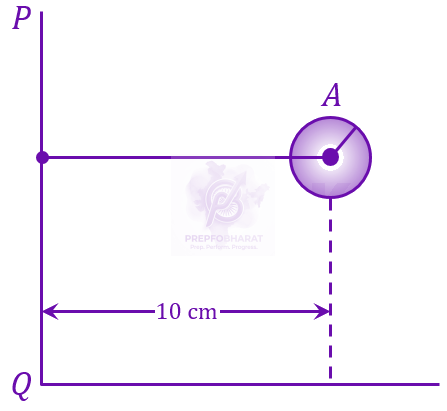
A body of mass $5\mathrm{kg}$ is moving with a momentum of $10\mathrm{kg}m{s}^{-1}$. Now a force of $2N$ acts on the body in the direction of its motion for $5s$. The increase in the Kinetic energy of the body is _____ $J$.
A force $F=(5+3{y}^{2})$ acts on a particle in the $y$-direction, where $F$ is newton and $y$ is in meter. The work done by the force during a displacement from $y=2m$ to $y=5m$ is ______ $J$.
Identify the correct statements from the following: (A) Work done by a man in lifting a bucket out of a well by means of a rope tied to the bucket is negative (B) Work done by gravitational force in lifting a bucket out of a well by a rope tied to the bucket is negative (C) Work done by friction on a body sliding down an inclined plane is positive (D) Work done by an applied force on a body moving on a rough horizontal plane with uniform velocity is zero (E) Work done by the air resistance on an oscillating pendulum is negative Choose the correct answer from the options given below:
A vector in $x-y$ plane makes an angle of ${30}^{o}$ with $y$-axis. The magnitude of $y$-component of vector is $2\sqrt{3}$. The magnitude of $x$-component of the vector will be :
A particle of mass $m$ moving with velocity $v$ collides with a stationary particle of mass $2m$. After collision, they stick together and continue to move together with velocity
Match List I with List II <table class="pyq-table"><tbody><tr><td></td><td>List</td><td></td><td>List II</td></tr><tr><td>A</td><td>Young's Modulus $(Y)$</td><td>I</td><td>$[{\mathrm{ML}}^{–1}T{}^{–1}]$</td></tr><tr><td>B</td><td>Co-efficient of Viscosity $(\eta )$</td><td>II</td><td>$[{\mathrm{ML}}^{2}T{}^{–1}]$</td></tr><tr><td>C</td><td>Planck's Constant $(h)$</td><td>III</td><td>$[{\mathrm{ML}}^{–1}T{}^{–2}]$</td></tr><tr><td>D</td><td>Work Function $(\phi )$</td><td>IV</td><td>$[{\mathrm{ML}}^{2}{T}^{–2}]$</td></tr></tbody></table>Choose the correct answer from the options given below:
Match List I with List II <table class="pyq-table"><tbody><tr><td></td><td>List I</td><td></td><td>List II</td></tr><tr><td>A</td><td>Torque</td><td>I</td><td>$\mathrm{kg}{m}^{–1}{s}^{–2}$</td></tr><tr><td>B</td><td>Energy density</td><td>II</td><td>$\mathrm{kg}m{s}^{–1}$</td></tr><tr><td>C</td><td>Pressure gradient</td><td>III</td><td>$\mathrm{kg}{m}^{–2}{s}^{–2}$</td></tr><tr><td>D</td><td>Impulse</td><td>IV</td><td>$\mathrm{kg}{m}^{2}{s}^{–2}$</td></tr></tbody></table>Choose the correct answer from the options given below :
A vector in $x-y$ plane makes an angle of ${30}^{o}$ with $y$-axis. The magnitude of $y$-component of vector is $2\sqrt{3}$. The magnitude of $x$-component of the vector will be :
Moment of inertia of a disc of mass $M$ and radius '$R$' about any of its diameter is $\frac{M{R}^{2}}{4}$. The moment of inertia of this disc about an axis normal to the disc and passing through a point on its edge will be, $\frac{x}{2}M{R}^{2}$. The value of $x$ is ______.
A solid sphere of mass $1\mathrm{kg}$ rolls without slipping on a plane surface. Its kinetic energy is $7\times {10}^{-3}J$. The speed of the centre of mass of the sphere is ______ $\mathrm{cm}{s}^{-1}$.
When vector $\vec{A}=2\hat{i}+3\hat{j}+2\hat{k}$ is subtracted from vector $\vec{B}$, it gives a vector equal to $2\hat{j}$. Then the magnitude of vector $\vec{B}$ will be:
A body of mass $1\mathrm{kg}$ collides head on elastically with a stationary body of mass $3\mathrm{kg}$. After collision, the smaller body reverses its direction of motion and moves with a speed of $2m{s}^{-1}$. The initial speed of the smaller body before collision is ______ $m{s}^{-1}$.
Two particles of equal mass $m$ move in a circle of radius $r$ under the action of their mutual gravitational attraction. The speed of each particle will be :
There is an air bubble of radius $1.0\mathrm{mm}$ in a liquid of surface tension $0.075N{m}^{–1}$ and density $1000\mathrm{kg}{m}^{–3}$ at a depth of $10\mathrm{cm}$ below the free surface. The amount by which the pressure inside the bubble is greater than the atmospheric pressure is _______ $Pa(g=10m{s}^{-2})$.
Vectors $a\hat{i}+b\hat{j}+\hat{k}$ and $2\hat{i}-3\hat{j}+4\hat{k}$ are perpendicular to each other when $3a+2b=7$, the ratio of $a$ to $b$ is $\frac{x}{2}$. The value of $x$ is _____.
Given below are two statements: Statement I : For a planet, if the ratio of mass of the planet to its radius increase, the escape velocity from the planet also increase. Statement II : Escape velocity is independent of the radius of the planet. In the light of above statements, choose the most appropriate answer from the options given below
A planet having mass $9{M}_{e}$ and radius $4{R}_{e},$ where ${M}_{e}$ and ${R}_{e}$ are mass and radius of earth respectively, has escape velocity in $\mathrm{km}{s}^{-1}$ given by: (Given escape velocity on earth ${V}_{e}=11.2\times {10}^{3}m{s}^{-1}$)
Two satellites of masses $m$ and $3m$ revolve around the earth in circular orbits of radii $r&3r$ respectively. The ratio of orbital speeds of the satellites respectively is
Every planet revolves around the sun in an elliptical orbit : A. The force acting on a planet is inversely proportional to square of distance from sun. B. Force acting on planet is inversely proportional to product of the masses of the planet and the sun. C. The centripetal force acting on the planet is directed away from the sun. D. The square of time period of revolution of planet around sun is directly proportional to cube of semi-major axis of elliptical orbit. Choose the correct answer from the options given below :
A physical quantity $P$ is given as $P=\frac{{a}^{2}{b}^{3}}{c\sqrt{d}}$. The percentage error in the measurement of $a,b,c$ and $d$ are $1%,2%,3%$ and $4%$ respectively. The percentage error in the measurement of quantity $P$ will be
Given below are two statements: one is labelled as Assertion A and the other is labelled as Reason R Assertion A : A spherical body of radius $(5\pm 0.1)\mathrm{mm}$ having a particular density is falling through a liquid of constant density. The percentage error in the calculation of its terminal velocity is $4%$. Reason R : The terminal velocity of the spherical body falling through the liquid is inversely proportional to its radius. In the light of the above statements, choose the correct answer from the options given below
Vectors $a\hat{i}+b\hat{j}+\hat{k}$ and $2\hat{i}-3\hat{j}+4\hat{k}$ are perpendicular to each other when $3a+2b=7$, the ratio of $a$ to $b$ is $\frac{x}{2}$. The value of $x$ is _____.
Electric field in a certain region is given by $\vec{E}=(\frac{A}{{x}^{2}}\hat{i}+\frac{B}{{y}^{3}}\hat{j})$. The SI unit of $A$ and $B$ are :
Given below are two statements: one is labelled as Assertion A and the other is labelled as Reason R Assertion (A) : Steel is used in the construction of buildings and bridges. Reason (R) : Steel is more elastic and its elastic limit is high. In the light of above statements, choose the most appropriate answer from the options given below
Choose the incorrect statement from the following:
A ball of mass $200g$ rests on a vertical post of height $20m$. A bullet of mass $10g$, travelling in horizontal direction, hits the centre of the ball. After collision both travels independently. The ball hits the ground at a distance $30m$ and the bullet at a distance of $120m$ from the foot of the post. The value of initial velocity of the bullet will be (if $g=10m{s}^{-2}$) :
Given below are two statements: one is labelled as Assertion A and the other is labelled as Reason R Assertion A : An electric fan continues to rotate for some time after the current is switched off. Reason R: Fan continues to rotate due to inertia of motion. In the light of above statements, choose the most appropriate answer from the options given below.
A solid sphere of mass $500g$ radius $5\mathrm{cm}$ is rotated about one of its diameter with angular speed of $10\mathrm{rad}{s}^{-1}$. If the moment of inertia of the sphere about its tangent is $x\times {10}^{-2}$ times its angular momentum about the diameter. Then the value of $x$ will be
The length of a metallic wire is increased by $20%$ and its area of cross-section is reduced by $4%.$ The percentage change in resistance of the metallic wire is $________.$
The figure represents the momentum time $(p-t)$ curve for a particle moving along an axis under the influence of the force. Identify the regions on the graph where the magnitude of the force is maximum and minimum respectively ? If $({t}_{3}-{t}_{2})<{t}_{1}$ 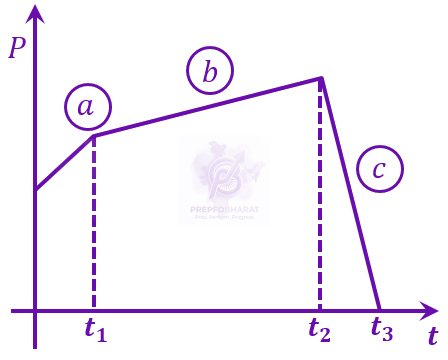
Two forces having magnitude $A$ and $\frac{A}{2}$ are perpendicular to each other. The magnitude of their resultant is:
A solid sphere and a solid cylinder of same mass and radius are rolling on a horizontal surface without slipping. The ratio of their radius of gyrations respectively $({k}_{sph}:{k}_{cyl})$ is $2:\sqrt{x}$. The value of $x$ is _______.
Given below are two statements: one is labelled as Assertion A and the other is labelled as Reason R Assertion $A$: A pendulum clock when taken to Mount Everest becomes fast. Reason $R$: The value of g (acceleration due to gravity) is less at Mount Everest than its value on the surface of earth. In the light of the above statements, choose the most appropriate answer from the options given below
A nucleus disintegrates into two smaller parts, which have their velocities in the ratio $3:2$. The ratio of their nuclear sizes will be ${(\frac{x}{3})}^{\frac{1}{3}}$. The value of ‘$x$’ is:
Two satellites $A$ and $B$ move round the earth in the same orbit. The mass of $A$ is twice the mass of $B$. The quantity which is same for the two satellites will be
A space ship of mass $2\times {10}^{4}\mathrm{kg}$ is launched into a circular orbit close to the earth surface. The additional velocity to be imparted to the space ship in the orbit to overcome the gravitational pull will be (if $g=10m{s}^{-2}$ and radius of earth $=6400\mathrm{km}$ ):
Two forces having magnitude $A$ and $\frac{A}{2}$ are perpendicular to each other. The magnitude of their resultant is:
Two resistance are given as ${R}_{1}=(10\pm 0.5)\Omega$ and ${R}_{2}=(15\pm 0.5)\Omega .$ The percentage error in the measurement of equivalent resistance when they are connected in parallel is
Given below are two statements: one is labelled as Assertion A and the other is labelled as Reason R. Assertion A: Earth has atmosphere whereas moon doesn’t have any atmosphere. Reason R: The escape velocity on moon is very small as compared to that on earth. In the light of the above statements, choose the correct answer from the options given below:
In a screw gauge, there are $100$ divisions on the circular scale and the main scale moves by $0.5\mathrm{mm}$ on a complete rotation of the circular scale. The zero of circular scale lies $6$ divisions below the line of graduation when two studs are brought in contact with each other. When a wire is placed between the studs, $4$ linear scale divisions are clearly visible while 46$^{th}$ division the circular scale coincide with the reference line. The diameter of the wire is ______ $\times {10}^{-2}\mathrm{mm}.$
A bullet of $10g$ leaves the barrel of gun with a velocity of $600m{s}^{-1}$. If the barrel of gun is $50\mathrm{cm}$ long and mass of gun is $3\mathrm{kg},$ then value of impulse supplied to the gun will be:
Assuming the earth to be a sphere of uniform mass density, the weight of a body at a depth $d=\frac{R}{2}$ from the surface of earth, if its weight on the surface of earth is $200N$, will be : (Given $R=$ radius of earth)
Two discs of same mass and different radii are made of different materials such that their thicknesses are $1\mathrm{cm}$ and $0.5\mathrm{cm}$ respectively. The densities of materials are in the ratio $3:5$. The moment of inertia of these discs respectively about their diameters will be in the ratio of $\frac{x}{6}$. The value of $x$ is ______.
A ball is thrown vertically upward with an initial velocity of $150m{s}^{-1}$. The ratio of velocity after $3s$ and $5s$ is $\frac{x+1}{x}$. The value of $x$ is _____. {take, $g=10m{s}^{-2}$}
A stone of mass $1\mathrm{kg}$ is tied to end of a massless string of length $1m$. If the breaking tension of the string is $400N$, then maximum linear velocity, the stone can have without breaking the string, while rotating in horizontal plane, is:
The surface tension of soap solution is $3.5\times {10}^{-2}N{m}^{-1}$. The amount of work done required to increase the radius of soap bubble from $10\mathrm{cm}$ to $20\mathrm{cm}$ is _____$\times {10}^{-4}J$ . (take $\pi =\frac{22}{7}$)
A stone is projected at angle $30^{\circ}$ to the horizontal. The ratio of kinetic energy of the stone at point of projection to its kinetic energy at the highest point of flight will be :
The radii of two planets $A$ and $B$ are $R$ and $4R$ and their densities are $\rho$ and $\frac{\rho }{3}$ respectively. The ratio of acceleration due to gravity at their surfaces $({g}_{A}:{g}_{B})$ will be
A planet has double the mass of the earth. Its average density is equal to that of the earth. An object weighing $W$ on earth will weigh on that planet:
The distance travelled by a particle is related to time $t$ as $x=4{t}^{2}$. The velocity of the particle at $t=5s$ is
The position-time graphs for two students $A$ and $B$ returning from the school to their homes are shown in figure. 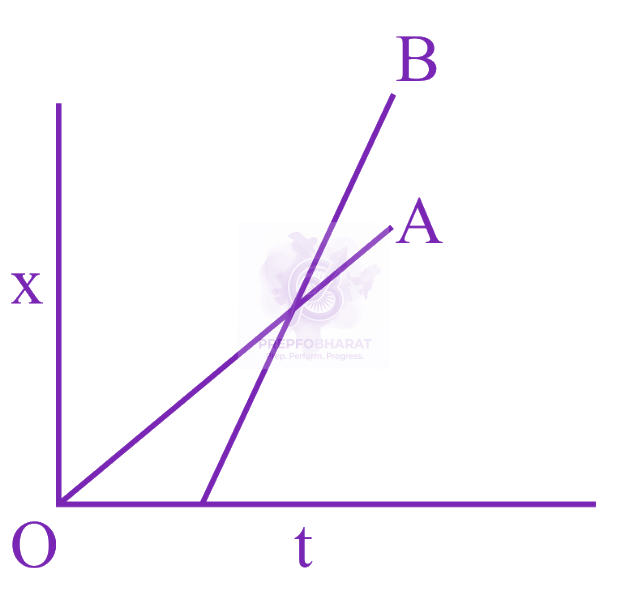 (A) $A$ lives closer to the school (B) $B$ lives closer to the school (C) $A$ takes lesser time to reach home (D) $A$ travels faster than $B$ (E) $B$ travels faster than $A$ Choose the correct answer from the options given below
As shown in the figure a block of mass $10\mathrm{kg}$ lying on a horizontal surface is pulled by a force F acting at an angle $30^{\circ}$, with horizontal. For ${\mu }_{s}=0.25$, the block will just start to move for the value of $F$: [Given g $=10m\cdot {s}^{–2}$] 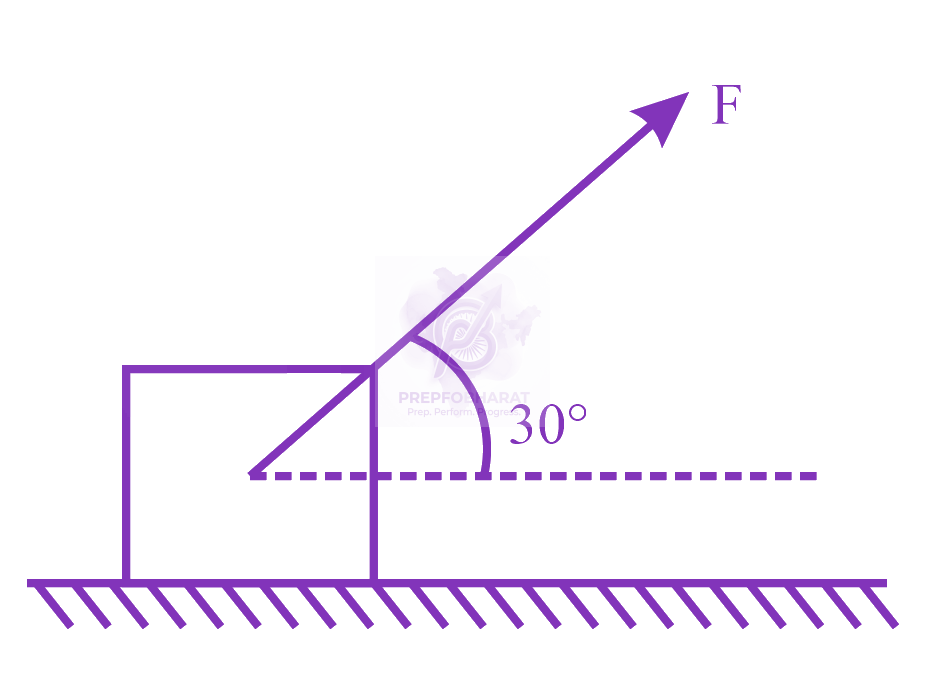
A body of mass $(5\pm 0.5)\mathrm{kg}$ is moving with a velocity of $(20\pm 0.4)m{s}^{-1}.$ Its kinetic energy will be
$100$ balls each of mass $m$ moving with speed $v$ simultaneously strike a wall normally and reflected back with same speed, in time $ts$. The total force exerted by the balls on the wall is
An object of mass $m$ initially at rest on a smooth horizontal plane starts moving under the action of force $F=2N$. In the process of its linear motion, the angle $\theta$ (as shown in figure) between the direction of force and horizontal varies as $\theta =kx$, where $k$ is a constant and $x$ is the distance covered by the object from its initial position. The expression of kinetic energy of the object will be $E=\frac{n}{k}\mathrm{sin}\theta$. The value of $n$ is ______. 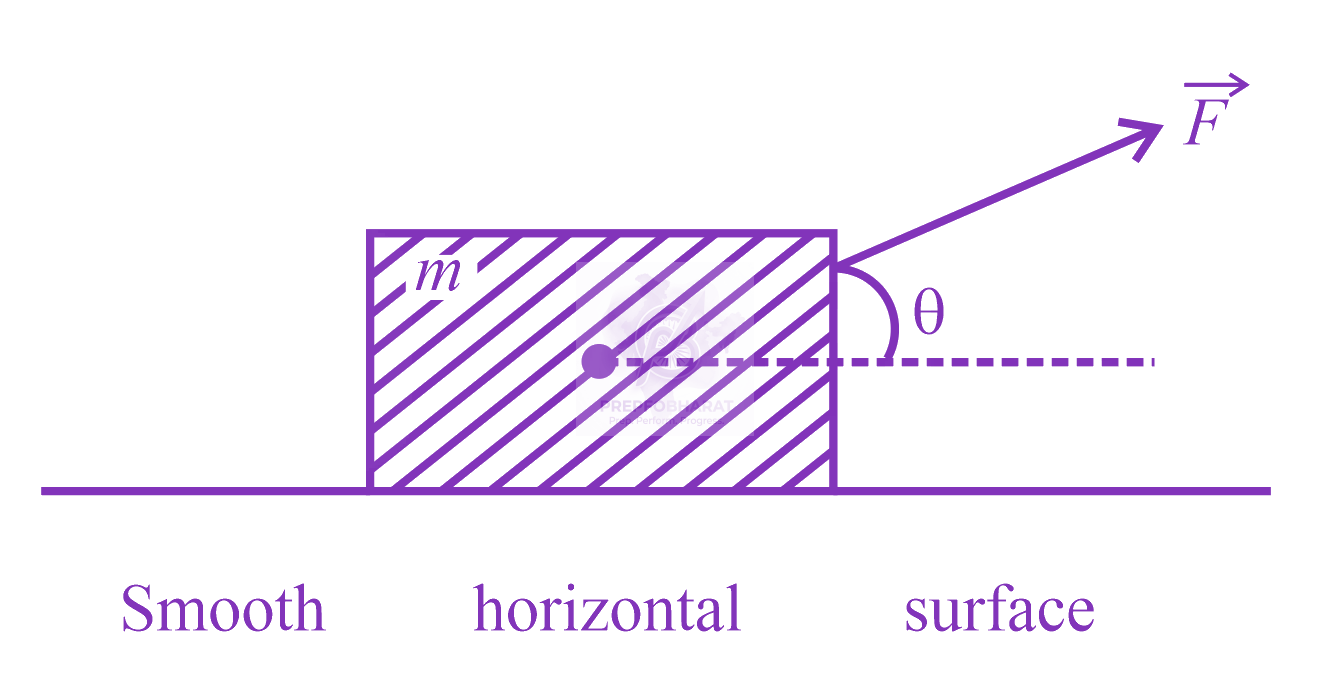
A body is released from a height equal to the radius $(R)$ of the earth. The velocity of the body when it strikes the surface of the earth will be: (Given $g=$ acceleration due to gravity on the earth.)
A spherical body of mass $2\mathrm{kg}$ starting from rest acquires a kinetic energy of $10000J$ at the end of ${5}^{\text{th }}$ second. The force acted on the body is _____ $N$.
A satellite is revolving around earth in a circular orbit. What will happen to its orbit if we suddenly stop it?
A solid sphere is rolling on a horizontal plane without slipping. If the ratio of angular momentum about axis of rotation of the sphere to the total energy of moving sphere is $\pi :22$ then, the value of its angular speed will be$_________rad{s}^{-1}.$
Form the $v-t$ graph shown, the ratio of distance to displacement in $25s$ of motion is: 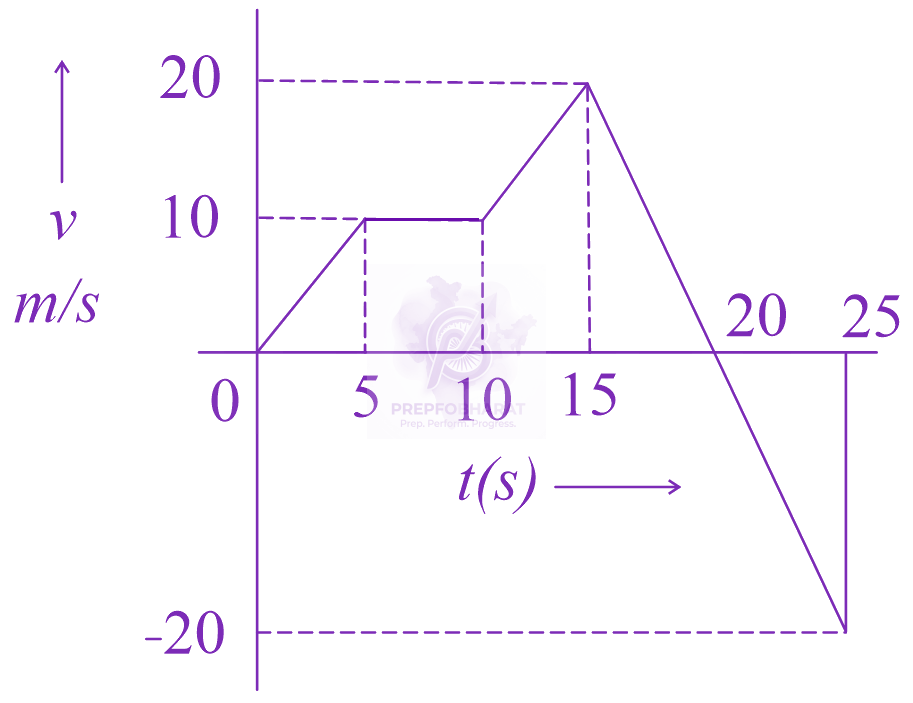
If the distance of the earth from Sun is $1.5\times {10}^{6}\mathrm{km}$, then the distance of an imaginary planet from Sun, if its period of revolution is $2.83$ years is:
A block of mass $m$ slides down the plane inclined at angle $30^{\circ}$ with an acceleration $\frac{g}{4}$ . The value of coefficient of kinetic friction will be :
The trajectory of projectile, projected from the ground is given by $y=x-\frac{{x}^{2}}{20}$. Where $x$ and $y$ are measured in meter. The maximum height attained by the projectile will be.
Given below are two statements: one is labelled as Assertion A and the other is labelled as Reason R Assertion A: When you squeeze one end of a tube to get toothpaste out from the other end, Pascal’s principle is observed. Reason R: A change in the pressure applied to an enclosed incompressible fluid is transmitted undiminished to every portion of the fluid and to the walls of its container. In the light of the above statements, choose the most appropriate answer from the options given below.
Match List I with List II <table class="pyq-table"><tbody><tr><td colspan="2" rowspan="1">List I</td><td colspan="2" rowspan="1">List II</td></tr><tr><td>$A.$</td><td>Planck's constant $(h)$</td><td>$I.$</td><td>$[{M}^{1}{L}^{2}{T}^{-2}]$</td></tr><tr><td>$B.$</td><td>Stopping potential $({V}_{s})$</td><td>$\mathrm{II}.$</td><td>$[{M}^{1}{L}^{1}{T}^{-1}]$</td></tr><tr><td>$C.$</td><td>Work function $(\phi )$</td><td>$\mathrm{III}.$</td><td>$[{M}^{1}{L}^{2}{T}^{-1}]$</td></tr><tr><td>$D.$</td><td>Momentum $(p)$</td><td>$\mathrm{IV}.$</td><td>$[{M}^{1}{L}^{2}{T}^{-3}{A}^{-1}]$</td></tr></tbody></table>
A person travels $x$ distance with velocity ${v}_{1}$ and then $x$ distance with velocity ${v}_{2}$ in the same direction. The average velocity of the person is $v$, then the relation between $v,{v}_{1}$ and ${v}_{2}$ will be
A tennis ball is dropped on to the floor from a height of $9.8m$. It rebounds to a height $5.0m$. Ball comes in contact with the floor for $0.2s$. The average acceleration during contact is ______ $m{s}^{-2}$. [Given $g=10m{s}^{-2}$]
An object moves with speed ${v}_{1},{v}_{2}\text{and}{v}_{3}$ along a line segment $AB,BC\text{and}CD$ respectively as shown in figure. Where $AB=BC\text{and}AD=3AB$, then average speed of the object will be : 
If $\vec{P}=3\hat{i}+\sqrt{3}\hat{j}+2\hat{k}$ and $\vec{Q}=4\hat{i}+\sqrt{3}\hat{j}+2.5\hat{k}$ then, the unit vector in the direction of $\vec{P}\times \vec{Q}$ is $\frac{1}{x}(\sqrt{3}\hat{i}+\hat{j}-2\sqrt{3}\hat{k})$. The value of $x$ is
A body of mass $200g$ is tied to a spring of spring constant $12.5N{m}^{-1}$, while the other end of spring is fixed at point $O$. If the body moves about $O$ in a circular path on a smooth horizontal surface with constant angular speed $5\mathrm{rad}{s}^{-1}$, then the ratio of extension in the spring to its natural length will be :
Figures (a), (b), (c) and (d) show variation of force with time. 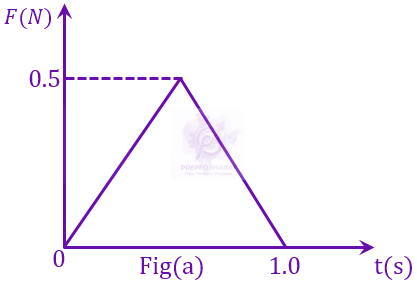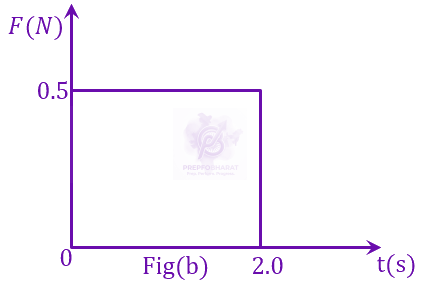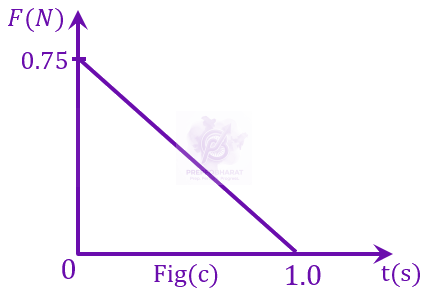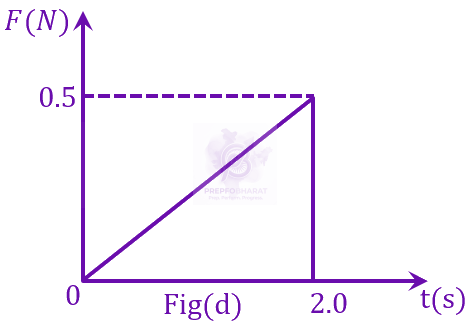 The impulse is highest in figure.
A cylindrical wire of mass$(0.4\pm 0.01)g$ has length $(8\pm 0.04)\mathrm{cm}$ and radius $(6\pm 0.03)\mathrm{mm}$. The maximum error in its density will be
A cylindrical wire of mass$(0.4\pm 0.01)g$ has length $(8\pm 0.04)\mathrm{cm}$ and radius $(6\pm 0.03)\mathrm{mm}$. The maximum error in its density will be
Young’s moduli of the material of wires A and B are in the ratio of $1:4$, while its area of cross sections are in the ratio of $1:3$. If the same amount of load is applied to both the wires, the amount of elongation produced in the wires A and B will be in the ratio of [Assume length of wires A and B are same]
The surface of water in a water tank of cross section area $750{\mathrm{cm}}^{2}$ on the top of a house is $hm$. above the tap level. The speed of water coming out through the tap of cross section area $500{\mathrm{mm}}^{2}$ is $30\mathrm{cm}{s}^{-1}$. At that instant, $\frac{dh}{dt}$ is $x\times {10}^{-3}m{s}^{-1}$. The value of $x$ will be ______.
Two resistance are given as ${R}_{1}=(10\pm 0.5)\Omega$ and ${R}_{2}=(15\pm 0.5)\Omega .$ The percentage error in the measurement of equivalent resistance when they are connected in parallel is
Given below are two statements: Statement I: Acceleration due to earth's gravity decreases as you go 'up' or 'down' from earth's surface. Statement II: Acceleration due to earth's gravity is same at a height '$h$' and depth '$d$' from earth's surface, if $h=d$. In the light of above statements, choose the most appropriate answer form the options given below
Three forces ${F}_{1}=10N,{F}_{2}=8N,{F}_{3}=6N$ are acting on a particle of mass $5\mathrm{kg}$. The forces ${F}_{2}$ and ${F}_{3}$ are applied perpendicularly so that particle remains at rest. If the force ${F}_{1}$ is removed, then the acceleration of the particle is
The length of a metallic wire is increased by $20%$ and its area of cross-section is reduced by $4%.$ The percentage change in resistance of the metallic wire is $________.$
If two vectors $\vec{P}=\hat{i}+2m\hat{j}+m\hat{k}$ and $\vec{Q}=4\hat{i}-2\hat{j}+m\hat{k}$ are perpendicular to each other. Then, the value of $m$ will be
An air bubble of volume $1{\mathrm{cm}}^{3}$ rises from the bottom of a lake $40m$ deep to the surface at a temperature of $12^{\circ}C.$ The atmospheric pressure is $1\times {10}^{5}\mathrm{Pa},$ the density of water is $1000\mathrm{kg}{m}^{-3}$ and $g=10m{s}^{-2}.$There is no difference of the temperature of water at the depth of $40m$ and on the surface. The volume of air bubble when it reaches the surface will be
Two wires each of radius $0.2\mathrm{cm}$ and negligible mass, one made of steel and the other made of brass are loaded as shown in the figure. The elongation of the steel wire is ______${10}^{–6}m$. [Young's modulus for steel $=2\times {10}^{11}N{m}^{–2}$ and $g=10m{s}^{–2}$] 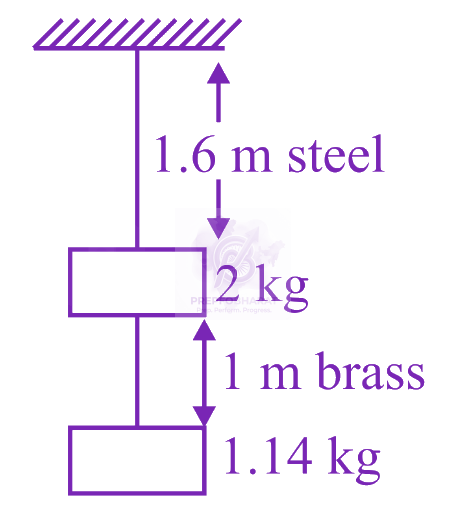
A force $\vec{F}=(2+3x)\hat{i}$ acts on a particle in the $x$ direction where $F$ is in Newton and $x$ is in meter. The work done by this force during a displacement from $x=0$ to $x=4m$ is _____ $J$.
$(P+\frac{a}{{V}^{2}})(V-b)=RT$ represents the equation of state of some gases. Where $P$ is the pressure, $V$ is the volume, $T$ is the temperature and $a,b,R$ are the constants. The physical quantity, which has dimensional formula as that of $\frac{{b}^{2}}{a}$ , will be :
Assume that the earth is a solid sphere of uniform density and a tunnel is dug along its diameter throughout the earth. It is found that when a particle is released in this tunnel, it executes a simple harmonic motion. The mass of the particle is $100g$. The time period of the motion of the particle will be (approximately) (take $g=10{\mathrm{ms}}^{-2}$, radius of earth $=6400\mathrm{km}$)
At any instant the velocity of a particle of mass $500g$ is $(2t\hat{i}+3{t}^{2}\hat{j})m{s}^{-1}$ . If the force acting on the particle at $t=1s$ is $(\hat{i}+x\hat{j})N$ . Then the value of $x$ will be:
Glycerin of density $1.25\times {10}^{3}\mathrm{kg}{m}^{–3}$ is flowing through the conical section of pipe. The area of cross-section of the pipe at its ends are $10{\mathrm{cm}}^{2}$ and $5{\mathrm{cm}}^{2}$ and pressure drop across its length is $3N{m}^{–2}$. The rate of flow of glycerine through the pipe is $x\times {10}^{–5}{m}^{3}{s}^{–1}$. The value of $x$ is _____.
A machine gun of mass $10\mathrm{kg}$ fires $20g$ bullets at the rate of $180$ bullets per minute with a speed of $100m{s}^{–1}$ each. The recoil velocity of the gun is :
Given below are two statements: one is labelled as Assertion $A$ and the other is labelled as Reason $R.$ Assertion A: When a body is projected at an angle $45^{\circ},$ its range is maximum. Reason R: For maximum range, the value of sin $2\theta$ should be equal to one. In the light of the above statements, choose the correct answer from the options given below:
The time period of a satellite, revolving above earth's surface at a height equal to $R$ will be (Given $g={\pi }^{2}m{s}^{-2},R=$ radius of earth)
A metal block of base area $0.20{m}^{2}$ is placed on a table, as shown in figure. A liquid film of thickness $0.25\mathrm{mm}$ is inserted between the block and the table. The block is pushed by a horizontal force of $0.1N$ and moves with a constant speed. If the viscosity of the liquid is $5.0\times {10}^{–3}\mathrm{Pl}$, the speed of block is ______ $\times {10}^{-3}m{s}^{-1}$. 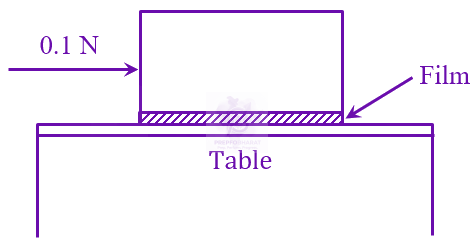
At a certain depth $d$ below surface of earth, value of acceleration due to gravity becomes four times that of its value at a height $3R$ above earth surface. Where $R$ is Radius of earth (Take $R=6400\mathrm{km}$). The depth $d$ is equal to
${I}_{\mathrm{CM}}$ is moment of inertia of a circular disc about an axis (CM) passing through its center and perpendicular to the plane of disc. ${I}_{\mathrm{AB}}$ is its moment of inertia about an axis AB perpendicular to plane and parallel to axis CM at a distance $\frac{2}{3}R$ from center, where R is the radius of the disc. The ratio of ${I}_{\mathrm{AB}}$ and ${I}_{\mathrm{CM}}$ is $x:9$. The value of $x$ is ______. 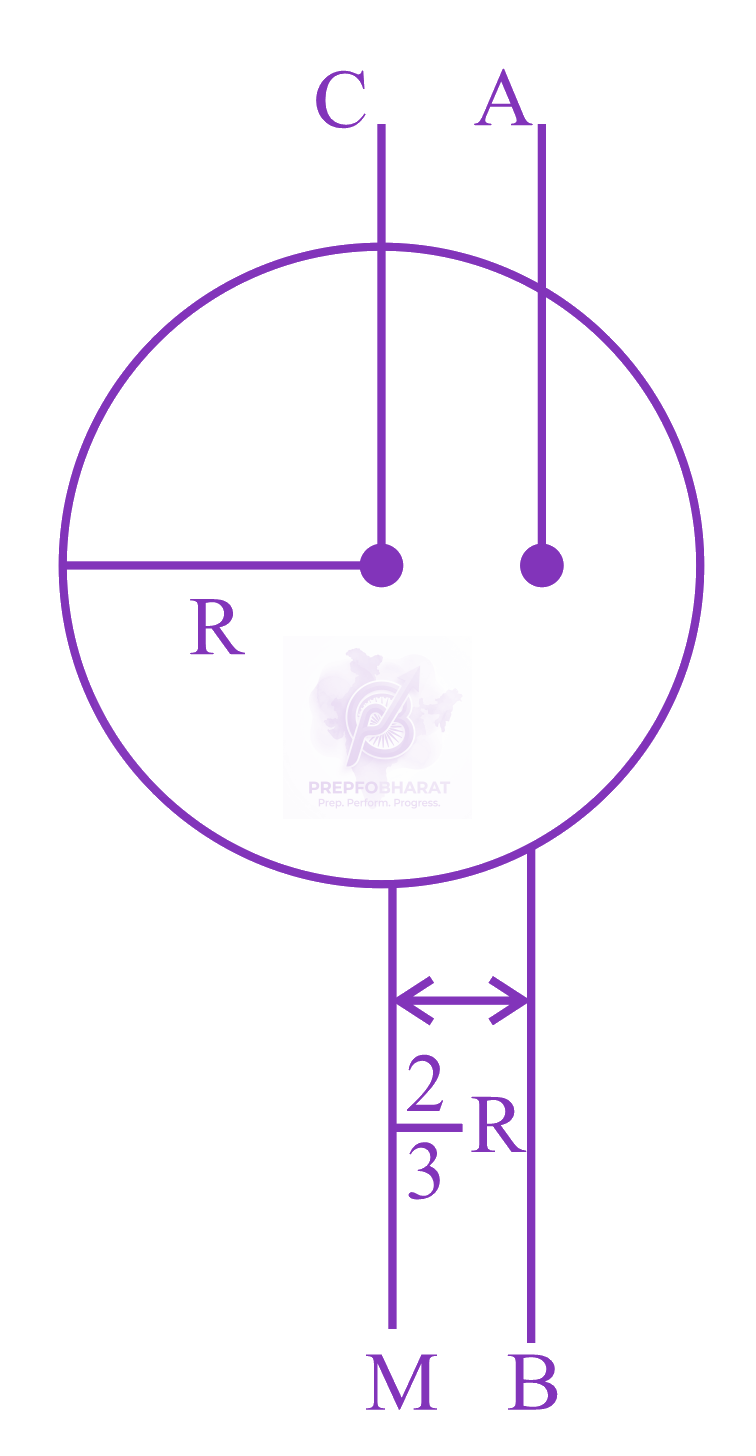
A ring and a solid sphere rotating about an axis passing through their centres have same radii of gyration. The axis of rotation is perpendicular to plane of ring. The ratio of radius of ring to that of sphere is $\sqrt{\frac{2}{x}}$. The value of $x$ is _____.
If earth has a mass nine times and radius twice to the of a planet $P$. Then $\frac{{v}_{e}}{3}\sqrt{x}m{s}^{-1}$ will be the minimum velocity required by a rocket to pull out of gravitational force of $P$, where ve is escape velocity on earth. The value of $x$ is
A coin placed on a rotating table just slips when it is placed at a distance of $1\mathrm{cm}$ from the centre. If the angular velocity of the table is halved, it will just slip when placed at a distance of _____ from the centre:
A vehicle of mass $200\mathrm{kg}$ is moving along a levelled curved road of radius $70m$ with angular velocity of $0.2\mathrm{rad}{s}^{-1}$. The centripetal force acting on the vehicle is:
A steel rod has a radius of $20\mathrm{mm}$ and a length of $2.0m.$ A force of $62.8\mathrm{kN}$ stretches it along its length. Young's modulus of steel is $2.0\times {10}^{11}N{m}^{-2}$. The longitudinal strain produced in the wire is $_________\times {10}^{-5}$.
A light rope is wound around a hollow cylinder of mass $5\mathrm{kg}$ and radius $70\mathrm{cm}$. The rope is pulled with a force of $52.5N$. The angular acceleration of the cylinder will be _____ $\mathrm{rad}{s}^{-2}$.
A certain pressure '$P$' is applied to $1$ litre of water and $2$ litre of a liquid separately. Water gets compressed to $0.01%$ whereas the liquid gets compressed to $0.03%$. The ratio of Bulk modulus of water to that of the liquid is $\frac{3}{x}$. The value of $x$ is ______.
As shown in the figure, in an experiment to determine Young's modulus of a wire, the extension-load curve is plotted. The curve is a straight line passing through the origin and makes an angle of $45^{\circ}$ with the load axis. The length of wire is $62.8\mathrm{cm}$ and its diameter is $4\mathrm{mm}$. The Young's modulus is found to be $x\times {10}^{4}N{m}^{-2}$ The value of $x$ is _______. 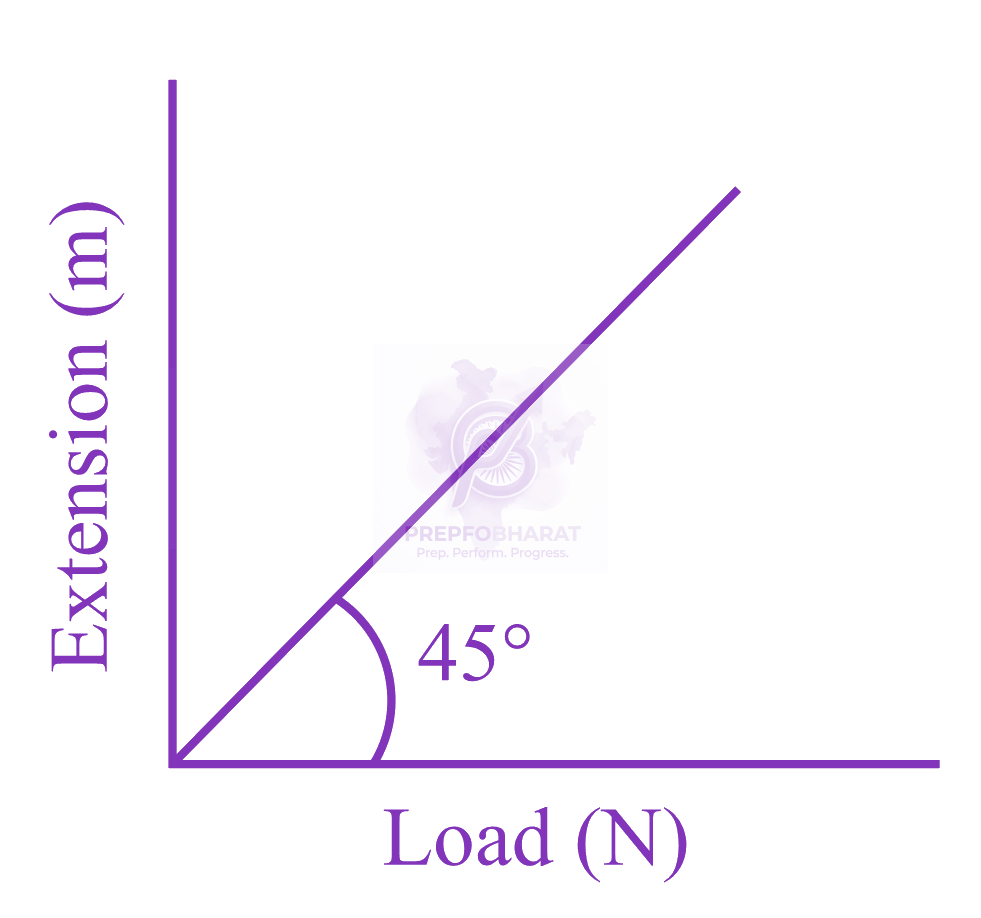
If the velocity of light $c$, universal gravitational constant $G$ and planck's constant $h$ are chosen as fundamental quantities. The dimensions of mass in the new system is:
Three forces ${F}_{1}=10N,{F}_{2}=8N,{F}_{3}=6N$ are acting on a particle of mass $5\mathrm{kg}$. The forces ${F}_{2}$ and ${F}_{3}$ are applied perpendicularly so that particle remains at rest. If the force ${F}_{1}$ is removed, then the acceleration of the particle is
Force acts for $20s$ on a body of mass $20\mathrm{kg}$, starting from rest, after which the force ceases and then body describes $50m$ in the next $10s$. The value of force will be :
A wire of length $L$ and radius $r$ is clamped rigidly at one end. When the other end of the wire is pulled by a force$f$, its length increases by $l$. Another wire of same material of length $2L$ and radius $2r$ is pulled by a force $2f$. Then the increase in its length will be:
Surface tension of a soap bubble is $2.0\times {10}^{-2}N{m}^{-1}$ . Work done to increase the radius of soap bubble from $3.5\mathrm{cm}$ to $7\mathrm{cm}$ will be : [Take $\pi =\frac{22}{7}$ ]
If the earth suddenly shrinks to $\frac{1}{64}\mathrm{th}$ of its original volume with its mass remaining the same, the period of rotation of earth becomes $\frac{24}{x}h$. The value of $x$ is ________
Figure below shows a liquid being pushed out of the tube by a piston having area of cross section $2.0{\mathrm{cm}}^{2}$. The area of cross section at the outlet is $10{\mathrm{mm}}^{2}$. If the piston is pushed at a speed of $4\mathrm{cm}{s}^{-1}$, the speed of outgoing fluid is _____ $\mathrm{cm}{s}^{-1}$ 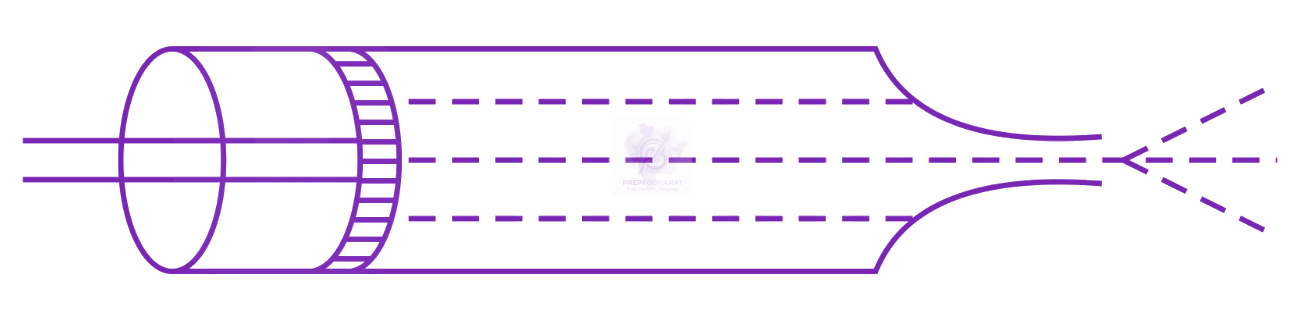
A block is fastened to a horizontal spring. The block is pulled to a distance $x=10\mathrm{cm}$ from its equilibrium position (at $x=0$) on a frictionless surface from rest. The energy of the block at $x=5\mathrm{cm}$ is $0.25J$. The spring constant of the spring is ______ $N{m}^{-1}$.
A body is dropped on ground from a height ${h}_{1}$ and after hitting the ground, it rebounds to a height ${h}_{2}$. If the ratio of velocities of the body just before and after hitting ground is $4$, then percentage loss in kinetic energy of the body is $\frac{x}{4}$. The value of $x$ is _____.
Given below are two statements: Statement I: Area under velocity-time graph gives the distance travelled by the body in a given time. Statement II: Area under acceleration-time graph is equal to the change in velocity in the given time. In the light of given statements, choose the correct answer from the options given below.
If the maximum load carried by an elevator is $1400\mathrm{kg}$ $(600\mathrm{kg}\text{-Passengers}+800\mathrm{kg}\text{-elevator})$ , which is moving up with a uniform speed of $3m{s}^{-1}$ and the frictional force acting on it is $2000N$, then the maximum power used by the motor is _____________$\mathrm{kW}.(g=10m{s}^{-2})$
In a metre bridge experiment the balance point is obtained if the gaps are closed by $2\Omega$ and $3\Omega$. A shunt of $X\Omega$ is added to $3\Omega$ resistor to shift the balancing point by $22.5\mathrm{cm}$. The value of $X$ is ______.
For a body projected at an angle with the horizontal from the ground, choose the correct statement
The escape velocities of two planets $AandB$ are in the ratio $1:2$. If the ratio of their radii respectively is $1:3$, then the ratio of acceleration due to gravity of planet $A$ to the acceleration of gravity of planet $B$ will be:
Under the same load, wire A having length $5.0m$ and cross section $2.5\times {10}^{-5}{m}^{2}$ stretches uniformly by the same amount as another wire $B$ of length $6.0m$ and a cross section of $3.0\times {10}^{-5}{m}^{2}$ stretches. The ratio of the Young's modulus of wire $A$ to that of wire $B$ will be:
A solid sphere of mass $2\mathrm{kg}$ is making pure rolling on a horizontal surface with kinetic energy $2240J$. The velocity of centre of mass of the sphere will be ______ $m{s}^{-1}$.
Given below are two statements: Statement I : A truck and a car moving with same kinetic energy are brought to rest by applying breaks which provide equal retarding forces. Both come to rest in equal distance. Statement II : A car moving towards east takes a turn and moves towards north, the speed remains unchanged. The acceleration of the car is zero. In the light of given statements, choose the most appropriate answer from the options given below
A ball is dropped from a height of $20m$. If the coefficient of restitution for the collision between ball and floor is $0.5$, after hitting the floor, the ball rebounds to a height of ______ $m$.
If the gravitational field in the space is given as $(-\frac{K}{{r}^{2}})$. Taking the reference point to be at $r=2\mathrm{cm}$ with gravitational potential $V=10J{\mathrm{kg}}^{-1}$. Find the gravitational potentials at $r=3\mathrm{cm}$ in SI unit (Given, that $K=6J\mathrm{cm}{\mathrm{kg}}^{-1}$)
To maintain a speed of $80\mathrm{km}{h}^{-1}$ by a bus of mass $500\mathrm{kg}$ on a plane rough road for $4\mathrm{km}$ distance, the work done by the engine of the bus will be _____ $\mathrm{kJ}$. [The coefficient of friction between tyre of bus and road is $0.04$]
If $1000$ droplets of water of surface tension $0.07N{m}^{-1}$. having same radius $1\mathrm{mm}$ each, combine to from a single drop. In the process the released surface energy is- $(\text{Take}\pi =\frac{22}{7})$
$T$ is the time period of simple pendulum on the earth's surface. Its time period becomes $xT$ when taken to a height $R$ (equal to earth's radius) above the earth's surface. Then, the value of $x$ will be:
If two vectors $\vec{P}=\hat{i}+2m\hat{j}+m\hat{k}$ and $\vec{Q}=4\hat{i}-2\hat{j}+m\hat{k}$ are perpendicular to each other. Then, the value of $m$ will be
A solid cylinder is released from rest from the top of an inclined plane of inclination $30^{\circ}$ and length $60\mathrm{cm}$. If the cylinder rolls without slipping, its speed upon reaching the bottom of the inclined plane is ______ $m{s}^{-1}$. (Given $g=10m{s}^{-2}$) 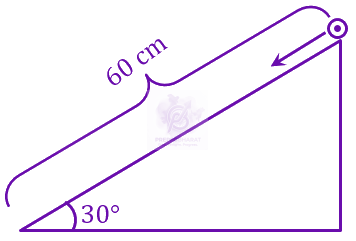
The equation of a circle is given by ${x}^{2}+{y}^{2}={a}^{2}$, where $a$ is the radius. If the equation is modified to change the origin other than $(0,0)$, then find out the correct dimensions of $A$ and $B$ in a new equation : ${(x-At)}^{2}+{(y-\frac{t}{B})}^{2}={a}^{2}$ The dimensions of $t$ is given as $[{T}^{-1}]$
Given below are two statements : Statement I : Astronomical unit (Au), Parsec (Pc) and Light year (ly) are units for measuring astronomical distances. Statement II : Au < Parsec (Pc) < ly In the light of the above statements, choose the most appropriate answer from the options given below:
A body of mass $10\mathrm{kg}$ is moving with an initial speed of $20m{s}^{-1}$. The body stops after $5s$ due to friction between body and the floor. The value of the coefficient of friction is: (Take acceleration due to gravity $g=10m{s}^{-2}$)
The range of the projectile projected at an angle of ${15}^{\circ }$ with horizontal is $50m$. If the projectile is projected with same velocity at an angle of ${45}^{\circ }$ with horizontal, then its range will be
Choose the correct relationship between Poisson ratio $(\sigma )$, bulk modulus $(K)$ and modulus of rigidity $(\eta )$ of a given solid object:
A projectile is projected at $30^{\circ}$ from horizontal with initial velocity $40m{s}^{-1}$. The velocity of the projectile at $t=2s$ from the start will be:
In an experiment of measuring the refractive index of a glass slab using travelling microscope in physics lab, a student measures real thickness of the glass slab as $5.25\mathrm{mm}$ and apparent thickness of the glass slab at $5.00\mathrm{mm}$. Travelling microscope has $20$ divisions in one $\mathrm{cm}$ on main scale and $50$ divisions on Vernier scale is equal to $49$ divisions on main scale. The estimated uncertainty in the measurement of refractive index of the slab is $\frac{x}{10}\times {10}^{-3}$, where $x$ is ______
Consider a block kept on an inclined plane (inclined at $45^{\circ}$) as shown in the figure. If the force required to just push it up the incline is $2$ times the force required to just prevent it from sliding down, the coefficient of friction between the block and inclined plane $(\mu )$ is equal to : 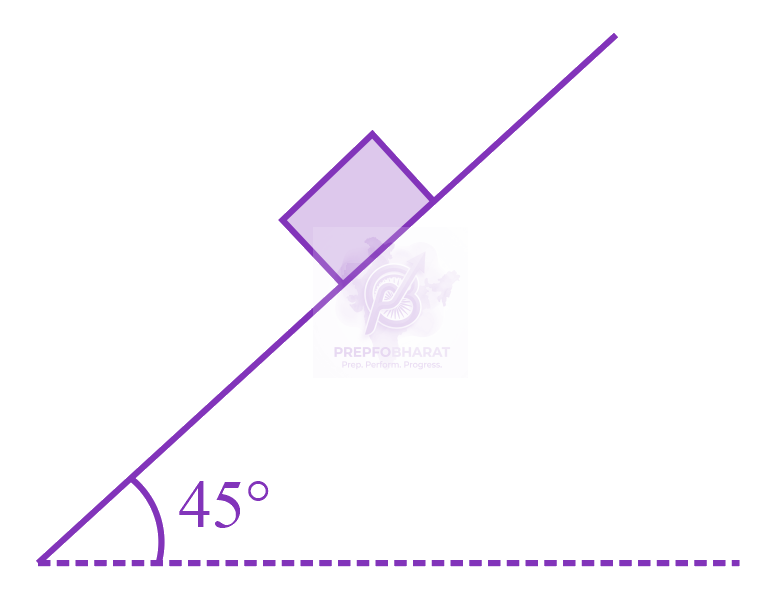.
The ratio of escape velocity of a planet to the escape velocity of earth will be:- Given: Mass of the planet is $16$ times mass of earth and radius of the planet is $4$ times the radius of earth.
The momentum of a body is increased by $50%$. The percentage increase in the kinetic energy of the body is_$_______%.$
A particle of mass $100g$ is projected at time $t=0$ with a speed $20m{s}^{–1}$ at an angle $45^{\circ}$ to the horizontal as given in the figure. The magnitude of the angular momentum of the particle about the starting point at time $t=2s$ is found to be $\sqrt{K}\mathrm{kg}{m}^{2}{s}^{-1}$. The value of $K$ is ______. (Take $g=10m{s}^{-2}$) 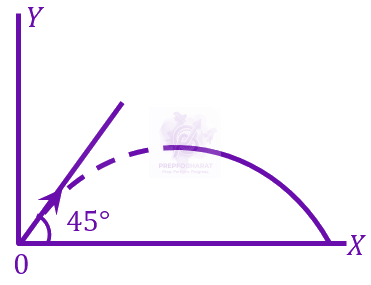
A closed circular tube of average radius $15\mathrm{cm}$, whose inner walls are rough, is kept in vertical plane. A block of mass $1\mathrm{kg}$ just fit inside the tube. The speed of block is $22m{s}^{-1}$, when it is introduced at the top of tube. After completing five oscillations, the block stops at the bottom region of tube. The work done by the tube on the block is ________ $J$. (Given $g=10m{s}^{-2}$). 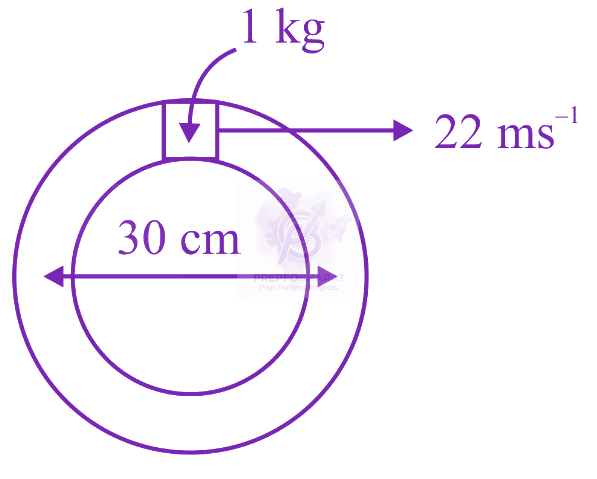
A disc is rolling without slipping on a surface. The radius of the disc is $R.$ At $t=0,$ the top most point on the disc is $A$ as shown in figure. When the disc completes half of its rotation, the displacement of point $A$ from its initial position is 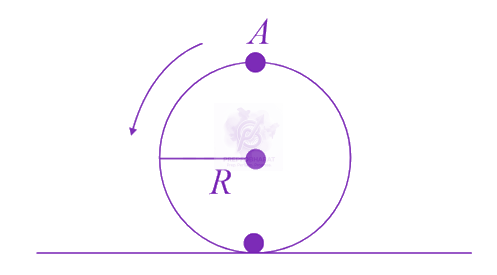
A hollow spherical ball of uniform density rolls up a curved surface with an initial velocity $3m{s}^{-1}$ (as shown in figure). Maximum height with respect to the initial position covered by it will be _____ $\mathrm{cm}$ (take, $g=10m{s}^{-2}$) 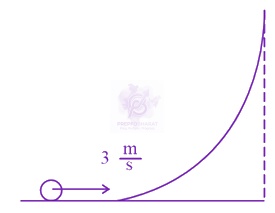
The ratio of powers of two motors is $\frac{3\sqrt{x}}{\sqrt{x+1}},$ that are capable of raising $300\mathrm{kg}$ water in $5$ minutes and $50\mathrm{kg}$ water in $2$ minutes respectively from a well of $100m$ deep. The value of $x$ will be
Two projectiles are projected at $30^{\circ}$ and $60^{\circ}$with the horizontal with the same speed. The ratio of the maximum height attained by the two projectiles respectively is:
Match List I with List II <table class="pyq-table"><tbody><tr><td></td><td>List I</td><td></td><td>List II</td></tr><tr><td>A</td><td>Angular momentum</td><td>I</td><td>$[{\mathrm{ML}}^{2}{T}^{-2}]$</td></tr><tr><td>B</td><td>Torque</td><td>II</td><td>$[{\mathrm{ML}}^{-2}{T}^{-2}]$</td></tr><tr><td>C</td><td>Stress</td><td>III</td><td>$[{\mathrm{ML}}^{2}{T}^{-1}]$</td></tr><tr><td>D</td><td>Pressure gradient</td><td>IV</td><td>$[{\mathrm{ML}}^{-1}{T}^{-2}]$</td></tr></tbody></table>Choose the correct answer from the options given below :
Two bodies are having kinetic energies in the ratio $16:9.$ If they have same linear momentum, the ratio of their masses respectively is:
A mercury drop of radius ${10}^{–3}m$ is broken into $125$ equal size droplets. Surface tension of mercury is $0.45N{m}^{–1}$ . The gain in surface energy is:
For a train engine moving with speed of $20{\mathrm{ms}}^{–1}$, the driver must apply brakes at a distance of $500m$ before the station for the train to come to rest at the station. If the brakes were applied at half of this distance, the train engine would cross the station with speed $\sqrt{x}{\mathrm{ms}}^{-1}$. The value of $x$ is ______. (Assuming same retardation is produced by brakes)
The speed of a swimmer is $4\mathrm{km}{h}^{-1}$ in still water. If the swimmer makes his strokes normal to the flow of river of width $1\mathrm{km}$, he reaches a point $750m$ down the stream on the opposite bank. The speed of the river water is ______ $\mathrm{km}{h}^{-1}$.
An object is allowed to fall from a height $R$ above the earth, where $R$ is the radius of earth. Its velocity when it strikes the earth’s surface, ignoring air resistance, will be :
A block of mass $5\mathrm{kg}$ starting from rest pulled up on a smooth incline plane making an angle of $30^{\circ}$ with horizontal with an effective acceleration of $1m{s}^{-2}$. The power delivered by the puling force at $t=10s$ from the start is _____ $W$. [Use $g=10m{s}^{-2}$] (Calculate the nearest integer value)
Match Column-I with Column-II : <table class="pyq-table"><tbody><tr><td></td><td>Column-I (x-t graphs)</td><td></td><td>Column-II (v-t graphs)</td></tr><tr><td>A</td><td><img src="https://prepforbharat.s3.ap-south-1.amazonaws.com/exam/615f0e999476412f48314daf/Physics/images/Motion_In_One_Dimension/648b5a6f417cc3fb48d681ca/question_1__q_648b5a6f417cc3fb48d681ca__cdn-question-pool.getmarks.app__a93a3577-e9a7-4822-ac03-ed49a273718c-9895369_1__6a09e268fd_final_ppt_sync.png" alt="JEE Main 2023 Physics, Motion In One Dimension — question figure 1"></td><td>I</td><td><img src="https://prepforbharat.s3.ap-south-1.amazonaws.com/exam/615f0e999476412f48314daf/Physics/images/Motion_In_One_Dimension/648b5a6f417cc3fb48d681ca/question_2__q_648b5a6f417cc3fb48d681ca__cdn-question-pool.getmarks.app__9823f8a8-ea83-4cbb-a6a8-dc0c24d00d03-9895369_5__bdadca48ee_final_ppt_sync.png" alt="JEE Main 2023 Physics, Motion In One Dimension — question figure 2"></td></tr><tr><td>B</td><td><img src="https://prepforbharat.s3.ap-south-1.amazonaws.com/exam/615f0e999476412f48314daf/Physics/images/Motion_In_One_Dimension/648b5a6f417cc3fb48d681ca/question_3__q_648b5a6f417cc3fb48d681ca__cdn-question-pool.getmarks.app__cbabd51f-2221-4567-95cc-e956a042b78a-6db6f371-02ff-4ed5-81d2__f76592d204_final_ppt_sync.png" alt="JEE Main 2023 Physics, Motion In One Dimension — question figure 3"></td><td>II</td><td><img src="https://prepforbharat.s3.ap-south-1.amazonaws.com/exam/615f0e999476412f48314daf/Physics/images/Motion_In_One_Dimension/648b5a6f417cc3fb48d681ca/question_4__q_648b5a6f417cc3fb48d681ca__cdn-question-pool.getmarks.app__c234cd67-2a0e-499d-ace8-a01abf2d0f38-9895369_6__30e6398b57_final_ppt_sync.png" alt="JEE Main 2023 Physics, Motion In One Dimension — question figure 4"></td></tr><tr><td>C</td><td><img src="https://prepforbharat.s3.ap-south-1.amazonaws.com/exam/615f0e999476412f48314daf/Physics/images/Motion_In_One_Dimension/648b5a6f417cc3fb48d681ca/question_5__q_648b5a6f417cc3fb48d681ca__cdn-question-pool.getmarks.app__a1245e56-3f30-411b-b778-83b713901ed8-9895369_3__60e4b97f81_final_ppt_sync.png" alt="JEE Main 2023 Physics, Motion In One Dimension — question figure 5"></td><td>III</td><td><img src="https://prepforbharat.s3.ap-south-1.amazonaws.com/exam/615f0e999476412f48314daf/Physics/images/Motion_In_One_Dimension/648b5a6f417cc3fb48d681ca/question_6__q_648b5a6f417cc3fb48d681ca__cdn-question-pool.getmarks.app__f6c6c70f-6c61-433d-aed9-fdf42b9e5cec-9895369_7__832b8642a6_final_ppt_sync.png" alt="JEE Main 2023 Physics, Motion In One Dimension — question figure 6"></td></tr><tr><td>D</td><td><img src="https://prepforbharat.s3.ap-south-1.amazonaws.com/exam/615f0e999476412f48314daf/Physics/images/Motion_In_One_Dimension/648b5a6f417cc3fb48d681ca/question_7__q_648b5a6f417cc3fb48d681ca__cdn-question-pool.getmarks.app__2bf6fb79-1819-4db7-b3f7-71bb9af1298c-9895369_4__0aba3b47e2_final_ppt_sync.png" alt="JEE Main 2023 Physics, Motion In One Dimension — question figure 7"></td><td>IV</td><td><img src="https://prepforbharat.s3.ap-south-1.amazonaws.com/exam/615f0e999476412f48314daf/Physics/images/Motion_In_One_Dimension/648b5a6f417cc3fb48d681ca/question_8__q_648b5a6f417cc3fb48d681ca__cdn-question-pool.getmarks.app__83ac15f1-1639-4008-80af-3aa79c1a99bd-9895369_8__1164d77f0b_final_ppt_sync.png" alt="JEE Main 2023 Physics, Motion In One Dimension — question figure 8"></td></tr></tbody></table>Choose the correct answer from the options given below:
The orbital angular momentum of a satellite is $L$, when it is revolving in a circular orbit at height $h$ from earth surface. If the distance of satellite from the earth centre is increased by eight times to its initial value, then the new angular momentum will be
Eight equal drops of water are falling through air with a steady speed of $10\mathrm{cm}{s}^{-1}$. If the drops coalesce, the new velocity is:-
The acceleration due to gravity at height $h$ above the earth if $h\ll R$ (Radius of earth) is given by
As per the given figure, a small ball $P$ slides down the quadrant of a circle and hits the other ball $Q$ of equal mass which is initially at rest. Neglecting the effect of friction and assume the collision to be elastic, the velocity of ball $Q$ after collision will be : $(g=10m{s}^{-2})$ 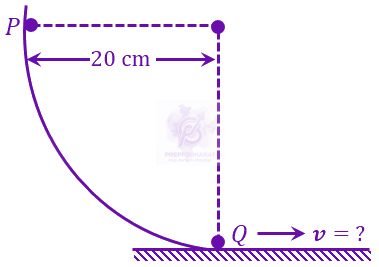
The initial speed of a projectile fired from ground is $u$. At the highest point during its motion, the speed of projectile is $\frac{\sqrt{3}}{2}u$. The time of flight of the projectile is:
A child of mass $5\mathrm{kg}$ is going round a merry-go-round that makes $1$ rotation in $3.14s$. The radius of the merry-go-round is $2m$. The centrifugal force on the child will be
An object of mass $8\mathrm{kg}$ is hanging from one end of a uniform rod $CD$ of mass $2\mathrm{kg}$ and length $1m$ pivoted at its end $C$ on a vertical wall as shown in figure. It is supported by a cable $AB$ such that the system is in equilibrium. The tension in the cable is: (Take $g=10m{s}^{-2}$) 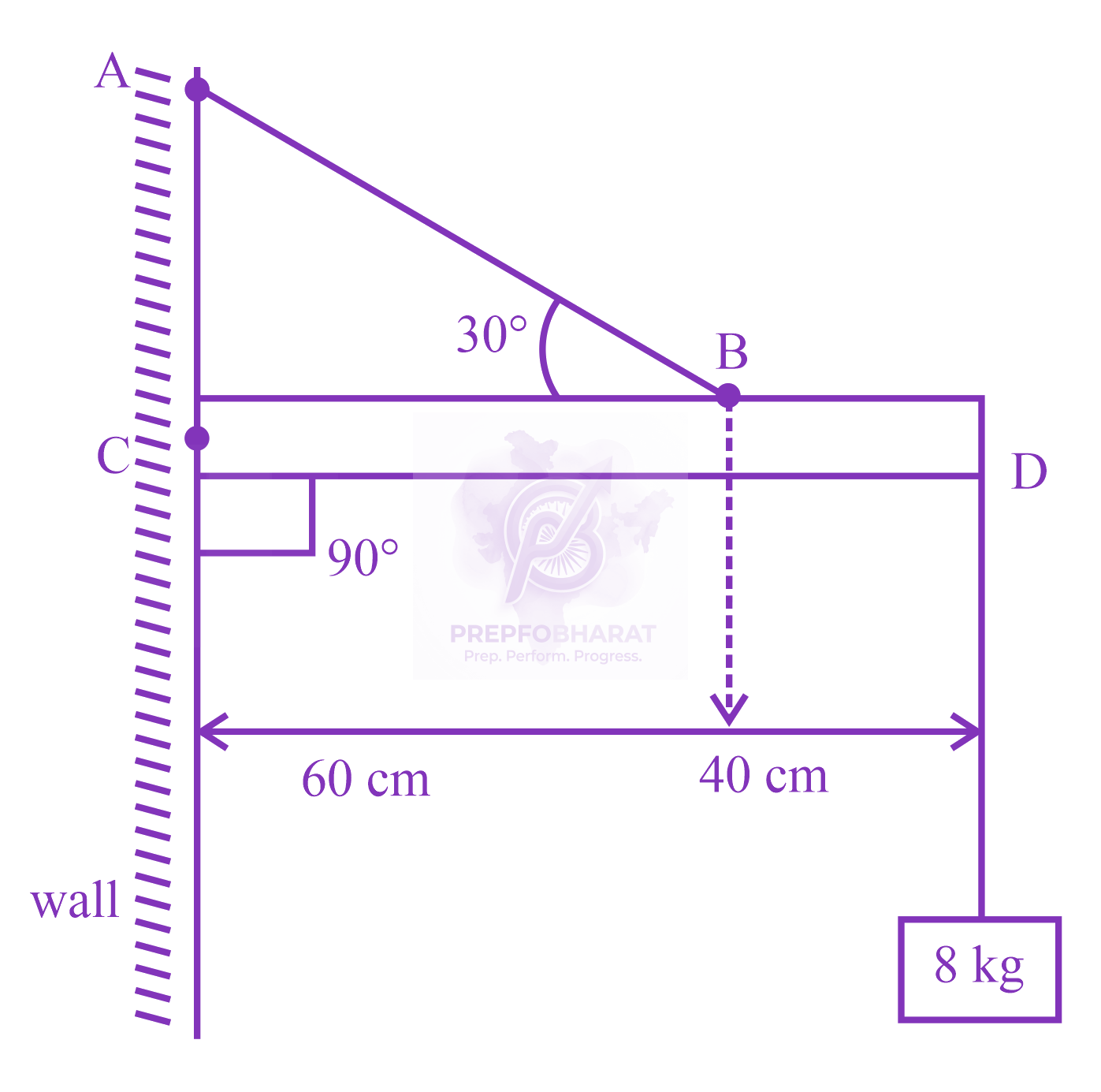
Match List I with List II<table class="pyq-table"><tbody><tr><td></td><td>List I</td><td></td><td>List II</td></tr><tr><td>A.</td><td>Torque</td><td>I.</td><td>$M{L}^{-2}{T}^{-2}$</td></tr><tr><td>B.</td><td>Stress</td><td>II.</td><td>$M{L}^{2}{T}^{-2}$</td></tr><tr><td>C.</td><td>Pressure gradient</td><td>III.</td><td>$M{L}^{-1}{T}^{-1}$</td></tr><tr><td>D.</td><td>Coefficient of viscosity</td><td>IV.</td><td>$M{L}^{-1}{T}^{-2}$</td></tr></tbody></table>Choose the correct answer from the options given below :
A uniform solid cylinder with radius $R$ and length $L$ has moment of inertia ${I}_{1}$, about the axis of cylinder. A concentric solid cylinder of radius ${R}^{'}=\frac{R}{2}$ and length ${L}^{'}=\frac{L}{2}$ is carved out of the original cylinder. If ${I}_{2}$ is the moment of inertia of the carved out portion of the cylinder then $\frac{{I}_{1}}{{I}_{2}}=$ __________. (Both ${I}_{1}$ and ${I}_{2}$ are about the axis of the cylinder)
A car is moving on a horizontal curved road with radius $50m$. The approximate maximum speed of car will be, if friction between tyres and road is $0.34$. [Take $g=10m{s}^{-2}$]
Dimension of $\frac{1}{{\mu }_{0}{\epsilon }_{0}}$ should be equal to
The position of a particle related to time is given by $x=(5{t}^{2}-4t+5)m$. The magnitude of velocity of the particle at $t=2$ s will be :
Two planets A and B of radii $R$ and $1.5R$ have densities $\rho$ and $\frac{\rho }{2}$ respectively. The ratio of acceleration due to gravity at the surface of B to A is:
If $\vec{P}=3\hat{i}+\sqrt{3}\hat{j}+2\hat{k}$ and $\vec{Q}=4\hat{i}+\sqrt{3}\hat{j}+2.5\hat{k}$ then, the unit vector in the direction of $\vec{P}\times \vec{Q}$ is $\frac{1}{x}(\sqrt{3}\hat{i}+\hat{j}-2\sqrt{3}\hat{k})$. The value of $x$ is
The weight of a body on the earth is $400N.$ Then weight of the body when taken to a depth half of the radius of the earth will be:
A small ball of mass $M$ and density $\rho$ is dropped in a viscous liquid of density ${\rho }_{0}$. After some time, the ball falls with a constant velocity. What is the viscous force on the ball?
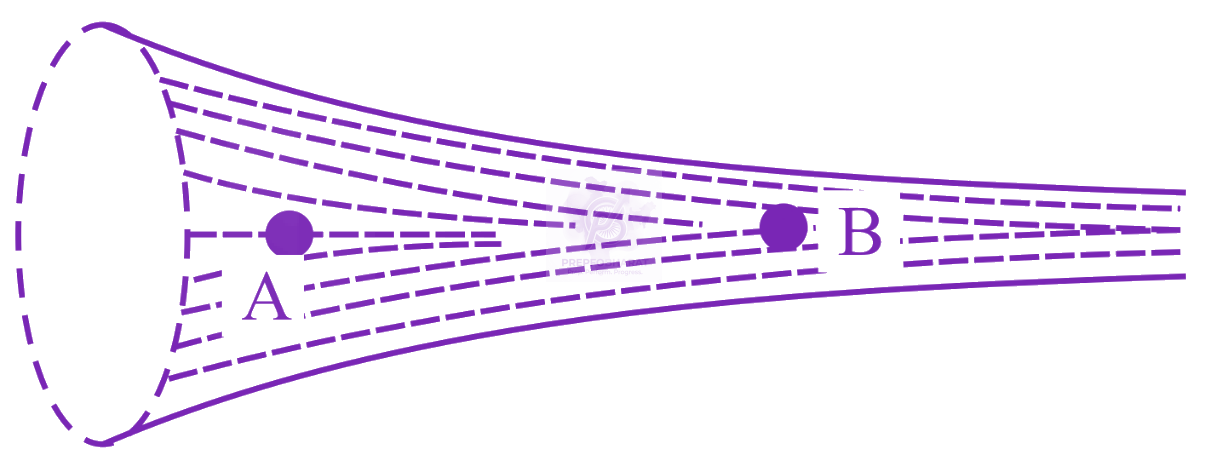 The figure shows a liquid of given density flowing steadily in horizontal tube of varying cross-section. Cross-sectional areas at $A$ is $1.5{\mathrm{cm}}^{2},$ and $B$ is $25{\mathrm{mm}}^{2},$ if the speed of liquid at $B$ is $60\mathrm{cm}{s}^{-1}$ then $({P}_{A}–{P}_{B})$ is (Given ${P}_{A}$ and ${P}_{B}$ are liquid pressures at $A$ and $B$ points. Density $\rho =1000\mathrm{kg}{m}^{-3}$ $A$ and $B$ are on the axis of tube)
A small block of mass $100g$ is tied to a spring of spring constant $7.5N{m}^{-1}$ and length $20\mathrm{cm}.$ The other end of spring is fixed at a particular point $A.$ If the block moves in a circular path on a smooth horizontal surface with constant angular velocity $5\mathrm{rad}{s}^{-1}$about point $A,$ then tension in the spring is
Two objects are projected with same velocity $u$ however at different angles $\alpha$ and $\beta$ with the horizontal. If $\alpha +\beta =90^{\circ}$, the ratio of horizontal range of the first object to the ${2}^{\mathrm{nd}}$ object will be :
As shown in figure, a $70\mathrm{kg}$ garden roller is pushed with a force of $\vec{F}=200N$ at an angle of $30^{\circ}$ with horizontal. The normal reaction on the roller is (Given $g=10m{s}^{-2}$) 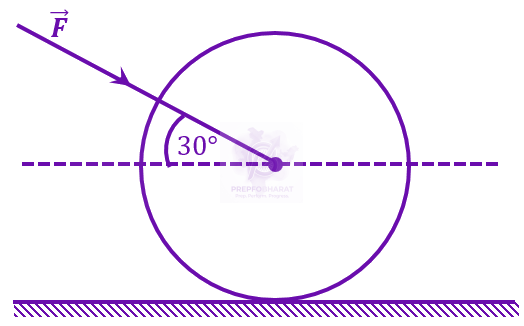
The time period of a satellite of earth is $24$ hours. If the separation between the earth and the satellite is decreased to one fourth of the previous value, then its new time period will become.
A body of mass $2\mathrm{kg}$ is initially at rest. It starts moving unidirectionally under the influence of a source of constant power $P$. Its displacement in $4s$ is $\frac{1}{3}{\alpha }^{2}\sqrt{P}m$. The value of $\alpha$ will be ______.
A nucleus disintegrates into two nuclear parts, in such a way that ratio of their nuclear sizes is $1:{2}^{1/3}$. Their respective speed have a ratio of $n:1$. The value of $n$ is_________
The speed of a wave produced in water is given by $\nu ={\lambda }^{a}{g}^{b}{\rho }^{c}$. Where $\lambda ,g$ and $\rho$ are wavelength of wave, acceleration due to gravity and density of water respectively. The values of $a,b$ and $c$ respectively, are
A vehicle travels $4\mathrm{km}$ with speed of $3\mathrm{km}{h}^{-1}$ and another $4\mathrm{km}$ with speed of $5\mathrm{km}{h}^{-1}$, then its average speed is :
A circular plate is rotating in horizontal plane, about an axis passing through its centre and perpendicular to the plate, with an angular velocity $\omega$. A person sits at the centre having two dumbbells in his hands. When he stretched out his hands, the moment of inertia of the system becomes triple. If $E$ be the initial Kinetic energy of the system, then final Kinetic energy will be $\frac{E}{x}$. The value of $x$ is
For rolling spherical shell, the ratio of rotational kinetic energy and total kinetic energy is $\frac{x}{5}$. The value of $x$ is _____.
The time taken by an object to slide down $45^{\circ}$ rough inclined plane is $n$ times as it takes to slide down a perfectly smooth $45^{\circ}$ incline plane. The coefficient of kinetic friction between the object and the incline plane is:
Match List I with List II <table class="pyq-table"><tbody><tr><td colspan="2" rowspan="1">List - I</td><td colspan="2" rowspan="1">List - II</td></tr><tr><td>A</td><td>Surface tension</td><td>I.</td><td>$\mathrm{kg}{m}^{-1}{s}^{-1}$</td></tr><tr><td>B</td><td>Pressure</td><td>II.</td><td>$\mathrm{kg}m{s}^{-1}$</td></tr><tr><td>C</td><td>Viscosity</td><td>III.</td><td>$\mathrm{kg}{m}^{-1}{s}^{-2}$</td></tr><tr><td>D</td><td>Impulse</td><td>IV.</td><td>$\mathrm{kg}{s}^{-2}$</td></tr></tbody></table>Choose the correct answer from the options given below:
A metal block of mass $m$ is suspended from a rigid support through a metal wire of diameter $14\mathrm{mm}$. The tensile stress developed in the wire under equilibrium state is $7\times {10}^{5}N{m}^{–2}$. The value of mass $m$ is ______ $\mathrm{kg}$. (Take $g=9.8m{s}^{-2}$ and $\pi =\frac{22}{7}$)
As shown in the figure, a particle is moving with constant speed $\pi m{s}^{-1}$. Considering its motion from $A$ to $B$, the magnitude of the average velocity is: 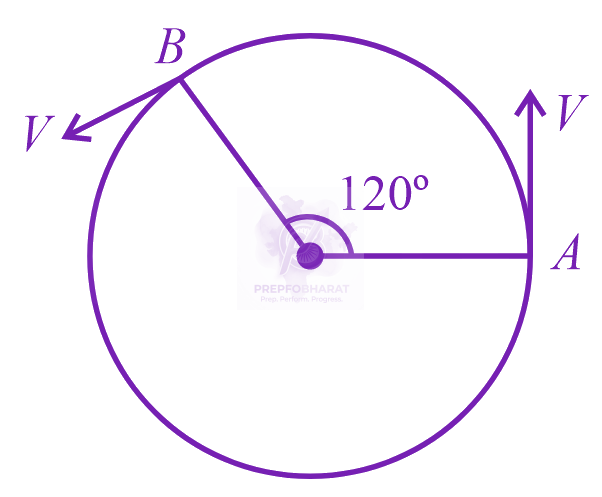
A spherical drop of liquid splits into $1000$ identical spherical drops. If ${u}_{i}$ is the surface energy of the original drop and ${u}_{f}$ is the total surface energy of the resulting drops, the (ignoring evaporation), $\frac{{u}_{f}}{{u}_{i}}=(\frac{10}{x})$. Then value of $x$ is ______:
A car is moving on a circular path of radius $600m$ such that the magnitudes of the tangential acceleration and centripetal acceleration are equal. The time taken by the car to complete first quarter of revolution, if it is moving with an initial speed of $54\mathrm{km}{h}^{-1}$ is $t(1–{e}^{–\frac{\pi }{2}})s$. The value of $t$ is ______.
A body weight $W$, is projected vertically upwards from earth's surface to reach a height above the earth which is equal to nine times the radius of earth. The weight of the body at that height will be:
As per given figure, a weightless pulley $P$ is attached on a double inclined frictionless surface. The tension in the string (massless) will be (if $g=10m{s}^{-2}$) 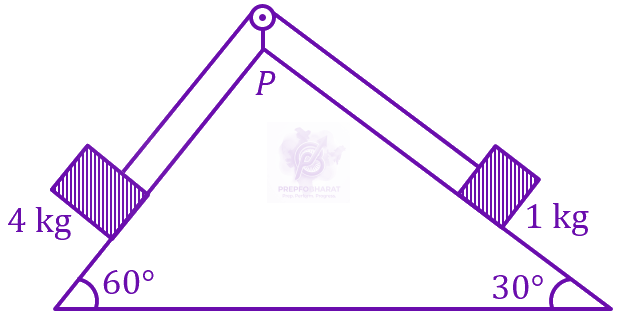
A horse rider covers half the distance with $5m{s}^{-1}$ speed. The remaining part of the distance was travelled with speed $10m{s}^{-1}$ for half the time and with speed $15m{s}^{-1}$ for other half of the time. The mean speed of the rider averaged over the whole time of motion is $\frac{x}{7}m{s}^{-1}$. The value of $x$ is ______.
A body of mass is taken from earth surface to the height $h$ equal to twice the radius of earth $({R}_{e})$, the increase in potential energy will be : ($g=$ acceleration due to gravity on the surface of earth)
A child stands on the edge of the cliff $10m$ above the ground and throws a stone horizontally with an initial speed of $5m{s}^{–1}$ . Neglecting the air resistance, the speed with which the stone hits the ground will be _____ $m{s}^{–1}$ (given, $g=10m{s}^{–2}$ ).
An air bubble of diameter $6\mathrm{mm}$ rises steadily through a solution of density $1750\mathrm{kg}{m}^{-3}$ at the rate of $0.35\mathrm{cm}{s}^{-1}$. The co-efficient of viscosity of the solution (neglect density of air) is ________ Pas (given, $g=10m{s}^{-2}$).
A small particle moves to position $5\hat{i}-2\hat{j}+\hat{k}$ from its initial position $2\hat{i}+3\hat{j}-4\hat{k}$ under the action of force $5\hat{i}+2\hat{j}+7\hat{k}N$. The value of work done will be ______ $J$.
The length of a wire becomes ${l}_{1}$ and ${l}_{2}$ when $100N$ and $120N$ tension are applied respectively. If $10{l}_{2}=11{l}_{1}$, then the natural length of wire will be $\frac{1}{x}{l}_{1}$. Here the value of $x$ is
A hydraulic automobile lift is designed to lift vehicles of mass $5000\mathrm{kg}$. The area of cross section of the cylinder carrying load is $250{\mathrm{cm}}^{2}$. The maximum pressure the smaller piston would have to bear is [Assume $g=10m{s}^{-2}$]
Match List I with List II : <table class="pyq-table"><tbody><tr><td></td><td>List-I (Physical Quantity)</td><td></td><td>List-II (Dimensional Formula)</td></tr><tr><td>A</td><td>Pressure gradient</td><td>I</td><td>$[{M}^{0}{L}^{2}{T}^{-2}]$</td></tr><tr><td>B</td><td>Energy density</td><td>II</td><td>$[{M}^{1}{L}^{-1}{T}^{-2}]$</td></tr><tr><td>C</td><td>Electric Field</td><td>III</td><td>$[{M}^{1}{L}^{-2}{T}^{-2}]$</td></tr><tr><td>D</td><td>Latent heat</td><td>IV</td><td>$[{M}^{1}{L}^{1}{T}^{-3}{A}^{-1}]$</td></tr></tbody></table>Choose the correct answer from the options given below:
A force of $-P\hat{k}$ acts on the origin of the coordinate system. The torque about the point $(2,-3)$ is $P(a\hat{i}+b\hat{j})$, The ratio of $\frac{a}{b}$ is $\frac{x}{2}$. The value of $x$ is
If a solid sphere of mass $5\mathrm{kg}$ and a disc of mass $4\mathrm{kg}$ have the same radius, then the ratio of moment of inertia of the disc about a tangent in its plane to the moment of inertia of the sphere about its tangent will be $\frac{x}{7}$. The value of $x$ is ______.
A uniform disc of mass $0.5\mathrm{kg}$ and radius $r$ is projected with velocity $18m{s}^{-1}$ at $t=0s$ on a rough horizontal surface. It starts off with a purely sliding motion at $t=0s$. After $2s$ it acquires a purely rolling motion (see figure). The total kinetic energy of the disc after $2s$ will be ______ $J$. (given, coefficient of friction is $0.3$ and $g=10m{s}^{-2}$). 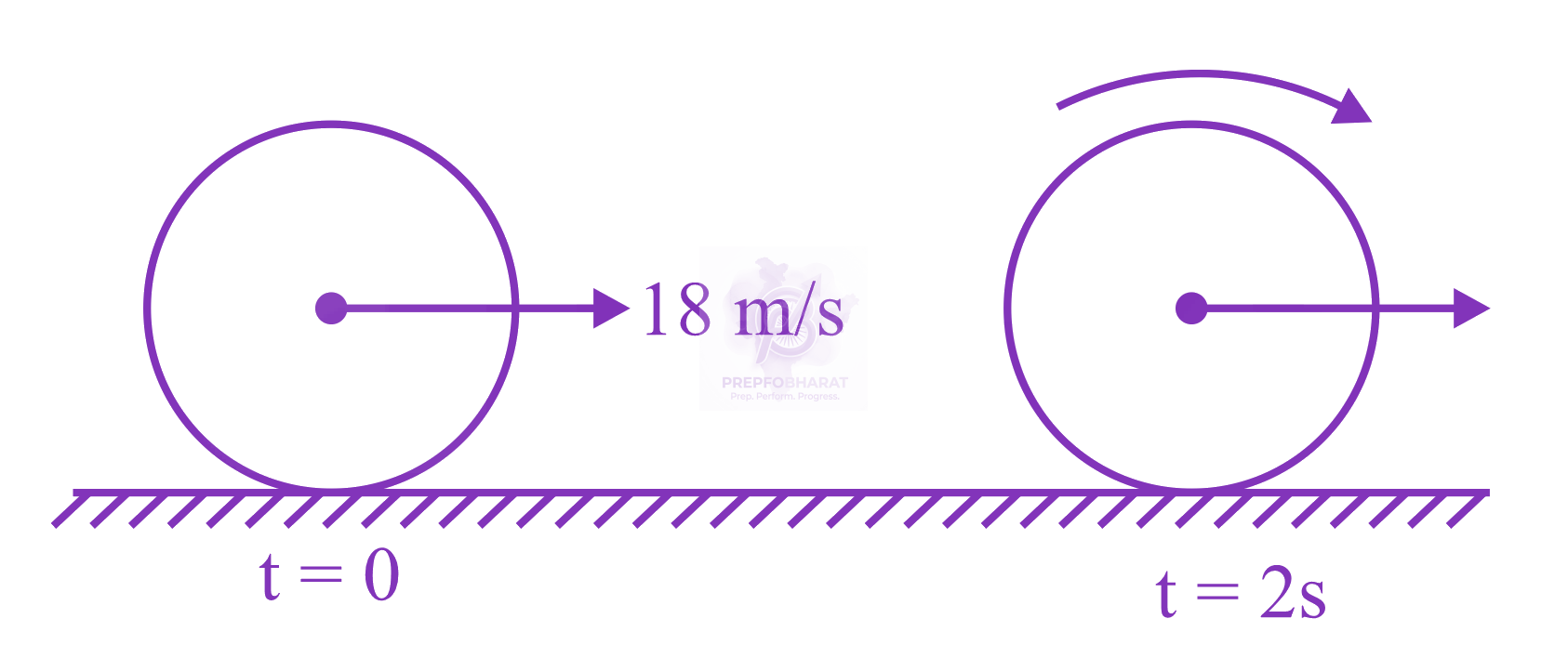
A $100m$ long wire having cross-sectional area $6.25\times {10}^{-4}{m}^{2}$ and Young's modulus is ${10}^{10}N{m}^{-2}$ is subjected to a load of $250N$, then the elongation in the wire will be :
Spherical insulating ball and a spherical metallic ball of same size and mass are dropped from the same height. Choose the correct statement out of the following {Assume negligible air friction}
Two bodies are projected from ground with same speeds $40m{s}^{-1}$ at two different angles with respect to horizontal. The bodies were found to have same range. If one of the body was projected at an angle of $60^{\circ}$, with horizontal then sum of the maximum heights, attained by the two projectiles, is _____ $m$. (Given $g=10m{s}^{-2}$)
Two identical particles each of mass $m$ go round a circle of radius $a$ under the action of their mutual gravitational attraction. The angular speed of each particle will be :
Given below are two statements: Statement I: Pressure in a reservoir of water is same at all points at the same level of water. Statement II: The pressure applied to enclosed water is transmitted in all directions equally. In the light of the above statements, choose the correct answer from the options given below:
An average force of $125N$ is applied on a machine gun firing bullets each of mass $10g$ at the speed of $250m{s}^{-1}$ to keep it in position. The number of bullets fired per second by the machine gun is :