JEE Main 2018 — Mechanics
Physics Mechanics questions from JEE Main 2018.
Other Years
48 Mechanics Questions from 2018
A body of mass $m$ is moving in a circular orbit of radius $R$ about a planet of mass $M$. At some instant, it splits into two equal masses. The first mass moves in a circular orbit of radius $\frac{R}{2}$ . And the other mass, in a circular orbit of radius $\frac{3R}{2}.$ The difference between the final and the initial total energies is
A body of mass $m$ is moving in a circular orbit of radius $R$ about a planet of mass $M$. At some instant, it splits into two equal masses. The first mass moves in a circular orbit of radius $\frac{R}{2}$, and the other mass, in a circular orbit of radius $\frac{3 R}{2}$. The difference between the final and initial total energies is:
A body of mass $2 \mathrm{~kg}$ slides down with an acceleration of $3 \mathrm{~m} / \mathrm{s}^2$ on a rough inclined plane having a slope of $30^{\circ}$. The external force required to take the same body up the plane with the same acceleration will be: $\left(\mathrm{g}=10 \mathrm{~m} / \mathrm{s}^2\right)$
A body of mass $m$ starts moving from rest along $x-$axis so that its velocity varies as $v=a\sqrt{s}$ where $a$ is a constant and $s$ is the distance covered by the body. The total work done by all the forces acting on the body in the first $t$ second after the start of the motion is
A disc rotates about its axis of symmetry in a hoizontal plane at a steady rate of $3.5$ revolutions per second. A coin placed at a distance of $1.25 \mathrm{~cm}$ from the axis of rotation remains at rest on the disc. The coefficient of friction between the coin and the disc is $\left(\mathrm{g}=10 \mathrm{~m} / \mathrm{s}^2\right)$
A force of $40N$ acts on a point $B$ at the end of an L-shaped object as shown in the figure. The angle $\theta$ that will produce the maximum moment of the force about point $A$ is given by: 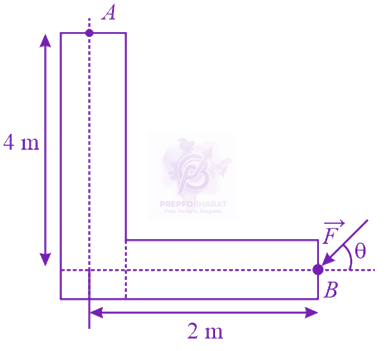
A force of $40 \mathrm{~N}$ acts on a point $\mathrm{B}$ at the end of an L-shaped object, as shown in the figure. The angle $\theta$ that will produce maximum moment of the force about point $\mathrm{A}$ is given by: 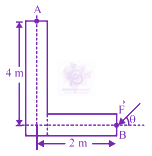
A given object takes $n$ times more time to slide down a $45^{\circ}$ rough inclined plane as it takes to slide down a perfectly smooth $45^{\circ}$ incline. The coefficient of kinetic friction between the object and the incline is :
A given object takes $n$ times more time to slide down a ${45}^{o}$ rough inclined plane as it takes to slide down a perfectly smooth ${45}^{o}$ incline. The coefficient of kinetic friction between the object and the incline is:
A man in a car at location Q on a straight highway is moving with speed $\mathrm{v}$. He decides to reach a point $P$ in a field at a distance $d$ from highway (point $M$ ) as shown in the figure.Speed of the car in the field is half to that on the highway. What should be the distance RM, so that the time taken to reach $P$ is minimum? 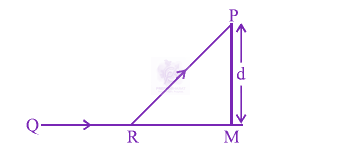
A particle is moving in a circular path of radius a under the action of an attractive potential $U=-\frac{k}{2{r}^{2}}.$ Its total energy is:
A particle is moving with a uniform speed in a circular orbit of radius R in a central force inversely proportional to the ${n}^{th}$ power of R. If the period of rotation of the particle is T, then:
A proton of mass $\mathrm{m}$ collides elastically with a particle of unknown mass at rest. After the collision, the proton and the unknown particle are seen moving at an angle of $90^{\circ}$ with respect to each other. The mass of unknown particle is:
A small soap bubble of radius 4cm is trapped inside another bubble of radius 6cm without any contact. Let ${P}_{2}$ be the pressure inside the inner bubble and ${P}_{0}$, the pressure outside the outer bubble. Radius of another bubble with pressure difference ${P}_{2}-{P}_{0}$ between its inside and outside would be:
A solid sphere of radius r made of a soft material of bulk modulus K is surrounded by a liquid in a cylindrical container. A massless piston of area $a$ floats on the surface of the liquid, covering entire cross-section of cylindrical container. When a mass m is placed on the surface of the piston to compress the liquid, the fractional decrement in the radius of the sphere $(\frac{dr}{r})$ , is:
A thin circular disk is in the $xy$ plane as shown in the figure. The ratio of its moment of inertia about $z$ and $z'$ axes will be: 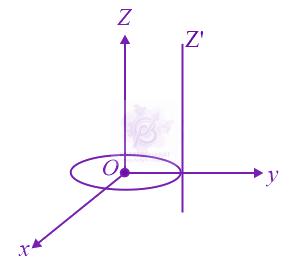
A thin rod $\mathrm{MN}$, free to rotate in the vertical plane about the fixed end $\mathrm{N}$, is held horizontal. When the end $\mathrm{M}$ is released the speed of this end, when the rod makes an angle $\alpha$ with the horizontal, will be proportional to: (see figure) 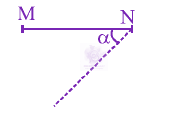
A thin uniform bar of length $\mathrm{L}$ and mass $8 \mathrm{~m}$ lies on a smooth horizontal table. Two point masses $\mathrm{m}$ and $2 \mathrm{~m}$ moving in the same horizontal plane from opposite sides of the bar with speeds $2 \mathrm{v}$ and $v$ respectively. The masses stick to the bar after collision at a distance $\frac{\mathrm{L}}{3}$ and $\frac{\mathrm{L}}{6}$ respectively from the centre of the bar. If the bar starts rotating about its center of mass as a result of collision, the angular speed of the bar will be: 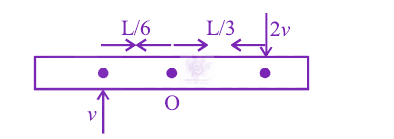
A thin uniform tube is bent into a circle of radius r in the vertical plane. Equal volumes of two immiscible liquids, Whose densities are ${\rho }_{1}$ and ${\rho }_{2} ({\rho }_{1}>{\rho }_{2} ),$ fill half the circle. The angle $\theta$ between the radius vector passing through the common interface and the vertical is:
A thin uniform tube is bent into a circle of radius $r$ in the virtical plane. Equal volumes of two immiscible liquids, whose densities are $\rho_1$ and $\rho_2\left(\rho_1>\rho_2\right)$ fill half the circle. The angle $\theta$ between the radius vector passing through the common interface and the vertical is
A uniform $\operatorname{rod} A B$ is suspended from a point $X$, at a variable distance from $x$ from $A$, as shown. To make the rod horizontal, a mass $m$ is suspended from its end $A$. A set of $(m, x)$ values is recorded. The appropriate variable that give a straight line, when plotted, are: 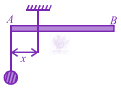
A uniform rod $AB$ is suspended from a point $X$, at a variable distance $x$ from $A$, as shown. To make the rod horizontal, a mass $m$ is suspended from its end $A$. A set of $(m,x)$ value is recorded. The appropriate variables that give a straight line, when plotted, are: 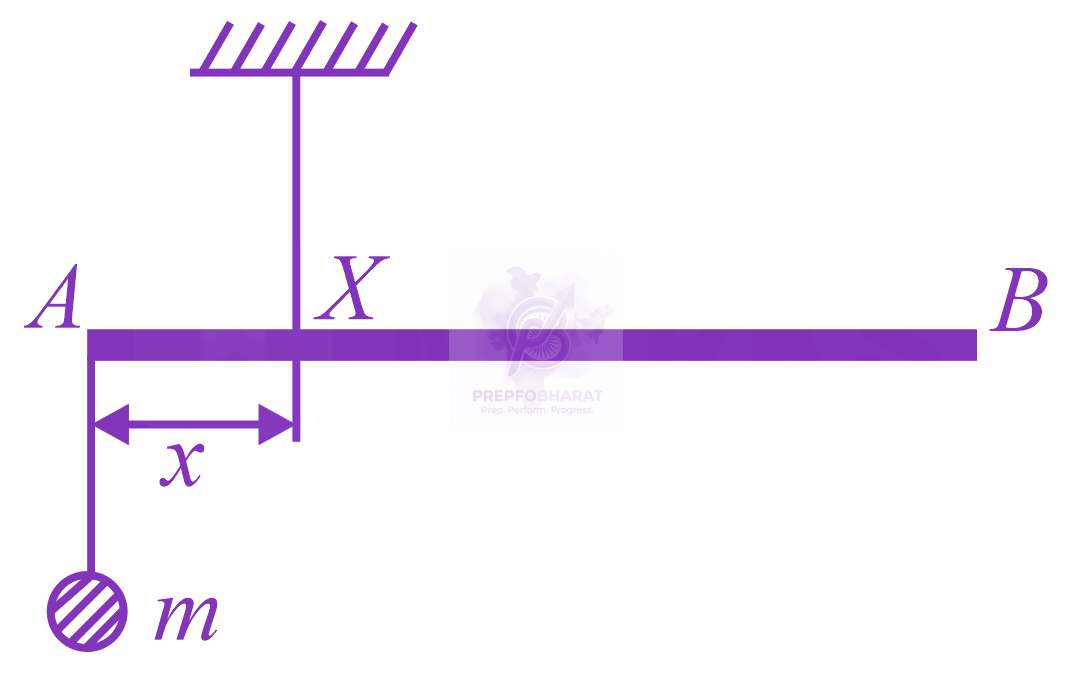
All the graphs below are intended to represent the same motion. One of them does it incorrectly. Pick it up.
An automobile, traveling at $40\mathrm{km}{h}^{-1}$, can be stopped at a distance of $40m$ by applying brakes. If the same automobile is traveling at $80\mathrm{km}{h}^{-1}$, the minimum stopping distance in metres is (Assume no skidding):
An automobile, travelling at $40 \mathrm{~km} / \mathrm{h}$, can be stopped at a distance of $40 \mathrm{~m}$ by applying brakes. If the same automobile is travelling at $80 \mathrm{~km} / \mathrm{h}$, the minimum stopping distance, in metres, is (assume no skidding)
As shown in the figure, forces of $10^5 \mathrm{~N}$ each are applied in opposite directions, on the upper and lower faces of a cube of side $10 \mathrm{~cm}$, shifting the upper face parallel to itself by $0.5 \mathrm{~cm}$. If the side of another cube of the same material is, $20 \mathrm{~cm}$ then under similar conditions as above, the displacement will be: 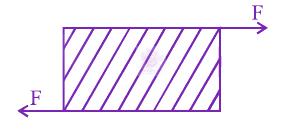
From a uniform circular disc of radius R and mass 9 M, a small disc of radius $\frac{R}{3}$ is removed as shown in the figure. The moment of inertia of the remaining disc about an axis perpendicular to the plane of the disc and passing through centre of disc is: 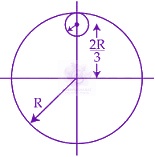
In a collinear collision, a particle with an initial speed ${v}_{0}$ strikes a stationary particle of the same mass. If the final total kinetic energy is $50%$ greater than the original kinetic energy, the magnitude of the relative velocity between the two particles, after the collision, is
In a screw gauge, 5 complete rotations of the screw cause it to move a linear distance of $0.25$ $\mathrm{cm}$. There are 100 circular scale divisions. The thickness of a wire measured by this screw gauge gives a reading of 4 main scale divisions and 30 circular scale divisions. Assuming negligible zero error, the thickness of the wire is:
In a screw gauge, $5$ complete rotations of the screw cause it to move a linear distance of $0.25\mathrm{cm}$. There are$100$ circular scale divisions. The thickness of a wire measured by this screw gauge gives a reading of $4$ main scale divisions and $30$ circular scale divisions. Assuming negligible error, the thickness of the wire is
It is found that if a neutron suffers an elastic collinear collision with a deuterium at rest, the fractional loss of its energy is ${P}_{d}$, while for its similar collision with a carbon nucleus at rest, the fractional loss of energy is ${P}_{c}$. The values of ${P}_{d}$ and ${P}_{c}$ are respectively
Let $\vec{A}=(\hat{i} + \hat{j}) and \vec{B}=(2\hat{i}- \hat{j})$ . The magnitude of a coplanar vector $\vec{C}$ such that $\vec{A} . \vec{C}=\vec{B}. \vec{C}= \vec{A} . \vec{B}$ is given by:
Seven identical circular planar disks, each of mass M and radius R are welded symmetrically as shown. The moment of inertia of the arrangement about the axis normal to the plane and passing through the point P is: 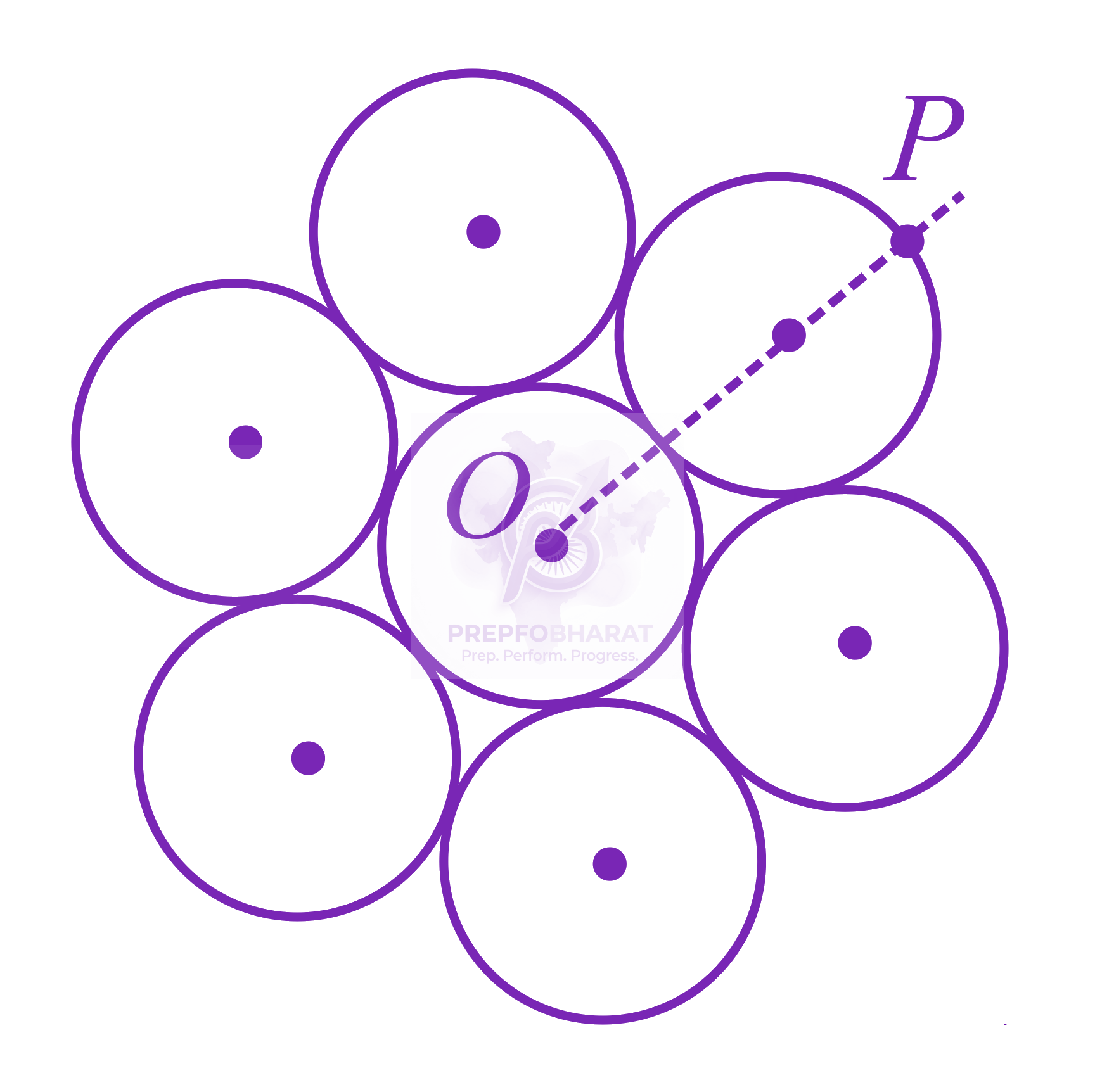
Suppose that the angular velocity of rotation of the Earth is increased. Then, as a consequence,
Take the mean distance of the moon and the sun from the earth to be $0.4\times {10}^{6}\mathrm{km}$ and $150\times {10}^{6}\mathrm{km}$, respectively. Their masses are $8\times {10}^{22}$ $\mathrm{kg}$ and $2\times {10}^{30}$ $\mathrm{kg}$, respectively. The radius of the earth is $6400\mathrm{km}$. Let $\Delta {F}_{1}$ be the difference in the forces exerted by the moon at the nearest and farthest point on the earth, and $\Delta {F}_{2}$ be the difference in the forces exerted by the sun at the nearest and farthest points on the earth. Then, the number closest to $\frac{\Delta {F}_{1}}{\Delta {F}_{2}}$ is,
Take the mean distance of the moon and the sun from the earth to be $0.4 \times 10^6 \mathrm{~km}$ and $150 \times 10^6 \mathrm{~km}$ respectively. Their masses are $8 \times 10^{22} \mathrm{~kg}$ and $2 \times$ $10^{30} \mathrm{~kg}$ respectively. The radius of the earth is $6400 \mathrm{~km}$. Let $\Delta F_1$ be the difference in the forces exerted by the moon at the nearest and farthest points on the earth and $\Delta \mathrm{F}_2$ be the difference in the force exerted by the sun at the nearest and farthest points on the earth. Then, the number closest to $\frac{\Delta F_1}{\Delta F_2}$ is:
The characteristic distance at which quantum gravitational effects are significant, the Planck length, can be determined from a suitable combination of the fundamental physical constants $\mathrm{G}, \mathrm{h}$ and $\mathrm{c}$. Which of the following correctly gives the Planck length?
The density of a material, in the shape of a cube, is determined by measuring three sides of the cube and its mass. If the relative errors in measuring the mass and length are $1.5%$ and $1%$, respectively, the maximum error in determining the density is:
The mass of a hydrogen molecule is $3.32\times {10}^{-27 }\mathrm{kg}.$ If ${10}^{23}$ hydrogen molecules strike, per second, a fixed wall of the area $2 {\mathrm{cm}}^{2}$ at an angle of ${45}^{o}$ to the normal, and rebound elastically with a speed of ${10}^{3}m{s}^{-1},$ then the pressure on the wall is nearly:
The percentage errors in quantities $P$, $Q$, $R$ and $S$ are $0.5%$, $1%$, $3%$ and $1.5%$ respectively in the measurement of a physical quantity $A= \frac{ {P}^{3} {Q}^{2} }{ \sqrt{ R } S }$. The maximum percentage error in the value of $A$ will be:
The relative error in the determination of the surface area of a sphere is $\alpha$. The relative error in the determination of its volume is
The relative error in the determination of the surface area of a sphere is $\alpha$. Then the relative error in the determination of its volume is
The relative uncertainty in the period of a satellite orbiting around the earth is ${10}^{-2}$ . If the relative uncertainty in the radius of the orbit is negligible, the relative uncertainty in the mass of the earth is:
The velocity-time graphs of a car and a scooter are shown in the figure. (i) the difference between the distance travelled by the car and the scooter in $15 \mathrm{~s}$ and (ii) the time at which the car will catch up with the scooter are, respectively 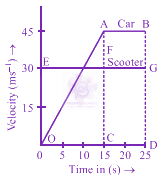
The velocity time graphs of a car and a scooter are shown in the figure. (i) The difference between the distance travelled by the car and the scooter in 15 s and (ii) the time at which the car will catch up with the scooter are, respectively. 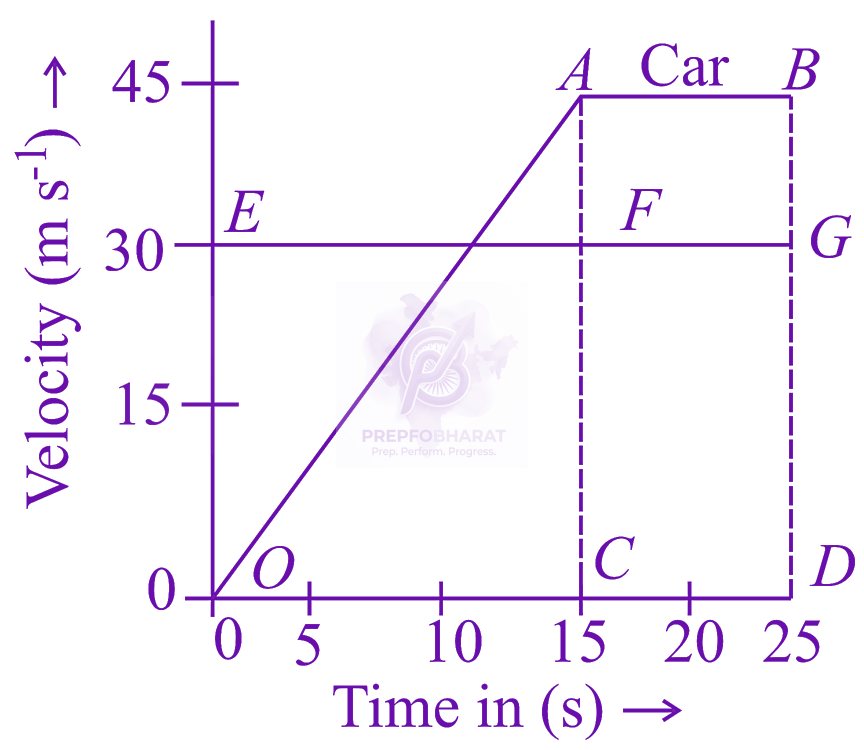
Two masses ${m}_{1}=5 \mathrm{kg}$ and ${m}_{2}=10 \mathrm{kg}$, connected by an inextensible string over a frictionless pulley, are moving as shown in the figure. The coefficient of friction of horizontal surface is $0.15$. The minimum weight m that should be put on top of ${m}_{2}$ to stop the motion is: 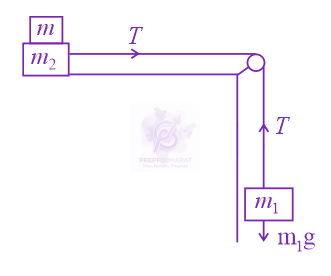
Two particles of the same mass $m$ are moving in circular orbits because of force, given by $F (r)=-\frac{16}{r}-{r}^{3}$. The first particle is at a distance $r=1$, and the second, at $r=4$. The best estimate for the ratio of kinetic energies of the first and the second particle is closest to
When an air bubble of radius $r$ rises from the bottom to the surface of a lake, its radius becomes $\frac{5 \mathrm{r}}{4}$. Taking the atmospheric pressure to be equal to $10 \mathrm{~m}$ height of water column, the depth of the lake would approximately be (ignore the surface tension and the effect of temperature):