JEE Main 2024 — Mechanics
Physics Mechanics questions from JEE Main 2024.
Other Years
245 Mechanics Questions from 2024
Mercury is filled in a tube of radius $2 \mathrm{~cm}$ up to a height of $30 \mathrm{~cm}$. The force exerted by mercury on the bottom of the tube is _____ N. (Given, atmospheric pressure $=10^5 \mathrm{Nm}^{-2}$, density of mercury $=1.36 \times 10^4 \mathrm{~kg} \mathrm{~m}^{-}$ $\left.{ }^3, \mathrm{~g}=10 \mathrm{~m} \mathrm{~s}^{-2}, \pi=\frac{22}{7}\right)$
If $\vec{a}$ and $\vec{b}$ makes an angle $\cos ^{-1}\left(\frac{5}{9}\right)$ with each other, then $|\vec{a}+\vec{b}|=\sqrt{2}|\vec{a}-\vec{b}|$ for $|\vec{a}|=n|\vec{b}|$ The integer value of $\mathrm{n}$ is ____
The dimension of Planck constant is same as
A particle moves in a circle of radius R with constant speed v. Its centripetal acceleration is
What is the maximum height attained by the ball perpendicular to the inclined surface?
What is the time of flight of the ball along the inclined plane?
The dimensional formula of latent heat is :
Four particles $A, B, C, D$ of mass $\frac{m}{2}, m, 2 m, 4 m$, have same momentum, respectively. The particle with maximum kinetic energy is :
A body of mass $5\mathrm{kg}$ moving with a uniform speed $3\sqrt{2}m{s}^{-1}$ in $X-Y$ plane along the line $y=x+4$. The angular momentum of the particle about the origin will be _______$\mathrm{kg}{m}^{2}{s}^{-1}$.
Given below are two statements : Statement (I) : Dimensions of specific heat is $\left[\mathrm{L}^2 \mathrm{~T}^{-2} \mathrm{~K}^{-1}\right]$. Statement (II) : Dimensions of gas constant is $\left[\mathrm{M} \mathrm{L}^2 \mathrm{~T}^{-1} \mathrm{~K}^{-1}\right]$. In the light of the above statements, choose the most appropriate answer from the options given below.
To project a body of mass $m$ from earth's surface to infinity, the required kinetic energy is (assume, the radius of earth is $R_E, g=$ acceleration due to gravity on the surface of earth):
A body projected vertically upwards with a certain speed from the top of a tower reaches the ground in $t_1$. If it is projected vertically downwards from the same point with the same speed, it reaches the ground in $t_2$. Time required to reach the ground, if it is dropped from the top of the tower, is :
In the given arrangement of a doubly inclined plane two blocks of masses $M$ and $m$ are placed. The blocks are connected by a light string passing over an ideal pulley as shown. The coefficient of friction between the surface of the plane and the blocks is $0.25$. The value of $m$, for which $M=10\mathrm{kg}$ will move down with an acceleration of $2m{s}^{-2}$, is: (take $g=10m{s}^{-2}$ and $\mathrm{tan}37^{\circ}=\frac{3}{4}$) 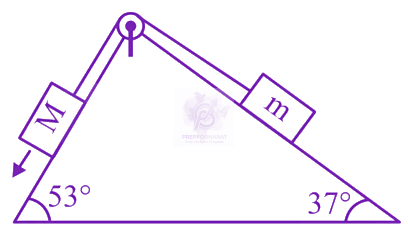
Assuming the earth to be a sphere of uniform mass density, a body weighed $300 \mathrm{~N}$ on the surface of earth. How much it would weigh at R/4 depth under surface of earth ?
Two bodies of mass $4g$ and $25g$ are moving with equal kinetic energies. The ratio of magnitude of their linear momentum is :
A physical quantity $Q$ is found to depend on quantities $a,b,c$ by the relation $Q=\frac{{a}^{4}{b}^{3}}{{c}^{2}}$. The percentage error in $a,b$ and $c$ are $3%,4%$ and $5%$ respectively. Then, the percentage error in $Q$ is:
Three blocks $A,B$ and $C$ are pulled on a horizontal smooth surface by a force of $80N$ as shown in figure. The tensions ${T}_{1}\text{and}{T}_{2}$ in the string are respectively: 
A block of mass $100\mathrm{kg}$ slides over a distance of $10m$ on a horizontal surface. If the co-efficient of friction between the surfaces is $0.4$ , then the work done against friction (in $J$) is:
A body moves on a frictionless plane starting from rest. If $S_n$ is distance moved between $t=n-1$ and $\mathrm{t}=\mathrm{n}$ and $\mathrm{S}_{\mathrm{n}-1}$ is distance moved between $\mathrm{t}=\mathrm{n}-2$ and $\mathrm{t}=\mathrm{n}-1$, then the ratio $\frac{\mathrm{S}_{\mathrm{n}-1}}{\mathrm{~S}_{\mathrm{n}}}$ is $\left(1-\frac{2}{x}\right)$ for $\mathrm{n}=10$. The value of $x$ is ______.
A planet takes $200$ days to complete one revolution around the Sun. If the distance of the planet from Sun is reduced to one fourth of the original distance, how many days will it take to complete one revolution?
Match List I with List II : 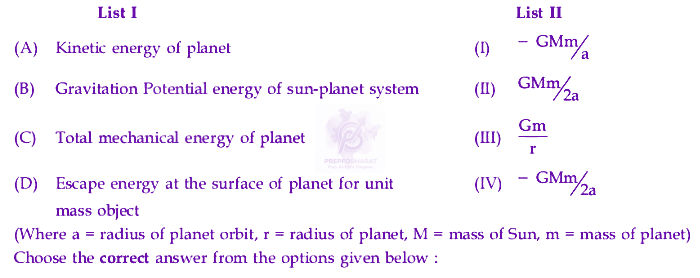
A body of $m \mathrm{~kg}$ slides from rest along the curve of vertical circle from point $A$ to $B$ in friction less path. The velocity of the body at $B$ is: 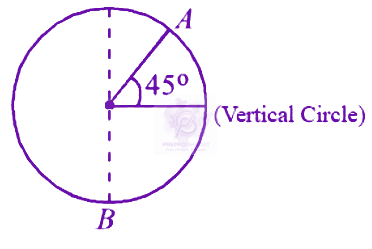 $\text { (given, } R=14 \mathrm{~m}, g=10 \mathrm{~m} / \mathrm{s}^2 \text { and } \sqrt{2}=1.4 \text { ) }$
Given below are two statements: Statement I : If a capillary tube is immersed first in cold water and then in hot water, the height of capillary rise will be smaller in hot water. Statement II : If a capillary tube is immersed first in cold water and then in hot water, the height of capillary rise will be smaller in cold water. In the light of the above statements, choose the most appropriate from the options given below
Correct formula for height of a satellite from earths surface is:
Two metallic wires $P$ and $Q$ have same volume and are made up of same material. If their area of cross sections are in the ratio $4:1$ and force ${F}_{1}$ is applied to $P$, an extension of $\Delta l$ is produced. The force which is required to produce same extension in $Q$ is ${F}_{2}$. The value of $\frac{{F}_{1}}{{F}_{2}}$ is ______.
One end of a metal wire is fixed to a ceiling and a load of $2\mathrm{kg}$ hangs from the other end. A similar wire is attached to the bottom of the load and another load of $1\mathrm{kg}$ hangs from this lower wire. Then the ratio of longitudinal strain of upper wire to that of the lower wire will be [Area of cross section of wire $=0.005{\mathrm{cm}}^{2},Y=2\times {10}^{11}N{m}^{-2}$ and $g=10m{s}^{-2}$]
The equation of state of a real gas is given by $(P+\frac{a}{{V}^{2}})(V-b)=RT$, where $P,V$ and $T$ are pressure, volume and temperature respectively and $R$ is the universal gas constant. The dimensions of $\frac{a}{{b}^{2}}$ is similar to that of :
A light planet is revolving around a massive star in a circular orbit of radius $R$ with a period of revolution $T.$ If the force of attraction between planet and star is proportional to ${R}^{-3/2}$ then choose the correct option :
A small spherical ball of radius $r$, falling through a viscous medium of negligible density has terminal velocity $v$. Another ball of the same mass but of radius $2r$, falling through the same viscous medium will have terminal velocity:
If mass is written as $m=k{c}^{P}{G}^{-1/2}{h}^{1/2}$, then the value of $P$ will be : (Constants have their usual meaning with $k$ a dimensionless constant)
For three vectors $\vec{A}=(-x \hat{i}-6 \hat{j}-2 \hat{k}), \vec{B}=(-\hat{i}+4 \hat{j}+3 \hat{k})$ and $\vec{C}=(-8 \hat{i}-\hat{j}+3 \hat{k})$, if $\vec{A} \cdot(\vec{B} \times \vec{C})=0$, then value of $x$ is _________
The excess pressure inside a soap bubble is thrice the excess pressure inside a second soap bubble. The ratio between the volume of the first and the second bubble is:
Young's modules of material of a wire of length $L$ and cross-sectional area $A$ is $Y.$ If the length of the wire is doubled and cross-sectional area is halved then Young's modules will be:
A car of $800 \mathrm{~kg}$ is taking turn on a banked road of radius $300 \mathrm{~m}$ and angle of banking $30^{\circ}$. If coefficient of static friction is 0.2 then the maximum speed with which car can negotiate the turn safely: $\left(\mathrm{g}=10 \mathrm{~m} / \mathrm{s}^2, \sqrt{3}=1.73\right)$
A wire of length $L$ and radius $r$ is clamped at one end. If its other end is pulled by a force $F$, its length increases by $l$. If the radius of the wire and the applied force both are reduced to half of their original values keeping original length constant, the increase in length will become:
Given below are two statements : Statement (I) : The limiting force of static friction depends on the area of contact and independent of materials. Statement (II) : The limiting force of kinetic friction is independent of the area of contact and depends on materials. In the light of the above statements, choose the most appropriate answer from the options given below :
What is the dimensional formula of $a b^{-1}$ in the equation $\left(\mathrm{P}+\frac{\mathrm{a}}{\mathrm{V}^2}\right)(\mathrm{V}-\mathrm{b})=\mathrm{RT}$, where letters have their usual meaning.
Match List-I with List-II. $\begin{matrix} & \text{ List-I } & & \text{ List-II } \\ \text{ A. } & \text{ Coefficient of viscosity } & \text{ I. } & [{\mathrm{ML}}^{2}{T}^{-2}] \\ \text{ B. } & \text{ Surface Tension } & \text{ II. } & [{\mathrm{ML}}^{2}{T}^{-1}] \\ \text{ C. } & \text{ Angular momentum } & \text{ III. } & [{\mathrm{ML}}^{-1}{T}^{-1}] \\ \text{ D. } & \text{ Rotational kinetic energy } & \text{ IV. } & [{\mathrm{ML}}^{0}{T}^{-2}]\end{matrix}$
A force is represented by $F=a{x}^{2}+b{t}^{\frac{1}{2}}$, where $x=$ distance and $t=$ time. The dimensions of $\frac{{b}^{2}}{a}$ are :
A ball is projected at 45° with speed 20 m/s. Find the maximum height reached (in metres). Take g = 10 m/s².
All surfaces shown in figure are assumed to be frictionless and the pulleys and the string are light. The acceleration of the block of mass $2\mathrm{kg}$ is: 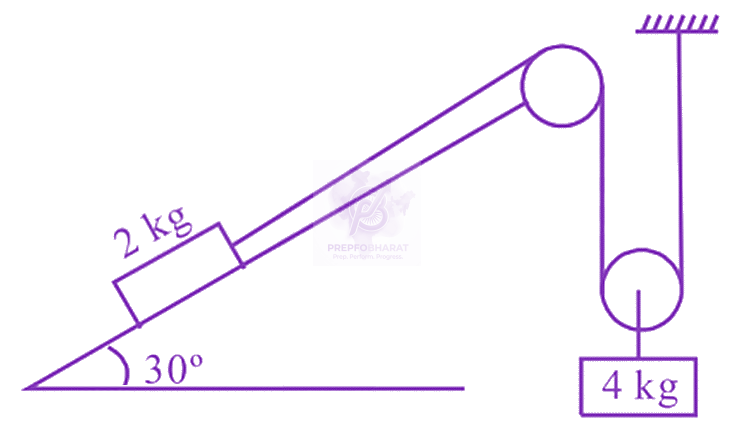
If the radius of curvature of the path of two particles of same mass are in the ratio $3:4$, then in order to have constant centripetal force, their velocities will be in the ratio of:
A block of mass $5\mathrm{kg}$ is placed on a rough inclined surface as shown in the figure. If ${\vec{F}}_{1}$ is the force required to just move the block up the inclined plane and ${\vec{F}}_{2}$ is the force required to just prevent the block from sliding down, then the value of $|{\vec{F}}_{1}|-|{\vec{F}}_{2}|$ is: [Use $g=10m{s}^{-2}$] 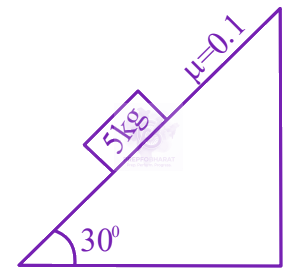
A body of mass $2\mathrm{kg}$ begins to move under the action of a time dependent force given by $\vec{F}=(6t\hat{i}+6{t}^{2}\hat{j})N$. The power developed by the force at the time $t$ is given by:
Given below are two statements : one is labelled as Assertion (A) and the other is labelled as Reason (R). Assertion (A) : The angular speed of the moon in its orbit about the earth is more than the angular speed of the earth in its orbit about the sun. Reason (R): The moon takes less time to move around the earth than the time taken by the earth to move around the sun. In the light of the above statements, choose the most appropriate answer from the options given below :
A vector has magnitude same as that of $\vec{A}=3\hat{j}+4\hat{j}$ and is parallel to $\vec{B}=4\hat{i}+3\hat{j}$. The $x$ and $y$ components of this vector in first quadrant are $x$ and $3$ respectively where $x=$____.
A particle is moving in a straight line. The variation of position $x$ as a function of time $t$ is given as $x=({t}^{3}-6{t}^{2}+20t+15)m$. The velocity of the body when its acceleration becomes zero is:
A body of mass $50 \mathrm{~kg}$ is lifted to a height of $20 \mathrm{~m}$ from the ground in the two different ways as shown in the figures. The ratio of work done against the gravity in both the respective cases, will be : 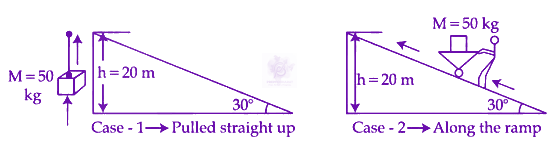
A particle is placed at the point $A$ of a frictionless track $\mathrm{ABC}$ as shown in figure. It is gently pushed towards right. The speed of the particle when it reaches the point $B$ is: $($Take $g=10m{s}^{-2})$. 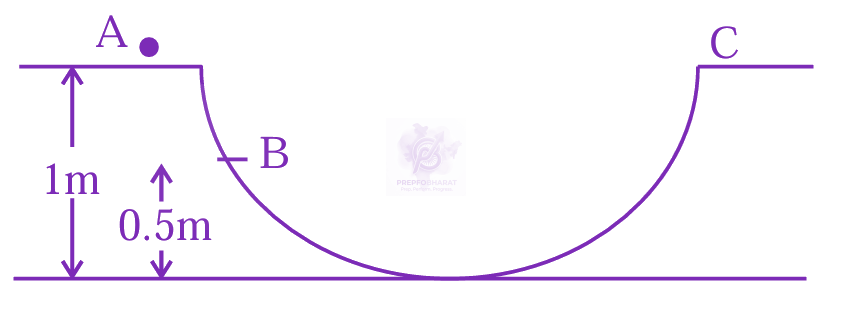
A ball suspended by a thread swings in a vertical plane so that its magnitude of acceleration in the extreme position and lowest position are equal. The angle $(\theta )$ of thread deflection in the extreme position will be :
An elastic spring under tension of $3 \mathrm{~N}$ has a length $a$. Its length is $b$ under tension $2 \mathrm{~N}$. For its length $(3 a-2 b)$, the value of tension will be______$\mathrm{N}$.
If the percentage errors in measuring the length and the diameter of a wire are $0.1%$ each. The percentage error in measuring its resistance will be:
Projectiles $A$ and $B$ are thrown at angles of $45^{\circ}$ and $60^{\circ}$ with vertical respectively from top of a $400m$ high tower. If their times of flight are same, the ratio of their speeds of projection ${v}_{A}:{v}_{B}$ is:
In a system two particles of masses $m_1=3 \mathrm{~kg}$ and $m_2=2 \mathrm{~kg}$ are placed at certain distance from each other. The particle of mass $m_1$ is moved towards the center of mass of the system through a distance $2 \mathrm{~cm}$. In order to keep the center of mass of the system at the original position, the particle of mass $m_2$ should move towards the center of mass by the distance _____ $\mathrm{cm}$.
A liquid column of height $0.04 \mathrm{~cm}$ balances excess pressure of a soap bubble of certain radius. If density of liquid is $8 \times 10^3 \mathrm{~kg} \mathrm{~m}^{-3}$ and surface tension of soap solution is $0.28 \mathrm{Nm}^{-1}$, then diameter of the soap bubble is _____ $\mathrm{cm}$. (if $g=10 \mathrm{~m} \mathrm{~s}^{-2}$ )
Identify the physical quantity that cannot be measured using spherometer :
A string is wrapped around the rim of a wheel of moment of inertia $0.40 \mathrm{kgm}^2$ and radius $10 \mathrm{~cm}$. The wheel is free to rotate about its axis. Initially the wheel is at rest. The string is now pulled by a force of $40 \mathrm{~N}$. The angular velocity of the wheel after $10 \mathrm{~s}$ is $x \mathrm{rad} / \mathrm{s}$, where $x$ is _______
A solid sphere and a hollow cylinder roll up without slipping on same inclined plane with same initial speed $v$. The sphere and the cylinder reaches upto maximum heights $h_1$ and $h_2$, respectively, above the initial level. The ratio $h_1: h_2$ is $\frac{n}{10}$. The value of $n$ is______.
In an experiment to measure focal length $(f)$ of convex lens, the least counts of the measuring scales for the position of object $(\mathrm{u})$ and for the position of image $(\mathrm{v})$ are $\Delta \mathrm{u}$ and $\Delta \mathrm{v}$, respectively. The error in the measurement of the focal length of the convex lens will be:
A satellite of $10^3 \mathrm{~kg}$ mass is revolving in circular orbit of radius $2 R$. If $\frac{10^4 R}{6} J$ energy is supplied to the satellite, it would revolve in a new circular orbit of radius (use $g=10 \mathrm{~m} / \mathrm{s}^2, R=$ radius of earth)
Two planets $A$ and $B$ having masses $m_1$ and $m_2$ move around the sun in circular orbits of $r_1$ and $r_2$ radii respectively. If angular momentum of $A$ is $L$ and that of $B$ is $3 \mathrm{~L}$, the ratio of time period $\left(\frac{T_A}{T_B}\right)$ is:
A vector has magnitude same as that of $\vec{A}=3\hat{j}+4\hat{j}$ and is parallel to $\vec{B}=4\hat{i}+3\hat{j}$. The $x$ and $y$ components of this vector in first quadrant are $x$ and $3$ respectively where $x=$____.
A particle moves in $x-y$ plane under the influence of a force $\vec{F}$ such that its linear momentum is $\overrightarrow{\mathrm{p}}(\mathrm{t})=\hat{i} \cos (\mathrm{kt})-\hat{j} \sin (\mathrm{kt})$. If $\mathrm{k}$ is constant, the angle between $\overrightarrow{\mathrm{F}}$ and $\overrightarrow{\mathrm{p}}$ will be :
If two vectors $\vec{A}$ and $\vec{B}$ having equal magnitude $R$ are inclined at an angle $\theta$, then
If $R$ is the radius of the earth and the acceleration due to gravity on the surface of earth is $g={\pi }^{2}m{s}^{-2}$, then the length of the second's pendulum at a height $h=2R$ from the surface of earth will be:
Three vectors $\overrightarrow{\mathrm{OP}}, \overrightarrow{\mathrm{OQ}}$ and $\overrightarrow{\mathrm{OR}}$ each of magnitude $\mathrm{A}$ are acting as shown in figure. The resultant of the three vectors is $\mathrm{A} \sqrt{x}$. The value of $x$ is ________ . 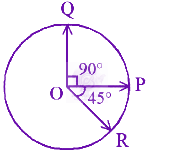
A body starts moving from rest with constant acceleration covers displacement ${S}_{1}$ in first $(p-1)$ seconds and ${S}_{2}$ in first $p$ seconds. The displacement ${S}_{1}+{S}_{2}$ will be made in time :
To find the spring constant $(k)$ of a spring experimentally, a student commits $2 \%$ positive error in the measurement of time and $1 \%$ negative error in measurement of mass. The percentage error in determining value of $k$ is :
A body travels $102.5 \mathrm{~m}$ in $\mathrm{n}^{\text {th }}$ second and $115.0 \mathrm{~m}$ in $(\mathrm{n}+2)^{\text {th }}$ second. The acceleration is :
Time periods of oscillation of the same simple pendulum measured using four different measuring clocks were recorded as $4.62 \mathrm{~s}, 4.632 \mathrm{~s}, 4.6 \mathrm{~s}$ and $4.64 \mathrm{~s}$. The arithmetic mean of these readings in correct significant figure is :
A satellite revolving around a planet in stationary orbit has time period 6 hours. The mass of planet is one-fourth the mass of earth. The radius orbit of planet is : $\left(\right.$ Given $=$ Radius of geo-stationary orbit for earth is $4.2 \times 10^4 \mathrm{~km}$ )
Two forces $\bar{F}_1$ and $\bar{F}_2$ are acting on a body. One force has magnitude thrice that of the other force and the resultant of the two forces is equal to the force of larger magnitude. The angle between $\vec{F}_1$ and $\vec{F}_2$ is $\cos ^{-1}\left(\frac{1}{n}\right)$. The value of $|n|$ is _____.
Three vectors $\overrightarrow{\mathrm{OP}}, \overrightarrow{\mathrm{OQ}}$ and $\overrightarrow{\mathrm{OR}}$ each of magnitude $\mathrm{A}$ are acting as shown in figure. The resultant of the three vectors is $\mathrm{A} \sqrt{x}$. The value of $x$ is ________ . <img src="https://prepforbharat.s3.ap-south-1.amazonaws.com/exam/615f0e999476412f48314daf/Physics/images/Mathematics_in_Physics/6644673e970e6e9ab542d189/question_1__q_6644673e970e6e9ab542d189__cdn-question-pool.getmarks.app__2lVkSARXmD6m9kWJNBuxeqQ9A4nIA-PraY9j4kTNAvM.original.fullsiz__d69eaf474b_final_ppt_sync.png" alt="JEE Main 2024 Physics, Mathematics in Physics — question figure">
A man carrying a monkey on his shoulder does cycling smoothly on a circular track of radius $9 \mathrm{~m}$ and completes 120 resolutions in 3 minutes. The magnitude of centripetal acceleration of monkey is $\left(\right.$ in $\mathrm{m} / \mathrm{s}^2$ ) :
The resistance $R=\frac{V}{I}$, where $V=(200\pm 5)V$ and $I=(20\pm 0.2)A$, the percentage error in the measurement of $R$ is :
Consider two physical quantities $A$ and $B$ related to each other as $E=\frac{B-{x}^{2}}{At}$ where $E,x$ and $t$ have dimensions of energy, length and time respectively. The dimension of $AB$ is
A particle of mass $m$ moves on a straight line with its velocity increasing with distance according to the equation $v=\alpha \sqrt{x}$, where $\alpha$ is a constant. The total work done by all the forces applied on the particle during its displacement from $x=0$ to $x=\mathrm{d}$, will be :
A particle is moving in one dimension (along $x$ axis) under the action of a variable force. It's initial position was $16m$ right of origin. The variation of its position $(x)$ with time $(t)$ is given as $x=–3{t}^{3}+18{t}^{2}+16t,$ where $x$ is in $m$ and $t$ is in $s.$ The velocity of the particle when its acceleration becomes zero is _________ $m{s}^{-1}.$
If $\epsilon_0$ is the permittivity of free space and $\mathrm{E}$ is the electric field, then $\epsilon_0 \mathrm{E}^2$ has the dimensions :
Time periods of oscillation of the same simple pendulum measured using four different measuring clocks were recorded as $4.62 \mathrm{~s}, 4.632 \mathrm{~s}, 4.6 \mathrm{~s}$ and $4.64 \mathrm{~s}$. The arithmetic mean of these readings in correct significant figure is :
For three vectors $\vec{A}=(-x \hat{i}-6 \hat{j}-2 \hat{k}), \vec{B}=(-\hat{i}+4 \hat{j}+3 \hat{k})$ and $\vec{C}=(-8 \hat{i}-\hat{j}+3 \hat{k})$, if $\vec{A} \cdot(\vec{B} \times \vec{C})=0$, then value of $x$ is _________
If two vectors $\vec{A}$ and $\vec{B}$ having equal magnitude $R$ are inclined at an angle $\theta$, then
A big drop is formed by coalescing $1000$ small identical drops of water. If ${E}_{1}$ be the total surface energy of $1000$ small drops of water and ${E}_{2}$ be the surface energy of single big drop of water, the ${E}_{1}$ : ${E}_{2}$ is $x:1$, where $x=$________.
The resultant of two vectors $\vec{A}$ and $\vec{B}$ is perpendicular to $\vec{A}$ and its magnitude is half that of $\vec{B}$. The angle between vectors $\vec{A}$ and $\vec{B}$ is ______ $\circ$.
A bob of mass $m$ is suspended by a light string of length $L$. It is imparted a minimum horizontal velocity at the lowest point $A$ such that it just completes half circle reaching the top most position $B$. The ratio of kinetic energies $\frac{(K.E.{)}_{A}}{(K.E.{)}_{B}}$ is : 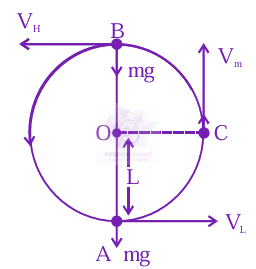
Consider a disc of mass $5\mathrm{kg}$, radius $2m$, rotating with angular velocity of $10\mathrm{rad}{s}^{-1}$ about an axis perpendicular to the plane of rotation. An identical disc is kept gently over the rotating disc along the same axis. The energy dissipated so that both the discs continue to rotate together without slipping is _________$J$. 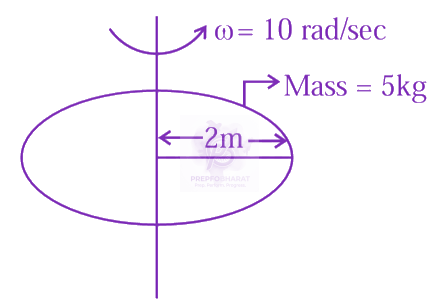
In hydrogen like system the ratio of coul0mbian force and gravitational force between an electron and a proton is in the order of :
Young's modulus is determined by the equation given by $\mathrm{Y}=49000 \frac{\mathrm{m}}{\mathrm{l}} \frac{\mathrm{dyn}}{\mathrm{cm}^2}$ where $M$ is the mass and $l$ is the extension of wire used in the experiment. Now error in Young modules $(Y)$ is estimated by taking data from $M-l$ plot in graph paper. The smallest scale divisions are $5 \mathrm{~g}$ and $0.02 \mathrm{~cm}$ along load axis and extension axis respectively. If the value of $M$ and $l$ are $500 \mathrm{~g}$ and $2 \mathrm{~cm}$ respectively then percentage error of $Y$ is :
A heavy iron bar, of weight $W$ is having its one end on the ground and the other on the shoulder of a person. The bar makes an angle $\theta$ with the horizontal. The weight experienced by the person is :
The density and breaking stress of a wire are $6 \times 10^4 \mathrm{~kg} / \mathrm{m}^3$ and $1.2 \times 10^8 \mathrm{~N} / \mathrm{m}^2$ respectively. The wire is suspended from a rigid support on a planet where acceleration due to gravity is $\frac{1}{3}^{\text {rd }}$ of the value on the surface of earth. The maximum length of the wire with breaking is _____ m (take, $\mathrm{g}=10 \mathrm{~m} / \mathrm{s}^2$ ).
The resistance $R=\frac{V}{I}$, where $V=(200\pm 5)V$ and $I=(20\pm 0.2)A$, the percentage error in the measurement of $R$ is :
A big drop is formed by coalescing 1000 small droplets of water. The ratio of surface energy of 1000 droplets to that of energy of big drop is $\frac{10}{x}$. The value of $x$ is __________
Given below are two statements: Statement I : When speed of liquid is zero everywhere, pressure difference at any two points depends on equation $P_1-P_2=\rho g\left(h_2-h_1\right)$. Statement II : In ventury tube shown $2 \mathrm{gh}=v_1^2-v_2^2$ 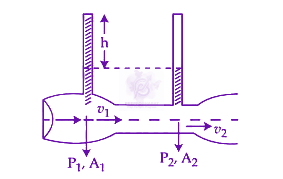 In the light of the above statements, choose the most appropriate answer from the options given below.
If $\mathrm{G}$ be the gravitational constant and $\mathrm{u}$ be the energy density then which of the following quantity have the dimensions as that of the $\sqrt{\mathrm{uG}}$ :
A physical quantity $Q$ is found to depend on quantities $a,b,c$ by the relation $Q=\frac{{a}^{4}{b}^{3}}{{c}^{2}}$. The percentage error in $a,b$ and $c$ are $3%,4%$ and $5%$ respectively. Then, the percentage error in $Q$ is:
In an experiment to measure focal length $(f)$ of convex lens, the least counts of the measuring scales for the position of object $(\mathrm{u})$ and for the position of image $(\mathrm{v})$ are $\Delta \mathrm{u}$ and $\Delta \mathrm{v}$, respectively. The error in the measurement of the focal length of the convex lens will be:
The equation of stationary wave is : $y=2 a \sin \left(\frac{2 \pi n t}{\lambda}\right) \cos \left(\frac{2 \pi x}{\lambda}\right) \text {. }$ Which of the following is NOT correct :
A soap bubble is blown to a diameter of $7 \mathrm{~cm} .36960 \mathrm{erg}$ of work is done in blowing it further. If surface tension of soap solution is $40 \mathrm{dyne} / \mathrm{cm}$ then the new radius is______ $\mathrm{cm}$ Take $\left(\pi=\frac{22}{7}\right)$
A body of mass $M$ thrown horizontally with velocity $v$ from the top of the tower of height $H$ touches the ground at a distance of $100 \mathrm{~m}$ from the foot of the tower. A body of mass $2 \mathrm{M}$ thrown at a velocity $\frac{v}{2}$ from the top of the tower of height $4 \mathrm{H}$ will touch the ground at a distance of _____$\mathrm{m}$.
The angle between vector $\vec{Q}$ and the resultant of $(2 \vec{Q}+2 \vec{P})$ and $(2 \vec{Q}-2 \vec{P})$ is :
A block of mass $1\mathrm{kg}$ is pushed up a surface inclined to horizontal at an angle of $60^{\circ}$ by a force of $10N$ parallel to the inclined surface as shown in figure. When the block is pushed up by $10m$ along inclined surface, the work done against frictional force is : $[g=10m{s}^{-2}]$ 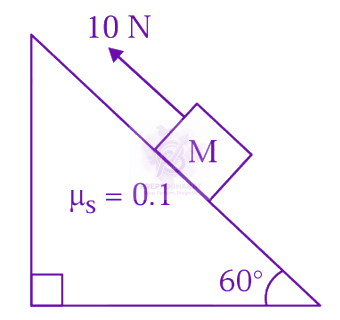
Two satellite $A$ and $B$ go round a planet in circular orbits having radii $4 R$ and $R$ respectively. If the speed of $\mathrm{A}$ is $3 v$, the speed of $\mathrm{B}$ will be :
A hollow sphere is rolling on a plane surface about its axis of symmetry. The ratio of rotational kinetic energy to its total kinetic energy is $\frac{x}{5}$. The value of $x$ is _____ .
An artillery piece of mass ${M}_{1}$ fires a shell of mass ${M}_{2}$ horizontally. Instantaneously after the firing, the ratio of kinetic energy of the artillery and that of the shell is :
Given below are two statements : Statement (I) : Viscosity of gases is greater than that of liquids. Statement (II) : Surface tension of a liquid decreases due to the presence of insoluble impurities. In the light of the above statements, choose the most appropriate answer from the options given below :
Three blocks $M_1, M_2, M_3$ having masses $4 \mathrm{~kg}, 6 \mathrm{~kg}$ and $10 \mathrm{~kg}$ respectively are hanging from a smooth pully using rope 1,2 and 3 as shown in figure. The tension in the rope $1, T_1$ when they are moving upward with acceleration of $2 \mathrm{~ms}^{-2}$ is _____$\mathrm{N}\left(\right.$ if $\mathrm{g}=10 \mathrm{~m} / \mathrm{s}^2$ ). 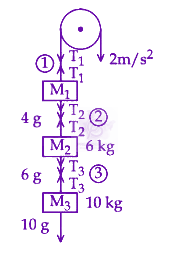
Given below are two statements : Statement I : When a capillary tube is dipped into a liquid, the liquid neither rises nor falls in the capillary. The contact angle may be $0^{\circ}$. Statement II : The contact angle between a solid and a liquid is a property of the material of the solid and liquid as well. In the light of the above statement, choose the correct answer from the options given below.
In an expression $a \times 10^{\mathrm{b}}$;
A plane is in level flight at constant speed and each of its two wings has an area of $40{m}^{2}.$ If the speed of the air is $180\mathrm{km}{h}^{-1}$ over the lower wing surface and $252\mathrm{km}{h}^{-1}$ over the upper wing surface, the mass of the plane is ________$\mathrm{kg}.$ (Take air density to be $1\mathrm{kg}{m}^{–3}$ and $g=10m{s}^{–2}$)
Position of an ant ( $S$ in metres) moving in $Y-Z$ plane is given by $S=2{t}^{2}\hat{j}+5\hat{k}$ (where $t$ is in second). The magnitude and direction of velocity of the ant at $t=1s$ will be :
Two identical spheres each of mass $2\mathrm{kg}$ and radius $50\mathrm{cm}$ are fixed at the ends of a light rod so that the separation between the centers is $150\mathrm{cm}$. Then, moment of inertia of the system about an axis perpendicular to the rod and passing through its middle point is $\frac{x}{20}\mathrm{kg}{m}^{2}$, where the value of $x$ is
A uniform thin metal plate of mass $10 \mathrm{~kg}$ with dimensions is shown. The ratio of $\mathrm{x}$ and $\mathrm{y}$ coordinates of center of mass of plate in $\frac{n}{9}$. The value of $n$ is ________ 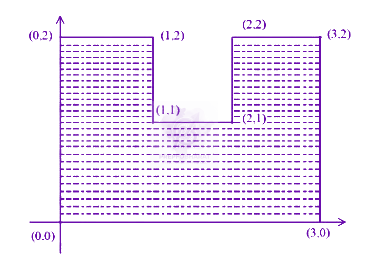
Each of three blocks $P,Q$ and $R$ shown in figure has a mass of $3\mathrm{kg}$. Each of the wire $A$ and $B$ has cross-sectional area $0.005{\mathrm{cm}}^{2}$ and Young's modulus $2\times {10}^{11}N{m}^{-2}$. Neglecting friction, the longitudinal strain on wire $B$ is _____ $\times {10}^{-4}$. (Take $g=10m{s}^{-2}$) 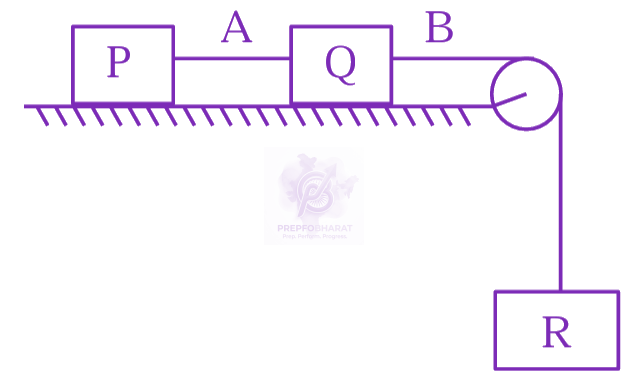
A big drop is formed by coalescing $1000$ small droplets of water. The surface energy will become :
If $\vec{a}$ and $\vec{b}$ makes an angle $\cos ^{-1}\left(\frac{5}{9}\right)$ with each other, then $|\vec{a}+\vec{b}|=\sqrt{2}|\vec{a}-\vec{b}|$ for $|\vec{a}|=n|\vec{b}|$ The integer value of $\mathrm{n}$ is ____
When kinetic energy of a body becomes 36 times of its original value, the percentage increase in the momentum of the body will be:
One main scale division of a vernier caliper is equal to $m$ units. If $\mathrm{n}^{\text {th }}$ division of main scale coincides with $(n+1)^{\text {th }}$ division of vernier scale, the least count of the vernier caliper is :
If the percentage errors in measuring the length and the diameter of a wire are $0.1%$ each. The percentage error in measuring its resistance will be:
A body is moving unidirectionally under the influence of a constant power source. Its displacement in time $\mathrm{t}$ is proportional to :
The angle between vector $\vec{Q}$ and the resultant of $(2 \vec{Q}+2 \vec{P})$ and $(2 \vec{Q}-2 \vec{P})$ is :
Young's modulus is determined by the equation given by $\mathrm{Y}=49000 \frac{\mathrm{m}}{\mathrm{l}} \frac{\mathrm{dyn}}{\mathrm{cm}^2}$ where $M$ is the mass and $l$ is the extension of wire used in the experiment. Now error in Young modules $(Y)$ is estimated by taking data from $M-l$ plot in graph paper. The smallest scale divisions are $5 \mathrm{~g}$ and $0.02 \mathrm{~cm}$ along load axis and extension axis respectively. If the value of $M$ and $l$ are $500 \mathrm{~g}$ and $2 \mathrm{~cm}$ respectively then percentage error of $Y$ is :
An astronaut takes a ball of mass $m$ from earth to space. He throws the ball into a circular orbit about earth at an altitude of $318.5 \mathrm{~km}$. From earth's surface to the orbit, the change in total mechanical energy of the ball is $x \frac{\mathrm{GM}_{\mathrm{e}} \mathrm{m}}{21 \mathrm{R}_{\mathrm{e}}}$. The value of $x$ is (take $\left.\mathrm{R}_{\mathrm{e}}=6370 \mathrm{~km}\right)$ :
A $90 \mathrm{~kg}$ body placed at $2 \mathrm{R}$ distance from surface of earth experiences gravitational pull of : $\text { ( } \mathrm{R}=\text { Radius of earth, } \mathrm{g}=10 \mathrm{~m} \mathrm{~s}^{-2} \text { ) }$
A small steel ball is dropped into a long cylinder containing glycerine. Which one of the following is the correct representation of the velocity time graph for the transit of the ball?
A particle moves in a circle of radius R with constant angular velocity ω. If the centripetal acceleration is 4 m/s² when R = 2 m, what is the angular velocity?
A particle moving in a straight line covers half the distance with speed $6 \mathrm{~m} / \mathrm{s}$. The other half is covered in two equal time intervals with speeds $9 \mathrm{~m} / \mathrm{s}$ and $15 \mathrm{~m} / \mathrm{s}$ respectively. The average speed of the particle during the motion is :
A cylinder is rolling down on an inclined plane of inclination $60^{\circ}$. Its acceleration during rolling down will be $\frac{x}{\sqrt{3}}m{s}^{-2}$, where $x=$ _______(use $g=10m{s}^{-2}$).
The mass of the moon is $\frac{1}{144}$ times the mass of a planet and its diameter $\frac{1}{16}$ times the diameter of a planet. If the escape velocity on the planet is v, the escape velocity on the moon will be:
A particle moves in $x-y$ plane under the influence of a force $\vec{F}$ such that its linear momentum is $\overrightarrow{\mathrm{p}}(\mathrm{t})=\hat{i} \cos (\mathrm{kt})-\hat{j} \sin (\mathrm{kt})$. If $\mathrm{k}$ is constant, the angle between $\overrightarrow{\mathrm{F}}$ and $\overrightarrow{\mathrm{p}}$ will be :
The radius $(r)$, length $(l)$ and resistance $(R)$ of a metal wire was measured in the laboratory as<br>$r=(0.35\pm 0.05)\mathrm{cm}$, $R=(100\pm 10)\mathrm{ohm}$, $l=(15\pm 0.2)\mathrm{cm}$<br>The percentage error in resistivity of the material of the wire is :
The radius $(r)$, length $(l)$ and resistance $(R)$ of a metal wire was measured in the laboratory as $r=(0.35\pm 0.05)\mathrm{cm}$, $R=(100\pm 10)\mathrm{ohm}$, $l=(15\pm 0.2)\mathrm{cm}$ The percentage error in resistivity of the material of the wire is :
The potential energy function (in $J$ ) of a particle in a region of space is given as $U=(2{x}^{2}+3{y}^{3}+2z)$. Here $x,y$ and $z$ are in meter. The magnitude of $x$ - component of force (in $N$ ) acting on the particle at point $P(1,2,3)m$ is:
In an expression $a \times 10^{\mathrm{b}}$;
A ball of mass $0.5\mathrm{kg}$ is attached to a string of length $50\mathrm{cm}$. The ball is rotated on a horizontal circular path about its vertical axis. The maximum tension that the string can bear is $400N$. The maximum possible value of angular velocity of the ball in $\mathrm{rad}{s}^{-1}$ is,:
Two discs of moment of inertia ${I}_{1}=4\mathrm{kg}{m}^{2}$ and ${I}_{2}=2\mathrm{kg}{m}^{2}$ about their central axes & normal to their planes, rotating with angular speeds $10\mathrm{rad}{s}^{-1}&4\mathrm{rad}{s}^{-1}$ respectively are brought into contact face to face with their axe of rotation coincident. The loss in kinetic energy of the system in the process is _________$J$.
Pressure inside a soap bubble is greater than the pressure outside by an amount : (given : $\mathrm{R}=$ Radius of bubble $\mathrm{S}=$ Surface tension of bubble)
Train A is moving along two parallel rail tracks towards north with $72\mathrm{km}{h}^{-1}$ and train $B$ is moving towards south with speed $108\mathrm{km}{h}^{-1}$. Velocity of train $B$ with respect to $A$ and velocity of ground with respect to $B$ are (in $m{s}^{-1}$):
Given below are two statements : Statement I : The contact angle between a solid and a liquid is a property of the material of the solid and liquid as well. Statement II : The rise of a liquid in a capillary tube does not depend on the inner radius of the tube. In the light of the above statements, choose the correct answer from the options given below:
A block of mass $m$ is placed on a surface having vertical cross section given by $y=\frac{{x}^{2}}{4}$. If coefficient of friction is $0.5$, the maximum height above the ground at which block can be placed without slipping is:
The bob of a pendulum was released from a horizontal position. The length of the pendulum is $10m$. If it dissipates $10%$ of its initial energy against air resistance, the speed with which the bob arrives at the lowest point is: [Use, $g=10m{s}^{-2}$ ]
A body of mass $1000\mathrm{kg}$ is moving horizontally with a velocity $6m{s}^{-1}$. If $200\mathrm{kg}$ extra mass is added, the final velocity (in $m{s}^{-1}$) is:
A spherical ball of radius $1 \times 10^{-4} \mathrm{~m}$ and density $10^5 \mathrm{~kg} / \mathrm{m}^3$ falls freely under gravity through a distance $h$ before entering a tank of water, If after entering in water the velocity of the ball does not change, then the value of $h$ is approximately: (The coefficient of viscosity of water is $9.8 \times 10^{-6} \mathrm{~N} \mathrm{~s} / \mathrm{m}^2$ )
If average depth of an ocean is $4000m$ and the bulk modulus of water is $2\times {10}^{9}N{m}^{-2}$, then fractional compression $\frac{\Delta V}{V}$ of water at the bottom of ocean is $\alpha \times {10}^{-2}$. The value of $\alpha$ is _______, (Given, $g=10m{s}^{-2},\rho =1000\mathrm{kg}{m}^{-3}$)
A given object takes $\mathrm{n}$ times the time to slide down $45^{\circ}$ rough inclined plane as it takes the time to slide down an identical perfectly smooth $45^{\circ}$ inclined plane. The coefficient of kinetic friction between the object and the surface of inclined plane is :
A cube of ice floats partly in water and partly in kerosene oil. The ratio of volume of ice immersed in water to that in kerosene oil (specific gravity of Kerosene oil $=0.8$, specific gravity of ice $=0.9$) 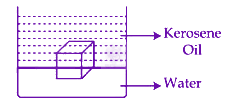
A wire of cross sectional area A, modulus of elasticity $2 \times 10^{11} \mathrm{Nm}^{-2}$ and length $2 \mathrm{~m}$ is stretched between two vertical rigid supports. When a mass of $2 \mathrm{~kg}$ is suspended at the middle it sags lower from its original position making angle $\theta=\frac{1}{100}$ radian on the points of support. The value of $\mathrm{A}$ is _______ $\times 10^{-4} \mathrm{~m}^2$ (consider $x< < \mathrm{L}$ ). (given : $\mathrm{g}=10 \mathrm{~m} / \mathrm{s}^2$ )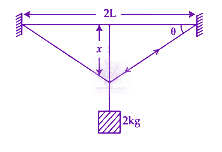
A cricket player catches a ball of mass $120g$ moving with $25m{s}^{-1}$ speed. If the catching process is completed in $0.1s$ then the magnitude of force exerted by the ball on the hand of player will be(in SI unit):
A clock has $75 \mathrm{~cm}, 60 \mathrm{~cm}$ long second hand and minute hand respectively. In 30 minutes duration the tip of second hand will travel $x$ distance more than the tip of minute hand. The value of $x$ in meter is nearly (Take $\pi=3.14$ ) :
The measured value of the length of a simple pendulum is $20\mathrm{cm}$ with $2\mathrm{mm}$ accuracy. The time for $50$ oscillations was measured to be $40$ seconds with $1$ second resolution. From these measurements, the accuracy in the measurement of acceleration due to gravity is $N%$. The value of $N$ is:
Applying the principle of homogeneity of dimensions, determine which one is correct, where $T$ is time period, $G$ is gravitational constant, $M$ is mass, $r$ is radius of orbit.
What is the range of the ball along the inclined plane?
Two blocks of mass $2\mathrm{kg}$ and $4\mathrm{kg}$ are connected by a metal wire going over a smooth pulley as shown in figure. The radius of wire is $4.0\times {10}^{-5}m$ and Young's modulus of the metal is $2.0\times {10}^{11}N{m}^{-2}$. The longitudinal strain developed in the wire is $\frac{1}{\alpha \pi }$. The value of $\alpha$ is _____. [Use $g=10m{s}^{-2}$) 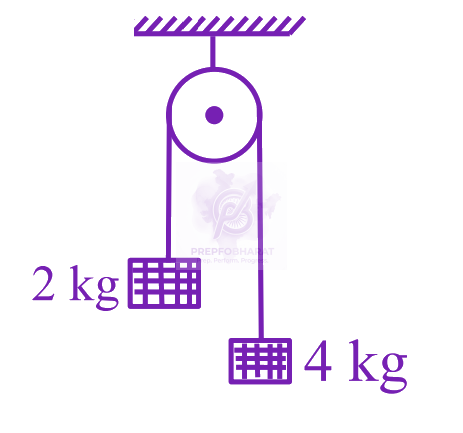
The angle of projection for a projectile to have same horizontal range and maximum height is :
A body falling under gravity covers two points $A$ and $B$ separated by $80m$ in $2s$. The distance of upper point $A$ from the starting point is _____$m$. Use $(g=10m{s}^{-2})$
A stationary particle breaks into two parts of masses $m_A$ and $m_B$ which move with velocities $v_A$ and $v_B$ respectively. The ratio of their kinetic energies $\left(K_B: K_A\right)$ is :
Four identical particles of mass $m$ are kept at the four corners of a square. If the gravitational force exerted on one of the masses by the other masses is $(\frac{2\sqrt{2}+1}{32})\frac{G{m}^{2}}{{L}^{2}}$, the length of the sides of the square is
If a rubber ball falls from a height $h$ and rebounds upto the height of $h / 2$. The percentage loss of total energy of the initial system as well as velocity ball before it strikes the ground, respectively, are :
A coin is placed on a disc. The coefficient of friction between the coin and the disc is $\mu$. If the distance of the coin from the center of the disc is $r$, the maximum angular velocity which can be given to the disc, so that the coin does not slip away, is :
A wooden block of mass $5 \mathrm{~kg}$ rests on a soft horizontal floor. When an iron cylinder of mass $25 \mathrm{~kg}$ is placed on the top of the block, the floor yields and the block and the cylinder together go down with an acceleration of $0.1 \mathrm{~ms}^{-2}$. The action force of the system on the floor is equal to:
A sphere of relative density $\sigma$ and diameter $D$ has concentric cavity of diameter $d$. The ratio of $\frac{D}{d}$, if it just floats on water in a tank is :
The identical spheres each of mass $2M$ are placed at the corners of a right angled triangle with mutually perpendicular sides equal to $4m$ each. Taking point of intersection of these two sides as origin, the magnitude of position vector of the centre of mass of the system is $\frac{4\sqrt{2}}{x}$, where the value of $x$ is ________.
Two cars are travelling towards each other at speed of $20 \mathrm{~m} \mathrm{~s}^{-1}$ each. When the cars are $300 \mathrm{~m}$ apart, both the drivers apply brakes and the cars retard at the rate of $2 \mathrm{~m} \mathrm{~s}^{-2}$. The distance between them when they come to rest is :
The resultant of two vectors $\vec{A}$ and $\vec{B}$ is perpendicular to $\vec{A}$ and its magnitude is half that of $\vec{B}$. The angle between vectors $\vec{A}$ and $\vec{B}$ is ______ $\circ$.
The displacement and the increase in the velocity of a moving particle in the time interval of $t$ to $(t+1)s$ are $125m$ and $50m{s}^{-1}$, respectively. The distance travelled by the particle in $(t+2{)}^{\text{th }}s$ is ___________ $m$.
A spherical body of mass $100g$ is dropped from a height of $10m$ from the ground. After hitting the ground, the body rebounds to a height of $5m$. The impulse of force imparted by the ground to the body is given by: (given $g=9.8m{s}^{-2}$)
There are 100 divisions on the circular scale of a screw gauge of pitch $1 \mathrm{~mm}$. With no measuring quantity in between the jaws, the zero of the circular scale lies 5 divisions below the reference line. The diameter of a wire is then measured using this screw gauge. It is found that 4 linear scale divisions are clearly visible while 60 divisions on circular scale coincide with the reference line. The diameter of the wire is :
The de-Broglie wavelength associated with a particle of mass $m$ and energy $E$ is $h / \sqrt{2 m E}$. The dimensional formula for Planck's constant is :
A ball rolls off the top of a stairway with horizontal velocity $u$. The steps are $0.1m$ high and $0.1m$ wide. The minimum velocity $u$ with which that ball just hits the step $5$ of the stairway will be $\sqrt{x}m{s}^{-1}$, where $x=$_______ [use $g=10m{s}^{-2}$].
A $2 \mathrm{~kg}$ brick begins to slide over a surface which is inclined at an angle of $45^{\circ}$ with respect to horizontal axis. The co-efficient of static friction between their surfaces is:
Match List I with List II $\begin{array}{|l|l|r|l|} \hline \text{ LIST I } & \text{ LIST II } \\ \hline \text{A.} & \text{Torque} & \text{I.} & {\left[M^1 L^1 T^{-2} A^{-2}\right]} \\ \hline \text{B.} & \text{Magnetic field} & \text{II.} & {\left[L^2 A^1\right]} \\ \hline \text{C.} & \text{Magnetic moment} & \text{III.} & {\left[M^1 T^{-2} A^{-1}\right]} \\ \hline \text{D.} & \text{Permeability of free space} & \text{IV.} & {\left[M^1 L^2 T^{-2}\right]} \\ \hline \end{array}$ Choose the correct answer from the options given below:
A particle is moving in a circle of radius $50\mathrm{cm}$ in such a way that at any instant the normal and tangential components of its acceleration are equal. If its speed at $t=0$ is $4m{s}^{-1}$, the time taken to complete the first revolution will be $\frac{1}{\alpha }[1-{e}^{-2\pi }]s$, where $\alpha =$______.
Given below are two statements : one is labelled as Assertion (A) and the other is labelled as Reason (R) Assertion (A) : The property of body, by virtue of which it tends to regain its original shape when the external force is removed, is Elasticity. Reason (R) : The restoring force depends upon the bonded inter atomic and inter molecular force of solid. In the light of the above statements, choose the correct answer from the options given below :
The reading of pressure metre attached with a closed pipe is $4.5\times {10}^{4}N{m}^{-2}$. On opening the valve, water starts flowing and the reading of pressure metre falls to $2.0\times {10}^{4}N{m}^{-2}$. The velocity of water is found to be $\sqrt{V}m{s}^{-1}$. The value of $V$ is _________.
The depth below the surface of sea to which a rubber ball be taken so as to decrease its volume by $0.02%$ is _____ $m$. (Take density of sea water $={10}^{3}\mathrm{kg}{m}^{-3}$, Bulk modulus of rubber $=9\times {10}^{8}N{m}^{-2}$, and $g=10m{s}^{-2}$)
A bullet of mass $50 \mathrm{~g}$ is fired with a speed $100 \mathrm{~m} / \mathrm{s}$ on a plywood and emerges with $40 \mathrm{~m} / \mathrm{s}$. The percentage loss of kinetic energy is :
A particle moving in a circle of radius $R$ with uniform speed takes time $T$ to complete one revolution. If this particle is projected with the same speed at an angle $\theta$ to the horizontal, the maximum height attained by it is equal to $4R$. The angle of projection $\theta$ is then given by :
A body starts falling freely from height $H$ hits an inclined plane in its path at height $h$. As a result of this perfectly elastic impact, the direction of the velocity of the body becomes horizontal. The value of $\frac{H}{h}$ for which the body will take the maximum time to reach the ground is _____.
A cyclist starts from the point $P$ of a circular ground of radius $2 \mathrm{~km}$ and travels along its circumference to the point $\mathrm{S}$. The displacement of a cyclist is: 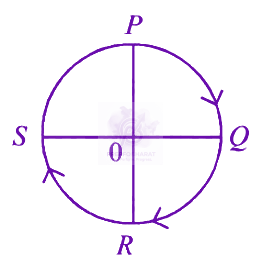
The acceleration due to gravity on the surface of earth is $g$. If the diameter of earth reduces to half of its original value and mass remains constant, then acceleration due to gravity on the surface of earth would be :
A light string passing over a smooth light fixed pulley connects two blocks of masses ${m}_{1}$ and ${m}_{2}$. If the acceleration of the system is $\frac{g}{8}$, then the ratio of masses is 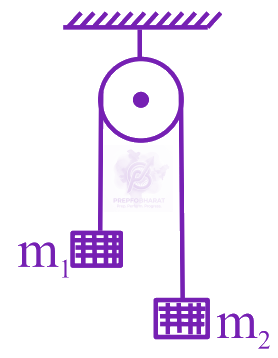
A disc of radius $R$ and mass $M$ is rolling horizontally without slipping with speed $v$. It then moves up an inclined smooth surface as shown in figure. The maximum height that the disc can go up the incline is: 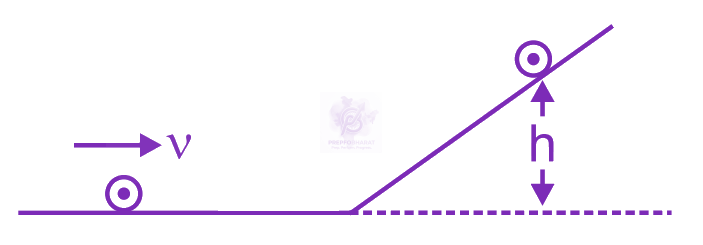
Ratio of radius of gyration of a hollow sphere to that of a solid cylinder of equal mass, for moment of Inertia about their diameter axis $\mathrm{AB}$ as shown in figure is $\sqrt{8 / x}$. The value of $x$ is : 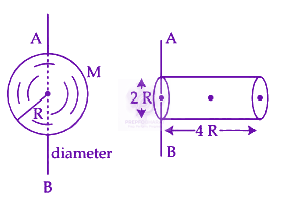
A thin circular disc of mass $M$ and radius $R$ is rotating in a horizontal plane about an axis passing through its centre and perpendicular to its plane with angular velocity $\omega$. If another disc of same dimensions but of mass $\mathrm{M} / 2$ is placed gently on the first disc co-axially, then the new angular velocity of the system is :
To find the spring constant $(k)$ of a spring experimentally, a student commits $2 \%$ positive error in the measurement of time and $1 \%$ negative error in measurement of mass. The percentage error in determining value of $k$ is :
Given below are two statements: Statement (I) : Planck's constant and angular momentum have the same dimensions. Statement (II) : Linear momentum and moment of force have the same dimensions. In light of the above statements, choose the correct answer from the options given below :
In a test experiment on a model aeroplane in wind tunnel, the flow speeds on the upper and lower surfaces of the wings are $70m{s}^{-1}$ and $65m{s}^{-1}$ respectively. If the wing area is $2{m}^{2}$, the lift of the wing is _______$N$. (Given density of air $=1.2\mathrm{kg}{m}^{-3}$)
A particle starts from origin at $t=0$ with a velocity $5\hat{i}m{s}^{-1}$ and moves in $x-y$ plane under action of a force which produces a constant acceleration of $(3\hat{i}+2\hat{j})m{s}^{-2}$. If the $x$-coordinate of the particle at that instant is $84m$, then the speed of the particle at this time is $\sqrt{\alpha }m{s}^{-1}$. The value of $\alpha$ is _______.
With rise in temperature, the Young's modulus of elasticity
A light unstretchable string passing over a smooth light pulley connects two blocks of masses $m_1$ and $m_2$. If the acceleration of the system is $\frac{g}{8}$, then the ratio of the masses $\frac{m_2}{m_1}$ is :
Two forces $\bar{F}_1$ and $\bar{F}_2$ are acting on a body. One force has magnitude thrice that of the other force and the resultant of the two forces is equal to the force of larger magnitude. The angle between $\vec{F}_1$ and $\vec{F}_2$ is $\cos ^{-1}\left(\frac{1}{n}\right)$. The value of $|n|$ is _____.
Match List-I with List-II : $\begin{array}{|c|c|c|c|} \hline & \text { List-I } & & \text { List-II } \\ \hline \text { (A) } & \text { A force that restores an elastic body of unit area to its original state } & \text { (I) } & \text { Bulk modulus } \\ \hline \text { (B) } & \text { Two equal and opposite forces parallel to opposite faces } & \text { (II) } & \text { Young's modulus } \\ \hline \text { (C) } & \begin{array}{l} \text { Forces perpendicular everywhere to the surface per unit area } \\ \text { same everywhere } \end{array} & \text { (III) } & \text { Stress } \\ \hline \text { (D) } & \text { Two equal and opposite forces perpendicular to opposite faces } & \text { (IV) } & \text { Shear modulus } \\ \hline \end{array}$ Choose the correct answer from the options given below :
A particle initially at rest starts moving from reference point $x=0$ along $x$-axis, with velocity $v$ that varies as $v=4\sqrt{x}m{s}^{-1}$. The acceleration of the particle is _____ $m{s}^{-2}$.
A body of mass $m$ is projected with a speed $u$ making an angle of ${45}^{o}$ with the ground. The angular momentum of the body about the point of projection, at the highest point is expressed as $\frac{\sqrt{2}m{u}^{3}}{Xg}$. The value of $X$ is_______.
A light string passing over a smooth light pulley connects two blocks of masses $m_1$ and $m_2$ (where $m_2>m_1$ ). If the acceleration of the system is $\frac{g}{\sqrt{2}}$, then the ratio of the masses $\frac{m_1}{m_2}$ is:
A vernier callipers has 20 divisions on the vernier scale, which coincides with $19^{\text {th }}$ division on the main scale. The least count of the instrument is $0.1 \mathrm{~mm}$. One main scale division is equal to _____$\mathrm{mm}$.
A player caught a cricket ball of mass $150 \mathrm{~g}$ moving at a speed of $20 \mathrm{~m} / \mathrm{s}$. If the catching process is completed in $0.1 \mathrm{~s}$, the magnitude of force exerted by the ball on the hand of the player is:
The diameter of a sphere is measured using a vernier caliper whose 9 divisions of main scale are equal to 10 divisions of vernier scale. The shortest division on the main scale is equal to $1 \mathrm{~mm}$. The main scale reading is $2 \mathrm{~cm}$ and second division of vernier scale coincides with a division on main scale. If mass of the sphere is 8.635 g, the density of the sphere is:
A body of mass $4\mathrm{kg}$ experiences two forces ${\vec{F}}_{1}=5\hat{i}+8\hat{j}+7\hat{k}$ and ${\vec{F}}_{2}=3\hat{i}-4\hat{j}-3\hat{k.}$ The acceleration acting on the body is:
A heavy iron bar of weight $12\mathrm{kg}$ is having its one end on the ground and the other on the shoulder of a man. The rod makes an angle $60^{\circ}$ with the horizontal, the normal force applied by the man on bar is:
The maximum height reached by a projectile is $64 \mathrm{~m}$. If the initial velocity is halved, the new maximum height of the projectile is _____ $\mathrm{m}$.
If the radius of earth is reduced to three-fourth of its present value without change in its mass then value of duration of the day of earth will be ______ hours 30 minutes.
A $1 \mathrm{~kg}$ mass is suspended from the ceiling by a rope of length $4 \mathrm{~m}$. A horizontal force ' $F$ ' is applied at the mid point of the rope so that the rope makes an angle of $45^{\circ}$ with respect to the vertical axis as shown in figure. The magnitude of $F$ is : (Assume that the system is in equilibrium and $g=10 \mathrm{~m} / \mathrm{s}^2$ ) 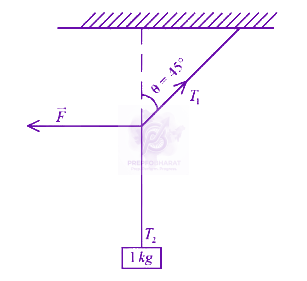
The relation between time ‘$t$’ and distance ‘$x$’ is $t=\alpha {x}^{2}+\beta x$, where $\alpha$ and $\beta$ are constants. The relation between acceleration $(a)$ and velocity $(v)$ is:
A particle of mass $m$ projected with a velocity $u$ making an angle of $30^{\circ}$ with the horizontal. The magnitude of angular momentum of the projectile about the point of projection when the particle is at its maximum height $h$ is :
A uniform rod $AB$ of mass $2\mathrm{kg}$ and Length $30\mathrm{cm}$ at rest on a smooth horizontal surface. An impulse of force $0.2Ns$ is applied to end B. The time taken by the rod to turn through at right angles will be $\frac{\pi }{x}s,$ where $x=$ ____.
The gravitational potential at a point above the surface of earth is $-5.12\times {10}^{7}J{\mathrm{kg}}^{-1}$ and the acceleration due to gravity at that point is $6.4m{s}^{-2}$. Assume that the mean radius of earth to be $6400\mathrm{km}$. The height of this point above the earth's surface is:
Two persons pull a wire towards themselves. Each person exerts a force of $200 \mathrm{~N}$ on the wire. Young's modulus of the material of wire is $1 \times 10^{11} \mathrm{~N} \mathrm{~m}^{-2}$. Original length of the wire is $2 \mathrm{~m}$ and the area of cross section is $2 \mathrm{~cm}^2$. The wire will extend in length by ______ $\mu \mathrm{m}$.
A simple pendulum doing small oscillations at a place $\mathrm{R}$ height above earth surface has time period of $T_1=4 \mathrm{~s}$. $T_2$ would be it's time period if it is brought to a point which is at a height $2 \mathrm{R}$ from earth surface. Choose the correct relation $[R=$ radius of earth $]$ :
Least count of a vernier caliper is $\frac{1}{20 \mathrm{~N}} \mathrm{~cm}$. The value of one division on the main scale is $1 \mathrm{~mm}$. Then the number of divisions of main scale that coincide with $\mathrm{N}$ divisions of vernier scale is :
While measuring diameter of wire using screw gauge the following readings were noted. Main scale reading is $1 \mathrm{~mm}$ and circular scale reading is equal to 42 divisions. Pitch of screw gauge is $1 \mathrm{~mm}$ and it has 100 divisions on circular scale. The diameter of the wire is $\frac{x}{50} \mathrm{~mm}$. The value of $x$ is :
Small water droplets of radius $0.01 \mathrm{~mm}$ are formed in the upper atmosphere and falling with a terminal velocity of $10 \mathrm{~cm} / \mathrm{s}$. Due to condensation, if 8 such droplets are coalesced and formed a larger drop, the new terminal velocity will be _____$\mathrm{cm} / \mathrm{s}$.
A bullet is fired into a fixed target looses one third of its velocity after travelling $4\mathrm{cm}$. It penetrates further $D\times {10}^{-3}m$ before coming to rest. The value of $D$ is :
Four particles, each of mass $1\mathrm{kg}$ are placed at four corners of a square of side $2m$. The moment of inertia of the system about an axis perpendicular to its plane and passing through one of its vertex is $______\mathrm{kg}{m}^{2}$.
A small liquid drop of radius $R$ is divided into $27$ identical liquid drops. If the surface tension is $T$, then the work done in the process will be :
A force $\left(3 x^2+2 x-5\right) \mathrm{N}$ displaces a body from $x=2 \mathrm{~m}$ to $x=4 \mathrm{~m}$. Work done by this force is ________ $J$.
$10$ divisions on the main scale of a Vernier calliper coincide with $11$ divisions on the Vernier scale. If each division on the main scale is of $5$ units, the least count of the instrument is :
Three bodies A, B and C have equal kinetic energies and their masses are $400 \mathrm{~g}$. $1.2 \mathrm{~kg}$ and $1.6 \mathrm{~kg}$ respectively. The ratio of their linear momenta is :
Correct Bernoulli's equation is (symbols have their usual meaning) :
In a vernier calliper, when both jaws touch each other, zero of the vernier scale shifts towards left and its $4^{\text {th }}$ division coincides exactly with a certain division on main scale. If 50 vernier scale divisions equal to 49 main scale divisions and zero error in the instrument is $0.04 \mathrm{~mm}$ then how many main scale divisions are there in $1 \mathrm{~cm}$ ?
A circular disc reaches from top to bottom of an inclined plane of length $l$. When it slips down the plane, if takes $t \mathrm{~s}$. When it rolls down the plane then it takes $\left(\frac{\alpha}{2}\right)^{1 / 2} t \mathrm{~s}$, where $\alpha$ is _________
A simple pendulum of length $1m$ has a wooden bob of mass $1\mathrm{kg}$. It is struck by a bullet of mass ${10}^{-2}\mathrm{kg}$ moving with a speed of $2\times {10}^{2}m{s}^{-1}$. The bullet gets embedded into the bob. The height to which the bob rises before swinging back is. (use $g=10m{s}^{-2}$)
A small ball of mass $m$ and density $\rho$ is dropped in a viscous liquid of density $\rho_0$. After sometime, the ball falls with constant velocity. The viscous force on the ball is :
A wooden block, initially at rest on the ground, is pushed by a force which increases linearly with time $t$. Which of the following curve best describes acceleration of the block with time:
A train starting from rest first accelerates uniformly up to a speed of $80 \mathrm{~km} / \mathrm{h}$ for time $t$, then it moves with a constant speed for time $3 t$. The average speed of the train for this duration of journey will be (in $\mathrm{km} / \mathrm{h}$ ) :
Three balls of masses $2 \mathrm{~kg}, 4 \mathrm{~kg}$ and $6 \mathrm{~kg}$ respectively are arranged at centre of the edges of an equilateral triangle of side $2 \mathrm{~m}$. The moment of intertia of the system about an axis through the centroid and perpendicular to the plane of triangle, will be _______ $\mathrm{kg} \mathrm{m}^2$.
If $50$ Vernier divisions are equal to $49$ main scale divisions of a travelling microscope and one smallest reading of main scale is $0.5\mathrm{mm}$ the Vernier constant of travelling microscope is:
Escape velocity of a body from earth is $11.2\mathrm{km}{s}^{-1}$. If the radius of a planet be one-third the radius of earth and mass be one-sixth that of earth, the escape velocity from the plate is:
A heavy box of mass $50 \mathrm{~kg}$ is moving on a horizontal surface. If co-efficient of kinetic friction between the box and horizontal surface is 0.3 then force of kinetic friction is :
A bus moving along a straight highway with speed of $72 \mathrm{~km} / \mathrm{h}$ is brought to halt within $4 s$ after applying the brakes. The distance travelled by the bus during this time (Assume the retardation is uniform) is _____m.
A ring and a solid sphere roll down the same inclined plane without slipping. They start from rest. The radii of both bodies are identical and the ratio of their kinetic energies is $\frac{7}{x}$, where $x$ is ______.
The dimensional formula of angular impulse is :
A particle moves in a straight line so that its displacement $x$ at any time $t$ is given by $x^2=1+t^2$. Its acceleration at any time $\mathrm{t}$ is $x^{-\mathrm{n}}$ where $\mathrm{n}=$ ___________
The co-ordinates of a particle moving in $x-y$ plane are given by : $x=2+4 \mathrm{t}, y=3 \mathrm{t}+8 \mathrm{t}^2$. The motion of the particle is :
At what distance above and below the surface of the earth a body will have same weight? (Take radius of earth as $R$)
Match List - I with List - II.<br><table class="pyq-table"><tbody><tr><td colspan="2" rowspan="1">List - I (Number)</td><td colspan="2" rowspan="1">List - II (Signficant figure)</td></tr><tr><td>(A)</td><td>$1001$</td><td>(I)</td><td>$3$</td></tr><tr><td>(B)</td><td>$010.1$</td><td>(II)</td><td>$4$</td></tr><tr><td>(C)</td><td>$100.100$</td><td>(III)</td><td>$5$</td></tr><tr><td>(D)</td><td>$0.0010010$</td><td>(IV)</td><td>$6$</td></tr></tbody></table>Choose the correct answer from the options given below:
Consider a block and trolley system as shown in figure. If the coefficient of kinetic friction between the trolley and the surface is $0.04$, the acceleration of the system in $m{s}^{-2}$ is: (Consider that the string is massless and unstretchable and the pulley is also massless and frictionless) : 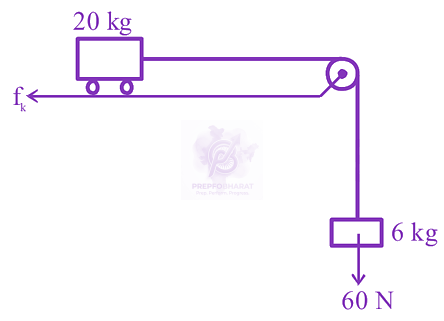
A circular table is rotating with an angular velocity of $\omega \mathrm{rad} / \mathrm{s}$ about its axis (see figure). There is a smooth groove along a radial direction on the table. A steel ball is gently placed at a distance of $1 \mathrm{~m}$ on the groove. All the surfaces are smooth. If the radius of the table is $3 \mathrm{~m}$, the radial velocity of the ball w.r.t. the table at the time ball leaves the table is $x \sqrt{2} \omega \mathrm{m} / \mathrm{s}$, where the value of $x$ is _____. 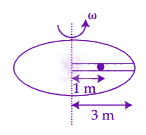
A metal wire of uniform mass density having length $L$ and mass $M$ is bent to form a semicircular arc and a particle of mass $\mathrm{m}$ is placed at the centre of the arc. The gravitational force on the particle by the wire is :
A body of weight $200 \mathrm{~N}$ is suspended from a tree branch through a chain of mass $10 \mathrm{~kg}$. The branch pulls the chain by a force equal to (if $g=10 \mathrm{~m} / \mathrm{s}^2$ ) :
Given below are two statements: one is labelled as Assertion(A) and the other is labelled as Reason (R). Assertion (A) : In Vernier calliper if positive zero error exists, then while taking measurements, the reading taken will be more than the actual reading. Reason (R) : The zero error in Vernier Calliper might have happened due to manufacturing defect or due to rough handling. In the light of the above statements, choose the correct answer from the options given below :
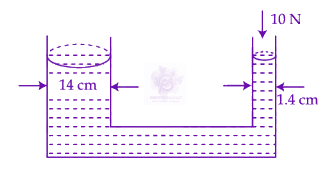 A hydraulic press containing water has two arms with diameters as mentioned in the figure. A force of $10 \mathrm{~N}$ is applied on the surface of water in the thinner arm. The force required to be applied on the surface of water in the thicker arm to maintain equilibrium of water is _____N.
A train is moving with a speed of $12m{s}^{-1}$ on rails which are $1.5m$ apart. To negotiate a curve radius $400m$, the height by which the outer rail should be raised with respect to the inner rail is (Given, $g=$ $10m{s}^{-2}$):
A stone of mass $900g$ is tied to a string and moved in a vertical circle of radius $1m$ making $10\mathrm{rpm}$. The tension in the string, when the stone is at the lowest point is (if ${\pi }^{2}=9.8$ and $g=9.8m{s}^{-2}$)
A solid circular disc of mass $50\mathrm{kg}$ rolls along a horizontal floor so that its center of mass has a speed of $0.4m{s}^{-1}$. The absolute value of work done on the disc to stop it is ______ $J$.
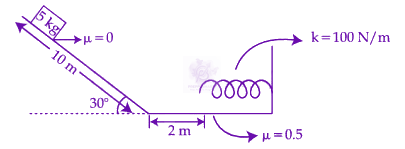 A block is simply released from the top of an inclined plane as shown in the figure above. The maximum compression in the spring when the block hits the spring is :