JEE Main 2019 — Mechanics
Physics Mechanics questions from JEE Main 2019.
Other Years
163 Mechanics Questions from 2019
A body of mass 2 kg is moving with velocity 3 m/s. The force required to stop it in 2 seconds is:
If speed (V), acceleration (A) and force (F) are considered as fundamental units, the dimension of Young's modulus will be :
A block kept on a rough inclined plane, as shown in the figure, remains at rest upto a maximum force $2N$ down the inclined plane. The maximum external force up the inclined plane that does not move the block is $10N.$ The coefficient of static friction between the block and the plane is: [Take $g=10 m/{s}^{2}$ ] 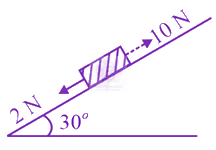
A wooden block floating in a bucket of water has $\frac{4}{5}$ of its volume submerged. When certain amount of an oil is poured into the bucket, it is found that the block is just under the oil surface with half of its volume under water and half in oil. The density of oil relative to that of water is:
Three blocks $A, B$ and $C$ are lying on a smooth horizontal surface, as shown in the figure. $A$ and $B$ have equal masses, $m$ while $C$ has mass $M.$ Block $A$ is given an initial speed $v$ towards $B$ due to which it collides with $B$ perfectly inelastically. The combined mass collides with $C,$ also perfectly inelastically . $\frac{5}{6}\text{t}\text{h}$ of the initial kinetic energy is lost in the whole process. What is the value of $M/m$? 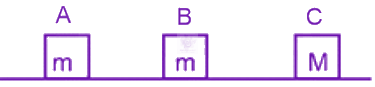
A particle which is experiencing a force, given by $\vec{F}=3\hat{i}-12\hat{j}$, undergoes a displacement of $\vec{d}=4\hat{i}$. If the particle had a kinetic energy of $3J$ at the beginning of the displacement, what is its kinetic energy at the end of the displacement?
A thin disc of mass $M$ and radius $R$ has mass per unit area $\sigma (r)=k{r}^{2}$ where $r$ is the distance from its centre. Its moment inertia about an axis going through its centre of mass and perpendicular to its plane is:
In the experimental set up of metre bridge shown in the figure, the null point is obtaine data distance of $40 \mathrm{~cm}$ from A. If a $10 \Omega$ resistor is connected in series with $\mathrm{R}_{1},$ the null point shifts by $10 \mathrm{~cm}$. The resistance that should be connected in parallel with $\left(\mathrm{R}_{1}+10\right) \Omega$ such that the null point shifts back to its initial position is 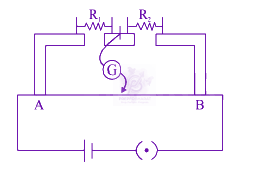
A body of mass $2 kg$ makes an elastic collision with a second body at rest and continues to move in the original direction but with one fourth of its original speed. What is the mass of the second body?
Let the moment of inertia of a hollow cylinder of length $30 cm$ (inner radius $10 cm$ and outer radius $20 cm$ ), about its axis be $\text{I}$ . The radius of a thin cylinder of the same mass such that its moment of inertia about its axis is also $\text{I},$ is:
Two stars of masses $3\times {10}^{31}\mathrm{kg}$ each, and at distance $2\times {10}^{11}m$ rotate in a plane about their common centre of mass $O.$ A meteorite passes through $O$ moving perpendicular to the stars,s rotation plane. In order to escape from the gravitational field of this double star, the minimum speed that meteorite should have at $O$ is ( Take Gravitational constant $G=6.67\times {10}^{-11}N{m}^{2}{\mathrm{kg}}^{-2}$)
Three particles of masses $50 g$, $100 g$ and $150 g$ are placed at the vertices of an equilateral triangle of side $1 m$ (as shown in the figure). The $(x, y)$ coordinates of the centre of mass will be: 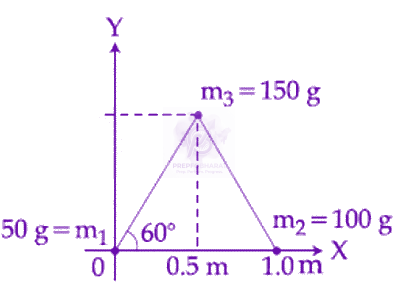
A load of mass $M kg$ is suspended from a steel wire of length $2m$ and radius $1.0 mm$ in Searle's apparatus experiment. The increase in length produced in the wire is $4.0 mm.$ Now the load is fully immersed in a liquid of relative density $2.$ The relative density of the material of load is $8.$ The new value of increase in length of the steel wire is:
A person standing on an open ground hears the sound of a jet aeroplane, coming from north at an angle ${60}^{o}$ with ground level, but he finds the aeroplane right vertically above his position. If $v$ is the speed of sound, speed of the plane is:
The ratio of surface tensions of mercury and water is given to be $7.5$, while the ratio of their densities is $13.6$. Their contact angles, with glass, are close to $135^{\circ}$ and $0^{\circ}$, respectively. If it is observed that mercury gets depressed by an amount $h$ in a capillary tube of radius ${r}_{1}$, while water rises by the same amount $h$ in a capillary tube of radius ${r}_{2}$, then the ratio $\frac{{r}_{1}}{{r}_{2}}$ is close to
The position co-ordinates of a particle moving in a $3D$ coordinate system is given by $x=a\mathrm{cos}\omega t$ $y=a\mathrm{sin}\omega t$ and $z=a\omega t$ The speed of the particle is:
A body is projected at $t=0$ with a velocity $10 \mathrm{~ms}^{-1}$ at an angle of $60^{\circ}$ with the horizontal. The radius of curvature of its trajectory at $t=1$ s is $R$. Neglecting air resistance and taking acceleration due to gravity $\mathrm{g}=10 \mathrm{~ms}^{-2}$, the value of $R$ is:
The position of a particle as a function of time $t,$ is given by $x(t)=at+b{t}^{2}-c{t}^{3}$ where $a, b$ and $c$ are constants. When the particles zero acceleration, then its velocity will be:
If the angular momentum of a planet of mass $m,$ moving around the Sun in a circular orbit is $L,$ about the center of the Sun, its areal velocity is:
A smooth wire of length $2\pi r$ is bent into a circle and kept in a vertical plane. A bead can slide smoothly on the wire. When the circle is rotating with angular speed $\omega$ about the vertical diameter $AB,$ as shown in figure, the bead is at rest with respect to the circular ring at position $P$ as shown. Then the value of ${\omega }^{2}$ is equal to: 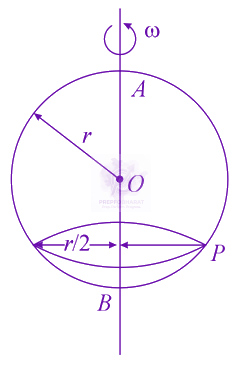
A man (mass $=50 kg$ ) and his son (mass $=20 kg$ ) are standing on a frictionless surface facing each other. The man pushes his son so that he starts moving at a speed of $0.70 m {s}^{-1}$ with respect to the man. The speed of the man with respect to the surface is:
A block of mass $10 kg$ is kept on a rough inclined plane as shown in the figure. A force of $3 N$ is applied on the block. The coefficient of static friction between the plane and the block is $0.6.$ What should be the minimum value of force $P,$ such that the block does not move downward? (take $g=10 m{s}^{-2}$ ) 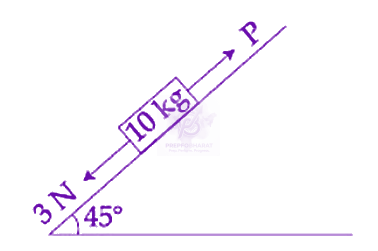
A particle of mass $20 g$ is released with an initial velocity $5 m{s}^{-1}$ along the curve from the point $A,$ as shown in the figure. The point $A$ is at height $h$ from point $B.$ The particle slides along the frictionless surface. When the particle reaches point $B,$ its angular momentum about $O$ will be: (Take $g=10 m{s}^{-2}$) 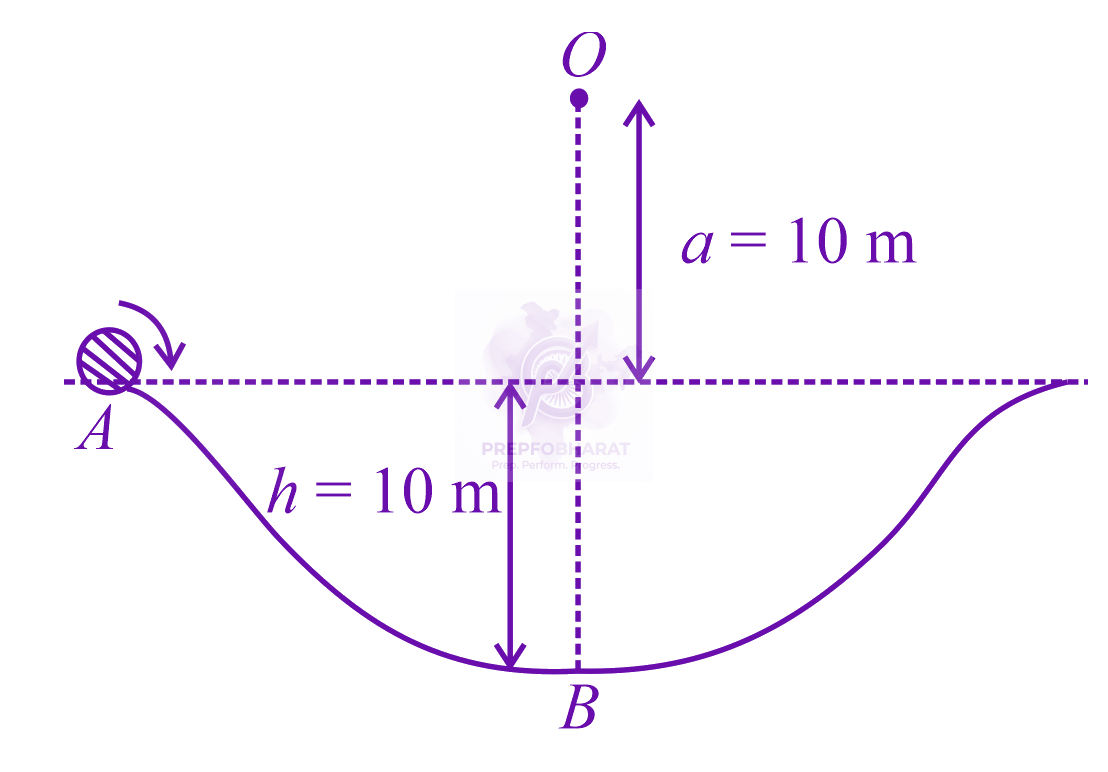
In the formula $X=5Y{Z}^{2}$ , $X$ and $Z$ have dimensions of capacitance and magnetic field, respectively. What are the dimensions of $Y$ in SI units?
In a simple pendulum experiment for determination of acceleration due to gravity $(g)$, time taken for $20$ oscillations is measures by using a watch of $1$ second least count. The mean value of time taken comes out to be $30 s$. The length of the pendulum is measured by using a meter scale of least count $1 mm$ and the value obtained is $55.0 cm$. The percentage error in the determination of $g$ is close to
A rod of length $50 cm$ is pivoted at one end. It is raised such that it makes an angle of ${30}^{o}$ from the horizontal as shown and released from rest. Its angular speed when it passes through the horizontal (in $rad {s}^{-1}$ ) will be $(g=10 m{s}^{-2})$ 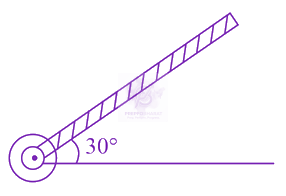
A simple pendulum, made of a string of length $l$ and $a$ bob of mass $m,$ is released from a small angle ${\theta }_{0}.$ It strikes a block of mass $M,$ kept on horizontal surface at its lowest point of oscillations, elastically. It bounces back and goes up to an angle ${\theta }_{1}.$ Then $M$ is given by:
A body of mass ${m}_{1}$ moving with an unknown velocity of ${v}_{1} \hat{i},$ undergoes a collinear collision with a body of mass ${m}_{2}$ moving with a velocity ${v}_{2} \hat{i}.$ After the collision, ${m}_{1}$ and ${m}_{2}$ move with velocities of ${v}_{3} \hat{i}$ and ${v}_{4} \hat{i},$ respectively. If ${m}_{2}=0.5 {m}_{1}$ and ${v}_{3}=0.5 {v}_{1},$ then ${v}_{1}$ is:
A spaceship orbits around a planet at a height of $20 km$ from its surface. Assuming that only gravitational field of the planet acts on the spaceship, what will be the number of complete revolutions made by the spaceship in $24$ hours around the planet? [Given: Mass of planet $=8\times {10}^{22} kg$ , Radius of planet $=2\times {10}^{6} m,$ Gravitational constant $G=6.67\times {10}^{-11} N{m}^{2}/k{g}^{2}$ ]
Two satellites, $A$ and $B$, have masses $m$ and $2m$ respectively. $A$ is in a circular orbit of radius $R$ and $B$ is in a circular orbit of radius $2R$ around the earth. The ratio of their kinetic energies, $\frac{{K}_{A}}{{K}_{B}}$ is:
A straight rod of length $L$ extends from $x=a$ to $x=L+a.$ The gravitational force it exerts on a point mass 'm' at $x=0,$ if the mass per unit length of the rod is $A+B{x}^{2},$ is given by:
A body of mass $1 \mathrm{~kg}$ falls freely from a height of $100 \mathrm{~m}$, on a platform of mass $3 \mathrm{~kg}$ which is mounted on a spring having spring constant $\mathrm{k}=1.25 \times 10^{6} \mathrm{~N} / \mathrm{m}$. The bodysticks to the platform and the spring's maximum compression is found to be $x$. Given that $g=10 \mathrm{~ms}^{-2},$ the value of $\mathrm{x}$ will be close to :
In the cube of side 'a' shown in the figure, the vector from the central point of the face $ABOD$ to the central point of the face $BEFO$ will be:<br><img src="https://prepforbharat.s3.ap-south-1.amazonaws.com/exam/615f0e999476412f48314daf/Physics/images/Mathematics_in_Physics/648b5a66417cc3fb48d666a3/question_1__q_648b5a66417cc3fb48d666a3__cdn-question-pool.getmarks.app__dfipwtyfqphmgqfmxreyumzdpvpggtkgoliwasbawcukbzmeqq__6f74dad4ca_final_ppt_sync.png" alt="JEE Main 2019 Physics, Mathematics in Physics — question figure">
The position vector of a particle changes with time according to the relation $\vec{r}(t)=15{t}^{2}\hat{i}+(4-20{t}^{2})\hat{j}.$ What is the magnitude of the acceleration at $t=1?$
A particle of mass $m$ is moving along a trajectory given by $x={x}_{0}+a cos{\omega }_{1}t$ $y={y}_{0}+b sin{\omega }_{2}t$ The torque, acting on the particle about the origin, at $t=0$ is:
A person standing on an open ground hears the sound of a jet aeroplane, coming from north at an angle ${60}^{o}$ with ground level, but he finds the aeroplane right vertically above his position. If $v$ is the speed of sound, speed of the plane is:
The diameter and height of a cylinder are measured by a meter scale to be $12.6\pm 0.1 cm$ and $34.2\pm 0.1 cm$ , respectively. What will be the value of its volume in appropriate significant figures?
A particle moves from the point $(2.0 \hat{i}+4.0 \hat{j}) \mathrm{m},$ at $\mathrm{t}=0$, with an initial velocity $(5.0 \hat{i}+4.0 \hat{j}) \mathrm{ms}^{-1} .$ It is acted upon by a constant force which produces a constant acceleration $(4.0 \hat{i}+4.0 \hat{j}) \mathrm{ms}^{-2} .$ What is the distance of the particle from the origin at time $2 \mathrm{~s} ?$
The diameter and height of a cylinder are measured by a meter scale to be $12.6\pm 0.1 cm$ and $34.2\pm 0.1 cm$ , respectively. What will be the value of its volume in appropriate significant figures?
A block of mass $m,$ lying on a smooth horizontal surface, is attached to a spring (of negligible mass) of spring constant $k.$ The other end of the spring is fixed, as shown in the figure. The block is initially at rest in its equilibrium position. If now the block is pulled with a constant force $F,$ the maximum speed of the block is: 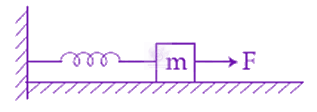
Moment of inertia of a body about a given axis is $1.5 kg {m}^{2}.$ Initially the body is at rest. In order to produce a rotational kinetic energy of $1200 J,$ the angular acceleration of $20 rad/{s}^{2}$ must be applied about the axis for a duration of:
A spring whose unstrentches length is $l$ has a force constant $k.$ The spring is cut into two pieces of unstretches lengths ${l}_{1}$ and ${l}_{2}$ where, ${l}_{1}=n{l}_{2}$ and $n$ is an integer. The ratio ${k}_{1}/{k}_{2}$ of the corresponding force constants, ${k}_{1}$ and ${k}_{2}$ will be:
A uniform cable of mass $M$ and length $L$ is placed on a horizontal surface such that its ${(\frac{1}{n})}^{th}$ part is hanging below the edge of the surface. To lift the hanging part of the cable upto the surface, the work done should be:
In the cube of side 'a' shown in the figure, the vector from the central point of the face $ABOD$ to the central point of the face $BEFO$ will be: 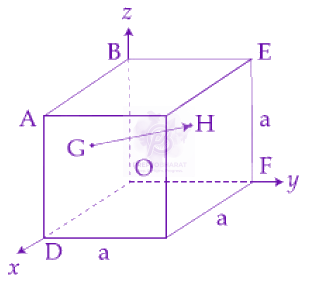
A particle is moving with a velocity $\vec{v}=K(y\hat{i}+x\hat{j}),$ where $K$ is a constant. The general equation for its path is:
A thin smooth rod of length $L$ and mass $M$ is rotating freely with angular speed ${\omega }_{0}$ about an axis perpendicular to the rod and passing through center. Two beads of mass $m$ and negligible size are at the center of the rod initially. The beads of mass $m$ and negligible size are at the center of the rod initially. The beads are free to slide along the rod. The angular speed of the system, when the beads reach the opposite ends of the rod, will be:
The area of a square is $5.29 c{m}^{2}.$ The area of $7$ such squares taking into account the significant figures is:
In a simple pendulum experiment for determination of acceleration due to gravity $(g)$, time taken for $20$ oscillations is measures by using a watch of $1$ second least count. The mean value of time taken comes out to be $30 s$. The length of the pendulum is measured by using a meter scale of least count $1 mm$ and the value obtained is $55.0 cm$. The percentage error in the determination of $g$ is close to
A liquid of density $\rho$ is coming out of a hose pipe of radius a with horizontal speed $v$ and hits a mesh. $50 \%$ of the liquid passes through the mesh unaffected. $25 \%$ looses all of its momentum and $25 \%$ comes back with the same speed. The resultant pressure on the mesh will be:
In the density measurement of a cube, the mass and edge length are measured as $(10.00\pm 0.10) kg$ and $(0.10\pm 0.01) m,$ respectively. The error in the measurement of density is:
A particle is moving along a circular path with a constant speed of $10 \mathrm{~ms}^{-1}$. What is the magnitude of the change in velocity of the particle, when it moves through an angle of $60^{\circ}$ around the centre of the circle?
The following bodies are made to roll up (without slipping) the same inclined plane from a horizontal plane: (i) a ring of radius $R,$ (ii) a solid cylinder of radius $\frac{R}{2}$ and (iii) a solid sphere of radius $\frac{R}{4}.$ If, in each case, the speed of the center of mass at the bottom of the incline is same, the ratio of the maximum heights they climb is:
In $SI$ units, the dimensions of $\sqrt{\frac{{\epsilon }_{0}}{{\mu }_{0}}}$ is:
A solid sphere of mass $M$ and radius $R$ is divided into two unequal parts. The first part has a mass of $\frac{7M}{8}$ and is converted into uniform disc of radius $2R$ . The second part is converted into a uniform solid sphere. Let ${I}_{1}$ be the moment of inertia of the disc about its axis and ${I}_{2}$ be the moment of inertia of the new sphere about its axis. The ratio ${I}_{1}/{I}_{2}$ is given by:
A bullet of mass $20 g$ has an initial speed of $1 m {s}^{-1}$, just before it starts penetrating a mud wall of thickness $20 cm$. If the wall offers a mean resistance of $2.5\times {10}^{-2} N,$ the speed of the bullet after emerging from the other side of the wall is close to:
In a meter bridge, the wire of length $1 m$ has a non-uniform cross-section such that, the variation $\frac{dR}{dl}$ of its resistance $R$ with length $l$ is $\frac{dR}{dl}\propto \frac{1}{\sqrt{l}}.$ Two equal resistances are connected as shown in the figure. The galvanometer has zero deflection when the jockey is at point $P.$ What is the length $AP?$ 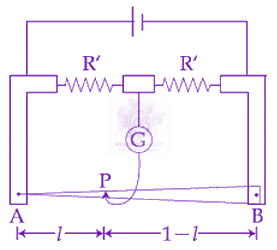
A rectangular solid box of length $0.3 m$ is held horizontally, with one of its sides on the edge of a platform of height $5 m$ . When released, it slips off the table in a very short time $\tau =0.01 s$ , remaining essentially horizontal. The angle by which it would rotate when it hits the ground will be (in radians) close to: 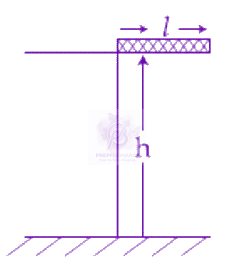
In a car race on straight road, car $A$ takes a time $t$ less than car $B$ at the finish and passes finishing point with a speed $v$ more than that of car $B.$ Both the cars start from rest and travel with constant acceleration ${a}_{1}$ and ${a}_{2}$ respectively. Then $v$ is equal to:
A rigid massless rod of length $3l$ has two masses attached at each end as shown in the figure. The rod is pivoted at point $P$ on the horizontal axis. When released from the initial horizontal position, its instantaneous angular acceleration will be 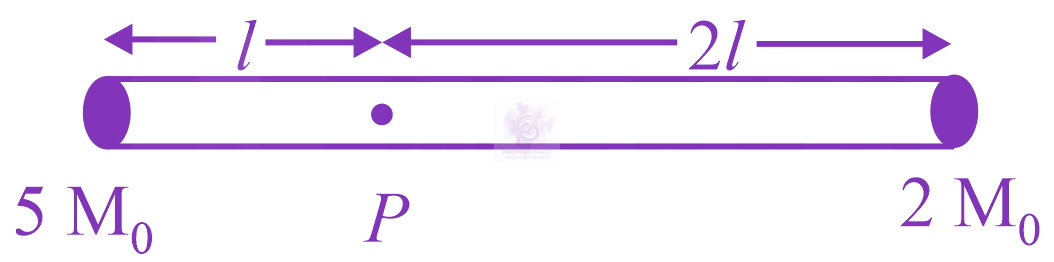
The force of interaction between two atoms is given by $F=\alpha \beta \exp \left(-\frac{x^{2}}{\alpha k T}\right) ;$ where $x$ is the distance, $\mathrm{k}$ is the Boltzmann constant and T is temperature and $\alpha$ and $\beta$ are two constants. The dimensions of $\beta$ is:
A solid sphere, of radius R acquires a terminal velocity ${v}_{1}$ when falling (due to gravity) through a viscous fluid having a coefficient of viscosity $\eta .$ The sphere is broken into 27 identical solid spheres. If each of these spheres acquires a terminal velocity, ${v}_{2},$ when falling through the same fluid, the ratio $(\frac{{v}_{1}}{{v}_{2}})$ equals:
A particle moves in one dimension from rest under the influence of a force that varies with the distance traveled by the particle as shown in the figure. The kinetic energy of the particle after it has traveled $3 m$ is: 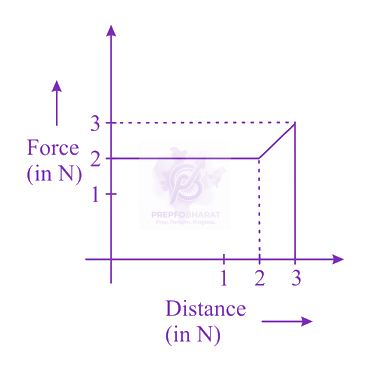
A rocket has to be launched from earth in such a way that it never returns. If $E$ is the minimum energy delivered by the rocket launcher, what should be the minimum energy that the launcher should have, if the same rocket is to be launched from the surface of the moon? Assume that the density of the earth and the moon are equal and that the earth's volume is $64$ times the volume of the moon.
Ship $A$ is sailing towards north-east with velocity) $\vec{v}=30\hat{i}+50\hat{j}\mathrm{km}{h}^{-1}$ where $\hat{i}$ points east and $\hat{j},$ north. The ship $B$ is at a distance of $80 km$ east and $150 km$ north of Ship $A$ and is sailing towards the west at $10km{h}^{-1}.$ $A$ will be at the minimum distance from $B$ in:
A ball is thrown vertically up (taken as $+z-axis$ ) from the ground. The correct momentum-height $(p-h)$ diagram is:
Two masses $m$ and $\frac{m}{2}$ are connected at the two ends of a massless rigid rod of length $l.$ The rod is suspended by a thin wire of torsional constant $k$ at the centre of mass of the rod-mass system (see figure). Because of torsional constant $k,$ the restoring torque is $\tau =k\theta$ for angular displacement $\theta .$ If the rod is rotated by ${\theta }_{0}$ and released, the tension in it when it passes through its mean position will be: 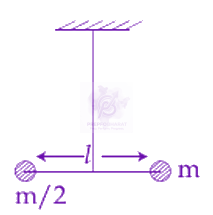
A rod, of length $L$ at room temperature and uniform area of cross section $A,$ is made of a metal having coefficient of linear expansion $\alpha /^{\circ}C$ It is observed that an external compressive force $F$ is applied on each of its ends, prevents any change in the length of the rod when its temperature rises by $\Delta TK$ Young's modulus, $Y$ for this metal is:
Water from a tap emerges vertically downwards with an initial speed of $1.0 m{s}^{-1}$ . The cross $-$ sectional area of the tap is ${ 10}^{-4} {m}^{2}$ . Assume that the pressure is constant throughout the stream of water and that the flow is streamlined. The cross $-$ sectional area of the stream, $0.15 m$ below the tap would be: (Take $g=10 m{s}^{-2}$ )
Four identical particles of mass $M$ are located at the corners of a square of side $‘a’$ . What should be their speed if each of them revolves under the influence of other’s gravitational field in a circular orbit circumscribing the square? 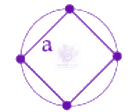
Two coaxial discs, having moments of inertia ${I}_{1}$ and $\frac{{I}_{1}}{2}$ , are rotating with respective angular velocities ${\omega }_{1}$ and $\frac{{\omega }_{1}}{2}$ , about their common axis. They are brought in contact with each other and thereafter they rotate with a common angular velocity. If ${E}_{f}$ and ${E}_{i}$ are the final and initial total energies, then $({E}_{f}-{E}_{i})$ is:
The position co-ordinates of a particle moving in a $3D$ coordinate system is given by<br>$x=a\mathrm{cos}\omega t$<br>$y=a\mathrm{sin}\omega t$<br>and $z=a\omega t$<br>The speed of the particle is:
A particle moves from the point $(2.0 \hat{i}+4.0 \hat{j}) \mathrm{m},$ at $\mathrm{t}=0$, with an initial velocity $(5.0 \hat{i}+4.0 \hat{j}) \mathrm{ms}^{-1} .$ It is acted upon by a constant force which produces a constant acceleration $(4.0 \hat{i}+4.0 \hat{j}) \mathrm{ms}^{-2} .$ What is the distance of the particle from the origin at time $2 \mathrm{~s} ?$
In the density measurement of a cube, the mass and edge length are measured as $(10.00\pm 0.10) kg$ and $(0.10\pm 0.01) m,$ respectively. The error in the measurement of density is:
A circular disc of radius $b$ has a hole of radius $a$ at its centre(see figure). If the mass per unit area of the disc varies as $(\frac{{\sigma }_{0}}{r})$ then, the radius of gyration of the disc about its axis passing through the center is 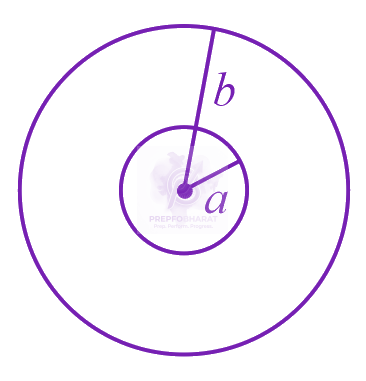
A particle is moving with a velocity $\vec{v}=K(y\hat{i}+x\hat{j}),$ where $K$ is a constant.<br>The general equation for its path is:
A tunning fork of frequency $480 Hz$ is used in an experiment for measuring speed of sound $(v)$ in air by resonance tube method. Resonance is observed to occur at two successive lengths of the air column, ${l}_{1}=30 cm$ and ${l}_{2}=70 cm.$ Then, $\nu$ is equal to:
A solid sphere of mass $M$ and radius $a$ is surrounded by a uniform concentric spherical shell of thickness $2a$ and mass $2M.$ The gravitational field at distance $3a$ from the centre will be:
Let $|\vec{{A}_{1}}|=3, |\vec{{A}_{2}}|=5$ and $|\vec{{A}_{1}}+\vec{{A}_{2}}|=5.$ The value of $(2\vec{{A}_{1}}+3\vec{{A}_{2}})\cdot (3\vec{{A}_{1}}-2\vec{{A}_{2}})$ is:
Two forces $P$ and $Q$, of magnitude $2F$ and $3F$, respectively, are at an angle $\theta$ with each other. If the force $Q$ is doubled, then their resultant also gets doubled. Then, the angle $\theta$ is:
The area of a square is $5.29 c{m}^{2}.$ The area of $7$ such squares taking into account the significant figures is:
Two blocks $A$ and $B$ of masses ${m}_{A}=1 kg$ and ${m}_{B}=3 kg$ are kept on the table as shown in figure. The coefficients of friction between $A$ and $B$ is $0.2$ and between $B$ and the surface of the table is also $0.2.$ The maximum force $F$ that can be applied on $B$ horizontally, so that the block $A$ does not slide over the block $B$ is : [Take $g=10 m/{s}^{2}$ ] 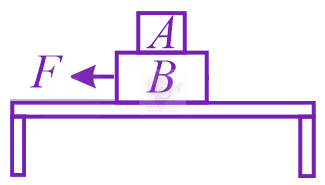
Ship $A$ is sailing towards north-east with velocity) $\vec{v}=30\hat{i}+50\hat{j}\mathrm{km}{h}^{-1}$ where $\hat{i}$ points east and $\hat{j},$ north. The ship $B$ is at a distance of $80 km$ east and $150 km$ north of Ship $A$ and is sailing towards the west at $10km{h}^{-1}.$ $A$ will be at the minimum distance from $B$ in:
Two vectors $\vec{A}$ and $\vec{B}$ have equal magnitudes. The magnitude of $(\vec{A}+\vec{B})$ is ' $n$ ' times the magnitude of $(\vec{A}-\vec{B})$ . The angle between $\vec{A}$ and $\vec{B}$ is:
A copper wire is stretched to make it $0.5%$ longer. The percentage change in its electrical resistance if its volume remains unchanged is:
The trajectory of a projectile near the surface of the earth is given as $y=2x-9{x}^{2}.$ If it were launched at an angle ${\theta }_{0}$ with speed ${v}_{0}$ then $(g=10 {m s}^{-2}):$
Two particles $A, B$ are moving on two concentric circles of radii ${R}_{1}$ and ${R}_{2}$ with equal angular speed $\omega .$ At $t=0,$ their positions and direction of motion are shown in the figure: 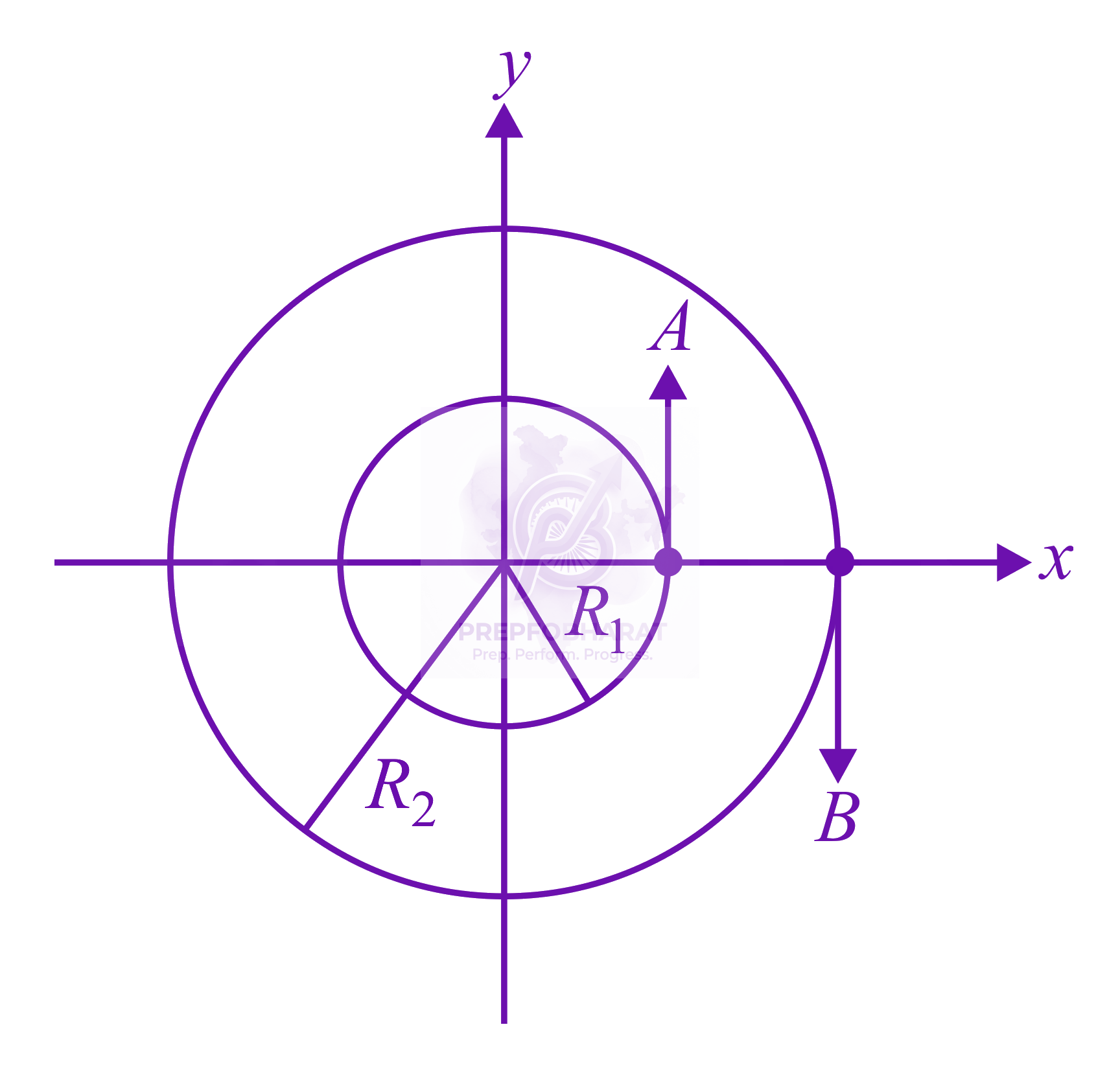 The relative velocity $\vec{{V}_{A}}-\vec{{V}_{B}}$ at $t=\frac{\pi }{2\omega }$ is given by:
The resistance of the meter bridge AB in given figure is $4 \Omega$. With a cell of emf $\varepsilon=0.5 \mathrm{~V}$ and rheostat resistance $\mathrm{R}_{\mathrm{h}}=2 \Omega$ the null point is obtained at some point J. When the cell is replaced by another one of emf $\varepsilon=\varepsilon_{2}$ the same null point $\mathrm{J}$ is found for $\mathrm{R}_{\mathrm{h}}=6 \Omega$. The $\operatorname{emf} \varepsilon_{2}$ is: 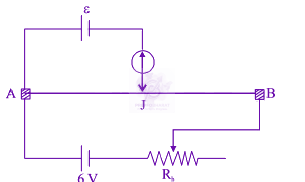
Two forces $P$ and $Q$, of magnitude $2F$ and $3F$, respectively, are at an angle $\theta$ with each other. If the force $Q$ is doubled, then their resultant also gets doubled. Then, the angle $\theta$ is:
The elastic limit of brass is $379 MPa$. The minimum diameter of a brass rod if it is to support a $400 N$ load without exceeding its elastic limit will be
The magnitude of torque on a particle of mass $1 \mathrm{~kg}$ is 2.5 Nm about the origin. If the force acting on it is $1 \mathrm{~N},$ and the distance of the particle from the origin is $5 \mathrm{~m},$ the angle between the force and the position vector is (in radians):
a string is wound around a hollow cylinder of mass $5 \mathrm{~kg}$ and radius $0.5 \mathrm{~m}$. If the string is now pulled with a horizontal force of $40 \mathrm{~N}$, and the cylinder is rolling without slipping on a horizontal surface (see figure), then the angular acceleration of the cylinder will be (Neglect the mass and thickness of the string) 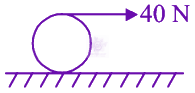
A force acts on a $2 \mathrm{kg}$ object so that its position is given as a function of time as $x=3{t}^{2}+5.$ What is the work done by this force in first $5$ seconds?
A heavy ball of mass $M$ is suspended from the ceiling of a car by a light string of mass $m (m\ll M).$ When the car is at rest, the speed of transverse waves in the string is $60 {\mathrm{ms}}^{-1}.$ When the car has acceleration $a,$ the wave-speed increases to $60.5 {\mathrm{ms}}^{-1}.$ The value of $a,$ in terms of gravitational acceleration $g,$ is closed to
Two vectors $\vec{A}$ and $\vec{B}$ have equal magnitudes. The magnitude of $(\vec{A}+\vec{B})$ is ' $n$ ' times the magnitude of $(\vec{A}-\vec{B})$ . The angle between $\vec{A}$ and $\vec{B}$ is:
A plane is inclined at an angle $\alpha =30^{\circ}$ with respect to the horizontal. A particle is projected with a speed $u=2 m {s}^{-1}$ , from the base of the plane, making an angle $\theta =15^{\circ}$ with respect to the plane as shown in the figure. The distance from the base, at which the particle hits the plane is close to: (Take $g=10 m {s}^{-2}$ ) 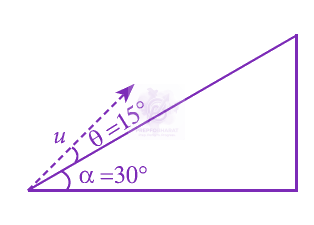
A thin circular plate of mass $M$ and radius $R$ has its density varying as $\text{ρ}(r){\text{=ρ}}_{\text{0}}\text{r}$ with ${\rho }_{0}$ as constant and $r$ is the distance from its centre. The moment of Inertia of the circular plate about an axis perpendicular to the plate and passing through its edge is $I=aM{R}^{2}$. The value of the coefficient $a$ is:
A shell is fired from a fixed artillery gun with an initial speed u such that it hits the target on the ground at a distance $R$ from it. If ${t}_{1}$ and ${t}_{2}$ are the values of the time taken by it to hit the target in two possible ways, the product ${t}_{1}{t}_{2}$ is:
Four particles $A, B, C$ and $D$ with masses ${m}_{A}=m,{m}_{B}=2m,{m}_{C}=3m$ and ${m}_{D}=4m$ are at the corners of a square. They have accelerations of equal magnitude with directions as shown. The acceleration of the centre of mass of the particles is: 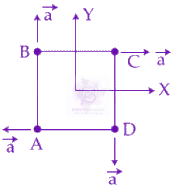
Expression for time in terms of $G$ (universal gravitational constant), $h$ (Planck constant) and $c$ (speed of light) is proportional to:
A homogeneous solid cylindrical roller of radius $R$ and mass $M$ is pulled on a cricket pitch by a horizontal force. Assuming rolling without slipping, angular acceleration of the cylinder is:
A person of mass $M$ is sitting on a swing of length $L$ and swinging with and an angular amplitude ${\theta }_{0}.$ If the person stands up when the swing passes through its lowest point, the work done by him, assuming that his centre of mass moves by a distance $l (l<<L),$ is close to:
The time dependence of the position of a particle of mass $m=2$ is given by $\vec{r }(t)=2t \hat{i}-3{t}^{2}\hat{j}$ . Its angular momentum, with respect to the origin, at time $t=2$ is:
A cubical block of side $0.5 m$ floats on water with $30%$ of its volume under water. What is the maximum weight that can be put on the block without fully submerging it under water? [Take, density of water $={10}^{3} kg/{m}^{3}$ ]
A particle starts from origin $O$ from rest and moves with a uniform acceleration along the positive $x-axis$ . Identify all figures that correctly represent the motion qualitatively. ( $a=$ acceleration, $v=$ velocity, $x=$ dispalcement, $t=$ time) $(A)$ 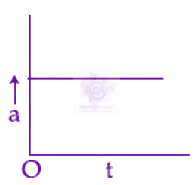 $(B)$ 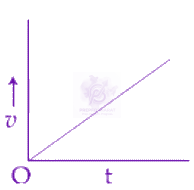 $(C)$ 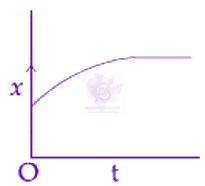 $(D)$ 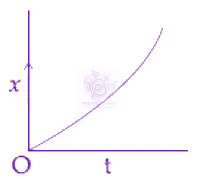
Let $L, R, C$ and $V$ represent inductance, resistance, capacitance and voltage, respectively. The dimension of $\frac{L}{RCV}$ in $SI$ units will be:
A solid sphere and solid cylinder of identical radii approach an incline with the same linear velocity (see figure). Both roll without slipping all throughout. The two climb maximum heights ${h}_{sph}$ and ${h}_{cyl}$ on the inline. The ratio $\frac{{h}_{sph}}{{h}_{cyl}}$ is given by: 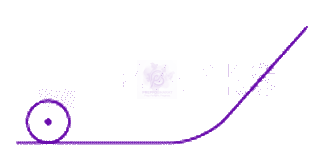
To mop-clean a floor, a cleaning machine presses a circular mop of radius $R$ vertically down with a total force $F$ and rotates it with a constant angular speed about its axis. If the force $F$ is distributed uniformly over the mop and if coefficient of friction between the mop and the floor is $\mu ,$ the torque, applied by the machine on the mop is:
A passenger train of length $60 m$ travels at a speed of $80\mathrm{km}/\mathrm{hr}$. Another freight train of length $120 m$ travels at a speed of $30\mathrm{km}/\mathrm{hr}$. The ratio of times taken by the passenger train to completely cross the freight train when: (i) they are moving in the same direction, and (ii) in the opposite directions is:
A particle is moving with speed $v=b\sqrt{x}$ along positive $x-$ axis. Calculate the speed of the particle at time $t=\tau$ (assume that the particle is at origin at $t=0$ )
A particle starts from the origin at time $t=0$ and moves along the positive $x-$axis. The graph of velocity with respect to time is shown in figure. What is the position of the particle at time $t=5s?$ 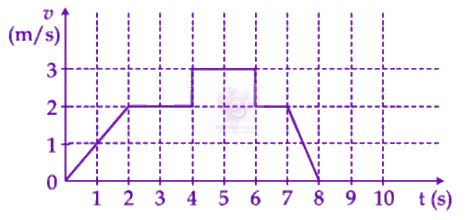
If Surface tension$(S)$, Moment of Inertia $(I)$ and Planck's constant $(h),$ were to be taken as the fundamental units, the dimensional formula for linear momentum would be:
Young's moduli of two wires $A$ and $B$ are in the ratio $7:4$ . Wire $A$ is $2 m$ long and has radius $R.$ Wire $B$ is $1.5 m$ long and has radius $2 mm.$ If the two wires stretch by the same length for a given load, the value of $R$ is close to:
An $L$ -shaped object, made of thin rods of uniform mass density, is suspended with a string as shown in figure. If $AB=BC,$ and the angle made by $AB$ with downward vertical is $\theta ,$ then: 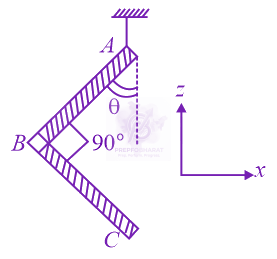
A boy’s catapult is made of rubber cord which is $42 cm$ long, with $6 mm$ diameter of cross-section and of negligible mass. The boy keeps a stone weighing $0.02 kg$ on it and stretches the cord by $20 cm$ by applying a constant force. When released, the stone flies off with a velocity of $20 m{s}^{-1}$ . Neglect the change in the area of cross-section of the cord while stretched. The Young’s modulus of rubber is closest to:
The value of acceleration due to gravity at Earth's surface is $9.8 m {s}^{-2}$ . The altitude above its surface at which the acceleration due to gravity decreases to $4.9 m {s}^{-2}$, is close to: (Radius of earth $=6.4\times {10}^{6} m$ )
The moment of inertial of a solid sphere, about an axis parallel to its diameter and at a distance of $x$ from it, is $'I{(x)}^{'}.$ Which one of the graphs represents the variation of $I(x)$ with $x$ correctly?
The least count of the main scale of a screw gauge is $1 \mathrm{mm}.$ The minimum number of divisions on its circular scale required to measure $5 \mu m$ diameter of a wire is:
A stationary horizontal disc is free to rotate about its axis. When a torque is applied on it, its kinetic energy as a function of $\theta$, where $\theta$ is the angle by which it has rotated, is given as $k{\theta }^{2}$. If its moment of inertia is $I$ then the angular acceleration of the disc is:
Let $|\vec{{A}_{1}}|=3, |\vec{{A}_{2}}|=5$ and $|\vec{{A}_{1}}+\vec{{A}_{2}}|=5.$ The value of $(2\vec{{A}_{1}}+3\vec{{A}_{2}})\cdot (3\vec{{A}_{1}}-2\vec{{A}_{2}})$ is:
A copper wire is stretched to make it $0.5%$ longer. The percentage change in its electrical resistance if its volume remains unchanged is:
If ${10}^{22}$ gas molecules each of mass ${10}^{-26}$ kg collides with a surface (perpendicular to it) elastically per second over an area $1 {m}^{2}$ with a speed ${10}^{4}m/s,$ the pressure exerted by the gas molecules will be of the order of:
A test particle is moving in a circular orbit in the gravitational field produced by a mass density $\rho (r)=\frac{K}{{r}^{2}}.$ Identify the current relation between the radius $R$ of the particle’s orbit and its period $T:$
A soap bubble, blown by a mechanical pump at the mouth of a tube increases in volume with time at a constant rate. The graph that correctly depicts the time dependence of pressure inside the bubble is given by:
A steel wire having a radius of $2.0 mm$ , carrying a load of $4 kg,$ is hanging from a ceiling. Given that $g=3.1\pi m {s}^{-2},$ what will be the tensile stress that would be developed in the wire?
A slab is subjected to two forces $\overrightarrow{\mathrm{F}_{1}}$ and $\overrightarrow{\mathrm{F}_{2}}$ of same magnitude $F$ as shown in the figure. Force $\overrightarrow{\mathrm{F}_{2}}$ is in XY- plane while force $\mathrm{F}_{1}$ acts along $z$ -axis at the point $(2 \vec{i}+3 \vec{j})$. The moment of these forces about point $\mathrm{O}$ will be: 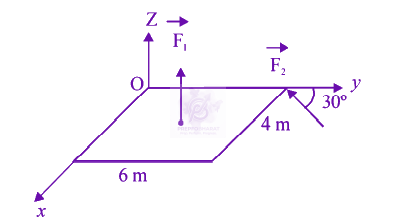
The top of a water tank is open to air and its water level is maintained. It is giving out $0.74 {m}^{3}$ water per minute through a circular opening of $2 \mathrm{cm}$ radius in its wall. The depth of the centre of the opening from the level of water in the tank is close to:
The stream of a river is flowing with a speed of $2 km{h}^{-1}$. A swimmer can swim at a speed of $4 \mathrm{km}{h}^{-1}$. The direction of the swimmer with respect to the flow of the river, to cross the river straight, is
A potentiometer wire $\mathrm{AB}$ having length $L$ and resistance $12r$ is joined to a cell $D$ of emf $\epsilon$ and internal resistance $r$. A cell $C$ having EMF $\epsilon /2$ and internal resistance $3r$ is connected. The length $\mathrm{AJ}$, at which the galvanometer, as shown in the figure, shows no deflection is 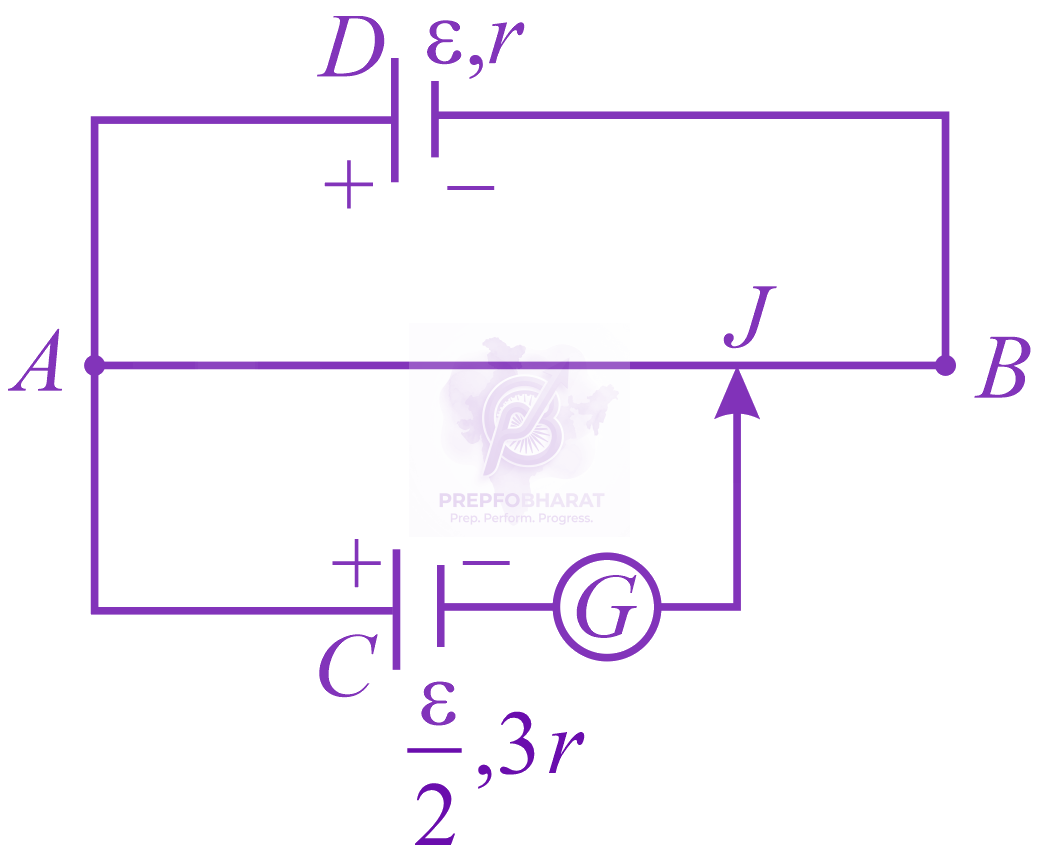
A mass of $10 \mathrm{kg}$ is suspended vertically by a rope from the roof. When a horizontal force is applied on the rope at some point, the rope deviated at an angle of $45^{\circ}$ at the roof point. If the suspended mass is at equilibrium, the magnitude of the force applied is $(g=10 m{s}^{-2})$
Two particles are projected from the same point with the same speed u such that they have the same range R, but different maximum heights, ${h}_{1}$ and ${h}_{2}.$ Which of the following is correct?
A metal coin of mass $5 g$ and radius $1 cm$ is fixed to a thin stick $AB$ of negligible mass as shown in the figure. The system is initially at rest. The constant torque, that will make the system rotate about $AB$ at $25$ rotations per second in $5 s$ , is close to: 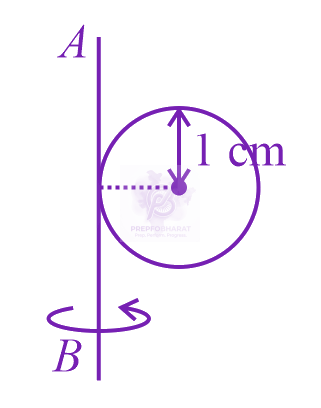
Which of the following combinations has the dimension of electrical resistance $({\epsilon }_{0}$ is the permittivity of vacuum and ${\mu }_{0}$ is the permeability of vacuum)?
A vertical closed cylinder is separated into two parts by a frictionless piston of mass $m$ and of negligible thickness. The piston is free to move along the length of the cylinder. The length of the cylinder above piston is ${l}_{1},$ and that below the piston is ${l}_{2},$ such that ${l}_{1}>{l}_{2}.$ Each part of the cylinder contains $n$ moles of an ideal gas at equal temperature $T.$ If the piston is stationary, its mass $m$ will be given by: ($R$ is universal gas constant and $g$ is the acceleration due to gravity)
A satellite of mass $M$ is in a circular orbit of radius $R$ about the center of the earth. A meteorite of the same mass, falling towards the earth, collides with the satellite completely inelastic. The speeds of the satellite and the meteorite are the same, just before the collision. The subsequent motion of the combined body will be:
The ratio of the weights of a body on Earth’s surface to that on the surface of a planet is $9:4$ The mass of the planet is $\frac{1}{9}th$ of that of the Earth. If $R$ is the radius of the Earth, what is the radius of the planet? (Take the planets to have the same mass density)
If $'M'$ is the mass of water that rises in a capillary tube of radius $'r'$ , then mass of water which will rise in a capillary tube of radius $'2r'$ is:
The mass and the diameter of a planet are three times the respective values for the Earth. The period of oscillation of a simple pendulum on the Earth is $2 \mathrm{~s}$. The period of oscillation of the same pendulum on the planet would be:
A wedge of mass $M=4m$ lies on a frictionless plane. A particle of mass $m$ approaches the wedge with speed $v.$ There is no friction between the particle and the plane or between the particle and the wedge. The maximum height climbed by the particle on the wedge is given by:
A uniform rod of length $l$ is being rotated in a horizontal plane with a constant angular speed about an axis passing through one of its ends. If the tension generated in the rod due to rotation is $T(x)$ at a distance $x$ from the axis, then which of the following graphs depicts it most closely?
A circular disc $D_{1}$ of mass $M$ and radius $R$ has two identical $\operatorname{discs} D_{2}$ and $D_{3}$ of the same mass $M$ and radius R attached rigidly at its opposite ends (see figure). The moment of inertia of the system about the axis OO', passing through the centre of $D_{1}$, as shown in the figure, will be 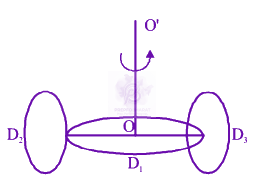
A ball is thrown upward with an initial velocity ${V}_{0}$ from the surface of the earth. The motion of the ball is affected by a drag force equal to $m\gamma {v}^{2}$ (where $m$ is mass of the ball, $v$ is its instantaneous velocity and $\gamma$ is a constant). Time taken by the ball to rise to its zenith is:
In an experiment, brass and steel wires of length $1 m$ each with areas of cross section $1 m{m}^{2}$ are used. The wires are connected in series and one end of the combined wire is connected to a rigid support and other end is subjected to elongation. The stress required to produce a net elongation of $0.2 mm$ is, [Given, the Young's Modulus for steel and brass are, respectively, $120\times {10}^{9} N/{m}^{2}$ and $60\times {10}^{9} N/{m}^{2}$ ]
A piece of wood of mass $0.03 kg$ is dropped from the top of a $100 m$ height building. At the same time, a bullet of mass $0.02 kg$ is fired vertically upward, with a velocity $100 m{s}^{-1},$ from the ground. The bullet gets embedded in the wood. Then the maximum height to which the combined system reaches above the top of the building before falling below is: $(g=10 m{s}^{-2})$
A uniform rectangular thin sheet $ABCD$ of mass $M$ has length $a$ and breadth $b$, as shown in the figure. If the shaded portion $HBGO$ is cut-off, the coordinates of the centre of mass of the remaining portion will be: 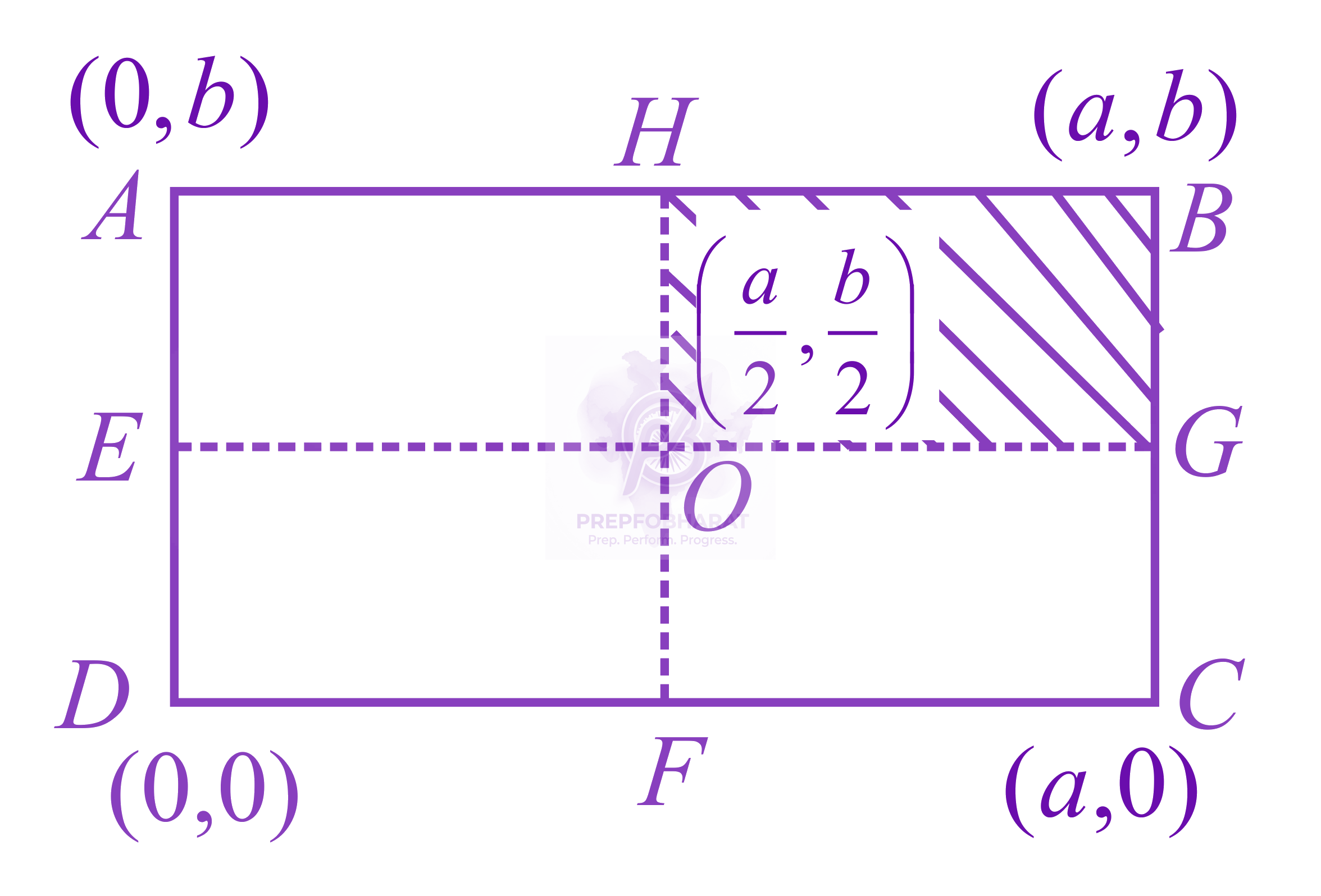
Two identical spherical balls of mass $M$ and radius $R$ each are stuck on two ends of a rod of length $2R$ and mass $M$(see figure). The moment of inertia of the system about the axis passing perpendicularly through the centre of the rod is 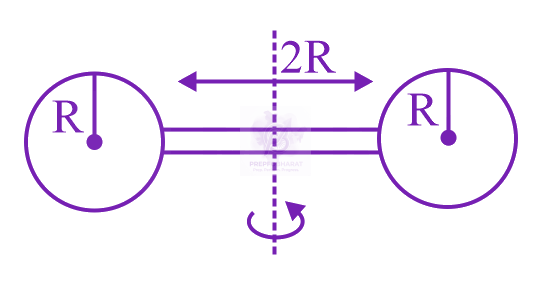
A long cylindrical vessel is half filled with a liquid. When the vessel is rotated about its own vertical axis, the liquid rises up near the wall. If the radius of vessel is $5 cm$ and its rotational speed is $2$ rotations per second, then the difference in the heights between the center and the sides, in $cm,$ will be:
Water flows into a large tank with flat bottom at the rate of ${10}^{-4} {m}^{3}{s}^{-1}.$ Water is also leaking out of a hole of area $1 c{m}^{2}$ at its bottom. If the height of the water in the tank remains steady then this height is:
A satellite is moving with a constant speed $v$ in circular orbit around the earth. An object of mass 'm' is ejected from the satellite such that it just escapes from the gravitational pull of the earth. At the time of ejection, the kinetic energy of the object is:
An equilateral triangle $\mathrm{ABC}$ is cut from a thin solid sheet of wood. (See figure) $\mathrm{D}, \mathrm{E}$ and $\mathrm{F}$ are the mid-points of its sides as shown and $\mathrm{G}$ is the centre of the triangle. The moment of inertia of the triangle about an axis passing through $\mathrm{G}$ and perpendicular to the plane of the triangle is $\mathrm{I}_{0}$. If the smaller triangle $\mathrm{DEF}$ is removed from $\mathrm{ABC}$, the moment of inertia of the remaining figure about the same axis is $I$. Then 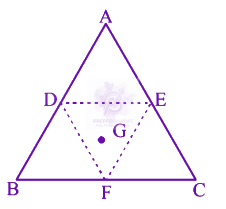
A satellite is revolving in a circular orbit at a height h from the carth surface, such that $\mathrm{h}< < \mathrm{R}$ where $\mathrm{R}$ is the radius of the earth. Assuming that the effect of earth"s atmosphere can be neglected the minimum increase in the speed required so that the satellite could escape from the gravitational field of earth is
Two particles of masses $M$ and $2M are$moving with speeds of $10 m{s}^{-1}$ and $5 m{s}^{-1}$, as shown in the figure. They collide at the origin and after that they move along the indicated directions with speeds ${v}_{1}$ and ${v}_{2}$, respectively. The values of ${v}_{1}$ and ${v}_{2}$ are, nearly 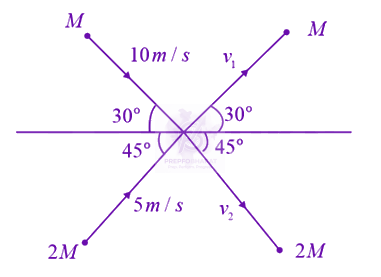
A particle of mass $\mathrm{m}$ is moving in a straight line with momentum p. Starting at time $t=0,$ a force $F=k$ t acts in the same direction on the moving particle during time interval T so that its momentum changes from $\mathrm{p}$ to $3 \mathrm{p}$. Here $k$ is a constant. The value of $\mathrm{T}$ is
The energy required to take a satellite to a height $h$ above the Earth surface (radius of Earth $=6.4\times {10}^{3}\mathrm{km}$ ) is ${E}_{1}$, and the kinetic energy required for the satellite to be in a circular orbit at this height is ${E}_{2}.$ The value of $h$ for which ${E}_{1}$ and ${E}_{2}$ are equal, is
The pitch and the number of divisions, on the circular scale, for a given screw gauge are $0.5\mathrm{mm}$ and $100$ respectively. When the screw gauge is fully tightened without any object, the zero of its circular scale lies $3$ divisions below the mean line. The readings of the main scale and the circular scale, for a thin sheet, are $5.5\mathrm{mm}$ and $48$ respectively, the thickness of this sheet is:
The position vector of the center of mass ${\vec{r}}_{\mathrm{cm}}$ of an asymmetric uniform bar of negligible area of cross-section as shown in figure is: 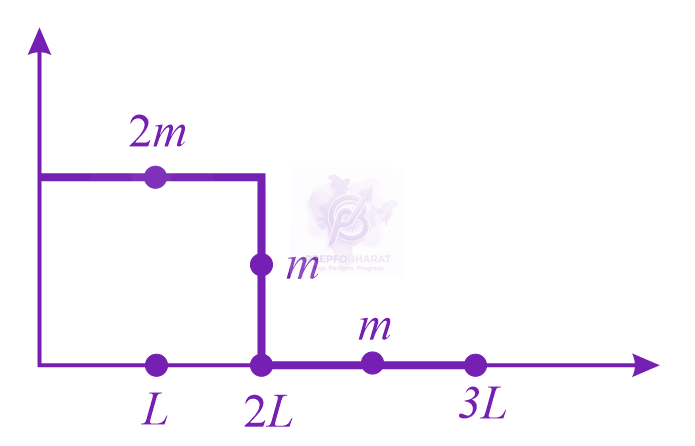
A particle of mass $m$ is moving with speed $2\text{v}$ and collides with a mass $2m$ moving with speed $\text{v}$ in the same direction. After the collision, the first mass is stopped completely while the second one splits into two particles each of mass $m,$ which move at an angle ${45}^{o}$ with respect to the original direction. The speed of each of the moving particle will be
A submarine experiences a pressure of $5.05\times {10}^{6} Pa$ at a depth of ${d}_{1}$ in a sea. When it goes further to a depth of ${d}_{2}$ , it experiences a pressure of $8.08\times {10}^{6} Pa$ . Then ${d}_{2}-{d}_{1}$ is approximately (density of water $={10}^{3} kg/{m}^{3}$ and acceleration due to gravity $=10 m{s}^{-2}$ ):
A block of mass $5 kg$ is (i) pushed in case $(A)$ and (ii) pulled in case $(B),$ by a force $F=20 N,$ making an angle of ${30}^{o}$ with the horizontal, as shown in the figures. The coefficient of friction between the block and floor is $\mu =0.2.$ The difference between the accelerations of the block, in case $(B)$ and case $(A)$ will be: $(g=10 m {s}^{-2})$ 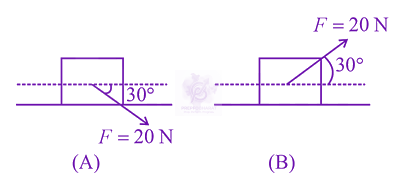
A block of mass $m$ is kept on a platform which starts from rest with a constant acceleration $g/2$ upwards, as shown in the figure. Work done by normal reaction on block in time $t$ is 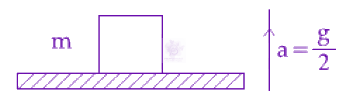
Two guns $A$ and $B$ can fire bullets at speeds $1 km/s$ and $2 km/s$ respectively. From a point on a horizontal ground, they are fired in all possible directions. The ratio of maximum areas covered by the bullets fired by the two guns, on the ground is:
The density of a material in $SI$ units is $128 kg {m}^{-3}.$ In certain units in which the unit of length is $25 cm$ and the unit of mass is $50g,$ the numerical value of density of the material is:
In a meter bridge experiment, the circuit diagram and the corresponding observation table are shown in figure. 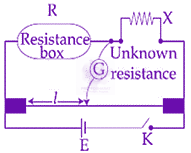<table class="pyq-table"><tbody><tr><th>S. No.</th><th>$R(\Omega )$</th><th>$l(cm)$</th></tr><tr><td>$_{1.}$ $_{2.}$ $_{3.}$ $_{4.}$</td><td>$1000$ $100$ $10$ $1$</td><td>$60$ $13$ $1.5$ $1.0$</td></tr></tbody></table> Which of the reading is inconsistent?
An alpha- particle of mass $m$ suffers $1-$ dimensional elastic collision with a nucleus at rest of unknown mass. It is scattered directly backwards losing $64%$ of its initial kinetic energy. The mass of the nucleus is