JEE Main 2017 — Mechanics
Physics Mechanics questions from JEE Main 2017.
Other Years
23 Mechanics Questions from 2017
A body is thrown vertically upwards. Which one of the following graphs correctly represents the velocity$(v)$ vs time $(t)$?
A body of mass $m={10}^{-2}\mathrm{kg}$ is moving in a medium and experiences a frictional force $F=-k{v}^{2} .$ Its initial speed is ${v}_{0}=10m{s}^{-1}.$ After $10s$ its kinetic energy is $\frac{1}{8}m{v}_{0}^{2},$ then value of $k$ will be:-
A car is standing $200 m$ behind a bus, which is also at rest. The two start moving at the same instant but with different forward accelerations. The bus has acceleration $2m{s}^{-2}$ and the car has acceleration $4 m{s}^{-2}$ . The car will catch up with the bus after time :
A circular hole of radius $\frac{R}{4}$ is made in a thin uniform disc having mass and radius $R$, as shown in figure. The moment of inertia of the remaining portion of the disc about an axis passing through the point $O$ and perpendicular to the plane of the disc is- 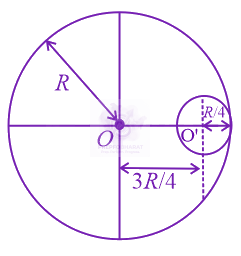
A conical pendulum of length $l$ makes an angle $\theta =45^{\circ}$ with respect to $Z-$axis and moves in a circle in the $XY$ plane. The radius of the circle is $0.4m$ and its center is vertically below $O$. The speed of the pendulum, in its circular path, will be - $(Take g=10 m{s}^{-2})$ 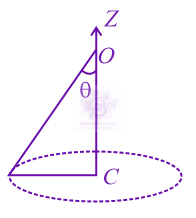
A man grows into a giant such that his linear dimensions increase by a factor of $9.$ Assuming that his density remains same, the stress in the leg will change by a factor of:
A physical quantity $P$ is described by the relation $P={a}^{\frac{1}{2}} {b}^{2} {c}^{3}{d}^{-4}$. If the relative errors in the measurement of $a$, $b$, $c$ and $d$ respectively, are $2%$, $1%$, $3%$ and $5%$. Then the relative error in $P$ will be:
A slender uniform rod of mass $M$ and length $l$ is pivoted at one end so that it can rotate in a vertical plane (see figure). There is negligible friction at the pivot. The free end is held vertically above the pivot and then released. The angular acceleration of the rod when it makes an angle $\theta$ with the vertical is: 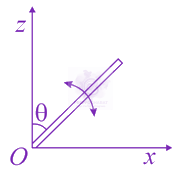
A time dependent force $F=6t$ acts on a particle of mass $1\mathrm{kg}$. If the particle starts from the rest, the work done by the force during the first $1\mathrm{sec}$ will be:
A uniform disc of radius $R$ and mass $M$ is free to rotate only about its axis. A string is wrapped over its rim and a body of mass $m$ is tied to the free end of the string as shown in the figure. The body is released from rest. Then the acceleration of the body is: 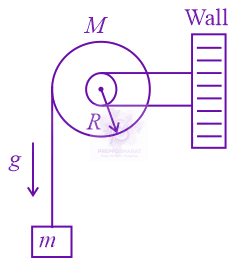
An object is dropped from a height $h$ from the ground. Every time it hits the ground it loses $50%$ of its kinetic energy. The total distance covered as $t\rightarrow \infty$ is:
If the Earth has no rotational motion, the weight of a person on the equator is $W$. Determine the speed with which the earth would have to rotate about its axis so that the person at the equator will weigh $\frac{3}{4} W$. The radius of the Earth is $6400\mathrm{km}$ and $g=10 m{s}^{-2}$
In a physical balance working on the principle of moments, when $5 \mathrm{mg}$ weight is placed on the left pan, the beam becomes horizontal. Both the empty pans of the balance are of equal mass. Which of the following statements is correct?
Moment of inertia of an equilateral triangular lamina $ABC$, about the axis passing through its centre $O$ and perpendicular to its plane is ${I}_{0}$ as shown in the figure. A cavity $DEF$ is cut out from the lamina, where $D,E,F$ are the mid points of the sides. Moment of inertia of the remaining part of lamina about the same axis is: 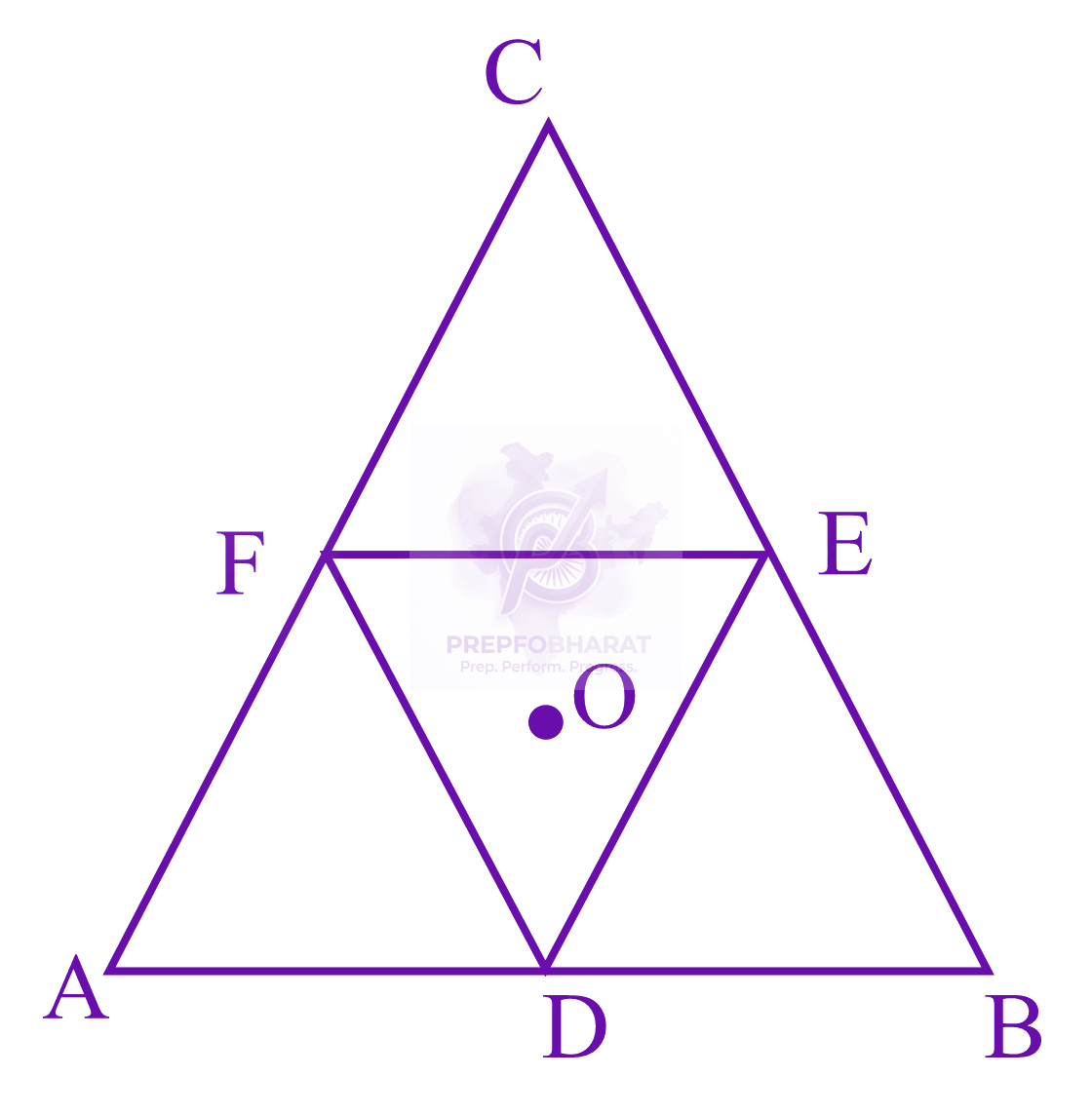
The following observations were taken for determining surface tension $T$ of water by capillary method: diameter of capillary, $D=1.25\times {10}^{-2}m$ rise of water, $h=1.45\times {10}^{-2}m$ Using $g=9.80 m{s}^{-2}$ and the simplified relation $T=\frac{rhg}{2}\times {10}^{3}N{m}^{-1}$ the possible error in surface tension is closest to:
The machine as shown has $2$ rods of length $1m$ connected by a pivot at the top. The end of one rod is connected to the floor by a stationary pivot and the end of the other rod has roller that rolls along the floor in a slot. As the roller goes back and forth, a $2\mathrm{kg}$ weight moves up and down. If the roller is moving towards right at a constant speed, the weight moves up with a : 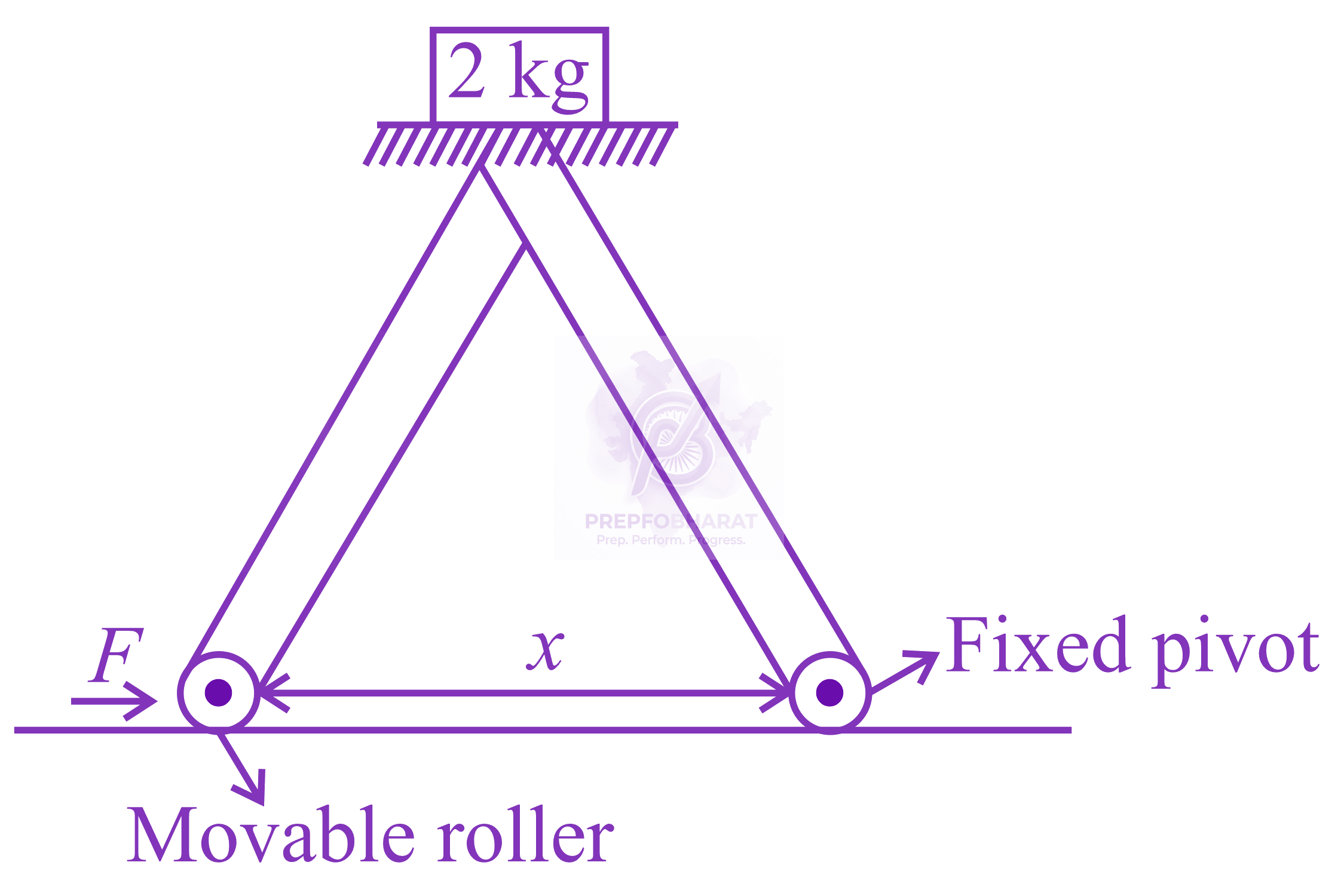
The mass density of a spherical body is given by $\rho (r)=\frac{k}{r}$ for $r\leq R$ and $\rho (r)=0$ for $r>R,$ where $r$ is the distance from the center. The correct graph that describes qualitatively the acceleration, $a$ of a test particle as a function of $r$ is:
The moment of inertia of a uniform cylinder of length $l$ and radius $R$ about its perpendicular bisector is $I.$ What is the ratio $l/R$ such that the moment of inertia is minimum?
The variation of acceleration due to gravity $g$ with distance $d$ from the centre of the earth is best represented by ($R$= Earth's radius):
Time $(T)$, velocity $(C)$ and angular momentum $(h)$ are chosen as fundamental quantities instead of mass, length and time. In terms of these, the dimensions of mass would be:
Two particles $A$ and $B$ of equal mass $M$ are moving with the same speed $v$ as shown in figure. They collide completely inelastic and move as a single particle $C$. The angle $\theta$ that the path of $C$ makes with the $X$-axis is given by- 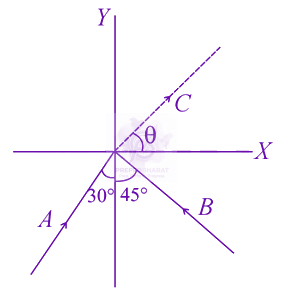
Two tubes of radii ${r}_{1}$ and ${r}_{2}$ and lengths ${l}_{1}$ and ${l}_{2,}$ respectively, are connected in series and a liquid flows through each of them in stream line conditions. ${P}_{1}$ and ${P}_{2}$ are pressure differences across the two tubes. If ${P}_{2}$ is $4{P}_{1}$ and ${l}_{2}$ is $\frac{ {l}_{1} }{ 4 }$ then the radius ${r}_{2}$ will be equal to :
Which graph corresponds to an object moving with a constant negative acceleration and a positive velocity?