JEE Main 2020 — Mechanics
Physics Mechanics questions from JEE Main 2020.
Other Years
142 Mechanics Questions from 2020
A air bubble of radius $1\text{ cm}$ in water has an upward acceleration of $9.8{\text{ cms}}^{–2}$. The density of water is $1{\text{ gm cm}}^{–3}$ and water offers negligible drag force on the bubble. The mass of the bubble is $(g=980\text{cm}/{\text{s}}^{2})$.
A ball is dropped from the top of a $100m$ high tower on a planet. In the last $\frac{1}{2}s$ before hitting the ground, it covers a distance of $19m.$ Acceleration due to gravity (in $m{s}^{-2}$ ) near the surface on that planet is______
A balloon is moving up in air vertically above a point $A$ on the ground. When it is a height ${h}_{1},$ a girl standing at a distance d (point B) from A (see figure) sees it at an angle $45^{\circ}$ with respect to the vertical. When the balloon climbs up a further height ${h}_{2}$, it is seen at an angle $60^{\circ}$ with respect to the vertical if the girl moves further by a distance $2.464d$ (point C). Then the height ${h}_{2}$ is (given $\mathrm{tan}30^{\circ}=0.5774$): 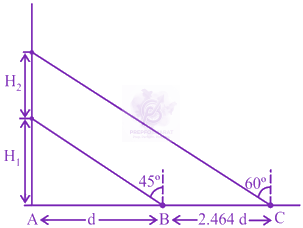
A bead of mass $m$ stays at point $P(a,b)$ on a wire bent in the shape of a parabola $y=4C{x}^{2}$ and rotating with angular speed $\omega$ (see figure). The value of $\omega$ is (neglect friction) 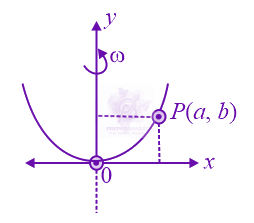
A block of mass $1.9\mathrm{kg}$ is at rest at the edge of a table, of height 1 m. A bullet of mass $0.1\mathrm{kg}$ collides with the block and sticks to it. If the velocity of the bullet is $20m{s}^{-1}$ in the horizontal direction just before the collision then the kinetic energy just before the combined system strikes the floor, is [Take $g=10m{s}^{-2}$. Assume there is no rotational motion and loss of energy after the collision is negligible.]
A block of mass $m=1\mathrm{kg}$ slides with velocity $v=6m{s}^{-1}$ on a frictionless horizontal surface and collides with a uniform vertical rod and sticks to it as shown. The rod is pivoted about $O$ and swings as a result of the collision making angle $\theta$ before momentarily coming to rest. if the rod has mass $M=2\mathrm{kg},$ and length $\ell =1m,$ the value of $\theta$ is approximately$(\mathrm{take}g=10m{s}^{-2})$ 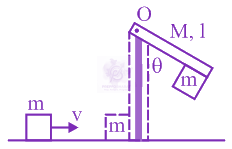
A block starts moving up an inclined plane of inclination $30^{\circ}$ with an initial velocity of${v}_{0}$. It comes back to its initial position with velocity $\frac{{v}_{0}}{2}.$ The value of the coefficient of kinetic friction between the block and the inclined plane is close to $\frac{1}{1000},$ The nearest integer to $I$ is :
A body A of mass $m$ is moving in a circular orbit of radius $R$ about a planet. Another body B of mass $\frac{m}{2}$ collides with A with a velocity which is half $(\frac{\vec{v}}{2})$ the instantaneous velocity $\vec{v}$ of A. The collision is completely inelastic. Then, the combined body:
A body is moving in a low circular orbit about a planet of mass $M$ and radius $R$. The radius of the orbit can be taken to be $R$ itself. Then the ratio of the speed of this body in the orbit to the escape velocity from the planet is:
A body $A$ of mass $m=0.1kg$ has an initial velocity of $3\hat{i}m{s}^{-1}$. It collides elastically with another body $B$ of the same mass which has an initial velocity of $5\hat{j}m{s}^{-1}$. After the collision, $A$ moves with a velocity $\vec{v}=4(\hat{i}+\hat{j})m{s}^{-1}$. The energy of $B$ after the collision is written as $\frac{x}{10}J$. The value of $x$ is
A body of mass $m=10kg$ is attached to one end of a wire of length $0.3m$. What is the maximum angular speed (in $rad{s}^{-1}$) with which it can be rotated about its other end in a space station without breaking the wire? [Breaking stress of wire $(\sigma )$$=4.8\times {10}^{7}N{m}^{-2}$ and area of cross-section of the wire$={10}^{-2}c{m}^{2}$]
A body of mass $2\mathrm{kg}$ is driven by an engine delivering a constant power of $1J{s}^{-1}$. the body starts from rest and moves in a straight line. After $9s$, the body has moved a distance (in $m$)….
A box weighs $196N$ on a spring balance at the north pole. Its weight recorded on the same balance if it is shifted to the equator is close to (Take $g=10{ms}^{-2}$ at the north pole and the radius of the earth $=6400km$ ):
A capillary tube made of glass of radius $0.15\mathrm{mm}$ is dipped vertically in a beaker filled with methylene iodide (surface tension $=0.05N{m}^{-1}$, density $=667\mathrm{kg}{m}^{-3}$) which rises to height $h$ in the tube. It is observed that the two tangents drawn from observed that the two tangents drawn from liquid-glass interfaces (from opp. sides of the capillary) make an angle of $60º$ with one another. Then $h$ is close to ($g=10m{s}^{-2}$)
A circular disc of mass $\text{M}$ and radius $\text{R}$ is rotating about its axis with angular speed ${\omega }_{1}$. If another stationary disc having radius $\frac{\text{R}}{2}$ and same mass $\text{M}$ is dropped co-axially on to the rotating disc. Gradually both discs attain constant angular speed ${\omega }_{2}$. The energy lost in the process is $\text{p%}$ of the initial energy. Value of $p$ is ______
A clock has a continuously moving second's hand of $0.1m$ length. The average acceleration of the tip of the hand (in units of ${\mathrm{ms}}^{-2}$ ]) is of the order of :
A cricket ball of mass $0.15\mathrm{kg}$ is thrown vertically up by a bowling machine so that it rises to a maximum height of $20m$ after leaving the machine. If the part pushing the ball applies a constant force $F$ on the ball applies a constant force $F$ on the ball and moves horizontally a distance of $0.2m$ while launching the ball, the value of $F(\mathrm{in}N)$ is $(g=10m{s}^{-2})$
A cube of metal is subjected to a hydrostatic pressure $4GPa$. The percentage change in the length of the side of the cube is close to : (Given bulk modulus of metal, $B=8\times {10}^{10}Pa$)
A cylindrical vessel containing a liquid is rotated about its axis so that the liquid rises at its sides as shown in the figure. The radius of vessel is $5\mathrm{cm}$ and the angular speed of rotation is $\omega \mathrm{rad}{s}^{-1}$. The difference in the height, $h(\mathrm{in}\mathrm{cm})$ of liquid at the Centre of vessel and at the sides of the vessel will be : 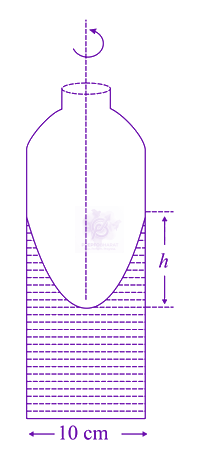
A $60HP$ electric motor lifts an elevator having a maximum total load capacity of $2000kg.$ If the frictional force on the elevator is $4000N,$ the speed of the elevator at full load is close to : $(1\mathrm{HP}=746W,g=10m{s}^{-2})$
A fluid is flowing through a horizontal pipe of varying cross-section, with $v {\mathrm{ms}}^{-1}$ at a point where the pressure is $P$ Pascal. At another point where pressure $\frac{P}{2}$ Pascal its speed is $V{\mathrm{ms}}^{-1}$. If the density of the fluid is $\rho \mathrm{kg}-{m}^{-3}$ and the flow is streamline, then $V$ is equal to
A force $\vec{F}=(\hat{i}+2\hat{j}+3\hat{k})N$ acts at a point $(4\hat{i}+3\hat{j}-\hat{k})m$. Then the magnitude of torque about the point $(\hat{i}+2\hat{j}+\hat{k})m$ will be $\sqrt{x}N-m.$The value of $x$ is..........
A helicopter rises from rest on the ground vertically upwards with a constant acceleration g. A food packet is dropped from the helicopter when it is at a height h. The time taken by the packet to reach the ground is close to [$g$ is the acceleration due to gravity]:
A hollow spherical shell at outer radius $R$ floats just submerged under the water surface. The inner radius of the shell is $r.$ If the specific gravity of the shell material is $\frac{27}{8}$ with respect to water, the value of $r$ is:
A leak proof cylinder of length $1m,$ made of a metal which has very low coefficient of expansion is floating vertically in water at ${0}^{o}C$ such that its height above the water surface is $20cm.$ When the temperature of water is increased to ${4}^{o}C,$ the height of the cylinder above the water surface becomes $21cm.$ The density of water at $T={4}^{o}C,$ relative to the density at $T={0}^{o}C$ is close to:
A mass of $10kg$ is suspended by a rope of length $4m$, from the ceiling. A force $F$ is applied horizontally at the mid-point of the rope such that the top half of the rope makes an angle of $45^{\circ}$ with the vertical. Then $F$ equals: (Take $g=10m{s}^{-2}$ and the rope to be massless)
A particle is moving along the $x$ -axis with its coordinate with time $t$ given by $x(t)=10+8t-3{t}^{2}.$ Another particle is moving along the $y$ -axis with its coordinate as a function of time given by $y(t)=5-8{t}^{3}.$ At $t=1s,$ the speed of the second particle as measured in the frame of the first particle is given as $\sqrt{v}.$ Then $v(inm{s}^{-1})$ is ___________.
A particle is moving unidirectional on a horizontal plane under the action of a constant power supplying energy source. The displacement (s) – time (t) graph that describes the motion of the particle is (graphs are drawn schematically and are not to scale):
A particle moves such that its position vector $\vec{r}(t)=\mathrm{cos}\omega t\hat{i}+\mathrm{sin}\omega t\hat{j}$ where $\omega$ is a constant and $t$ is time. Then which of the following statements is true for the velocity $\vec{v}(t)$ and acceleration $\vec{a}(t)$ of the particle:
A particle moving in the $\mathrm{xy}$-plane experiences a velocity dependent force $\vec{F}=k({\upsilon }_{y}\hat{i}+{\upsilon }_{x}\hat{j})$, where ${\upsilon }_{x}$ and ${\upsilon }_{y}$ are the $x$ and $y$ components of its velocity $\vec{\upsilon }$. If $\vec{a}$ is the acceleration of the particle, then which of the following statements is true for the particle ?
A particle of charge $q$ and mass $m$ is subjected to an electric field $E={E}_{0}(1–a{x}^{2})$ in the $x-$direction, where a and ${E}_{0}$ are constants. Initially the particle was at rest at $x=0$. Other than the initial position the kinetic energy of the particle becomes zero when the distance of the particle from the origin is :
A particle of mass $m$ and charge $q$ is released from rest in a uniform electric field. If there is no other force on the particle, the dependence of its speed $v$ on the distance $x$ travelled by it is correctly given by (graphs are schematic and not drawn to scale)
A particle of mass $200\mathrm{MeV}{c}^{-2}$ collides with a hydrogen atom at rest. Soon after the collision, the particle comes to rest, and the atom recoils and goes to its first excited state. The initial kinetic energy of the particle (in $\mathrm{eV}$) is $\frac{N}{4}.$ The value of $N$ is: (Given the mass of the hydrogen atom to be $1\mathrm{GeV}{c}^{-2}$).........
A particle of mass $m$ is dropped from a height $h$ above the ground. At the same time another particle of the same mass is thrown vertically upwards from the ground with a speed of $\sqrt{2gh}.$ If they collide head-on completely inelastically, the time taken for the combined mass to reach the ground, in units of $\sqrt{\frac{h}{g}}$ is:
A particle of mass $m$ is fixed to one end of a light spring having force constant $k$ and unstretched length $l.$ The other end is fixed. The system is given an angular speed $\omega$ about the fixed end of the spring such that it rotates in a circle in gravity free space. Then the stretch in the spring is:
A particle of mass $m$ is moving along the $x$-axis with initial velocity $u\hat{i}$. It collides elastically with a particle of mass $10m$ at rest and then moves with half its initial kinetic energy (see figure). If $\mathrm{sin}{\theta }_{1}=\sqrt{n}\mathrm{sin}{\theta }_{2}$ then value of n is ________. 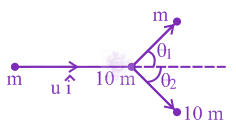
A particle of mass m is projected with a speed u from the ground at an angle $\theta =\frac{\pi }{3}$ w.r.t. horizontal (x-axis). When it has reached its maximum height, it collides completely inelastically with another particle of the same mass and velocity $u\hat{i}.$ The horizontal distance covered by the combined mass before reaching the ground is:
A particle of mass $m$ with an initial velocity $u\hat{i}$ collides perfectly elastically with a mass $3m$ at rest. It moves with a velocity $v\hat{j}$ after collision, then, $v$ is given by
A particle $(m=1kg)$ slides down a frictionless track $(AOC)$ starting from rest at a point $A$ (height $2m$ ). After reaching $C,$ the particle continues to move freely in air as a projectile. When it reaching its highest point $P$ (height $1m$ ), the kinetic energy of the particle (in $J$ ) is: (Figure drawn is schematic and not to scale; take $g=10m{s}^{-2}$ ) ______________. 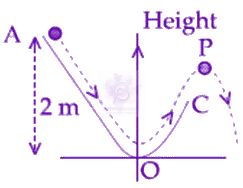
A particle starts from the origin at $t=0$ with an initial velocity of $3.0\hat{i}m/s$ and moves in the $x-y$ plane with a constant acceleration $(6.0\hat{i}+4.0\hat{j})m/{s}^{2}.$ The $x-$ coordinate of the particle at the instant when its $y-$ coordinate is $32m$ is $D$ meters. The value of $D$ is:
A person of $80\mathrm{kg}$ mass is standing on the rim of a circular platform of mass $200\mathrm{kg}$ rotating about its axis at $5$ revolutions per minute (rpm). The person now starts moving towards the centre of the platform. What will be the rotational speed (in $\mathrm{rpm}$ ) of the platform when the person reaches its centre....
A person pushes a box on a rough horizontal plateform surface. He applies a force of $200N$ over a distance of $15m$. Thereafter, he gets progressively tired and his applied force reduces linearly with distance to $100N$. The total distance through which the box has been moved is $30m$. What is the work done by the person during the total movement of the box?
A physical quantity z depends on four observables $a,b,c$ and $d$, as $z=\frac{{a}^{2}{b}^{2/3}}{\sqrt{c}{d}^{3}}.$ The percentage of error in the measurement of $a,b,c$ and $d$ are $2%,1.5%,4%$ and $2.5%$ respectively. The percentage of error in $z$ is :
A physical quantity z depends on four observables $a,b,c$ and $d$, as $z=\frac{{a}^{2}{b}^{2/3}}{\sqrt{c}{d}^{3}}.$ The percentage of error in the measurement of $a,b,c$ and $d$ are $2%,1.5%,4%$ and $2.5%$ respectively. The percentage of error in $z$ is :
A quantity $x$ is given by $(1F{v}^{2}/W{L}^{4})$ in terms of moment of inertia $I$, force $F$, velocity $v$, work $W$ and length $L$. The dimensional formula for $x$ is same as that of :
A quantity $f$ is given by $f=\sqrt{\frac{h{c}^{5}}{G}}$ where $c$ is speed of light, $G$ univasal gravitational constant and $h$ is the Planck’s constant. Dimension of $f$ is that of:
A rod of length $l$ has non-uniform linear mass density given by $\rho (x)=a+b{(\frac{x}{l})}^{2},$ where $a$ and $b$ are constants and $0\leq x\leq l$ The value of $x$ for the centre of mass of the rod is at:
A satellite is in an elliptical orbit around a planet $P.$ It is observed that the velocity of the satellite when it is farthest from the planet is 6 times less than that when it is closest to the planet. The ratio of distances between the satellite and the planet at closest and farthest points is :
A satellite is moving in a low nearly circular orbit around the earth. Its radius is roughly equal to that of the earth's radius ${R}_{e}.$ By firing rockets attached to it, its speed is instantaneously increased in the direction of its motion so that it become $\sqrt{\frac{3}{2}}$ times larger. Due to this the farthest distance from the centre of the earth that the satellite reaches is $R$. Value of $R$ is :
A satellite of mass$M$ is launched vertically upwards with an initial speed $u$ from the surface of the earth. After it reaches height $R$ ( $R=$ radius of the earth), it ejects a rocket of mass $\frac{M}{10}$ so that subsequently the satellite moves in a circular orbit. The kinetic energy of the rocket is ( $G$ is the gravitational constant; ${M}_{e}$ is the mass of the earth):
A screw gauge has 50 divisions on its circular scale. The circular scale is 4 units ahead of the pitch scale marking, prior to use. Upon one complete rotation of the circular scale, a displacement of $0.5\mathrm{mm}$ is noticed on the pitch scale. The nature of zero error involved and the lest count of the screw gauge, are respectively:
A simple pendulum is being used to determine the value of gravitational acceleration $g$ at a certain place. The length of the pendulum is $25.0cm$ and a stopwatch with $1s$ resolution measures the time taken for $40$ oscillations to be $50s$. The accuracy in $g$ is:
A simple pendulum is being used to determine the value of gravitational acceleration $g$ at a certain place. The length of the pendulum is $25.0cm$ and a stopwatch with $1s$ resolution measures the time taken for $40$ oscillations to be $50s$. The accuracy in $g$ is:
A small ball of mass $m$ is thrown upward with velocity $u$ from the ground. The ball experiences a resistive force $mk{v}^{2}$ where $v$ is it speed. The maximum height attained by the ball is :
A small block starts slipping down from a point $B$ on an inclined plane $AB$, which is making an angle $\theta$ with the horizontal section $BC$ is smooth and the remaining section $CA$ is rough with a coefficient of friction $\mu$. It is found that the block comes to rest as it reaches the bottom (point A) of the inclined plane. If $BC=2AC$, the coefficient of friction is given by $\mu =ktan\theta$. The value of $k$ is ....... 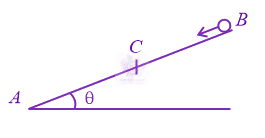
A small spherical droplet of density $d$ is floating exactly half immersed in a liquid of density $\rho$ and surface tension $T.$ The radius of the droplet is (take note that the surface tension applies an upward force on the droplet):
A spaceship in space sweeps stationary interplanetary dust. As a result, its mass increases at a rate $\frac{dM(t)}{dt}=b{v}^{2}(t),$ where $v(t)$ is its instantaneous velocity. The instantaneous acceleration of the satellite is:
A spring mass system (mass $m,$ spring constant $k$ and natural length $l$ ) rests in equilibrium on a horizontal disc. The free end of the spring is fixed at the centre of the disc. If the disc together with spring mass system rotates about it's axis with an angular velocity $\omega ,(k>>m{\omega }^{2})$ the relative change in the length of the spring is best given by the option:
A square shaped hole of side$l=\frac{a}{2}$ is carved out at a distance $d=\frac{a}{2}$ from the centre '$O$' of a uniform circular disk of radius a. If the distance of the centre of mass of the remaining portion from $O$ is $-\frac{a}{x}$, value of $X$ (to the nearest integer) is : 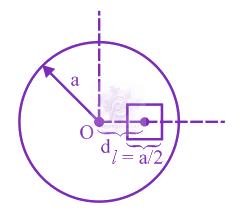
A student measuring the diameter of a pencil of circular cross-section with the help of a vernier scale records the following four readings $5.50\mathrm{mm}$, $5.55\mathrm{mm}$, $5.34\mathrm{mm}$, $5.65\mathrm{mm}$. The average of these four reading is $5.5375\mathrm{mm}$ and the standard deviation of the data is $0.07395\mathrm{mm}$. The average diameter of the pencil should therefore be recorded as :
A tennis ball is released from a height $\text{h}$ and after freely falling on a wooden floor it rebounds and reaches height $\text{h}/2$. The velocity versus height of the ball during its motion may be represented graphically by: (graphs are drawn schematically and on not to scale)
A thin rod of mass $0.9\mathrm{kg}$ and length $1m$ is suspended, at rest, from one end so that it can freely oscillate in the vertical plane. A particle of move $0.1\mathrm{kg}$ moving in a straight line with velocity $80m{s}^{-1}$ hits the rod at its bottom most point and sticks to it (see figure). The angular speed (in $\mathrm{rad}{s}^{-1}$) of the rod immediately after the collision will be ………… 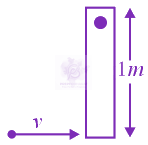
A uniform cylinder of mass $M$ and radius $R$ is to be pulled over a step of height a $(a<R)$ by applying a force $F$ at its centre $'O'$ perpendicular to the plane through the axes of the cylinder on the edge of the step (see figure). The minimum value of $F$ required is : 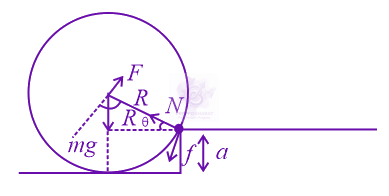
A uniform sphere of mass $500 g$ rolls without slipping on a plane horizontal surface with its centre moving at a speed of $5.00\mathrm{cm}{s}^{-1}$. Its kinetic energy is:
A uniformly thick wheel with moment of inertia $I$ and radius $R$ is free to rotate about its centre of mass (see fig). A massless string is wrapped over its rim and two blocks of masses ${m}_{1}$ and ${m}_{2}({m}_{1}>{m}_{2})$ are attached to the ends of the string. The system Is released from rest. The angular speed of the wheel when ${m}_{1}$ descends by a distance $h$ is: 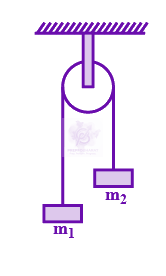
A wheel is rotating freely with an angular speed $\omega$ on a shaft. The moment of inertia of the wheel is $I$ and the moment of inertia of the shaft is negligible. Another wheel of moment of inertia $3I$ initially at rest is suddenly coupled to the same shaft. The resultant fractional loss in the kinetic energy of the system is:
A wire of density $9\times {10}^{–3}\mathrm{kg}{\mathrm{cm}}^{–3}$ is stretched between two clamps $1m$ apart. The resulting strain in the wire is $4.9\times {10}^{–4}$. The lowest frequency of the transverse vibrations in the wire (Young's modulus of wire $Y=9\times {10}^{10}{\mathrm{Nm}}^{–2}$ ), (to the nearest integer),_______
Amount of solar energy received on the earth's surface per unit area per unit time is defined a solar constant. Dimension of solar constant is:
An asteroid is moving directly towards the centre of the earth. When at a distance of $10R$ ($R$ is the radius of the earth) from the centre of the earth, it has a speed of $12\mathrm{km}{s}^{-1}.$ Neglecting the effect of earth's atmosphere, what will be the speed of the asteroid when it hits the surface of the earth (escape velocity from the earth is $11.2km{s}^{-1})$ ? Give your answer to the nearest integer in $\mathrm{km}{s}^{-1}$__________.
An elevator in a building can carry a maximum of $10$ persons, with the average mass of each person being $68kg$ . The mass of the elevator itself is $920kg$ and it moves with a constant speed of $3m/s$ . The frictional force opposing the motion is $6000N$ . If the elevator is moving up with its full capacity, the power delivered by the motor to the elevator $(g=10m/{s}^{2})$ must be at least:
An ideal fluid flows (laminar flow) through a pipe of non-uniform diameter. The maximum and minimum diameters of the pipes are $6.4cm$ and $4.8cm$ , respectively. The ratio of the minimum and the maximum velocities of fluid in this pipe is:
An insect is at the bottom of a hemispherical ditch of radius $1m$. It crawls up the ditch but starts slipping after it is at height h from the bottom. If the coefficient of friction between the ground and the insect is $0.75,$ then $h$is $:(g=10m{s}^{-2})$
An massless equilateral triangle EFG of side 'a' (As shown in figure) has three particles of mass $m$ situated at its vertices. The moment of inertia of the system about the line EX perpendicular to EG in the plane of EFG is $\frac{N}{20}{\mathrm{ma}}^{2}$ where $N$ is an integer. The value of $N$ is ___________ . 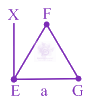
As shown in figure. When a spherical cavity (centred at $O$ ) of radius $1$ is cut out of a uniform sphere of radius $R$ (centred at $C$ ), the centre of mass of remaining (shaded part of sphere is at $G,$ i.e., on the surface of the cavity. $R$ can be determined by the equation: 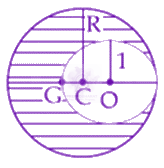
Blocks of masses $\text{m}, 2\text{m}, 4\text{m}$ and $8\text{m}$ are arranged in a line of a frictionless floor. Another block of mass $m$ , moving with speed $\upsilon$ along the same line (see figure) collides with mass $m$ in perfectly inelastic manner. All the subsequent collisions are also perfectly inelastic. By the time the last block of mass $8\text{m}$ starts moving the total energy loss is $\text{p%}$ of the original energy. Value of ‘$\text{p}$ ’ is close to: 
Consider a force $\vec{F}=-x\hat{i}+y\hat{j}$ . The work done by this force in moving a particle from point $A(1,0)$ to $B(0,1)$ along the line segment is : (all quantities are in SI units)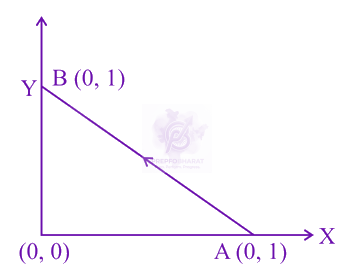
Consider a solid sphere of radius $R$ and mass density $\rho (r)={\rho }_{0}(1-\frac{{r}^{2}}{{R}^{2}}),0<r\leq R.$ The minimum density of a liquid in which it will float is:
Consider a uniform rod of mass $M=4m$ and length $l$ pivoted about its centre. A mass $m$ moving with velocity $v$ making angle $\theta =\frac{\pi }{4}$ to the rod’s long axis collides with one end of the rod and sticks to it. The angular speed of the rod-mass system just after the collision is:
Consider two solid spheres of radii ${R}_{1}=1m$,${R}_{2}=2m$ and masses ${M}_{1}$ and ${M}_{2},$ respectively. The gravitational field due to sphere $(1)$ and $(2)$ are shown. The value of $\frac{{M}_{1}}{{M}_{2}}$ is: 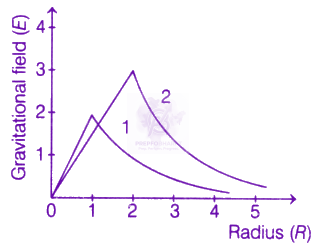
Consider two uniform discs of the same thickness and different radii ${R}_{1}=R$ and ${R}_{2}=\alpha R$ made of the same material. If the ratio of their moments of inertia ${I}_{1}$ and ${I}_{2}$, respectively, about their axes is ${I}_{1}:{I}_{2}=1:16$ then the value of $\alpha$ is :
Dimensional formula for thermal conductivity is (here $\text{K}$ denotes the temperature):
For the four sets of three measured physical quantities as given below. Which of the following options is correct?<br>$(i)$ ${A}_{1}=24.36,{B}_{1}=0.0724,{C}_{1}=256.2$<br>$(ii)$ ${A}_{2}=24.44,{B}_{2}=16.082,{C}_{2}=240.2$<br>$(iii)$ ${A}_{3}=25.2,{B}_{3}=19.2812,{C}_{3}=236.183$<br>$(iv)$ ${A}_{4}=25,{B}_{4}=236.191,{C}_{4}=19.5$
For the four sets of three measured physical quantities as given below. Which of the following options is correct? $(i)$ ${A}_{1}=24.36,{B}_{1}=0.0724,{C}_{1}=256.2$ $(ii)$ ${A}_{2}=24.44,{B}_{2}=16.082,{C}_{2}=240.2$ $(iii)$ ${A}_{3}=25.2,{B}_{3}=19.2812,{C}_{3}=236.183$ $(iv)$ ${A}_{4}=25,{B}_{4}=236.191,{C}_{4}=19.5$
Four point masses, each of mass $m$, are fixed at the corners of a square of side I. The square is rotating with angular frequency $\omega ,$ about an axis passing through one of the corners of the square and parallel to tis diagonal, as shown in the figure. The angular momentum of the square about the axis is 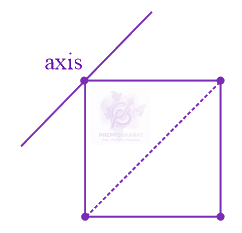
Given, $B$ is magnetic field induction, and ${\mu }_{0}$ is the magnetic permeability of vacuum. The dimension of $\frac{{B}^{2}}{2{\mu }_{0}}$ is:
Hydrogen ion and singly ionized helium atom are accelerated, from rest, through the same potential difference. The ratio of final speeds of hydrogen and helium ions is close to:
If momentum$(P)$, area $(A)$ and time $(T)$ are taken to be the fundamental quantities then the dimensional formula for energy is :
If speed $V$, area $A$ and force $F$ are chosen as fundamental units, then the dimension of Young's modulus will be :
If the potential energy between two molecules is given by $U=\frac{A}{{r}^{6}}+\frac{B}{{r}^{12}},$ then at equilibrium, separation between molecules, and the potential energy are:
If the screw on a screw-gauge is given six rotations, it moves by $3mm$ on the main scale. If there are $50$ divisions on the circular scale the least count of the screw gauge is:
In a reactor, $2\mathrm{kg}$ of $U23592$ fuel is fully used up in $30$ days. The energy released fission is $200\mathrm{MeV}$. Given that the Avogadro number, $N=6.023\times {10}^{26}$ per kilo mole and $1\mathrm{eV}=1.6\times {10}^{-19}J$. The power output of the reactor is close to:
In an experiment to verify Stokes law, a small spherical ball of radius $r$ and density $\rho$ falls under gravity through a distance $h$ in air before entering a tank of water. If the terminal velocity of the ball inside water is same as its velocity just before entering the water surface, then the value of $h$ is proportional to: (ignore viscosity of air)
$ABC$ is a plane lamina of the shape of an equilateral triangle. $D,E$ are mid-points of $AB,AC$ and $G$ is the centroid of the lamina. Moment of inertia of the lamina about an axis passing through $G$ and perpendicular to the plane $ABC$ is ${I}_{0}$. If part $ADE$ is removed, the moment of inertia of the remaining part about the same axis is $\frac{N{I}_{0}}{16}$ where $N$ is an integer. Value of $N$ is: 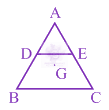
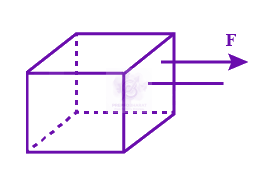 Consider a uniform cubical box of side a on a rough floor that is to be moved by applying minimum possible force $F$ at a point $b$ above its centre of mass (see figure). If the coefficient of friction is $\mu =0.4$ , the maximum possible value of $100\times \frac{b}{a}$ for a box not to topple before moving is ________
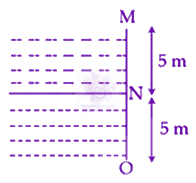 Two liquids of densities ${\rho }_{1}$ and ${\rho }_{2}({\rho }_{2}=2{\rho }_{1})$ are filled up behind a square wall of side $10m$ as shown in figure. Each liquid has a height of $5m.$ The ratio of the forces due to these liquids exerted on upper part MN to that at the lower part NO is (Assume that the liquids are not mixing):
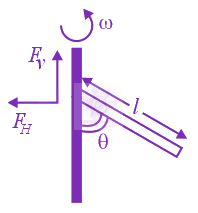 A uniform rod of length ' ${\ell }^{'}$ is pivoted at one of its ends on a vertical shaft of negligible radius. When the shaft rotates at angular speed $\omega$ the rod makes an angle $\theta$with it (see figure). To find $\theta$ equate the rate of change of angular momentum (direction going into the paper) $\frac{m{\ell }^{2}}{12}{\omega }^{2}\mathrm{sin}\theta$ about the centre of mass (CM) to the torque provided by the horizontal and vertical forces ${F}_{H}$and ${F}_{v}$ about the CM. The value of $\theta$ is then such that:
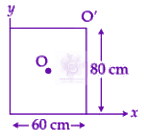 For a uniform rectangular sheet shown in the figure, the ratio of moments of inertia about the axes perpendicular to the sheet and passing through $O$ (the centre of mass) and $O$' (corner point) is:
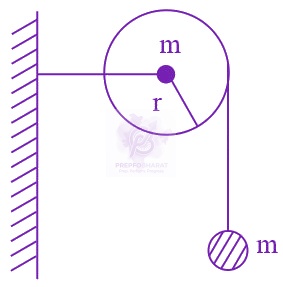 As shown in the figure, a bob of mass $m$ is tied to a massless string whose other end portion is wound on a fly wheel (disc) of radius $r$ and mass $m.$ When released from rest the bob starts falling vertically. When it has covered a distance of $h,$ the angular speed of the wheel will be:
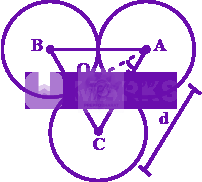 Three solid spheres each of mass $m$ and diameter $d$ are stuck together such that the lines connecting the centres form an equilateral triangle of side of length $d$ . The ratio $\frac{{I}_{0}}{{I}_{A}}$ of moment of inertia ${I}_{0}$ of the system about an axis passing the centroid and about center of any of the spheres ${I}_{A}$ and perpendicular to the plane of the triangle is:
Mass per unit area of a circular disc of radius a depends on the distance $r$ from its centre as $\sigma (r)=A+Br$ . The moment of inertia of the disc about the axis, perpendicular to the plane and passing through its centre is:
The moment of inertia of a uniform circular disc of radius R and mass M about an axis touching the disc at its diameter and normal to the disc is:
Moment of inertia of a cylinder of mass $m,$ length $L$ and radius $R$ about an axis passing through its centre and perpendicular to the axis of the cylinder is $I=M(\frac{{R}^{2}}{4}+\frac{{L}^{2}}{12}).$ If such a cylinder is to be made for a given mass of a material, the ratio $\frac{L}{R}$ for it to have minimum possible $I$ is:
On the $x$-axis and at a distance $x$ from the origin, the gravitational field due to a mass distribution is given by $\frac{Ax}{{({x}^{2}+{a}^{2})}^{3/2}}$ in the $x$-direction. The magnitude of the gravitational potential on the $x$-axis at a distance $x$, taking its value to be zero at infinity is:
One end of a straight uniform $1m$ long bar is pivoted on horizontal table. It is released from rest when it makes an angle ${30}^{o}$ from the horizontal (see figure). Its angular speed when it hits the table is given as $\sqrt{n}rad{s}^{-1}$ , where $n$ is an integer. The value of $n$ is ____________ 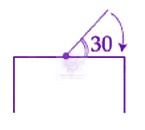
Particle $A$ of mass ${m}_{1}$ moving with velocity $(\sqrt{3}\hat{i}+\hat{j}){\mathrm{ms}}^{-1}$ collides with another particle $B$ of mass ${m}_{2}$ which is at rest initially. Let ${\vec{v}}_{1}$ and ${\vec{v}}_{2}$ be the velocities of particles $A$ and $B$ after collision respectively. If ${m}_{1}=2{m}_{2}$ and after collision ${\vec{v}}_{1}-(\hat{i}+\sqrt{3}\hat{j}){\mathrm{ms}}^{-1}$, the angle between ${\vec{v}}_{1}$ and ${\vec{v}}_{2}$ is :
Planet $A$ has mass $M$ and radius $R.$ Planet $B$ has half the mass and half the radius of Planet $A.$ If the escape velocities from the Planets $A$ and $B$ are ${v}_{A}$ and ${v}_{B},$ respectively, then $\frac{{v}_{A}}{{v}_{B}}=\frac{n}{4}.$ The value of $n$ is:
Pressure inside two soap bubbles are $1.01$ and $1.02$ atmosphere, respectively. The ratio of their volumes is :
Shown in the figure is a hollow ice-cream cone (it is open at top). If its mass is $M$, radius of its top is $R$ and height, $H$, then its moment of inertia about its axis is 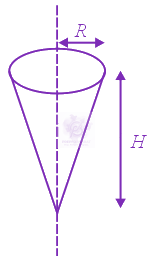
Shown in the figure is rigid and uniform one meter long rod $\mathrm{AB}$ held in horizontal position by two strings tied to its ends and attached to the ceiling. The rod is off mass $'m'$ and has another weight of mass $2m$ hung at a distance of $75\mathrm{cm}$ from $A$. The tension in the string at $A$ is: 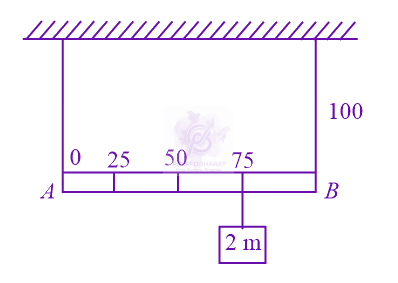
Speed of a transverse wave on a straight wire (mass $6.0g,$ length $60cm$ and area of cross-section $1.0m{m}^{2}$ is $90{ms}^{-1}$. If the Young's modulus of wire is $16\times {10}^{11}N{m}^{-2}$, the extension of wire over its natural length is:
Starting from the origin at time $\text{t}=0$, with initial velocity $5\overset{⏜}{j}{\text{ms}}^{-1}$, a particle moves in the $x$ -$y$ plane with a constant acceleration of $(10\overset{⏜}{i}+4\overset{⏜}{j}){\text{ms}}^{-2}$. At time $\text{t}$, its coordinates are $(20{\text{m, y}}_{0}\text{ m})$. The values of $\text{t}$ and ${\text{y}}_{0}$ are, respectively:
The acceleration due to gravity on the earth's surface at the poles is $g$ and angular velocity of the earth about the axis passing through the pole is $\omega$. An object is weighed at the equator and at a height $h$ above the poles by using a spring balance. If the weights are found to be same, then $h$ is: ($h\ll R$, where $R$ is the radius of the earth)
The centre of mass of a solid hemisphere of radius $8\mathrm{cm}$ is $x\mathrm{cm}$ from the centre of the flat surface. Then value of $x$ is
The coordinates of the centre of mass of a uniform flag-shaped lamina (thin flat plate) of mass $4kg$. (The coordinates of the same are shown in the figure) are: 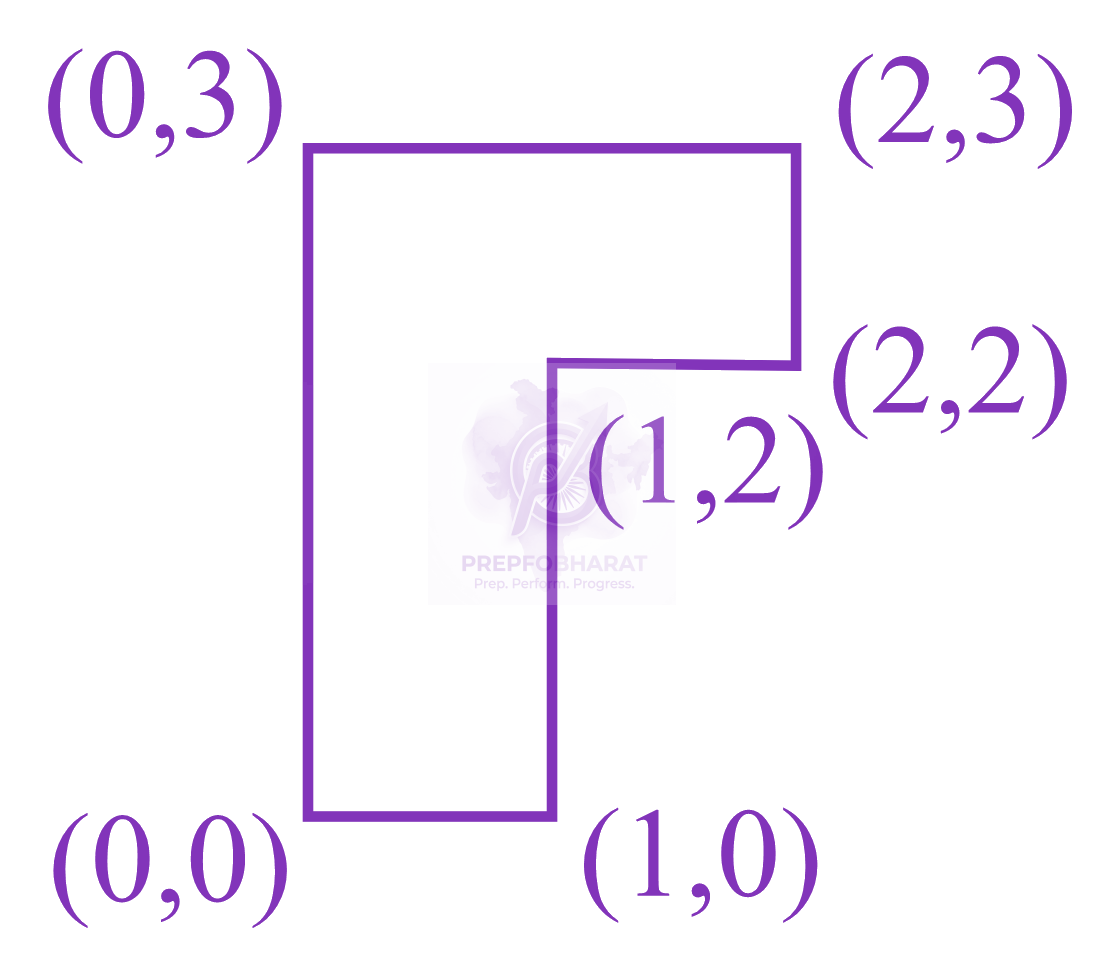
The density of a solid metal sphere is diameter. The maximum error in the density of the sphere is $(\frac{x}{100})%.$ If the relative errors in measuring the mass and the diameter are $6.0%$ and $1.5%$ respectively, the value of $x$ is $-$
The density of a solid metal sphere is diameter. The maximum error in the density of the sphere is $(\frac{x}{100})%.$ If the relative errors in measuring the mass and the diameter are $6.0%$ and $1.5%$ respectively, the value of $x$ is $-$
The dimension of stopping potential ${V}_{0}$ in photoelectric effect in units of Planck’s constant ‘ $h$ ’, speed of light ‘ $c$ ’ and Gravitational constant ‘ $G$ ’ and ampere $A$ is:
The distance $x$ covered by a paritcle in one dimensional motion varies with time $t$ as ${x}^{2}=a{t}^{2}+2bt+c$ . If the acceleration of the particle depends on $x$ as ${x}^{-n}$ , where $n$ is an integer, the value of $n$ is _________
The height ‘$h$’ at which the weight of a body will be the same as that at the same depth ‘h’ from the surface of the earth is (Radius of the earth is $R$ and effect of the rotation of the earth is neglected)
The least count of the main scale of a vernier calipers is $1\mathrm{mm}$. Its vernier scale is divided into $10$ divisions and coincide with $9$ divisions of the main scale. When jaws are touching each other, the ${7}^{\mathrm{th}}$ division of the vernier scale coincides with a division of the main scale and the zero of vernier scale is lying right side of the zero of the main scale. When this vernier is used to measure the length of the cylinder the zero of the vernier scale between $3.1\mathrm{cm}$ and $3.2\mathrm{cm}$ and ${4}^{\mathrm{th}}$ VSD coincides with the main scale division. The length of the cylinder is (VSD is vernier scale division)
The linear mass density of a thin rod $\mathrm{AB}$ of length $L$ varies from $A$ to $B$ as $\lambda (x)={\lambda }_{0}(1+\frac{x}{L})$, where $x$ is the distance from $A$. If $M$ is the mass of the rod then its moment of inertia about an axis passing through $A$ and perpendicular to the rod :
The mass density of a planet of radius R varies with the distance r from its centre as $\rho (r)={\rho }_{0}(1-\frac{{r}^{2}}{{R}^{2}})$ Then the gravitational field is maximum at:
The mass density of a spherical galaxy varies as $\frac{K}{r}$ over a large distance $r$ from its center. In that region, a small star is in a circular orbit of radius $R$. Then the period of revolution,$T$ depends on $R$ as:
The quantities $x=\frac{1}{\sqrt{{\mu }_{0}{\in }_{0}}},y=\frac{E}{B}$ and $z=\frac{l}{CR}$ are defined where C-capacitance, R-Resistance, $\ell -$length, E-Electric field, B-magnetic field and$\in 0,\mu 0,-$free space permittivity and permeability respectively. Then:
The radius of gyration of a uniform rod of length $l,$ about an axis passing through a point $\frac{l}{4}$ away from the centre of the rod, and perpendicular to it, is:
The speed verses time graph for a particle is shown in the figure. The distance travelled (in $m$) by the particle during the time interval $t=0$ to $t=5$ $s$ will be __________ 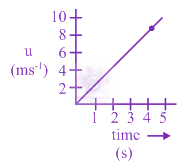
The sum of two forces $\vec{P}$ and $\vec{Q}$ is $\vec{R}$ such that $|\vec{R}|=|\vec{P}|$. Find the angle between resultant of $2\vec{P}$ and $\vec{Q}$ and $\vec{Q}$ , ________
The sum of two forces $\vec{P}$ and $\vec{Q}$ is $\vec{R}$ such that $|\vec{R}|=|\vec{P}|$. Find the angle between resultant of $2\vec{P}$ and $\vec{Q}$ and $\vec{Q}$ , ________
The value of the acceleration due to gravity is ${g}_{1}$ at a height $h=\frac{R}{2}$ ($R=$ radius of the earth) from the surface of the earth. It is again equal to ${g}_{1}$ at a depth $d$ below the surface the earth. The ratio $(\frac{d}{R})$ equals:
The velocity $(v)$ and time $(t)$ graph of a body in a straight line motion is shown in the figure. The point $S$ is at $4.333$ seconds. The total distance covered by the body in $6s$ is : 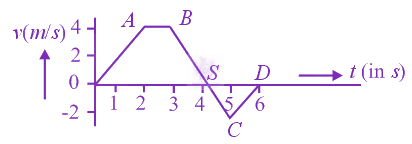
Three point particles of masses $1.0kg,1.5\mathrm{kg}$ and $2.5kg$ are placed at three corners of a right angle triangle of sides $4.0cm,3.0cm$ and $5.0cm$ as shown in the figure. The centre of mass of the system is at a point: 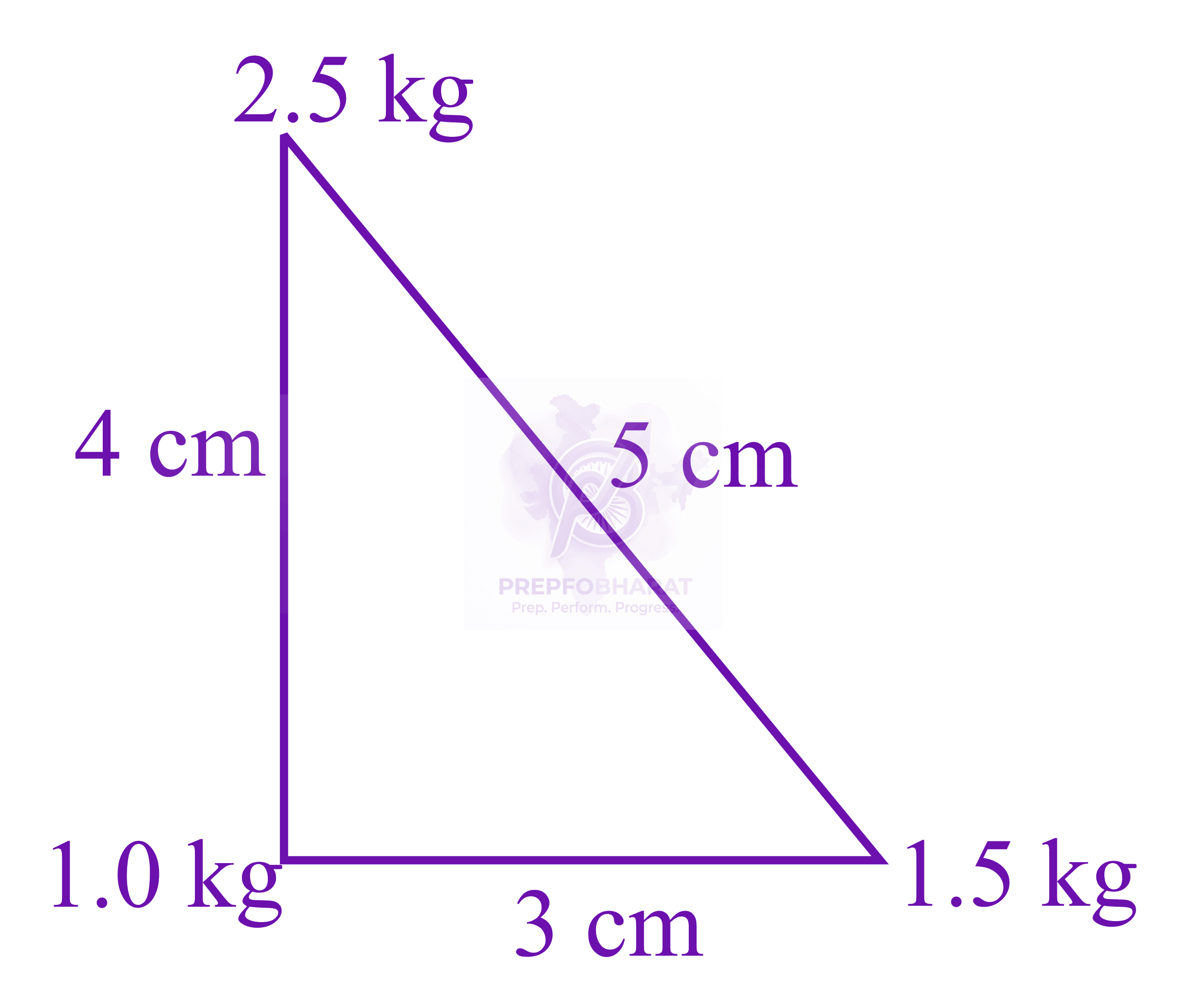
Train $A$ and train $B$ are running on parallel tracks in the opposite directions with speed of $36\mathrm{km}{\mathrm{hour}}^{-1}$ and $72\mathrm{km}{\mathrm{hour}}^{-1}$, respectively. A person is walking in train $A$ in the direction opposite to its motion with a speed of $1.8\mathrm{km}{\mathrm{hour}}^{-1}$. Speed $(\mathrm{in}m{s}^{-1})$ of this person as observed from train $B$ will be close to: (take the distance between the tracks as negligible)
Two bodies of the same mass are moving with the same speed, but in different directions in a plane. They have a completely inelastic collision and move together thereafter with a final speed which is half of their initial velocities of the two bodies (in degree) is -
Two identical cylindrical vessels are kept on the ground and each contain the same liquid of density $d$. The area of the base of both vessels is $S$ but the height of liquid in one vessel is ${x}_{1}$ and in the other ${x}_{2}$. When both cylinders are connected through a pipe of negligible volume very close to the bottom, the liquid flows from one vessel to the other until it comes to equilibrium at a new height. The change in energy of the system in the process is :
Two particles of equal mass $m$ have respective initial velocities $u\hat{i}$ and $u(\frac{\hat{i}+\hat{j}}{2})$ . They collide completely inelastically. The energy lost in the process is:
Two planets have masses $M$ and $16M$ and their radii are a and $2a$, respectively. The separation between the centres of the planets is $10a$. A body of mass $m$ is fired from the surface of the larger planet towards the smaller planet along the line joining their centres. For the body to be able to reach at the surface of smaller planet, the minimum firing speed needed is :
Two steel wires having same length are suspended from a ceiling under the same load. If the ratio of their energy stored per unit volume is $1:4,$ the ratio of their diameters is:
Two uniform circular discs are rotating independently in the same direction around their common axis passing through their centres. The moment of inertia and angular velocity of the first disc are $0.1\mathrm{kg}-{m}^{2}$ and $10\text{ rad }{s}^{-1}$ respectively while those for the second one are $0.2\mathrm{kg}-{m}^{2}$and $5\mathrm{rad}{s}^{-1}$ respectively. At some instant they get stuck together and start rotating as a single system about their common axis with some angular speed. The kinetic energy of the combined system is :
Using screw gauge of pitch $0.1\mathrm{cm}$ and $50$ divisions on its circular scale, the thickness of an object is measured. It should correctly be recorded as,
Water flows m a horizontal tube (see figure). The pressure of water changes by $700N{m}^{-2}$ between $A$ and $B$ where the area of cross section are $40c{m}^{2}$ and $20c{m}^{2},$ respectively. Find the rate of flow of water through the tube. (density of water $=1000kg{m}^{-3}$ ) 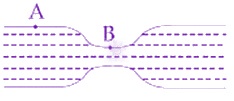
When a car is at rest, its driver sees rain drops falling on it vertically. When driving the car with speed $v$, he sees that rain drops coming at an angle ${60}^{\circ }$ from the horizontal. On further increasing the speed of the car to $(1+\beta )v$, this angle changes to ${45}^{\circ }$. The value of $\beta$ is close to :
When a long glass capillary tube of radius $0.015\mathrm{cm}$ is dipped in a liquid, the liquid rises to a height of $15\mathrm{cm}$ within it. If the contact angle between the liquid and glass to close to $0^{\circ}$, the surface tension of the liquid, in milliNewton ${m}^{-1},$ is $[{\rho }_{\text{(liqued) }}=900\mathrm{kg}{m}^{-3},g=10m{s}^{-2}]$ (Given answer in closed integer)