Mechanics PYQ
JEE Main Physics — Mechanics previous year questions with solutions.
Take a timed test
JEE Main Mechanics — Test 1
10 questions·20 min
Browse by Year
Mechanics at a glance
Questions per year
2069 across 25 yearsDifficulty mix
2069 total- easy769 · 37%
- medium955 · 46%
- hard345 · 17%
Subtopic-wise weightage
Breakdown of the 2052 Mechanics questions tagged to a subtopic, by year — darker cells mean more questions.
| Subtopic | Weightage | Total | 2026 | 2025 | 2024 | 2023 | 2022 | 2021 | 2020 | 2019 | 2018 | 2017 | 2016 | 2015 | 2014 | 2013 | 2012 | 2011 | 2010 | 2009 | 2008 | 2007 | 2006 | 2005 | 2004 | 2003 | 2002 |
|---|---|---|---|---|---|---|---|---|---|---|---|---|---|---|---|---|---|---|---|---|---|---|---|---|---|---|---|
| Units & Measurements | 21.0% | 430 | 25 | 40 | 65 | 48 | 51 | 74 | 24 | 46 | 8 | 3 | 5 | 6 | 6 | 5 | 7 | 2 | 1 | 1 | 3 | 1 | 2 | 2 | 3 | 2 | |
| Work, Energy & Power | 15.2% | 311 | 20 | 26 | 31 | 39 | 35 | 35 | 27 | 22 | 7 | 4 | 6 | 7 | 5 | 7 | 7 | 3 | 4 | 1 | 5 | 7 | 7 | 3 | 3 | ||
| Kinematics | 14.9% | 305 | 19 | 20 | 33 | 47 | 41 | 45 | 23 | 19 | 6 | 3 | 2 | 5 | 4 | 5 | 2 | 2 | 2 | 1 | 3 | 2 | 7 | 5 | 6 | 3 | |
| Properties of Matter | 14.8% | 303 | 35 | 31 | 40 | 40 | 31 | 29 | 19 | 17 | 5 | 2 | 3 | 2 | 15 | 10 | 9 | 2 | 1 | 1 | 3 | 2 | 2 | 2 | 1 | 1 | |
| Rotational Motion | 13.5% | 276 | 26 | 29 | 21 | 22 | 19 | 39 | 24 | 31 | 9 | 6 | 3 | 4 | 7 | 6 | 6 | 3 | 2 | 1 | 1 | 3 | 3 | 2 | 2 | 3 | 4 |
| Gravitation | 10.7% | 220 | 10 | 12 | 23 | 39 | 24 | 32 | 16 | 17 | 7 | 3 | 3 | 3 | 6 | 3 | 4 | 1 | 1 | 2 | 3 | 4 | 3 | 4 | |||
| Laws of Motion | 10.1% | 207 | 17 | 8 | 25 | 21 | 30 | 27 | 8 | 10 | 6 | 2 | 4 | 2 | 6 | 3 | 10 | 1 | 3 | 2 | 5 | 3 | 7 | 7 | |||
| All subtopics | 2052 | 152 | 166 | 238 | 256 | 231 | 281 | 141 | 162 | 48 | 23 | 24 | 26 | 50 | 38 | 48 | 10 | 10 | 6 | 14 | 10 | 15 | 28 | 25 | 26 | 24 |
All Mechanics Questions (2069)
If $\epsilon, E$ and $t$ represent the free space permittivity, electric field and time respectively, then the unit of $\frac{\epsilon E}{t}$ will be :
When a part of a straight capillary tube is placed vertically in a liquid, the liquid raises upto certain height $h$. If the inner radius of the capillary tube, density of the liquid and surface tension of the liquid decrease by $1 \%$ each, then the height of the liquid in the tube will change by $\%$.
From $18$ m height above the ground a ball is dropped from rest. The height above the ground at which the magnitude of velocity equal to the magnitude of acceleration (in the same set of units) due to gravity is _____ m. (Take $g = 10$ m/s$^2$ and neglect the air resistance)
Given below are two statements: Statement I: A satellite is moving around earth in the orbit very close to the earth surface. The time period of revolution of satellite depends upon the density of earth. Statement II: The time period of revolution of the satellite is $T=2 \pi \sqrt{\frac{R_{e}}{g}}$ (for satellite very close to the earth surface), where $R_{\mathrm{e}}$ radius of earth and $g$ acceleration due to gravity. In the light of the above statements, choose the correct answer from the options given below :
In a Vernier calipers, when both jaws touch each other, zero of the Vernier scale is shifted to the right of zero of the main scale and $7^{\text{th}}$ Vernier division coincides with a main scale reading. If the value of $1$ main scale division is $1$ mm and there are $10$ Vernier scale divisions, then the Vernier caliper has
Surface tension of two liquids (having same densities), $T_{1}$ and $T_{2}$, are measured using capillary rise method utilizing two tubes with inner radii of $r_{1}$ and $r_{2}$ where $r_{1}>r_{2}$. The measured liquid heights in these tubes are $h_{1}$ and $h_{2}$ respectively. [Ignore the weight of the liquid about the lowest point of miniscus]. The heights $h_{1}$ and $h_{2}$ and surfaces tensions $T_{1}$ and $T_{2}$ satisfy the relation:
Given below are two statements : Statement I: For a mechanical system of many particles total kinetic energy is the sum of kinetic energies of all the particles. Statement II: The total kinetic energy can be the sum of kinetic energy of the center of mass w.r.t to the origin and the kinetic energy of all the particles w.r.t. the center of mass as the reference. In the light of the above statements, choose the correct answer from the options given below :
A spherical ball of mass $2$ kg falls from a height of $10$ m and is brought to rest after penetrating $10$ cm into sand. The average force exerted by sand on the ball is _______ N. (Take $g = 10$ m/s$^2$)
A gas balloon is going up with a constant velocity of $10$ m/s. When this balloon reached a height of $75$ m, a stone is dropped from it and balloon keeps moving up with the same velocity. The height of the balloon when the stone hits the ground is ________ m. (Take $g=10$ m/s$^2$)
If $x$ and $y$ coordinates of a projectile as a function of time $(t)$ are given as $24t$ and $43.6t-4.9t^2$, respectively, then the angle (in degrees) made by the projectile with horizontal when $t=2$ s is ______.
A block is sliding down on an inclined plane of slope $\theta$ and at an instant $t=0$ this block is given an upward momentum so that it starts moving up on the inclined surface with velocity $u$. The distance $(S)$ travelled by the block before its velocity become zero, is $\_\_\_\_$. ($g=$ gravitational acceleration)
The height in terms of radius of the earth $(R)$, at which the acceleration due to gravity becomes $\dfrac{g}{9}$, where $g$ is acceleration due to gravity on earth's surface, is ______.
A soap bubble of surface tension $0.04 \mathrm{~N} / \mathrm{m}$ is blown to a diameter of 7 cm. If $(15000-x) \mu \mathrm{J}$ of work is done in blowing it further to make its diameter 14 cm, then the value of $x$ is $\_\_\_\_$. ($\pi=22 / 7$)
Suppose there is a uniform circular disc of mass $M \mathrm{~kg}$ and radius $r \mathrm{~m}$ shown in figure. The shaded regions are cut out from the disc. The moment of inertia of the remainder about the axis $A$ of the disc is given by $\frac{x}{256} M r^{2}$. The value of $x$ is $\_\_\_\_$. 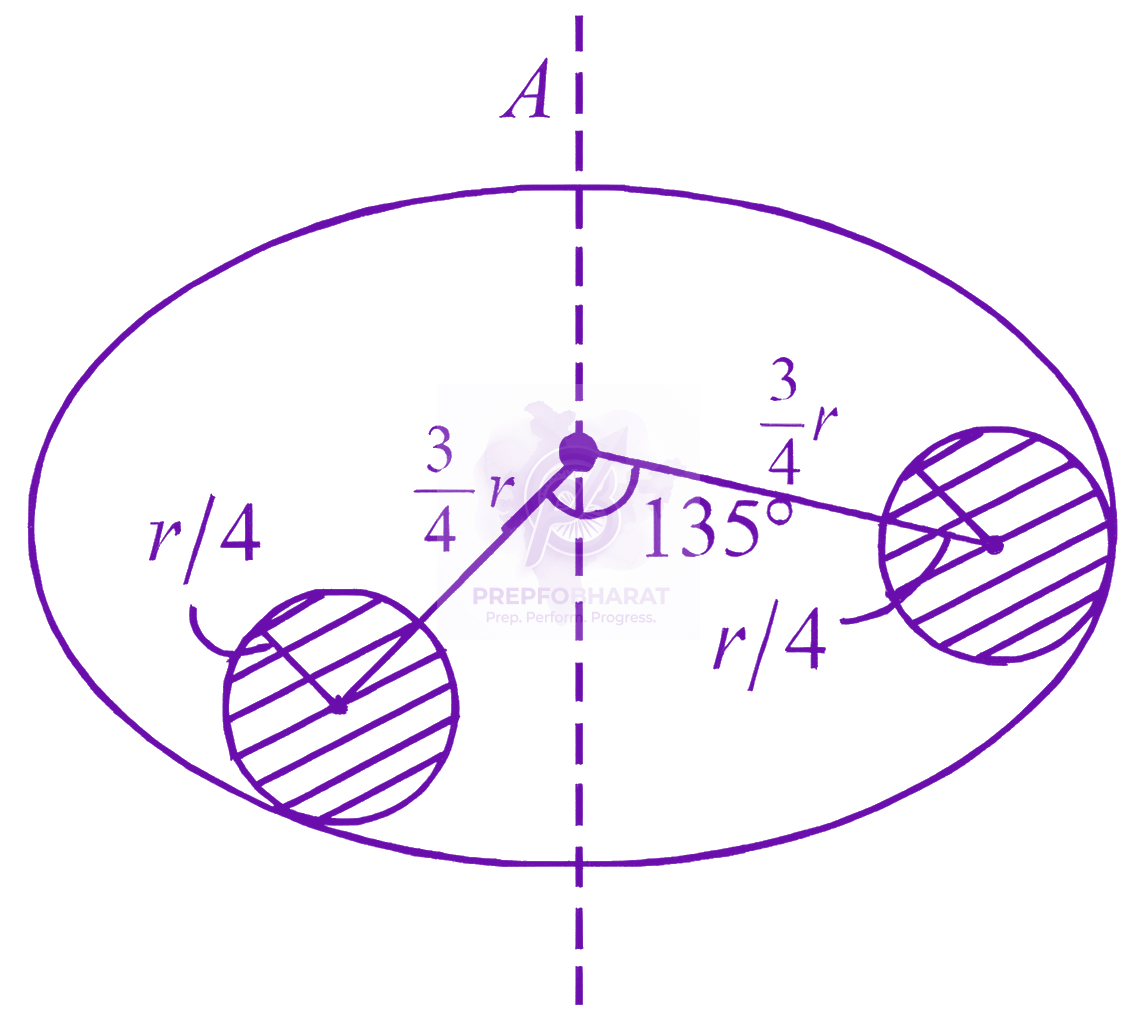
The velocity of a particle is given as $\vec{v} = -x\hat{i} + 2y\hat{j} - z\hat{k}$ m/s. The magnitude of acceleration at point $(1, 2, 4)$ is _______ m/s$^2$.
Two small balls with masses $m$ and 2 m are attached to both ends of a rigid rod of length $d$ and negligible mass. If angular momentum of this system is $L$ about an axis ($A$) passing through its centre of mass and perpendicular to the rod then angular velocity of the system about $A$ is :
A solid sphere ($A$) of mass $5m$ and a spherical shell ($B$) of mass $m$, both having same radius, are placed on a rough surface. When a force of same magnitude is applied tangentially at the highest points of $A$ and $B$, they start rolling without slipping with an acceleration of $a_A$ and $a_B$, respectively. The ratio of $a_A$ and $a_B$ is __________.
A $0.5$ kg mass is in contact against the inner wall of a cylindrical drum of radius $4$ m rotating about its vertical axis. The minimum rotational speed of the drum to enable the mass to remain stuck to the wall (without falling) is $5$ rad/s. The coefficient of friction between the drum's inner wall surface and mass is _______. (Take $g = 10$ m/s$^2$)
A uniform wire of length $l$ of weight $w$ is suspended from the roof with a weight of $W$ at the other end. The stress in the wire at $\dfrac{l}{3}$ distance from the top is $\left(\dfrac{W}{A} + \dfrac{2}{\gamma}\dfrac{w}{A}\right)$, where, $A$ is the cross sectional area of the wire. The value of $\gamma$ is _______.
Consider the equation $H = \dfrac{x^p \epsilon^q E^r}{t^s}$, where $H=$ magnetic field; $E=$ electric field, $\epsilon=$ permittivity, $x=$ distance, $t=$ time. The values of $p, q, r$ and $s$ respectively are:
Figure represents the extension ($\Delta l$) of a wire of length $1$ meter, suspended from the ceiling of the room at one end with a load $W$ connected to the other end. If the cross-sectional area of the wire is $10^{-5}$ m$^2$ then the Young's modulus of the wire is __________ N/m$^2$. 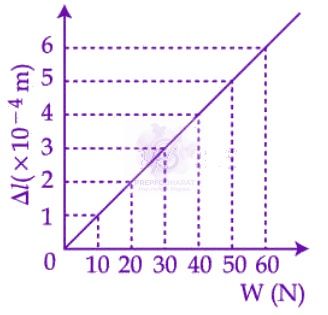
A gun mounted on the ground fires bullets in all directions with same speed. The farthest distance the bullets could reach is $6.4$ m. The speed of the bullets from the gun is ______ m/s. (take $g=10$ m/s$^2$)
Two masses $m$ and 2 m are connected by a light string going over a pulley (disc) of mass 30 m with radius $r=0.1 \mathrm{~m}$. The pulley is mounted in a vertical plane and it is free to rotate about its axis. The 2 m mass is released from rest and its speed when it has descended through a height of 3.6 m is $\_\_\_\_$ $\mathrm{m} / \mathrm{s}$. (Assume string does not slip and $\mathrm{g}=10 \mathrm{~m} / \mathrm{s}^{2}$)
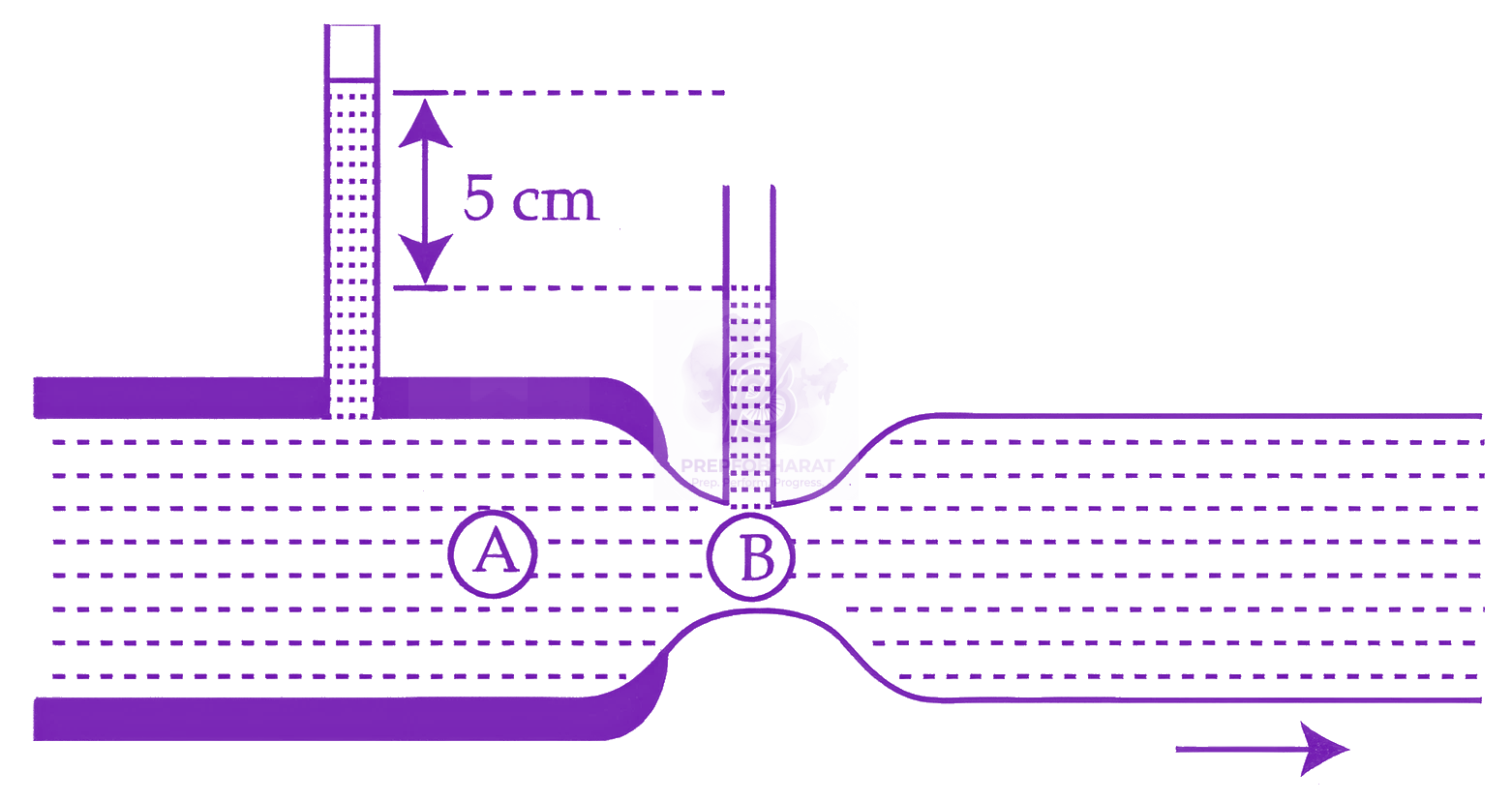
Water flows through a horizontal tube as shown in the figure. The difference in height between the water columns in vertical tubes is 5 cm and the area of cross-sections at $A$ and $B$ are $6 \mathrm{~cm}^{2}$ and $3 \mathrm{~cm}^{2}$ respectively. The rate of flow will be $\_\_\_\_$ $\mathrm{cm}^{3} / \mathrm{s}$. (take $g=10 \mathrm{~m} / \mathrm{s}^{2}$)