JEE Main 2002 — Mechanics
Physics Mechanics questions from JEE Main 2002.
Other Years
24 Mechanics Questions from 2002
When forces $F_1, F_2, F_3$ are acting on a particle of mass $m$ such that $F_2$ and $F_3$ are mutually perpendicular, then the particle remains stationary. If the force $F_1$ is now removed then the acceleration of the particle is
A spring of force constant $800 \mathrm{~N} / \mathrm{m}$ has an extension of $5 \mathrm{~cm}$. The work done is extending it from $5 \mathrm{~cm}$ to $15 \mathrm{~cm}$ is
Energy required to move a body of mass m from an orbit of radius 2R to 3R is
From a building two balls $\mathrm{A}$ and $\mathrm{B}$ are thrown such that $\mathrm{A}$ is thrown upwards $\mathrm{A}$ and $\mathrm{B}$ downwards (both vertically). If $\mathrm{v}_{\mathrm{A}}$ and $\mathrm{v}_{\mathrm{B}}$ are their respective velocities on reaching the ground, then
A bead of weight $w$ can slide on smooth circular wire in a vertical plane. The bead is attached by a light thread to the highest point of the wire and in equilibrium, the thread is taut and make an angle $\theta$ with the vertical then tension of the thread and reaction of the wire on the bead are
Initial angular velocity of a circular disc of mass $M$ is $\omega_1$. Then two small spheres of mass $m$ are attached gently to diametrically opposite points on the edge of the disc. What is the final angular velocity of the disc?
A solid sphere, a hallow sphere and a ring are released from top of an inclined plane (frictionless) so that they slide down the plane. Then maximum acceleration down the plane is for (no rolling)
Moment of inertia of a circular wire of mass M and radius R about its diameter is
If a body looses half of its velocity on penetrating 3 cm in a wooden block, then how much will it penetrate more before coming to rest?
The kinetic energy needed to project a body of mass $m$ from the earth surface (radius $R$ ) to infinity is
Three identical blocks of masses $\mathrm{m}=2 \mathrm{~kg}$ are drawn by a force $\mathrm{F}=10.2 \mathrm{~N}$ with an acceleration of $0.6 \mathrm{~ms}^{-2}$ on a frictions surface, then what is the tension (in $\mathrm{N}$ ) in the string between the blocks $B$ and $C$? 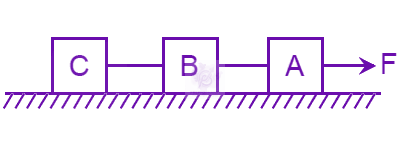
One end of a massless rope, which passes over a massless and frictionless pulley $P$ is tied to a hook $C$ while the other end is free. Maximum tension that the rope can bear is $360 \mathrm{~N}$. With what value of maximum safe acceleration (in $\mathrm{ms}^{-2}$ ) can a man of $60 \mathrm{~kg}$ climb on the rope? 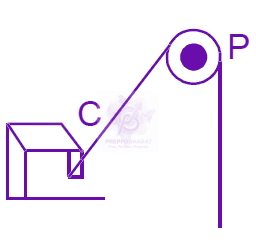
A particle of mass $m$ moves along line $P C$ with velocity $v$ as shown. What is the angular momentum of the particle about $\mathrm{P} ?$ 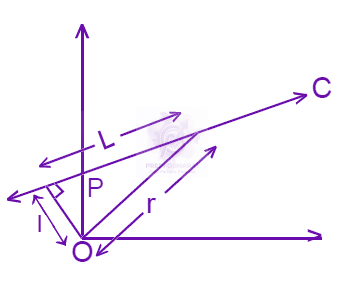
The minimum velocity (in $\mathrm{ms}^{-1}$ ) with which a car driver must traverse a flat curve of radius $150 \mathrm{~m}$ and coefficient of friction $0.6$ to avoid skidding is
The escape velocity of a body depends upon mass as
A cylinder of height $20 \mathrm{~m}$ is completely filled with water. The velocity of efflux of water (in $\mathrm{ms}^{-1}$ ) through a small hole on the side wall of the cylinder near its bottom is
Speeds of two identical cars are $u$ and $4 u$ at the specific instant. The ratio of the respective distances in which the two cars are stopped from that instant is
If suddenly the gravitational force of attraction between Earth and a satellite revolving around it becomes zero, then the satellite will
A light string passing over a smooth light pulley connects two blocks of masses $m_1$ and $m_2$ (vertically). If the acceleration of the system is $\mathrm{g} / 8$, then the ratio of the masses is
Two forces are such that the sum of their magnitudes is $18 \mathrm{~N}$ and their resultant is $12 \mathrm{~N}$ which is perpendicular to the smaller force. Then the magnitudes of the forces are
Two identical particles move towards each other with velocity $2 v$ and $v$ respectively. The velocity of centre of mass is
Identify the pair whose dimensions are equal
A ball whose kinetic energy is E, is projected at an angle of $45^{\circ}$ to the horizontal. The kinetic energy of the ball at the highest point of its flight will be
A lift is moving down with acceleration a. A man in the lift drops a ball inside the lift. The acceleration of the ball as observed by the man in the lift and a man standing stationary on the ground are respectively