JEE Main 2022 — Mechanics
Physics Mechanics questions from JEE Main 2022.
Other Years
233 Mechanics Questions from 2022
A fighter jet is flying horizontally at a certain altitude with a speed of $200{ms}^{-1}$. When it passes directly overhead an anti-aircraft gun, a bullet is fired from the gun, at an angle $\theta$ with the horizontal, to hit the jet. If the bullet speed is $400m{s}^{-1}$, the value of $\theta$ will be _____ $^{\circ}$.
The ratio of escape velocity on Earth to the escape velocity on a planet whose radius and mean density are twice that of Earth is:
An object of mass $5\mathrm{kg}$ is thrown vertically upwards from the ground. The air resistance produces a constant retarding force of $10N$ throughout the motion. The ratio of time of ascent to the time of descent will be equal to : [Use $g=10{ms}^{-2}$].
The time period of a satellite revolving around earth in a given orbit is $7$ hours. If the radius of orbit is increased to three times its previous value, then approximate new time period of the satellite will be
A body of mass $0.5\mathrm{kg}$ travels on straight line path with velocity $v=(3{x}^{2}+4)m{s}^{-1}$. The net work done by the force during its displacement from $x=0$ to $x=2m$ is
A ball of mass $0.5\mathrm{kg}$ is dropped from the height of $10m$. The height, at which the magnitude of velocity becomes equal to the magnitude of acceleration due to gravity, is _____ $m$. [Use $g=10m{s}^{-2}$ ]
A body is projected vertically upwards from the surface of earth with a velocity equal to one third of escape velocity. The maximum height attained by the body will be (Take radius of earth $=6400\mathrm{km}$ and $g=10{\mathrm{ms}}^{-2}$)
The one division of main scale of vernier callipers reads $1\mathrm{mm}$ and $10$ divisions of Vernier scale is equal to the $9$ divisions on main scale. When the two jaws of the instrument touch each other the zero of the Vernier lies to the right of zero of the main scale and its fourth division coincides with a main scale division. When a spherical bob is tightly placed between the two jaws, the zero of the Vernier scale lies in between $4.1\mathrm{cm}$ and $4.2\mathrm{cm}$ and ${6}^{\mathrm{th}}$ Vernier division coincides with a main scale division. The diameter of the bob will be _____ ${10}^{-2}\mathrm{cm}$.
Moment of Inertia (M.I.) of four bodies having same mass $M$ and radius $2R$ are as follows ${I}_{1}=$ M.I. of solid sphere about its diameter ${I}_{2}=$ M.I. of solid cylinder about its axis ${I}_{3}=$ M.I. of solid circular disc about its diameter ${I}_{4}=$ M.I. of thin circular ring about its diameter If $2({I}_{2}+{I}_{3})+{I}_{4}=x{I}_{1}$ then the value of $x$ will be _____ .
A body of mass $10\mathrm{kg}$ is projected at an angle of $45^{\circ}$ with the horizontal. The trajectory of the body is observed to pass through a point $(20,10)$. If $T$ is the time of flight, then its momentum vector, at time $t=\frac{T}{\sqrt{2}}$, is _____ . [Take $g=10m{s}^{-2}$]
Motion of a particle in $x-y$ plane is described by a set of following equations $x=4\mathrm{sin}(\frac{\pi }{2}-\omega t)m$ and $y=4\mathrm{sin}(\omega t)m$. The path of the particle will be
Two blocks of masses 10 kg and 4 kg are connected by a spring of negligible mass and placed on a frictionless horizontal surface. An impulse gives a velocity of 14 m/s to the heavier block in the direction of the lighter block. The velocity of the center of mass is:
The velocity of upper layer of water in a river is $36\mathrm{km}{h}^{-1}$. Shearing stress between horizontal layers of water is ${10}^{-3}N{m}^{-2}$. Depth of the river is _____ $m$. (Co-efficient of viscosity of water is ${10}^{-2}\mathrm{Pa}s$)
An object is projected in the air with initial velocity $u$ at an angle $\theta$. The projectile motion is such that the horizontal range $R$, is maximum. Another object is projected in the air with a horizontal range half of the range of first object. The initial velocity remains same in both the case. The value of the angle of projection, at which the second object is projected, will be _____ degree.
The velocity of a small ball of mass $0.3g$ and density $8g{\mathrm{cc}}^{-1}$ when dropped in a container filled with glycerine becomes constant after some time. If the density of glycerine is $1.3g{\mathrm{cc}}^{-1}$, then the value of viscous force acting on the ball will be $x\times {10}^{-4}N$, the value of $x$ is _____ . [use $g=10m{s}^{-2}$]
A wire of length $L$ and radius $r$ is clamped rigidly at one end. When the other end of the wire is pulled by a force $F$, its length increases by $5\mathrm{cm}$. Another wire of the same material of length $4L$ and radius $4r$ is pulled by a force $4F$ under same conditions. The increase in length of this wire is _____ $\mathrm{cm}$.
A system of two blocks of masses $m=2\mathrm{kg}$ and $M=8\mathrm{kg}$ is placed on a smooth table as shown in figure. The coefficient of static friction between two blocks is $0.5$. The maximum horizontal force $F$ that can be applied to the block of mass $M$ so that the blocks move together will be $(g=9.8m{s}^{-2})$ 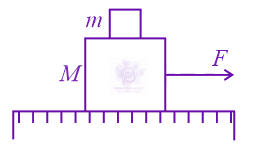
A car covers $AB$ distance with first one-third at velocity ${v}_{1}{ms}^{-1}$, second one-third at ${v}_{2}{ms}^{-1}$ and last one-third at ${v}_{3}{ms}^{-1}$. If ${v}_{3}=3{v}_{1},{v}_{2}=2{v}_{1}$ and ${v}_{1}=11{ms}^{-1}$, then the average velocity of the car is _____ ${ms}^{-1}$. 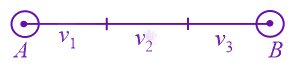
The escape velocity of a body on a planet $A$ is $12\mathrm{km}{s}^{-1}$. The escape velocity of the body on another planet $B$, whose density is four times and radius is half of the planet $A$, is
A thin circular ring of mass $M$ and radius $R$ is rotating with a constant angular velocity $2\mathrm{rad}{s}^{-1}$ in a horizontal plane about an axis vertical to its plane and passing through the center of the ring. If two objects each of mass $m$ be attached gently to the opposite ends of a diameter of ring, the ring will then rotate with an angular velocity (in $\mathrm{rad}{s}^{-1}$).
A body is projected from the ground at an angle of $45^{\circ}$ with the horizontal. Its velocity after $2s$ is $20{ms}^{-1}$. The maximum height reached by the body during its motion is _____ $m$. (use $g=10{ms}^{-2}$)
A student in the laboratory measures thickness of a wire using screw gauge. The readings are $1.22\mathrm{mm},1.23\mathrm{mm},1.19\mathrm{mm}$ and $1.20\mathrm{mm}$. The percentage error is $\frac{x}{121}%$. The value of $x$ is _____ .
If $\vec{A}=(2\hat{i}+3\hat{j}-\hat{k})m$ and $\vec{B}=(\hat{i}+2\hat{j}+2\hat{k})m$. The magnitude of component of vector $\vec{A}$ along vector $\vec{B}$ will be _____ $m$.
In an experiment of determine the Young's modulus of wire of a length exactly $1m$, the extension in the length of the wire is measured as $0.4\mathrm{mm}$ with an uncertainty of $\pm 0.02\mathrm{mm}$ when a load of $1\mathrm{kg}$ is applied. The diameter of the wire is measured as $0.4\mathrm{mm}$ with an uncertainty of $\pm 0.01\mathrm{mm}$. The error in the measurement of Young's modulus $(\Delta Y)$ is found to be $x\times {10}^{10}N{m}^{-2}$. The value of $x$ is _____ .
For $z={a}^{2}{x}^{3}{y}^{\frac{1}{2}}$, where '$a$' is a constant. If percentage error in measurement of '$x$' and '$y$' are $4%$and $12%$, respectively, then the percentage error for '$z$' will be _____$%$.
$\vec{A}$ is a vector quantity such that $|\vec{A}|=$ non-zero constant. Which of the following expression is true for $\vec{A}$?
If force $\vec{F}=3\hat{i}+4\hat{j}-2\hat{k}$ acts on a particle having position vector $2\hat{i}+\hat{j}+2\hat{k}$ then, the torque about the origin will be:
A person is standing in an elevator. In which situation, he experiences weight loss ?
If $t=\sqrt{x}+4$, then ${(\frac{dx}{dt})}_{t=4}$ is:
A pulley of radius $1.5m$ is rotated about its axis by a force $F=(12t-3{t}^{2})N$ applied tangentially (while $t$ is measured in seconds). If moment of inertia of the pulley about its axis of rotation is $4.5\mathrm{kg}{m}^{2}$, the number of rotations made by the pulley before its direction of motion is reversed, will be $\frac{K}{\pi }$. The value of $K$ is _____ .
A ball is projected with kinetic energy $E$, at an angle of $60^{\circ}$ to the horizontal. The kinetic energy of this ball at the highest point of its flight will become :
A boy ties a stone of mass $100g$ to the end of a $2m$ long string and whirls it around in a horizontal plane. The string can withstand the maximum tension of $80N$. If the maximum speed with which the stone can revolve is $\frac{K}{\pi }\mathrm{rev}{\mathrm{min}}^{-1}$. The value of $K$ is : (Assume the string is massless and un-stretchable)
A projectile is projected with velocity of $25m{s}^{-1}$ at an angle $\theta$ with the horizontal. After $t$ seconds its inclination with horizontal becomes zero. If $R$ represents horizontal range of the projectile, the value of $\theta$ will be : [use $\mathrm{use}g=10m{s}^{-2}$]
A solid cylinder and a solid sphere, having same mass $M$ and radius $R$, roll down the same inclined plane from top without slipping. They start from rest. The ratio of velocity of the solid cylinder to that of the solid sphere, with which they reach the ground, will be
A smooth circular groove has a smooth vertical wall as shown in figure. A block of mass $m$ moves against the wall with a speed $v$. Which of the following curve represents the correct relation between the normal reaction on the block by the wall $(N)$ and speed of the block $(v)$? 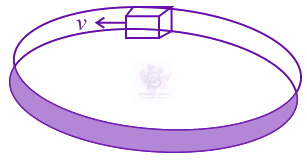
Two inclined planes are placed as shown in figure. A block is projected from the Point $A$ of inclined plane $AB$ along its surface with a velocity just sufficient to carry it to the top Point $B$ at a height $10m$. After reaching the Point $B$ the block slides down on inclined plane $BC$. Time it takes to reach to the point $C$ from point $A$ is $t(\sqrt{2}+1)s$. The value of t is _____ (use $g=10m{s}^{-2}$) 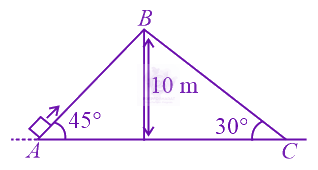
A curved in a level road has a radius $75m$. The maximum speed of a car turning this curved road can be $30m{s}^{-1}$ without skidding. If radius of curved road is changed to $48m$ and the coefficient of friction between the tyres and the road remains same, then maximum allowed speed would be _____ $m{s}^{-1}$.
Arrange the four graphs in descending order of total work done; where ${W}_{1},{W}_{2},{W}_{3}$ and ${W}_{4}$ are the work done corresponding to figure $a,b,c$ and $d$ respectively. 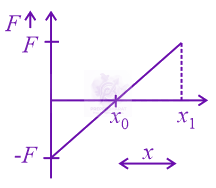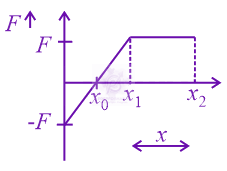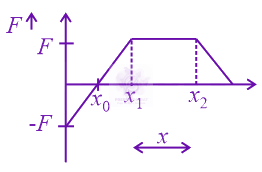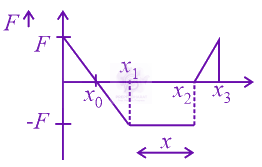
Two vectors $\vec{A}$ and $\vec{B}$ have equal magnitudes. If magnitude of $\vec{A}+\vec{B}$ is equal to two times the magnitude of $\vec{A}-\vec{B}$, then the angle between $\vec{A}$ and $\vec{B}$ will be
The SI unit of a physical quantity is $\mathrm{Pascal}‐\mathrm{sec}$. The dimensional formula of this quantity will be
If $\vec{A}=(2\hat{i}+3\hat{j}-\hat{k})m$ and $\vec{B}=(\hat{i}+2\hat{j}+2\hat{k})m$. The magnitude of component of vector $\vec{A}$ along vector $\vec{B}$ will be _____ $m$.
Which of the following relations is true for two unit vector $\hat{A}$ and $\hat{B}$ making an angle $\theta$ to each other?
Two vectors $\vec{A}$ and $\vec{B}$ have equal magnitudes. If magnitude of $\vec{A}+\vec{B}$ is equal to two times the magnitude of $\vec{A}-\vec{B}$, then the angle between $\vec{A}$ and $\vec{B}$ will be
The moment of inertia of a uniform thin rod about a perpendicular axis passing through one end is ${I}_{1}$. The same rod is bent into a ring and its moment of inertia about a diameter is ${I}_{2}$. If $\frac{{I}_{1}}{{I}_{2}}$ is $\frac{x{\pi }^{2}}{3}$, then the value of $x$ will be ______.
Match List-I with List-II <table class="pyq-table"><tbody><tr><td></td><td>List-I</td><td></td><td>List-II</td></tr><tr><td>(A)</td><td>Moment of inertia of solid sphere of radius $R$ about any tangent.</td><td>(I)</td><td>$\frac{5}{3}{\mathrm{MR}}^{2}$</td></tr><tr><td>(B)</td><td>Moment of inertia of hollow sphere of radius $(R)$ about any tangent.</td><td>(II)</td><td>$\frac{7}{5}{\mathrm{MR}}^{2}$</td></tr><tr><td>(C)</td><td>Moment of inertia of circular ring of radius $(R)$ about its diameter.</td><td>(III)</td><td>$\frac{1}{4}{\mathrm{MR}}^{2}$</td></tr><tr><td>(D)</td><td>Moment of inertia of circular disc of radius $(R)$ about any diameter.</td><td>(IV)</td><td>$\frac{1}{2}{\mathrm{MR}}^{2}$</td></tr></tbody></table>
A $\sqrt{34}m$ long ladder weighing $10\mathrm{kg}$ leans on a frictionless wall. Its feet rest on the floor $3m$ away from the wall as shown in the figure. If ${F}_{f}$ and ${F}_{w}$ are the reaction forces of the floor and the wall, then ratio of $\frac{{F}_{w}}{{F}_{f}}$ will be : (Use $g=10m{s}^{-2}$.) 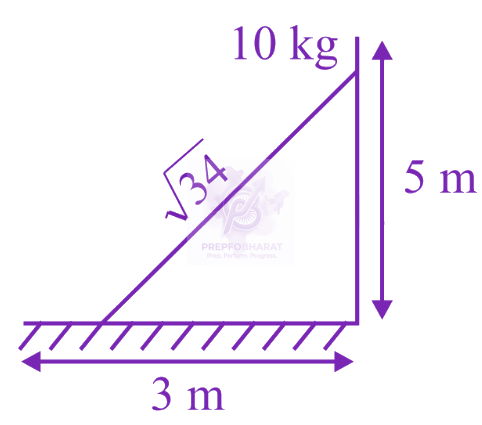
A water drop of radius $1\mu m$ falls in a situation where the effect of buoyant force is negligible. Co-efficient of viscosity of air is $1.8\times {10}^{-5}Ns{m}^{-2}$ and its density is negligible as compared to that of water ${10}^{6}g{m}^{-3}$. Terminal velocity of the water drop is (Take acceleration due to gravity $=10{ms}^{-2}$)
The distance of the Sun from earth is $1.5\times {10}^{11}m$ and its angular diameter is $2000''$ when observed from the earth. The diameter of the Sun will be
A ball of mass $m$ is thrown vertically upward. Another ball of mass $2m$ is thrown an angle $\theta$ with the vertical. Both the balls stay in air for the same period of time. The ratio of the heights attained by the two balls respectively is $\frac{1}{x}$. The value of $x$ is _____ .
Two objects of equal masses placed at certain distance from each other attracts each other with a force of $F$. If one-third mass of one object is transferred to the other object, then the new force will be
The height of any point $P$ above the surface of earth is equal to diameter of earth. The value of acceleration due to gravity at point $P$ will be : (Given $g=$acceleration due to gravity at the surface of earth).
Identify the pair of physical quantities which have different dimensions:
The dimensions of $(\frac{{B}^{2}}{{\mu }_{0}})$ will be (if ${\mu }_{0}$: permeability of free space and $B:$magnetic field)
The distance of the Sun from earth is $1.5\times {10}^{11}m$ and its angular diameter is $2000''$ when observed from the earth. The diameter of the Sun will be
A balloon has mass of $10g$ in air. The air escapes from the balloon at a uniform rate with velocity $4.5\mathrm{cm}{s}^{-1}$. If the balloon shrinks in $5s$ completely. Then, the average force acting on that balloon will be (in dyne).
If $Z=\frac{{A}^{2}{B}^{3}}{{C}^{4}}$, then the relative error in $Z$ will be
A force on an object of mass $100g$ is $(10\hat{i}+5\hat{j})N$. The position of that object at $t=2s$ is $(a\hat{i}+b\hat{j})m$ after starting from rest. The value of $\frac{a}{b}$ will be _____ .
The velocity of the bullet becomes one third after it penetrates $4\mathrm{cm}$ in a wooden block. Assuming that bullet is facing a constant resistance during its motion in the block. The bullet stops completely after travelling at $(4+x)\mathrm{cm}$ inside the block. The value of $x$ is
A ball of mass $0.15\mathrm{kg}$ hits the wall with its initial speed of $12m{s}^{-1}$ and bounces back without changing its initial speed. If the force applied by the wall on the ball during the contact is $100N$. calculate the time duration of the contact of ball with the wall.
Two satellites ${S}_{1}$ and ${S}_{2}$ are revolving in circular orbits around a planet with radius ${R}_{I}=3200\mathrm{km}$ and ${R}_{2}=800\mathrm{km}$ respectively. The ratio of speed of satellite ${S}_{1}$ to the speed of satellite ${S}_{2}$ in their respective orbits would be $\frac{1}{x}$ where $x=$
The distance of centre of mass from end $A$ of a one dimensional rod $(AB)$ having mass density $\rho ={\rho }_{0}(1-\frac{{x}^{2}}{{L}^{2}})\mathrm{kg}{m}^{-1}$ and length $L$ (in meter) is $\frac{3L}{\alpha }m$. The value of $\alpha$ is _____ (where $x$ is the distance form end $A$)
The maximum error in the measurement of resistance, current and time for which current flows in an electrical circuit are $1%,2%$ and $3%$ respectively. The maximum percentage error in the detection of the dissipated heat will be:
Two masses ${M}_{1}$ and ${M}_{2}$ are tied together at the two ends of a light inextensible string that passes over a frictionless pulley. When the mass ${M}_{2}$ is twice that of ${M}_{1}$. the acceleration of the system is ${a}_{1}$. When the mass ${M}_{2}$ is thrice that of ${M}_{1}$. The acceleration of The system is ${a}_{2}$. The ratio $\frac{{a}_{1}}{{a}_{2}}$ will be 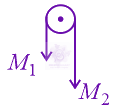
Potential energy as a function of $r$ is given by $U=\frac{A}{{r}^{10}}-\frac{B}{{r}^{5}}$, where $r$ is the interatomic distance, $A$ and $B$ are positive constants. The equilibrium distance between the two atoms will be :
A torque meter is calibrated to reference standards of mass, length and time each with $5%$ accuracy. After calibration, the measured torque with this torque meter will have net accuracy of
A travelling microscope has $20$ divisions per $\mathrm{cm}$ on the main scale while its Vernier scale has total $50$ divisions and $25$ Vernier scale divisions are equal to $24$ main scale divisions, what is the least count of the travelling microscope ?
A particle is moving in a straight line such that its velocity is increasing at $5{ms}^{-1}$ per meter. The acceleration of the particle is _____ $m{s}^{-2}$ at a point where its velocity is $20{ms}^{-1}$.
A monkey of mass $50\mathrm{kg}$ climbs on a rope which can withstand the tension $(T)$ of $350N$. If monkey initially climbs down with an acceleration of $4m{s}^{-2}$ and then climbs up with an acceleration of $5m{s}^{-2}$. Choose the correct option $(g=10m{s}^{-2})$
Three identical particle $A,B$ and $C$ of mass $100\mathrm{kg}$ each are placed in a straight line with $AB=BC=13m$. The gravitational force on a fourth particle $P$ of the same mass is $F$, when placed at a distance $13m$ from the particle $B$ on the perpendicular bisector of the line $AC$. The value of $F$ will be approximately
Water falls from a $40m$ high dam at the rate of $9\times {10}^{4}\mathrm{kg}$ per hour. Fifty percentage of gravitational potential energy can be converted into electrical energy. Using this hydro electric energy number of $100W$ lamps, that can be lit, is (Take $g=10{\mathrm{ms}}^{-2}$)
If the projection of $2\hat{i}+4\hat{j}-2\hat{k}$ on $\hat{i}+2\hat{j}+\alpha \hat{k}$ is zero. Then, the value of $\alpha$ will be
The elongation of a wire on the surface of the earth is ${10}^{-4}m$. The same wire of same dimensions is elongated by $6\times {10}^{-5}m$ on another planet. The acceleration due to gravity on the planet will be _____ $m{s}^{-2}$. (Take acceleration due to gravity on the surface of earth $=10{ms}^{-2}$)
Which of the following relations is true for two unit vector $\hat{A}$ and $\hat{B}$ making an angle $\theta$ to each other?
Four spheres each of mass $m$ form $a$ square of side $d$ (as shown in figure). A fifth sphere of mass $M$ is situated at the centre of square. The total gravitational potential energy of the system is 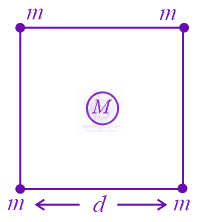
If the projection of $2\hat{i}+4\hat{j}-2\hat{k}$ on $\hat{i}+2\hat{j}+\alpha \hat{k}$ is zero. Then, the value of $\alpha$ will be
A torque meter is calibrated to reference standards of mass, length and time each with $5%$ accuracy. After calibration, the measured torque with this torque meter will have net accuracy of
The maximum error in the measurement of resistance, current and time for which current flows in an electrical circuit are $1%,2%$ and $3%$ respectively. The maximum percentage error in the detection of the dissipated heat will be:
In an experiment of determine the Young's modulus of wire of a length exactly $1m$, the extension in the length of the wire is measured as $0.4\mathrm{mm}$ with an uncertainty of $\pm 0.02\mathrm{mm}$ when a load of $1\mathrm{kg}$ is applied. The diameter of the wire is measured as $0.4\mathrm{mm}$ with an uncertainty of $\pm 0.01\mathrm{mm}$. The error in the measurement of Young's modulus $(\Delta Y)$ is found to be $x\times {10}^{10}N{m}^{-2}$. The value of $x$ is _____ .
A silver wire has a mass $(0.6\pm 0.006)g$, radius $(0.5\pm 0.005)\mathrm{mm}$ and length $(4\pm 0.04)\mathrm{cm}$. The maximum percentage error in the measurement of its density will be
A silver wire has a mass $(0.6\pm 0.006)g$, radius $(0.5\pm 0.005)\mathrm{mm}$ and length $(4\pm 0.04)\mathrm{cm}$. The maximum percentage error in the measurement of its density will be
Two cylindrical vessels of equal cross-sectional area $16{\mathrm{cm}}^{2}$ contain water upto heights $100\mathrm{cm}$ and $150\mathrm{cm}$ respectively. The vessels are interconnected so that the water levels in them become equal. The work done by the force of gravity during the process, is [Take density of water $={10}^{3}\mathrm{kg}{m}^{-3}$ and $g=10{\mathrm{ms}}^{-2}$]
Two bodies of masses ${m}_{1}=5\mathrm{kg}$ and ${m}_{2}=3\mathrm{kg}$ are connected by a light string going over a smooth light pulley on a smooth inclined plane as shown in the figure. The system is at rest. The force exerted by the inclined plane on the body of mass ${m}_{1}$ will be : [Take $g=10m{s}^{-2}$] 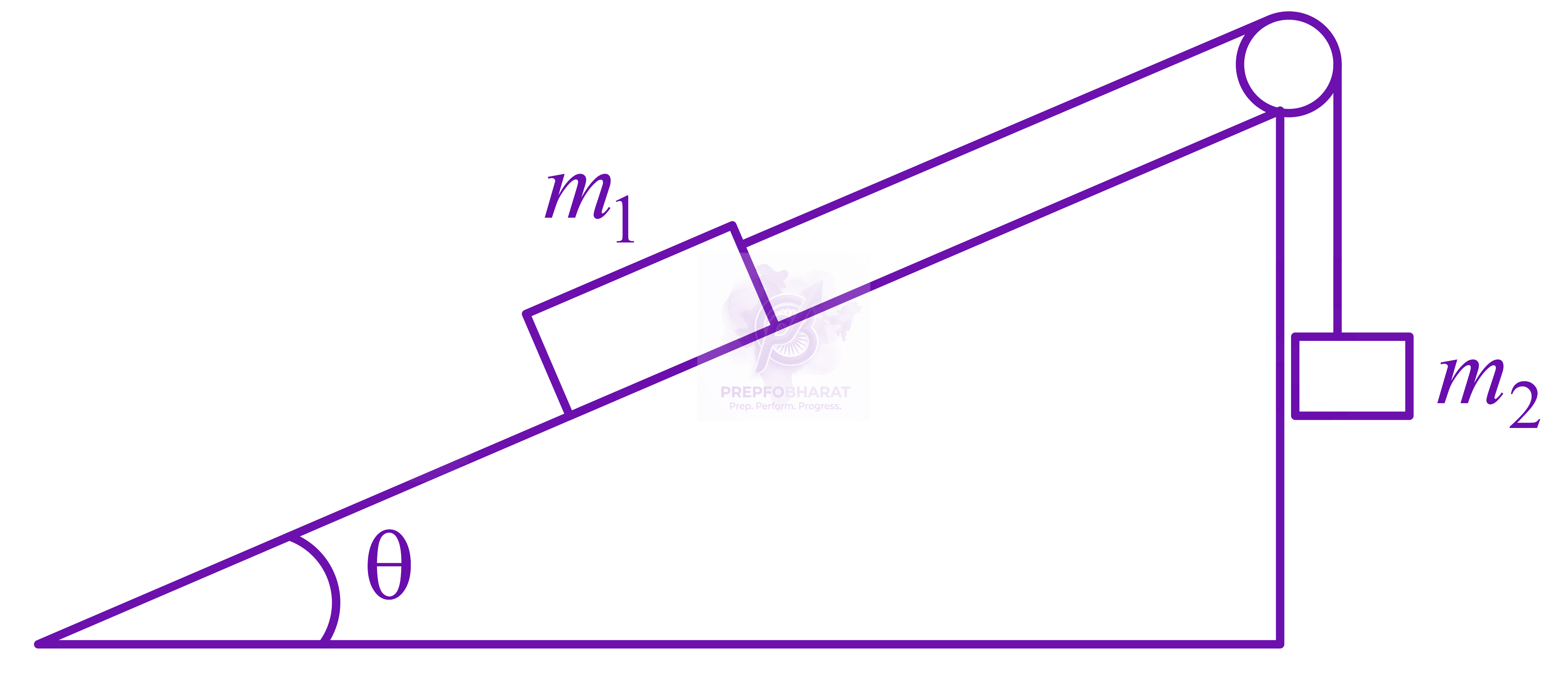
Which of the following physical quantities have the same dimensions?
The distance between Sun and Earth is $R$. The duration of year if the distance between Sun and Earth becomes $3R$ will be :
If the length of a wire is made double and radius is halved of its respective values. Then, the Young's modulus of the material of the wire will :
A disc of mass $1\mathrm{kg}$ and radius $R$ is free of rotate about a horizontal axis passing through its centre and perpendicular to the plane of disc. A body of same mass as that of disc is fixed at the highest point of the disc. Now the system is released, when the body comes to the lowest position, its angular speed will be $4\sqrt{\frac{x}{3R}}\mathrm{rad}{s}^{-1}$ where $x=$ _____ .
In an experiment to find acceleration due to gravity $(g)$ using simple pendulum, time period of $0.5s$ is measured from time of $100$ oscillation with a watch of $1s$ resolution. If measured value of length is $10\mathrm{cm}$ known to $1\mathrm{mm}$ accuracy. The accuracy in the determination of $g$ is found to be $x%$. The value of $x$ is
A ball is spun with angular acceleration $\alpha =6{t}^{2}-2t$ where $t$ is in second and $\alpha$ is in $\mathrm{rad}{s}^{-2}$. At $t=0$, the ball has angular velocity of $10\mathrm{rad}{s}^{-1}$ and angular position of $4\mathrm{rad}$. The most appropriate expression for the angular position of the ball is
Given below are two statements: One is labelled as Assertion (A) and the other is labelled as Reason (R). Assertion (A): Clothes containing oil or grease stains cannot be cleaned by water wash. Reason (R) : Because the angle of contact between the oil/ grease and water is obtuse. In the light of the above statements, choose the correct answer from the option given below.
Four forces are acting at a point $P$ in equilibrium as shown in figure. The ratio of force ${F}_{1}$ to ${F}_{2}$ is $1:x$ where $x=$_____ . 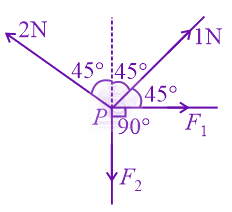
A block of mass $M$ slides down on a rough inclined plane with constant velocity. The angle made by the incline plane with horizontal is $\theta$. The magnitude of the contact force will be :
A stone of mass $m$, tied to a string is being whirled in a vertical circle with a uniform speed. The tension in the string is
Three masses $M=100\mathrm{kg},{m}_{1}=10\mathrm{kg}$ and ${m}_{2}=20\mathrm{kg}$ are arranged in a system as shown in figure. All the surfaces are frictionless and strings are inextensible and weightless. The pulleys are also weightless and frictionless. A force $F$ is applied on the system so that the mass ${m}_{2}$ moves upward with an acceleration of $2{\mathrm{ms}}^{-2}$. The value of $F$ is (Take $g=10{\mathrm{ms}}^{-2}$) 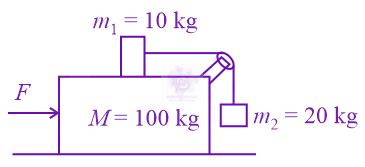
Two balls $A$ and $B$ are placed at the top of $180m$ tall tower. Ball $A$ is released from the top at $t=0s$. Ball $B$ is thrown vertically down with an initial velocity $u$ at $t=2s$. After a certain time, both balls meet $100m$ above the ground. Find the value of $u$ in $m{s}^{-1}$. [use $g=10{ms}^{-2}$]
A particle of mass $500g$ is moving in a straight line with velocity $v=b{x}^{\frac{5}{2}}$. The work done by the net force during its displacement from $x=0$ to $x=4m$ is (Take $b=0.25{m}^{\frac{-3}{2}}{s}^{-1}$).
A block of mass $10\mathrm{kg}$ starts sliding on a surface with an initial velocity of $9.8{\mathrm{ms}}^{-1}$. The coefficient of friction between the surface and block is $0.5$. The distance covered by the block before coming to rest is :[use $g=9.8{\mathrm{ms}}^{-2}$]
A system to $10$ balls each of mass $2\mathrm{kg}$ are connected via massless and unstretchable string. The system is allowed to slip over the edge of a smooth table as shown in figure. Tension on the string between the ${7}^{\mathrm{th}}$ and ${8}^{\mathrm{th}}$ ball is _____ $N$ when ${6}^{\mathrm{th}}$ ball just leaves the table. 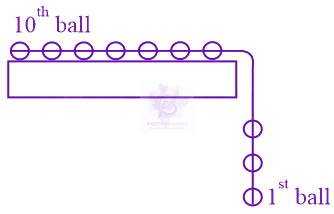
A drop of liquid of density $\rho$ is floating half immersed in a liquid of density $\sigma$ and surface tension $7.5\times {10}^{-4}N{\mathrm{cm}}^{-1}$. The radius of drop in $\mathrm{cm}$ will be : (Take : $g=10{\mathrm{ms}}^{-2}$)
A solid spherical ball is rolling on a frictionless horizontal plane surface about its axis of symmetry. The ratio of rotational kinetic energy of the ball to its total kinetic energy is
Two projectiles are thrown with same initial velocity making an angle of $45^{\circ}$ and $30^{\circ}$ with the horizontal respectively. The ratio of their respective ranges will be
For $z={a}^{2}{x}^{3}{y}^{\frac{1}{2}}$, where '$a$' is a constant. If percentage error in measurement of '$x$' and '$y$' are $4%$and $12%$, respectively, then the percentage error for '$z$' will be _____$%$.
A batsman hits back a ball of mass $0.4\mathrm{kg}$ straight in the direction of the bowler without changing its initial speed of $15{ms}^{-1}$. The impulse imparted to the ball is _____ $Ns$.
A body of mass $m$ is projected with velocity $\lambda {v}_{e}$ in vertically upward direction from the surface of the earth into space. It is given that ${v}_{e}$ is escape velocity and $\lambda <1$. If air resistance is considered to the negligible, then the maximum height from the centre of earth, to which the body can go, will be ($R$ : radius of earth)
A uniform heavy rod of mass $20\mathrm{kg}$. Cross sectional area $0.4{m}^{2}$ and length $20m$ is hanging from a fixed support. Neglecting the lateral contraction, the elongation in the rod due to its own weight is $x\times {10}^{-9}m$. The value of $x$ is _____ . (Given. Young's modulus $Y=2\times {10}^{11}{\mathrm{Nm}}^{-2}$ and $g=10m{s}^{-2}$ )
A block of mass $2\mathrm{kg}$ moving on a horizontal surface with speed of $4{ms}^{-1}$ enters a rough surface ranging from $x=0.5m$ to $x=1.5m$. The retarding force in this range of rough surface is related to distance by $F=-kx$ where $k=12N{m}^{-1}$. The speed of the block as it just crosses the rough surface will be
A small spherical ball of radius $0.1\mathrm{mm}$ and density ${10}^{4}\mathrm{kg}{m}^{-3}$ falls freely under gravity through a distance $h$ before entering a tank of water. If, after entering the water the velocity of ball does not change and it continue to fall with same constant velocity inside water, then the value of $h$ will be ____ $m$. (Given $g=10{ms}^{-2}$, viscosity of water $=1.0\times {10}^{-5}N‐s{m}^{-2}$ ).
$\vec{A}$ is a vector quantity such that $|\vec{A}|=$ non-zero constant. Which of the following expression is true for $\vec{A}$?
In an experiment to determine the Young's modulus, steel wires of five different lengths ($1,2,3,4$ and $5$) but of same cross-section $(2{\mathrm{mm}}^{2})$ were taken and curves between extension and load were obtained. The slope (extension/load) of the curves were plotted with the wire length and the following graph is obtained. If the Young's modulus of given steel wires is $x\times {10}^{11}N{m}^{-2}$, then the value of $x$ is _____ . 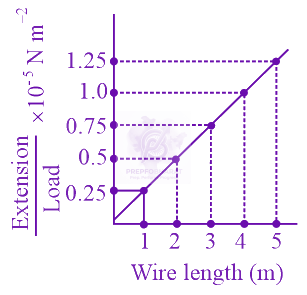
An expression of energy density is given by $u=\frac{\alpha }{\beta }\mathrm{sin}(\frac{\alpha x}{kt})$, where $\alpha ,\beta$ are constants, $x$ is displacement, $k$ is Boltzmann constant and $t$ is the temperature. The dimensions of $\beta$ will be
Two satellites $A$ and $B$ having masses in the ratio $4:3$ are revolving in circular orbits of radii $3r$ and $4r$ respectively around the earth. The ratio of total mechanical energy of $A$ to $B$ is
A block of mass $M$ placed inside a box descends vertically with acceleration $a$. The block exerts a force equal to one-fourth of its weight on the floor of the box. The value of $'a'$ will be
Two blocks of masses $10\mathrm{kg}$ and $30\mathrm{kg}$ are placed on the same straight line with coordinates $(0,0)\mathrm{cm}$ and $(x,0)\mathrm{cm}$ respectively. The block of $10\mathrm{kg}$ is moved on the same line through a distance of $6\mathrm{cm}$ towards the other block. The distance through which the block of $30\mathrm{kg}$ must be moved to keep the position of centre of mass of the system unchanged is
A disc with a flat small bottom beaker placed on it at a distance $R$ from its center is revolving about an axis passing through the center and perpendicular to its plane with an angular velocity $\omega$. The coefficient of static friction between the bottom of the beaker and the surface of the disc is $\mu$. The beaker will revolve with the disc if :
A man of $60\mathrm{kg}$ is running on the road and suddenly jumps into a stationary trolly car of mass $120\mathrm{kg}$. Then the trolly car starts moving with velocity $2{ms}^{-1}$. The velocity of the running man was _____ $m{s}^{-1}$, when he jumps into the car.
The velocity of a small ball of mass $m$ and density ${d}_{1}$, when dropped in a container filled with glycerine, becomes constant after some time. If the density of glycerine is ${d}_{2}$, then the viscous force acting on the ball, will be
A small toy starts moving from the position of rest under a constant acceleration. If it travels a distance of $10m$ in $ts$, the distance travelled by the toy in the next $ts$ will be:
One end of a massless spring of spring constant $k$ and natural length ${l}_{0}$ is fixed while the other end is connected to a small object of mass $m$ lying on a frictionless table. The spring remains horizontal on the table. If the object is made to rotate at an angular velocity $\omega$ about an axis passing trough fixed end, then the elongation of the spring will be
A ball is released from rest from point $P$ of a smooth semi-spherical vessel as shown in figure. The ratio of the centripetal force and normal reaction on the ball at point $Q$ is $A$ while angular position of point $Q$ is $\alpha$ with respect to point $P$. Which of the following graphs represent the correct relation between $A$ and $\alpha$ when ball goes from $Q$ to $R$? 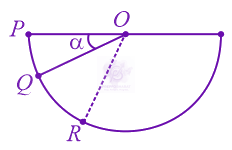
A water drop of radius $1\mathrm{cm}$ is broken into $729$ equal droplets. If surface tension of water is $75\mathrm{dyne}{\mathrm{cm}}^{-1}$, then the gain in surface energy upto first decimal place will be [Given $\pi =3.14$]
Identify the pair of physical quantities that have same dimensions:
A wire of length $L$ is hanging from a fixed support. The length changes to ${L}_{1}$ and ${L}_{2}$ when masses $1\mathrm{kg}$ and $2\mathrm{kg}$ are suspended respectively from its free end. Then the value of $L$ is equal to
Given below are two statements: One is labelled as Assertion A and the other is labelled as Reason R. Assertion A: If we move from poles to equator, the direction of acceleration due to gravity of earth always points towards the center of earth without any variation in its magnitude. Reason R: At equator, the direction of acceleration due to the gravity is towards the center of earth. In the light of above statements, choose the correct answer from the options given below
Three identical spheres each of mass $M$ are placed at the corners of a right angled triangle with mutually perpendicular sides equal to $3m$ each. Taking point of intersection of mutually perpendicular sides as origin, the magnitude of position vector of centre of mass of the system will be $\sqrt{x}m$. The value of $x$ is
At time $t=0$ a particle starts travelling from a height $7\hat{z}\mathrm{cm}$ in a plane keeping $z$ coordinate constant. At any instant of time, it's position along the $x$ and $y$ directions are defined as $3t$ and $5{t}^{3}$ respectively. At $t=1s$ acceleration of the particle will be
The percentage decrease in the weight of a rocket, when taken to a height of $32\mathrm{km}$ above the surface of earth will, be (Radius of earth $=6400\mathrm{km}$)
The radius of gyration of a cylindrical rod about an axis of rotation perpendicular to its length and passing through the center will be _____ $m.$ Given, the length of the rod is $10\sqrt{3}m$.
A uniform metal chain of mass $m$ and length $L$ passes over a massless and frictionless pulley. It is released from rest with a part of its length $l$ is hanging on one side and rest of its length $L-l$ is hanging on the other side of the pulley. At a certain point of time, when $l=\frac{L}{x}$, the acceleration of the chain is $\frac{g}{2}$. The value of $x$ is _____. 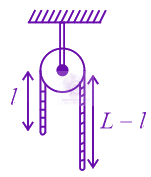
A bag of sand of mass $9.8\mathrm{kg}$ is suspended by a rope. $A$ bullet of $200g$ travelling with speed $10{\mathrm{ms}}^{-1}$ gets embedded in it, then loss of kinetic energy will be
A tube of length $50\mathrm{cm}$ is filled completely with an incompressible liquid of mass $250g$ and closed at both ends. The tube is then rotated in horizontal plane about one of its ends with a uniform angular velocity $x\sqrt{F}\mathrm{rad}{s}^{-1}$. If $F$ be the force exerted by the liquid at the other end then the value of $x$ will be _____ .
The area of cross-section of a large tank is $0.5{m}^{2}$. It has a narrow opening near the bottom having area of cross-section $1{\mathrm{cm}}^{2}$. A load of $25\mathrm{kg}$ is applied on the water at the top in the tank. Neglecting the speed of water in the tank, the velocity of the water, coming out of the opening at the time when the height of water level in the tank is $40\mathrm{cm}$ above the bottom, will be _____ $\mathrm{cm}{s}^{-1}$. [Take $g=10{ms}^{-2}$ ]
A body of mass $8\mathrm{kg}$ and another of mass $2\mathrm{kg}$ are moving with equal kinetic energy. The ratio of their respective momenta will be
An expression for a dimensionless quantity $P$ is given by $P=\frac{\alpha }{\beta }{\mathrm{log}}_{e}(\frac{kT}{\beta x})$; where $\alpha$ and $\beta$ are constants, $x$ is distance; $k$ is Boltzmann constant and $T$ is the temperature. Then the dimensions of $\alpha$ will be
A travelling microscope is used to determine the refractive index of a glass slab. If 40 divisions are there in $1\mathrm{cm}$ on main scale and $50$ Vernier scale divisions are equal to $49$ main scale divisions, then least count of the travelling microscope is _____ $\times {10}^{-6}m$.
If the initial velocity in horizontal direction of a projectile is unit vector $\hat{i}$ and the equation of trajectory is $y=5x(1-x)$. The $y$ component vector of the initial velocity is _____ $\hat{j}$ (Take $g=10m{s}^{-2}$)
A block of mass $200g$ is kept stationary on a smooth inclined plane by applying a minimum horizontal force $F=\sqrt{x}N$ as shown in figure. 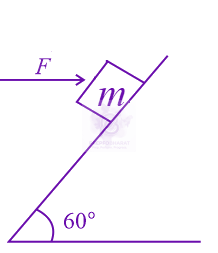 The value of $x=_____$.
A ball is thrown up vertically with a certain velocity so that, it reaches a maximum height $h$. Find the ratio of the times in which it is at height $\frac{h}{3}$ while going up and coming down respectively.
The length of a seconds pendulum at a height $h=2R$ from earth surface will be: (Given: $R=$ Radius of earth and acceleration due to gravity at the surface of earth $g={\pi }^{2}m{s}^{-2}$)
Assertion A: Product of Pressure $(P)$ and time $(t)$ has the same dimension as that of coefficient of viscosity. Reason: Coefficient of viscosity $=\frac{\mathrm{Force}}{\mathrm{Velocity}\mathrm{gradient}}$
A steel wire of length $3.2m({Y}_{S}=2.0\times {10}^{11}N{m}^{-2})$ and a copper wire of length $4.4m({Y}_{C}=1.1\times {10}^{11}N{m}^{-2})$ , both of radius $1.4\mathrm{mm}$ are connected end to end. When stretched by a load, the net elongation is found to be $1.4\mathrm{mm}$. The load applied, in Newton, will be: (Given $\pi =\frac{22}{7}$)
If momentum of a body is increased by $20%$, then its kinetic energy increases by :
For a particle in uniform circular motion, the acceleration $\vec{a}$ at any point $P(R,\theta )$ on the circular path of radius $R$ is (when $\theta$ is measured from the positive $x$-axis and $v$ is uniform speed):
If the acceleration due to gravity experienced by a point mass at a height $h$ above the surface of earth is same as that of the acceleration due to gravity at a depth $\alpha h(h\ll {R}_{e})$ ) from the earth surface. The value of $\alpha$ will be _____ . (use ${R}_{e}=6400\mathrm{km}$)
The bulk modulus of a liquid is $3\times {10}^{10}{\mathrm{Nm}}^{-2}$. The pressure required to reduce the volume of liquid by $2%$ is :
Consider a cylindrical tank of radius $1m$ is filled with water. The top surface of water is at $15m$ from the bottom of the cylinder. There is a hole on the wall of cylinder at a height of $5m$ from the bottom. A force of $5\times {10}^{5}N$ is applied an the top surface of water using a piston. The speed of efflux from the hole will be : (given atmospheric pressure ${P}_{A}=1.01\times {10}^{5}Pa$, density of water ${\rho }_{w}=1000\mathrm{kg}{m}^{-3}$ and gravitational acceleration $g=10m{s}^{-2}$) 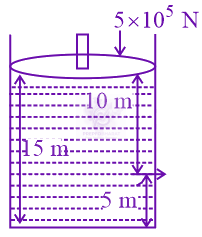
The elastic behaviour of material for linear stress and linear strain, is shown in the figure. The energy density for a linear strain of $5\times {10}^{-4}$ is _____ $\mathrm{kJ}{m}^{-3}$. Assume that material is elastic upto the linear strain of $5\times {10}^{-4}$, 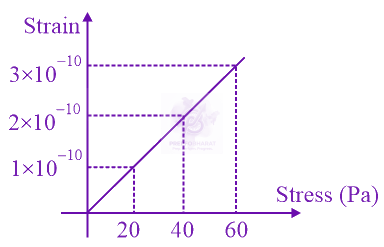
A juggler throws balls vertically upwards with same initial velocity in air. When the first ball reaches its highest position, he throws the next ball. Assuming the juggler throws $n$ balls per second, the maximum height the balls can reach is
From the top of a tower, a ball is thrown vertically upward which reaches the ground in $6s$. A second ball thrown vertically downward from the same position with the same speed reaches the ground in $1.5s$. A third ball released, from the rest from the same location, will reach the ground in _____ s.
A screw gauge of pitch $0.5\mathrm{mm}$ is used to measure the diameter of uniform wire of length $6.8\mathrm{cm}$, the main scale reading is $1.5\mathrm{mm}$ and circular scale reading is $7$. The calculated curved surface area of wire to appropriate significant figures is [Screw gauge has $50$ divisions on the circular scale]
A bag is gently dropped on a conveyor belt moving at a speed of $2m{s}^{-1}$. The coefficient of friction between the conveyor belt and bag is $0.4$ Initially, the bag slips on the belt before it stops due to friction. The distance travelled by the bag on the belt during slipping motion is : [Take $g=10m{s}^{-2}$]
A person moved from $A$ to $B$ on a circular path as shown in figure. If the distance travelled by him is $60m$, then the magnitude of displacement would be : (Given $\mathrm{cos}135^{\circ}=-0.7$)<br><img src="https://prepforbharat.s3.ap-south-1.amazonaws.com/exam/615f0e999476412f48314daf/Physics/images/Mathematics_in_Physics/648b5a6c417cc3fb48d677e9/question_1__q_648b5a6c417cc3fb48d677e9__cdn-question-pool.getmarks.app__63bb7d82cb755babaefa1a6c__b623b2a5de_final_ppt_sync.jpg" alt="JEE Main 2022 Physics, Mathematics in Physics — question figure">
The variation of acceleration due to gravity $(g)$ with distance $(r)$ from the center of the earth is correctly represented by (Given $R=$ radius of earth)
Consider the efficiency of Carnot's engine is given by $\eta =\frac{\alpha \beta }{\mathrm{sin}\theta }{\mathrm{log}}_{e}\frac{\beta x}{kT}$, where $\alpha$ and $\beta$ are constants. If $T$ is temperature, $k$ is Boltzman constant, $\theta$ is angular displacement and $x$ has the dimensions of length. Then, choose the incorrect option.
A car is moving with speed of $150\mathrm{km}{h}^{-1}$ and after applying the brake it will move $27m$ before it stops. If the same car is moving with a speed of one third the reported speed then it will stop after travelling _____ $m$ distance.
A pressure-pump has a horizontal tube of cross-sectional area $10{\mathrm{cm}}^{2}$ for the outflow of water at a speed of $20m{s}^{-1}$. The force exerted on the vertical wall just in front of the tube which stops water horizontally flowing out of the tube, is: [given : density of water $=1000\mathrm{kg}{m}^{-3}$]
Statement I : The law of gravitation holds good for any pair of bodies in the universe. Statement II : The weight of any person becomes zero when the person is at the centre of the earth. In the light of the above statements, choose the correct answer from the options given below.
A bullet of mass $200g$ having initial kinetic energy $90J$ is shot inside a long swimming pool as shown in the figure. If it's kinetic energy reduces to $40J$ within $1s$, the minimum length of the pool, the bullet has to travel so that it completely comes to rest is 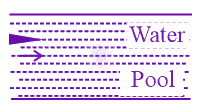
A projectile is launched at an angle $\alpha$ with the horizontal with a velocity $20{ms}^{-1}$. After $10s$, its inclination with horizontal is $\beta$. The value of $\mathrm{tan}\beta$ will be : $(g=10{ms}^{-2})$.
If $L,C$ and $R$ are the self inductance, capacitance and resistance respectively, which of the following does not have the dimension of time?
As per the given figure, two blocks each of mass $250g$ are connected to a spring of spring constant $2N{m}^{-1}$. If both are given velocity $v$ in opposite directions, then maximum elongation of the spring is 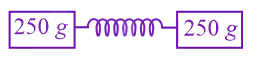
A ball is projected from the ground with a speed $15{ms}^{-1}$ at an angle $\theta$ with horizontal so that its range and maximum height are equal, then $\mathrm{tan}\theta$ will be equal to
A ball is thrown vertically upwards with a velocity of $19.6m{s}^{-1}$ from the top of a tower. The ball strikes the ground after $6s$. The height from the ground up to which the ball can rise will be $(\frac{k}{5})m$. The value of $k$ is _____ (use $g=9.8m{s}^{-2}$)
A particle of mass $m$ is moving in a circular path of constant radius $r$ such that its centripetal acceleration ${a}_{c}$ is varying with time $t$ as ${a}_{c}={k}^{2}r{t}^{2}$ , where $k$ is a constant. The power delivered to the particle by the force acting on it is -
A metal wire of length $0.5m$ and cross-sectional area ${10}^{-4}{m}^{2}$ has breaking stress $5\times {10}^{8}N{m}^{-2}$. A block of $10\mathrm{kg}$ is attached at one end of the string and is rotating in a horizontal circle. The maximum linear velocity of block will be _____ $m{s}^{-1}$.
Given below are two statements: One is labelled as Assertion (A) and other is labelled as Reason (R) Assertion (A) : Time period of oscillation of a liquid drop depends on surface tension $(S)$, if density of the liquid is $\rho$ and radius of the drop is $r$, then $T=K\sqrt{\frac{\rho {r}^{3}}{{S}^{\frac{3}{2}}}}$ is dimensionally correct, where $K$ is dimensionless. Reason (R) : Using dimensional analysis we get R.H.S. having different dimension than that of time period. In the light of above statements, choose the correct answer from the options given below.
In two different experiments, an object of mass $5\mathrm{kg}$ moving with a speed of $25{\mathrm{ms}}^{-1}$ hits two different walls and comes to rest within (i) $3$ second, (ii) $5$ seconds, respectively. Choose the correct option out of the following :
An object of mass $1\mathrm{kg}$ is taken to a height from the surface of earth which is equal to three times the radius of earth. The gain in potential energy of the object will be [If, $g=10m{s}^{-2}$ and radius of earth $=6400\mathrm{km}$]
In an experiment to find out the diameter of wire using screw gauge, the following observation were noted: 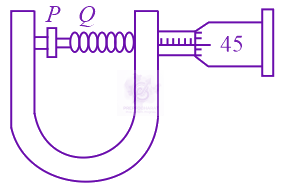 (a) Screw moves $0.5\mathrm{mm}$ on main scale in one complete rotation (b) Total divisions on circular scale $=50$ (c) Main scale reading is $2.5\mathrm{mm}$ (d) ${45}^{\mathrm{th}}$ division of circular scale is in the pitch line (e) Instrument has $0.03\mathrm{mm}$ negative error Then the diameter of wire is :
A mass of $10\mathrm{kg}$ is suspended vertically by a rope of length $5m$ from the roof. A force of $30N$ is applied at the middle point of rope in horizontal direction. The angle made by upper half of the rope with vertical is $\alpha ={\mathrm{tan}}^{-1}(x\times {10}^{-1})$. The value of $x$ is _____ . (Given, $g=10m{s}^{-2}$)
Sand is being dropped from a stationary dropper at a rate of $0.5\mathrm{kg}{s}^{-1}$ on a conveyor belt moving with a velocity of $5m{s}^{-1}$. The power needed to keep belt moving with the same velocity will be
The terminal velocity $({v}_{t})$ of the spherical rain drop depends on the radius $(r)$ of the spherical rain drop as
Two planets $A$ and $B$ of equal mass are having their period of revolutions ${T}_{A}$ and ${T}_{B}$ such that ${T}_{A}=2{T}_{B}$. These planets are revolving in the circular orbits of radii ${r}_{A}$ and ${r}_{B}$ respectively. Which out of the following would be the correct relationship of their orbits?
A pendulum of length $2m$ consists of a wooden bob of mass $50g$. A bullet of mass $75g$ is fired towards the stationary bob with a speed $v$. The bullet emerges out of the bob with a speed $\frac{v}{3}$ and the bob just completes the vertical circle. The value of $v$ is _____ $m{s}^{-1}$ (if $g=10m{s}^{-2}$).
In an experiment to find acceleration due to gravity $(g)$ using simple pendulum, time period of $0.5s$ is measured from time of $100$ oscillation with a watch of $1s$ resolution. If measured value of length is $10\mathrm{cm}$ known to $1\mathrm{mm}$ accuracy. The accuracy in the determination of $g$ is found to be $x%$. The value of $x$ is
A girl standing on road holds her umbrella at $45^{\circ}$ with the vertical to keep the rain away. If she starts running without umbrella with a speed of $15\sqrt{2}\mathrm{km}{h}^{-1}$, the rain drops hit her head vertically. The speed of rain drops with respect to the moving girl is
When a ball is dropped into a lake from a height $4.9m$ above the water level, it hits the water with a velocity $v$ and then sinks to the bottom with the constant velocity $v$. It reaches the bottom of the lake $4.0s$ after it is dropped. The approximate depth of the lake is
The force required to stretch a wire of cross-section $1{\mathrm{cm}}^{2}$ to double its length will be : (Given Yong's modulus of the wire $=2\times {10}^{11}N{m}^{-2}$)
Two buses $P$ and $Q$ start from a point at the same time and move in a straight line and their positions are represented by ${x}_{P}(t)=\alpha t+\beta {t}^{2}$ and ${x}_{Q}(t)=ft-{t}^{2}$. At what time, both the buses have same velocity ?
A square aluminium (shear modulus is $25\times {10}^{9}{\mathrm{Nm}}^{-2}$) slab of side $60\mathrm{cm}$ and thickness $15\mathrm{cm}$ is subjected to a shearing force (on its narrow face) of $18.0\times {10}^{4}N$. The lower edge is riveted to the floor. The displacement of the upper edge is _____ $\mu m$.
A NCC parade is going at a uniform speed of $9\mathrm{km}{h}^{-1}$ under a mango tree on which a monkey is sitting at a height of $19.6m$. At any particular instant, the monkey drops a mango. A cadet will receive the mango whose distance from the tree at time of drop is : (Given $g=9.8m{s}^{-2}$)
In van dar Wall equation $[P+\frac{a}{{V}^{2}}][V-b]=RT;P$ is pressure, $V$ is volume, $R$ is universal gas constant and $T$ is temperature. The ratio of constants $\frac{a}{b}$ is dimensionally equal to :
A spherical shell of $1\mathrm{kg}$ mass and radius $R$ is rolling with angular speed $\omega$ on horizontal plane (as shown in figure). The magnitude of angular momentum of the shell about the origin $O$ is $\frac{a}{3}{R}^{2}\omega$. The value of $a$ will be 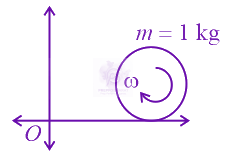
A $0.5\mathrm{kg}$ block moving at a speed of $12{\mathrm{ms}}^{-1}$ compresses a spring through a distance $30\mathrm{cm}$ when its speed is halved. The spring constant of the spring will be _____ ${\mathrm{Nm}}^{-1}$
If the radius of earth shrinks by $2%$ while its mass remains same. The acceleration due to gravity on the earth's surface will approximately
If momentum $[P]$, area $[A]$ and time $[T]$ are taken as fundamental quantities, then the dimensional formula for coefficient of viscosity is
A ball of mass $100g$ is dropped from a height $h=10\mathrm{cm}$ on a platform fixed at the top of a vertical spring (as shown in figure). The ball stays on the platform and the platform is depressed by a distance $\frac{h}{2}$. The spring constant is _____ $N{m}^{-1}$ (Use $g=10{ms}^{-2}$) 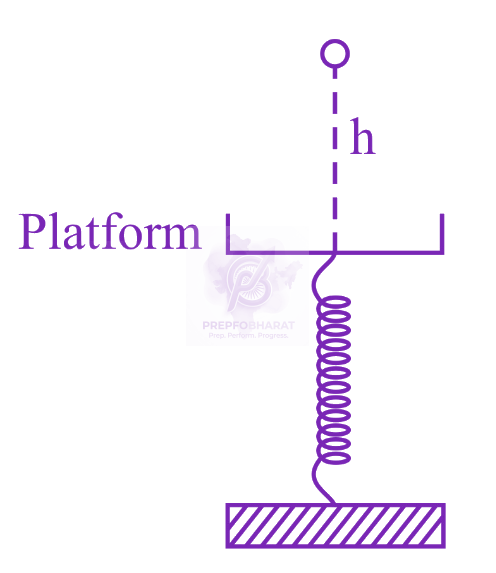
Assume there are two identical simple pendulum Clocks-$1$ is placed on the earth and Clock-$2$ is placed on a space station located at a height h above the earth surface. Clock-$1$ and Clock-$2$ operate at time periods $4s$ and $6s$ respectively. Then the value of $h$ is - (consider radius of earth ${R}_{E}=6400\mathrm{km}$ and $g$ on earth $10m{s}^{-2}$)
The position vector of $1\mathrm{kg}$ object is $\vec{r}=(3\hat{i}-\hat{j})m$ and its velocity $\vec{v}=(3\hat{j}+\hat{k})m{s}^{-1}$. The magnitude of its angular momentum is $\sqrt{x}Nms$, where $x$ is
Velocity $(v)$ and acceleration $(a)$ in two systems of units $1$ and $2$ are related as ${v}_{2}=\frac{n}{{m}^{2}}{v}_{1}$ and ${a}_{2}=\frac{{a}_{1}}{mn}$ respectively. Here $m$ and $n$ are constants. The relations for distance and time in two systems respectively are
A uniform chain of $6m$ length is placed on a table such that a part of its length is hanging over the edge of the table. The system is at rest. The co-efficient of static friction between the chain and the surface of the table is $0.5$, the maximum length of the chain hanging from the table is _____ $m$.
A block of mass $40\mathrm{kg}$ slides over a surface, when a mass of $4\mathrm{kg}$ is suspended through an inextensible massless string passing over frictionless pulley as shown below. The coefficient of kinetic friction between the surface and block is $0.02$. The acceleration of block is: (Given $g=10{ms}^{-2}$.) 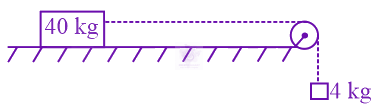
A block $A$ takes $2s$ to slide down a frictionless incline of $30^{\circ}$ and length $l$, kept inside a lift going up with uniform velocity $v$. If the incline is changed to $45^{\circ}$, the time taken by the block, to slide down the incline, will be approximately:
In a Vernier Caliper $10$ divisions of Vernier scale is equal to the $9$ divisions of main scale. When both jaws of Vernier calipers touch each other, the zero of the Vernier scale is shifted to the left of zero of the main scale and ${4}^{\mathrm{th}}$ Vernier scale division exactly coincides with the main scale reading. One main scale division is equal to $1\mathrm{mm}$. While measuring diameter of a spherical body, the body is held between two jaws. It is now observed that zero of the Vernier scale lies between $30$ and $31$ divisions of main scale reading and ${6}^{\mathrm{th}}$ Vernier scale division exactly. coincides with the main scale reading. The diameter of the spherical body will be:
The torque of a force $5\hat{i}+3\hat{j}-7\hat{k}$ about the origin is $\tau$. If the force acts on a particle whose position vector is $2\hat{i}+2\hat{j}+\hat{k}$, then the value of $\tau$ will be
A ball is released from a height $h$. If ${t}_{1}$ and ${t}_{2}$ be the time required to complete first half and second half of the distance respectively. Then, choose the correct relation between ${t}_{1}$ and ${t}_{2}$.
The diameter of an air bubble which was initially $2\mathrm{mm}$, rises steadily through a solution of density $1750 \mathrm{~kg} / \mathrm{m}^3$ at the rate of $0.35 \mathrm{~cm} / \mathrm{s}$. Coefficient of viscosity of the solution is ______ (Assume mass of the bubble to be negligible) (Answer in Poise to the nearest integer)
An object is taken to a height above the surface of earth at a distance $\frac{5}{4}R$ from the centre of the earth. Where radius of earth, $R=6400\mathrm{km}$. The percentage decrease in the weight of the object will be
A string of area of cross-section $4{\mathrm{mm}}^{2}$ and length $0.5$ is connected with a rigid body of mass $2\mathrm{kg}$. The body is rotated in a vertical circular path of radius $0.5m$. The body acquires a speed of $5m{s}^{-1}$ at the bottom of the circular path. Strain produced in the string when the body is at the bottom of the circle is _____ $\times {10}^{-5}$. (Use Young's modulus ${10}^{11}N{m}^{-2}$ and $g=10m{s}^{-2}$)
What percentage of kinetic energy of a moving particle is transferred to a stationary particle when it strikes the stationary particle of $5$ times its mass? (Assume the collision to be head-on elastic collision)
An object is thrown vertically upwards. At its maximum height, which of the following quantity becomes zero ?
The dimension of mutual inductance is
The approximate height from the surface of earth at which the weight of the body becomes $\frac{1}{3}$ of its weight on the surface of earth is : [Radius of earth $R=6400\mathrm{km}$ and $\sqrt{3}=1.732$]
A bullet is shot vertically downwards with an initial velocity of $100m{s}^{-1}$ from a certain height. Within $10s$, the bullet reaches the ground and instantaneously comes to rest due to the perfectly inelastic collision. The velocity-time curve for total time $t=20s$ will be : (Take $g=10m{s}^{-2}$)
Two billiard balls of mass $0.05\mathrm{kg}$ each moving in opposite directions with $10{\mathrm{ms}}^{-1}$ collide and rebound with the same speed. If the time duration of contact is $t=0.005s$, then what is the force exerted on the ball due to each other?
A rolling wheel of $12\mathrm{kg}$ is on an inclined plane at position $P$ and connected to a mass of $3\mathrm{kg}$ through a string of fixed length and pulley as shown in figure. Consider $PR$ as friction free surface. The velocity of centre of mass of the wheel when it reaches at the bottom $Q$ of the inclined plane $PQ$ will be $\frac{1}{2}\sqrt{xgh}m{s}^{-1}$. The value of $x$ (rounded off to the nearest integer) is _____. 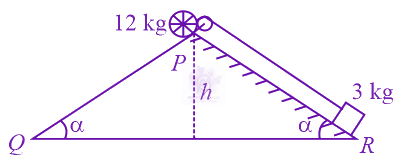
Four identical discs each of mass '$M$' and diameter '$a$' are arranged in a small plane as shown in figure. If the moment of inertia of the system about $O{O}^{'}$ is $\frac{x}{4}M{a}^{2}$. Then, the value of $x$ will be _____ . 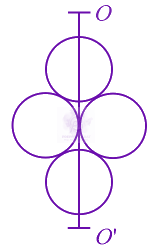
If $Z=\frac{{A}^{2}{B}^{3}}{{C}^{4}}$, then the relative error in $Z$ will be
For a free body diagram shown in the figure, the four forces are applied in the '$x$' and '$y$' directions. What additional force must be applied and at what angle with positive $x$-axis so that the net acceleration of body is zero? 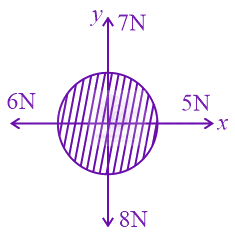
Given below are two statements. One is labelled as Assertion A and the other is labelled as Reason R. Assertion A: Two identical balls $A$ and $B$ thrown with same velocity '$u$' at two different angles with horizontal attained the same range $R$. If A and $B$ reached the maximum height ${h}_{1}$ and ${h}_{2}$ respectively, then $R=4\sqrt{{h}_{1}{h}_{2}}$ Reason R: Product of said heights. ${h}_{1}{h}_{2}=(\frac{{u}^{2}{\mathrm{sin}}^{2}\theta }{2g})\cdot (\frac{{u}^{2}{\mathrm{cos}}^{2}\theta }{2g})$
A body of mass $M$ at rest explodes into three pieces, in the ratio of masses $1:1:2$. Two smaller pieces fly off perpendicular to each other with velocities of $30{ms}^{-1}$ and $40{ms}^{-1}$ respectively. The velocity of the third piece will be
An ideal fluid of density $800\mathrm{kg}{m}^{-3}$, flows smoothly through a bent pipe (as shown in figure) that tapers in cross-sectional area from a to $\frac{a}{2}$. The pressure difference between the wide and narrow sections of pipe is $4100\mathrm{Pa}$. At wider section, the velocity of fluid is $\frac{\sqrt{x}}{6}{ms}^{-1}$ for $x=$_____ . (Given $g=10{ms}^{-2}$) 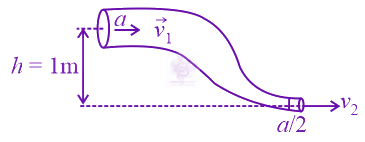
A water drop of diameter $2\mathrm{cm}$ is broken into $64$ equal droplets. The surface tension of water is $0.075N{m}^{-1}$. In this process the gain in surface energy will be
The Vernier constant of Vernier callipers is $0.1\mathrm{mm}$ and it has zero error of $(-0.05\mathrm{cm})$. While measuring diameter of a sphere, the main scale reading is $1.7\mathrm{cm}$ and coinciding vernier division is $5$ . The corrected diameter will be _____$\times {10}^{-2}\mathrm{cm}$.
The area of cross section of the rope used to lift a load by a crane is $2.5\times {10}^{-4}{m}^{2}$. The maximum lifting capacity of the crane is $10$ metric tons. To increase the lifting capacity of the crane to 25 metric tons, the required area of cross section of the rope should be (take $g=10{\mathrm{ms}}^{-2}$)
In a vernier callipers, each $\mathrm{cm}$ on the main scale is divided into $20$ equal parts. If tenth vernier scale division coincides with nineth main scale division. Then the value of vernier constant will be _____ $\times {10}^{-2}\mathrm{mm}$
Two bodies of mass $1\mathrm{kg}$ and $3\mathrm{kg}$ have position vectors $\hat{i}+2\hat{j}+\hat{k}$ and $-3\hat{i}-2\hat{j}+\hat{k}$ respectively. The magnitude of position vector of centre of mass of this system will be similar to the magnitude of vector :
A fly wheel is accelerated uniformly from rest and rotates through $5\mathrm{rad}$ in the first second. The angle rotated by the fly wheel in the next second, will be :
A liquid of density $750\mathrm{kg}{m}^{-3}$ flows smoothly through a horizontal pipe that tapers in cross-sectional area from ${A}_{1}=1.2\times {10}^{-2}{m}^{2}$ to ${A}_{2}=\frac{{A}_{1}}{2}$. The pressure difference between the wide and narrow sections of the pipe is $4500\mathrm{Pa}$. The rate of flow of liquid is _____ $\times {10}^{-3}{m}^{3}{s}^{-1}$.
In the given figure, the block of mass $m$ is dropped from the point $'A'$. The expression for kinetic energy of block when it reaches point $'B'$ is 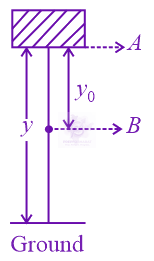
A spherical soap bubble of radius $3\mathrm{cm}$ is formed inside another spherical soap bubble of radius $6\mathrm{cm}$. If the internal pressure of the smaller bubble of radius $3\mathrm{cm}$ in the above system is equal to the internal pressure of the another single soap bubble of radius $r\mathrm{cm}$. The value of $r$ is _____
A stone tide to a string of length $L$ is whirled in a vertical circle with the other end of the string at the centre. At a certain instant of time, the stone is at its lowest position and has a speed $u$. The magnitude of change in its velocity, as it reaches a position where the string is horizontal, is $\sqrt{x({u}^{2}-gL)}$. The value of $x$ is
A block of mass '$m$' (as shown in figure) moving with kinetic energy $E$ compresses a spring through a distance $25\mathrm{cm}$ when, its speed is halved. The value of spring constant of used spring will be $nEN{m}^{-1}$ for $n=$_____. 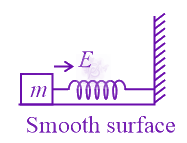
A uniform disc with mass $M=4\mathrm{kg}$ and radius $R=10\mathrm{cm}$ is mounted on a fixed horizontal axle as shown in figure. A block with mass $m=2\mathrm{kg}$ hangs from a massless cord that is wrapped around the rim of the disc. During the fall of the block, the cord does not slip and there is no friction at the axle. The tension in the cord is _____ $N$. (Take $g=10{\mathrm{ms}}^{-2}$) 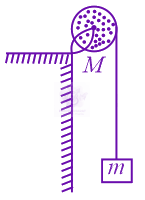
A person can throw a ball upto a maximum range of $100m$. How high above the ground he can throw the same ball?
A hanging mass $M$ is connected to a four times bigger mass by using a string pulley arrangement, as shown in the figure. The bigger mass is placed on a horizontal ice-slab and being pulled by $2\mathrm{Mg}$ force. In this situation, tension in the string is $\frac{x}{5}\mathrm{Mg}$ for $x=$_____. Neglect mass of the string and friction of the block (bigger mass) with ice slab. (Given $g=$ acceleration due to gravity) 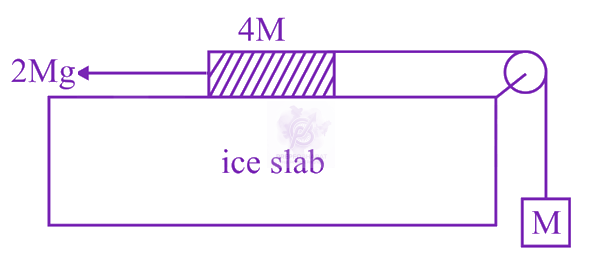
A block of metal weighing $2\mathrm{kg}$ is resting on a frictionless plane (as shown in figure). It is struck by a jet releasing water at a rate of $1\mathrm{kg}{s}^{-1}$ and at a speed of $10{ms}^{-1}$. Then, the initial acceleration of the block, in $m{s}^{-2}$, will be 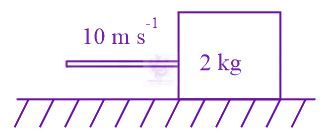
A particle experiences a variable force $\vec{F}=(4x\hat{i}+3{y}^{2}\hat{j})$ in a horizontal $x-y$ plane. Assume distance in meters and force is newton. If the particle moves from point $(1,2)$ to point $(2,3)$ in the $x-y$ plane, then Kinetic Energy changes by :
A metre scale is balanced on a knife edge at its centre. When two coins, each of mass $10g$ are put one on the top of the other at the $10.0\mathrm{cm}$ mark the scale is found to be balanced at $40.0\mathrm{cm}$ mark. The mass of the metre scale is found to be $x\times {10}^{-2}\mathrm{kg}$. The value of $x$ is _____ .
Two projectile thrown at $30^{\circ}$ and $45^{\circ}$ with the horizontal respectively, reach the maximum height in same time. The ratio of their initial velocities is
A pendulum is suspended by a string of length $250\mathrm{cm}$. The mass of the bob of the pendulum is $200g$. The bob is pulled aside until the string is at $60^{\circ}$ with vertical as shown in the figure. After releasing the bob, the maximum velocity attained by the bob will be _____ $m{s}^{-1}$. (if $g=10m{s}^{-2}$) 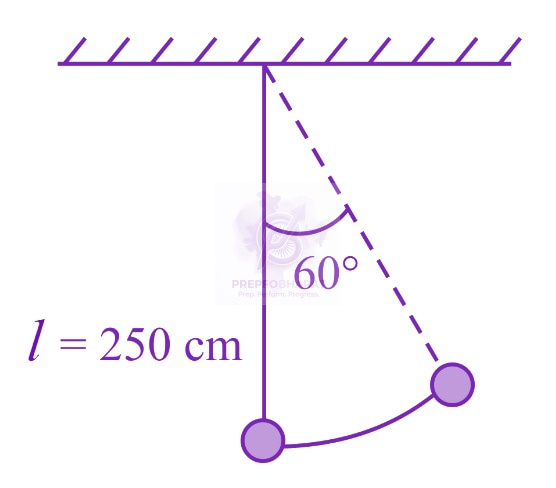
Match List I with List II. <table class="pyq-table"><tbody><tr><td></td><td>List I</td><td></td><td>List II</td></tr><tr><td>(A)</td><td>Torque</td><td>(I)</td><td>${\mathrm{Nms}}^{-1}$</td></tr><tr><td>(B)</td><td>Stress</td><td>(II)</td><td>${\mathrm{Jkg}}^{-1}$</td></tr><tr><td>(C)</td><td>Latent Heat</td><td>(III)</td><td>$\mathrm{Nm}$</td></tr><tr><td>(D)</td><td>Power</td><td>(IV)</td><td>${\mathrm{Nm}}^{-2}$</td></tr></tbody></table>Choose the correct answer from the options given below:
A ball is projected vertically upward with an initial velocity of $50{ms}^{-1}$ at $t=0s$. At $t=2s$, another ball is projected vertically upward with same velocity. At $t=$____$s$, second ball will meet the first ball $(g=10{ms}^{-2})$.
A solid cylinder length is suspended symmetrically through two massless strings, as shown in the figure. The distance from the initial rest position, the cylinder should be unbinding the strings to achieve a speed of $4m{s}^{-1}$, is _____$\mathrm{cm}$. (take $g=10m{s}^{-2}$) 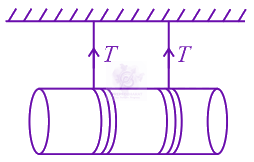
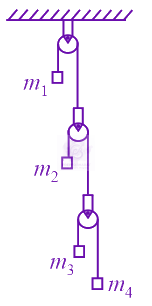
In the arrangement shown in figure ${a}_{1},{a}_{2},{a}_{3}$ and ${a}_{4}$ are the accelerations of masses ${m}_{1},{m}_{2},{m}_{3}$ and ${m}_{4}$ respectively. Which of the following relation is true for this arrangement?