Since 50 efficiency is given, half of the energy of the falling water will be used by the bulbs. Therefore,
21ΔtΔmgh=n×P⇒21×36009×104×10×40=100n⇒n=50
JEE Main 2022 — Physics Mechanics
Water falls from a 40m high dam at the rate of 9×10⁴kg per hour. Fifty percentage of gravitational potential energy can be converted into electrical energy. Using this hydro electric energy number of 100W lamps, that can be lit, is
(Take g=10ms−2)
Held on 28 Jun 2022 · Verified 6 Jul 2026.
25
50
100
18
Sign in to track your attempts and accuracy.
Sign in to keep a private note on this question. Nothing you write is ever public.
A small bob $A$ of mass $m$ is attached to a massless rigid rod of length 1 m pivoted at point $P$ and kept at an angle of $60^{\circ}$ with vertical as shown in figure. At distance of 1 m below point $P$, an identical bob $B$ is kept at rest on a smooth horizontal surface that extends to a circular track of radius $R$ as shown in figure. If bob $B$ just manages to complete the circular path of radius $R$ upto a point $Q$ after being hit elastically by $\operatorname{bob} A$, then radius $R$ is $\_\_\_\_$ m. 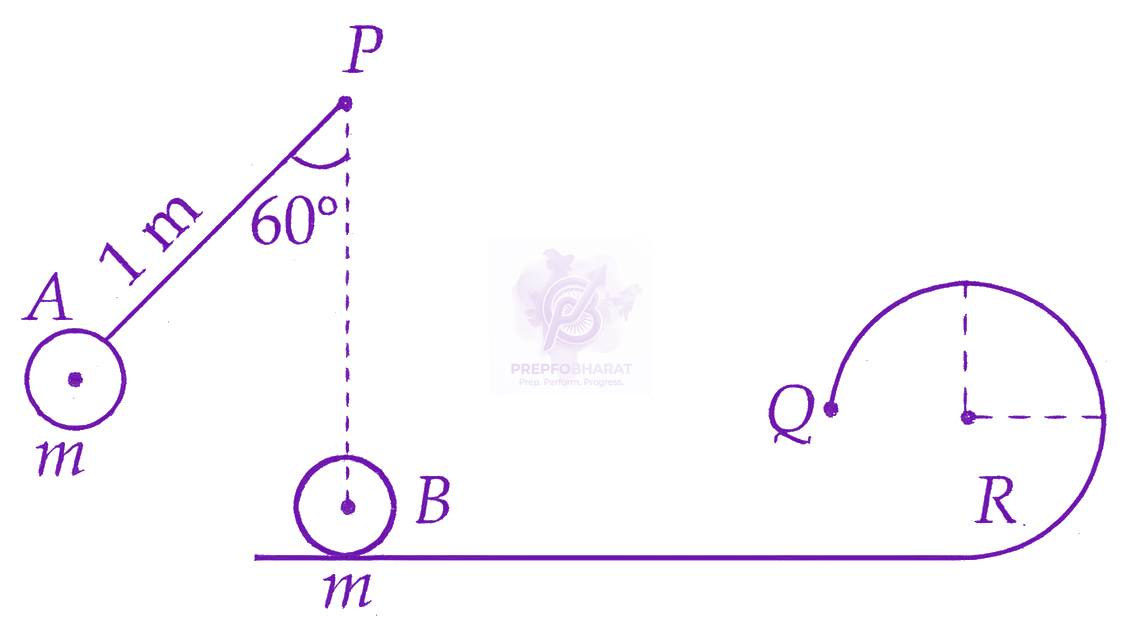
In a screw gauge the zero of main scale reference line coincides with the fifth division of the circular scale when two studs are in contact. There are $100$ divisions in circular scale and pitch of screw gauge is $0.1$ mm. When diameter of a sphere is measured, the reading of main scale is $5$ mm and $50^{\text{th}}$ division of circular scale coincides with the reference line of main scale. The diameter of sphere is _______ mm.
Two masses $m$ and 2 m are connected by a light string going over a pulley (disc) of mass 30 m with radius $r=0.1 \mathrm{~m}$. The pulley is mounted in a vertical plane and it is free to rotate about its axis. The 2 m mass is released from rest and its speed when it has descended through a height of 3.6 m is $\_\_\_\_$ $\mathrm{m} / \mathrm{s}$. (Assume string does not slip and $\mathrm{g}=10 \mathrm{~m} / \mathrm{s}^{2}$)
Water flows through a horizontal tube as shown in the figure. The difference in height between the water columns in vertical tubes is 5 cm and the area of cross-sections at $A$ and $B$ are $6 \mathrm{~cm}^{2}$ and $3 \mathrm{~cm}^{2}$ respectively. The rate of flow will be $\_\_\_\_$ $\mathrm{cm}^{3} / \mathrm{s}$. (take $g=10 \mathrm{~m} / \mathrm{s}^{2}$) 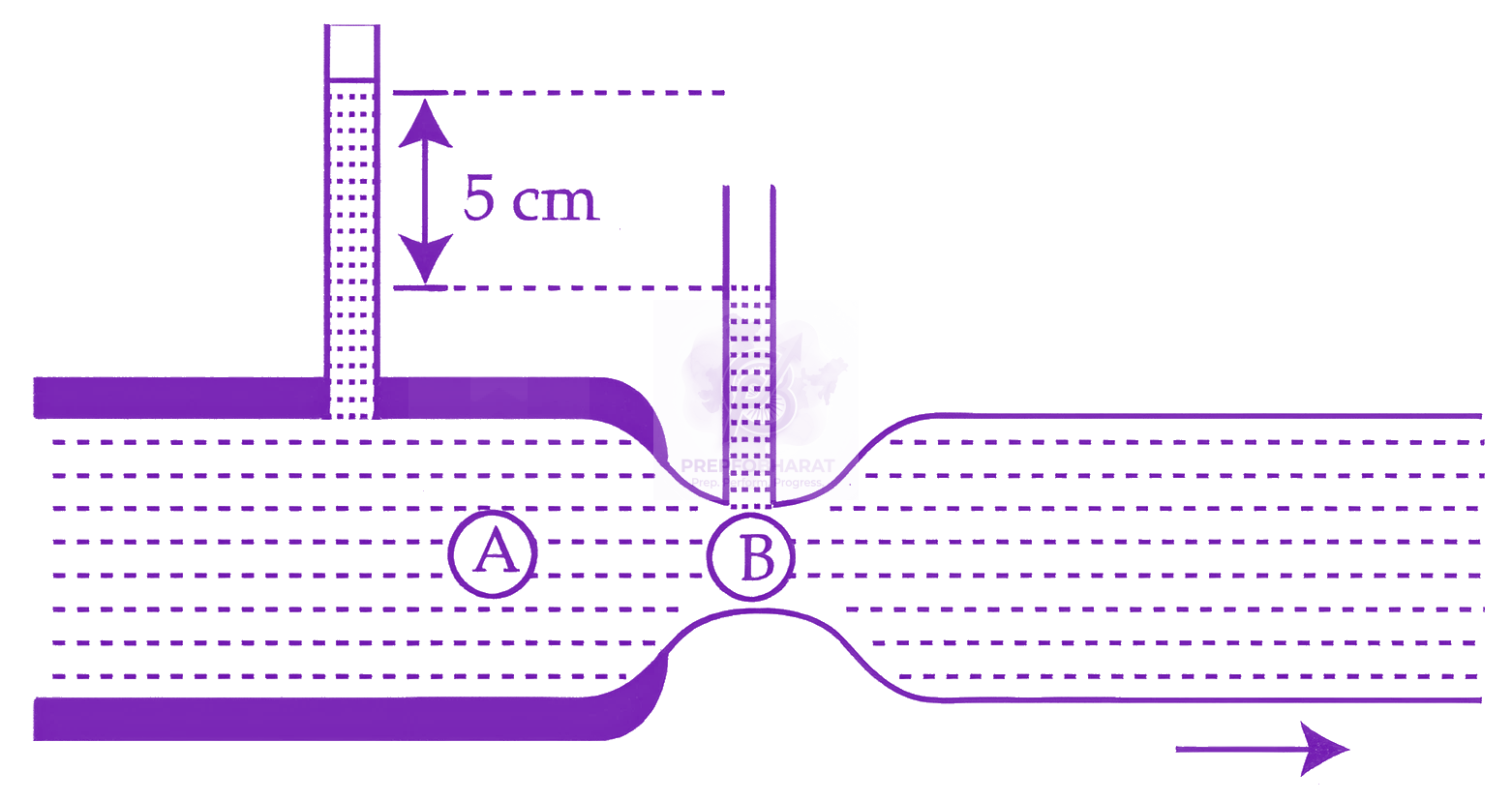
Two circular discs of radius each 10 cm are joined at their centres by a rod of length 30 cm and mass 600 gm as shown in figure. If the mass of each disc is 600 gm and applied torque between two discs is $43 \times 10^{5}$ dyne. cm, the angular acceleration of the discs about the given axis $A B$ is $\_\_\_\_$ $\mathrm{rad} / \mathrm{s}^{2}$. 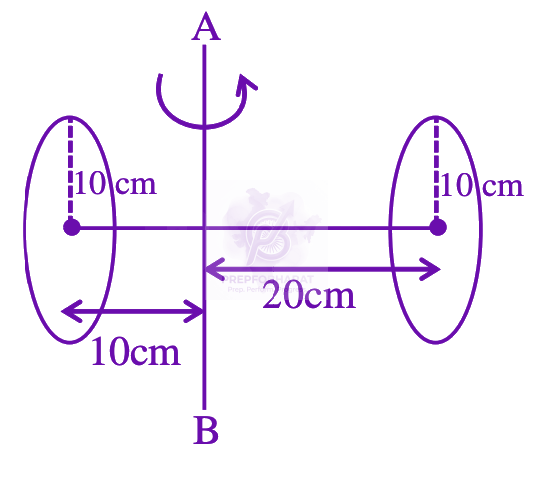
Work through every JEE Main Mechanics PYQ, year by year.