JEE Main 2014 — Mechanics
Physics Mechanics questions from JEE Main 2014.
Other Years
50 Mechanics Questions from 2014
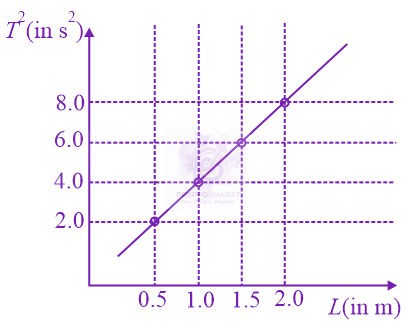 In an experiment to determine the gravitational acceleration $g$ of a place with the help of a simple pendulum, the measured time period squared is plotted against the string length of the pendulum in the figure. What is the value of $g$ at the place?
India's Mangalyan was sent to the Mars by launching it into a transfer orbit EOM around the sun. It leaves the earth at $E$ and meets Mars at $M$. If the semi-major axis of Earth's orbit is ${\text{a}}_{\text{e}} = \text{1.5} \times 1 {0}^{ 1 1 } \text{m}$ , that of Mar's orbit ${\text{a}}_{\text{m}} = \text{2.28} \times 1 {0}^{ 1 1 } \text{m}$, taking Kepler's laws, give the estimate of time for Mangalyan to reach Mars from Earth. 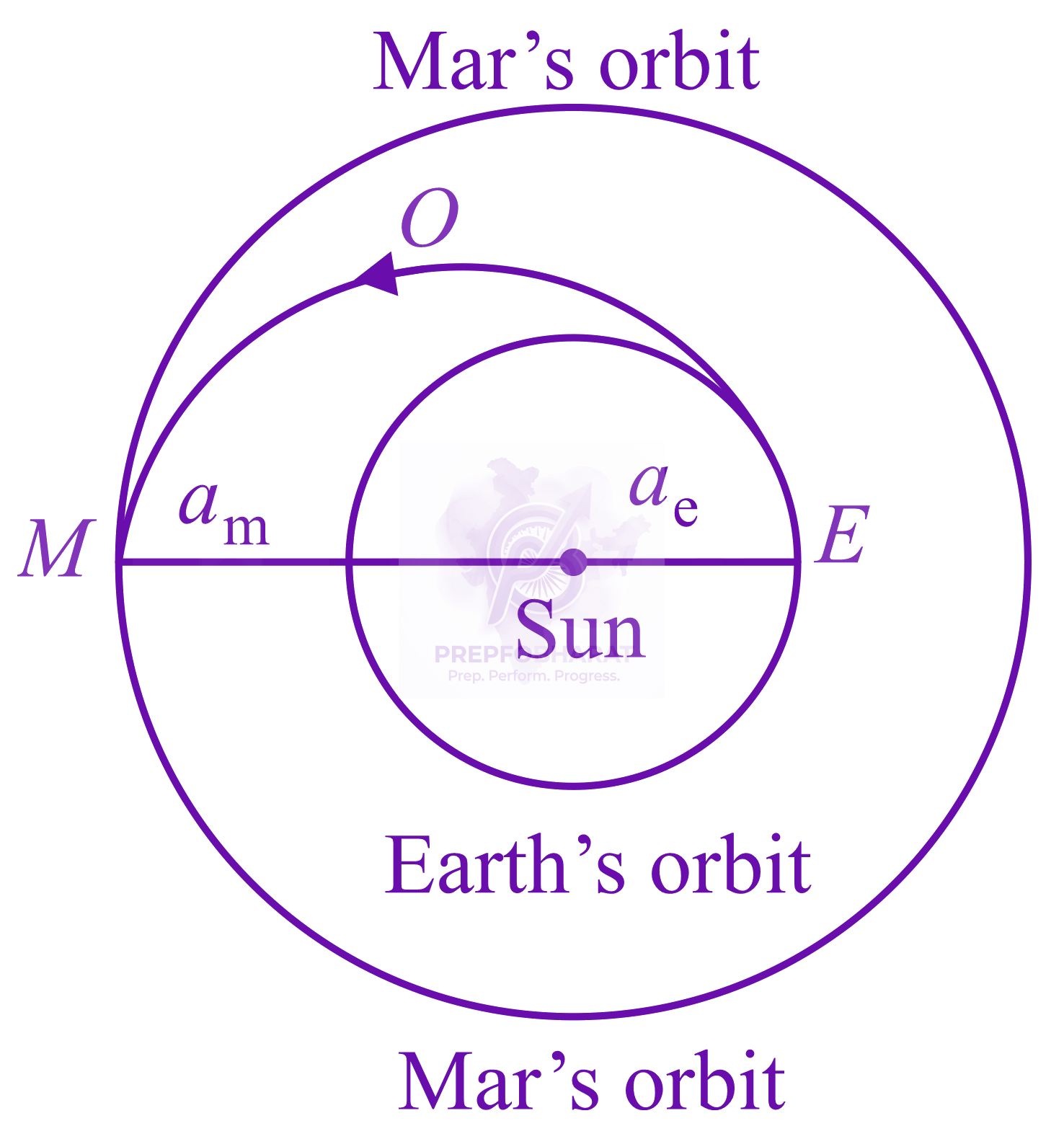
A person climbs up a stalled escalator in $60 \mathrm{~s}$. If standing on the same but escalator running with constant velocity he takes $40 \mathrm{~s}$. How much time is taken by the person to walk up the moving escalator?
Steel ruptures when a shear of $3.5 \times 10^8 \mathrm{~N} \mathrm{~m}^{-2}$ is applied. The force needed to punch a $1 \mathrm{~cm}$ diameter hole in a steel sheet $0.3 \mathrm{~cm}$ thick is nearly:
A cylinder of mass M$_{c}$ and sphere of mass M$_{s}$ are placed at points A and B of two inclines, respectively. (See figure). If they roll on the incline without slipping such that their accelerations are the same, then the ratio $\frac{ sin {\theta }_{\text{c}} }{ sin {\theta }_{\text{s}} }$ is : 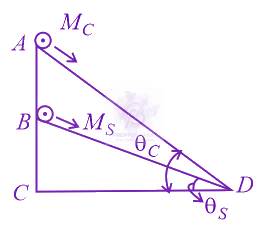
The gravitational field in a region is given by $\vec{g}=(5\hat{\text{i}}+12\hat{j})N{\mathrm{kg}}^{-1}$. The change in the gravitational potential energy of a particle of mass $2\mathrm{kg}$ when it is taken from the origin to a point $(7m,-3m)$ is
The current voltage relation of diode is given by I = (e$^{1000}$$^{ V/T}$ - 1) mA, where the applied voltage V is in volts and the temperature T is in degree Kelvin. If a student makes an error measuring $\pm \text{0.01 V}$ while measuring the current of 5 mA at 300 K, what will be the error in the value of current in mA ?
The velocity of water in a river is $18\mathrm{km}{h}^{-1}$ near the surface. If the river is $5m$ deep, find the shearing stress between the horizontal layers of water. The coefficient of viscosity of water$={10}^{-2}\mathrm{poise}$.
From the following combinations of physical constants (expressed through their usual symbols) the only combination, that would have the same value in different systems of units, is:
In terms of resistance $R$ and time $T$, the dimensions of ratio $\frac{\mu}{\varepsilon}$ of the permeability $\mu$ and permittivity $\varepsilon$ is:
Consider a cylinder of mass M resting on a rough horizontal rug that is pulled out from under it with acceleration 'a' perpendicular to the axis of the cylinder. What is F$_{friction}$ at point P ? It is assumed that the cylinder does not slip. 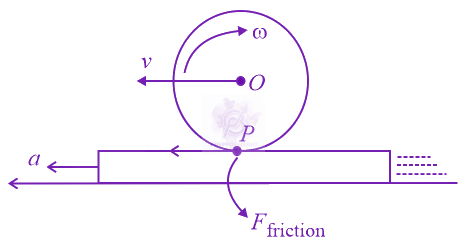
A cylindrical vessel of cross-section A contains water to a height $\mathrm{h}$. There is a hole in the bottom of radius ' $a$ '. The time in which it will be emptied is:
Water is flowing at a speed of 1.5 m s$^{-1}$ through a horizontal tube of cross-sectional area 10$^{-2}$ m$^{2}$$^{ }$and you are trying to stop the flow by your palm. Assuming that the water stops immediately after hitting the palm, the minimum force that you must exert should be (density of water = 10$^{3}$ kg m$^{-3}$)
Match List$‐I$ (Event) with List$‐\mathrm{II}$ (Order of the time interval for the happening of the event) and select the correct option from the options given below the lists. <table class="pyq-table"><tbody><tr><th></th><th>List-I</th><th></th><th>List-II</th></tr><tr><td>$(a)$</td><td>The rotation period of earth</td><td>$(i)$</td><td>${10}^{5}s$</td></tr><tr><td>$(b)$</td><td>Revolution period of earth</td><td>$(\mathrm{ii})$</td><td>${10}^{7}s$</td></tr><tr><td>$(c)$</td><td>Period of a light wave</td><td>$(\mathrm{iii})$</td><td>${10}^{-15}s$</td></tr><tr><td>$(d)$</td><td>Period of a sound wave</td><td>$(\mathrm{iv})$</td><td>${10}^{-3}s$</td></tr></tbody></table>
A student measured the length of a rod and wrote it as 3.50 cm. Which instrument did he use to measure it ?
A block A of mass 4 kg is placed on another block B of mass 5 kg, and the block B rests on a smooth horizontal table. If the minimum force that can be applied on A so that both the blocks move together is 12 N, the maximum force that can be applied on B for the blocks to move together will be :
The initial speed of a bullet fired from a rifle is $630 \mathrm{~m} / \mathrm{s}$. The rifle is fired at the centre of a target $700 \mathrm{~m}$ away at the same level as the target. How far above the centre of the target ?
A block of mass $m$ is placed on a surface with a vertical cross section given by $y=\frac{{x}^{3}}{6}$. If the coefficient of friction is $0.5$, the maximum height above the ground at which the block can be placed without slipping is
A large number of liquid drops each of radius $r$ coalesce to form a single drop of the radius $R$. The energy released in the process is converted into kinetic energy of the big drop so formed. The speed of the big drop is (given surface tension of the liquid $T$, density $\rho$)
The average mass of rain drops is $3.0 \times 10^{-5} \mathrm{~kg}$ and their avarage terminal velocity is $9 \mathrm{~m} / \mathrm{s}$. Calculate the energy transferred by rain to each square metre of the surface at a place which receives $100 \mathrm{~cm}$ of rain in a year.
An experiment is performed to obtain the value of acceleration due to gravity g by using a simple pendulum of length L. In this experiment time for 100 oscillations is measured by using a watch of 1 second least count and the value is 90.0 seconds. The length L is measured by using a meter scale of least count 1 mm and the value is 20.0 cm. The error in the determination of g would be :
There is a circular tube in a vertical plane. Two liquids which do not mix and of densities d$_{1}$ and d$_{2}$ are filled in the tube. Each liquid subtends 90$^{o}$ angle at centre. Radius joining their interface makes an angle $\alpha$ with vertical. Ratio $\frac{{\text{d}}_{1}}{ }$ is : 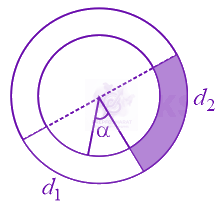
A ball of mass $160g$ is thrown up at an angle of $60^{\circ}$ to the horizontal at a speed of $10m{s}^{-1}$. The angular momentum of the ball at the highest point of the trajectory with respect to the point from which the ball is thrown is nearly $(g=10m{s}^{-2})$
From a tower of height H, a particle is thrown vertically upwards with a speed u. The time taken by the particle, to hit the ground, is n times that taken by it to reach the highest point of its path.The relation between H, u and n is :
A thin bar of length $\mathrm{L}$ has a mass per unit length $\lambda$, that increases linearly with distance from one end. If its total mass is $M$ and its mass per unit length at the lighter end is $\lambda_{\mathrm{O}}$, then the distance of the centre of mass from the lighter end is:
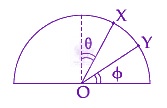 A particle is released on a vertical smooth semicircular track from point $X$ so that, $OX$ makes angle $\theta$ from the vertical (see figure). The normal reaction of the track on the particle vanishes at the point $Y$ where $OY$ makes an angle $\phi$ with the horizontal. Then
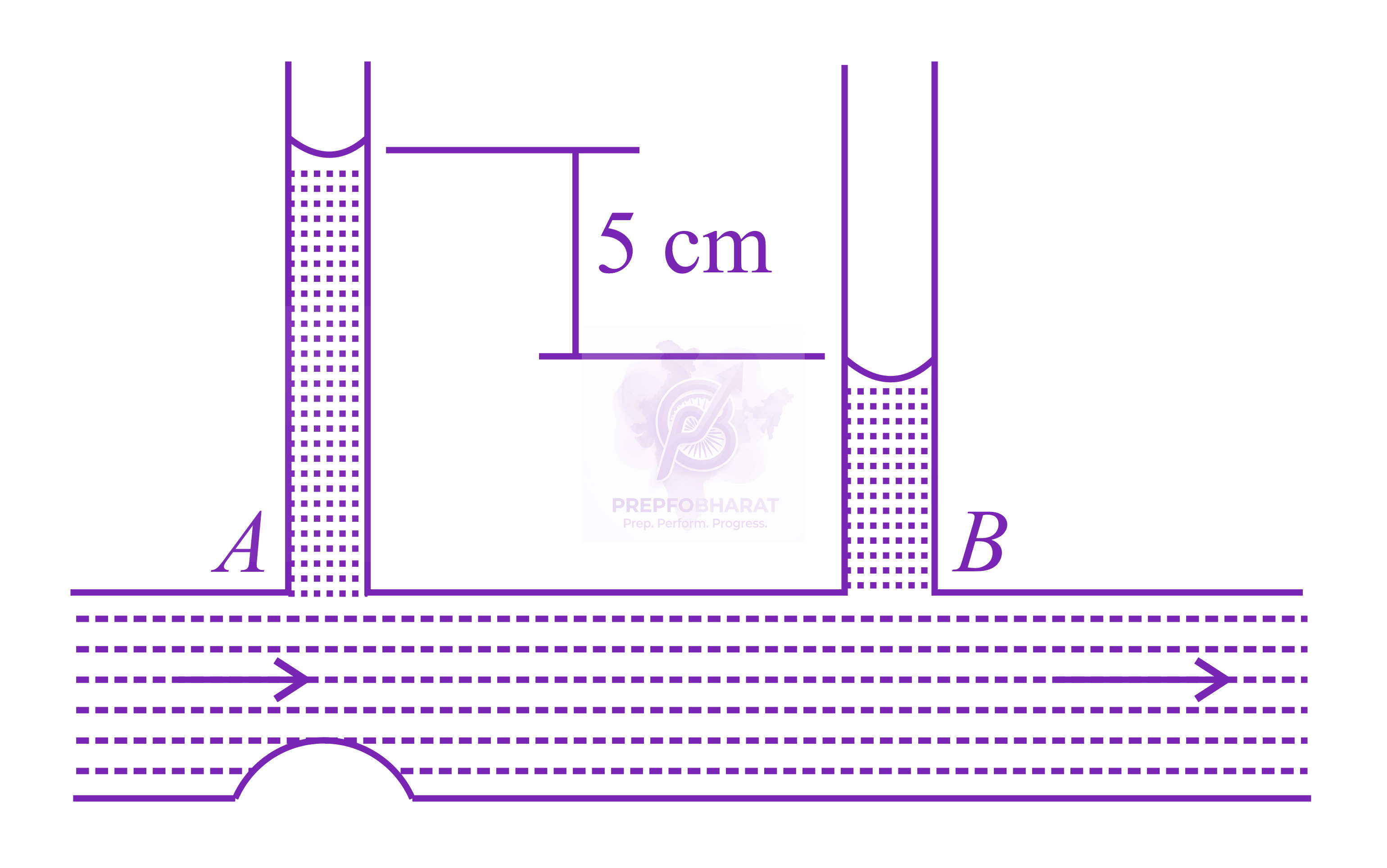 In the diagram shown, the difference in the two tubes of the manometer is $5\mathrm{cm}$, the cross-section of the tube at $A$ and $B$ is $6{\mathrm{mm}}^{2}$ and $10{\mathrm{mm}}^{2}$ respectively. The rate at which water flows through the tube is $(g=10m{s}^{-2})$
When a rubber-band is stretched by a distance x, it exerts a restoring force of magnitude F = ax + bx$^{2}$ where a and b are constants. The work done in stretching the unstretched rubber-band by L is :
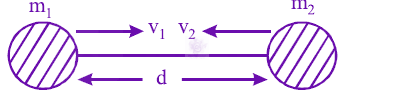 Two hypothetical planets of masses $\mathrm{m}_1$ and $\mathrm{m}_2$ are at rest when they are infinite distance apart. Because of the gravitational force they move towards each other along the line joining their centres. What is their speed when their separation is ' $d$ '? (Speed of $\mathrm{m}_1$ is $\mathrm{v}_1$ and that of $\mathrm{m}_2$ is $\mathrm{v}_2$ )
Three masses $\mathrm{m}, 2 \mathrm{~m}$ and $3 \mathrm{~m}$ are moving in $\mathrm{x}-\mathrm{y}$ plane with speed $3 \mathrm{u}, 2 \mathrm{u}$ and $\mathrm{u}$ respectively as shown in figure. The three masses collide at the same point at $\mathrm{P}$ and stick together. The velocity of resulting mass will be: 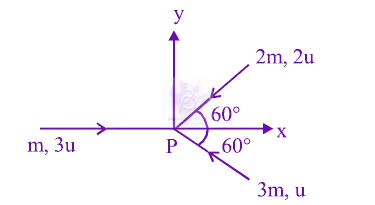
A heavy box is to be dragged along a rough horizontal floor. To do so, the person $A$ pushes it at an angle $30^{\circ}$ from the horizontal and requires a minimum force ${F}_{A}$, while the person $B$ pulls the box at an angle $60^{\circ}$ from the horizontal and needs minimum force ${F}_{B}$. If the coefficient of friction between the box and the floor is $\frac{\sqrt{3}}{5}$, the ratio $\frac{{F}_{A}}{{F}_{B}}$ is
A tank with a small hole at the bottom has been filled with water and kerosene (specific gravity $0.8$ ). The height of water is $3 \mathrm{~m}$ and that of kerosene $2 \mathrm{~m}$. When the hole is opened the velocity of fluid coming out from it is nearly: (take $\mathrm{g}=10 \mathrm{~ms}^{-2}$ and density of water $\left.=10^3 \mathrm{~kg} \mathrm{~m}^{-3}\right)$
The position of a projectile launched from the origin at t = 0 is given by $\vec{\text{r}} = ( 4 0 \hat{ i } + 5 0 \hat{ j } ) \text{m}$ at t = 2s. If the projectile was launched at an angle $\theta$ from the horizontal, then $\theta$ is (take g = 10 ms$^{-2}$).
A small ball of mass $\mathrm{m}$ starts at a point $\mathrm{A}$ with speed $\mathrm{v}_{\mathrm{o}}$ and moves along a frictionless track $\mathrm{AB}$ as shown. The track $\mathrm{BC}$ has coefficient of friction $\mu$. The ball comes to stop at $\mathrm{C}$ after travelling a distance $L$ which is: 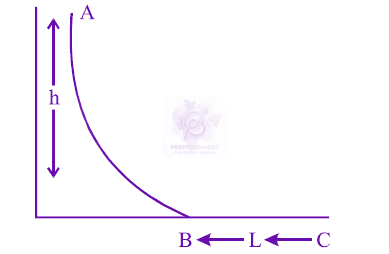
A capillary tube is immersed vertically in water and the height of the water column is $x$. When this arrangement is taken into a mine of depth d, the height of the water column is $y$. If R is the radius of earth, the ratio $\frac{ x }{ y }$ is :
A mass $m$ is supported by a massless string wound around a uniform hollow cylinder of mass m and radius R. If the string does not slip on the cylinder, with what acceleration will the mass fall on release? 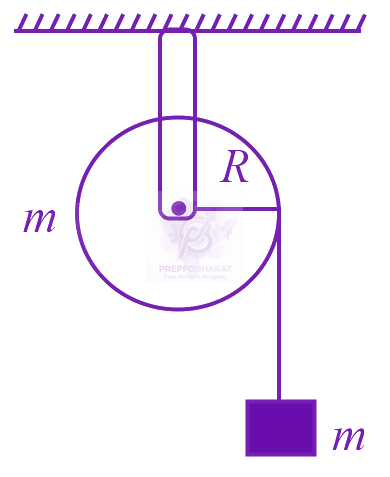
A body of mass $5 \mathrm{~kg}$ under the action of constant force $\vec{F}=F_x \hat{i}+F_y \hat{j}$ has velocity at $\mathrm{t}=0 \mathrm{~s}$ as $\overrightarrow{\mathrm{v}}=(6 \hat{\mathrm{i}}-2 \hat{\mathrm{j}} \mathrm{m} / \mathrm{s})$ and at $\mathrm{t}=10 \mathrm{~s}$ as $\overrightarrow{\mathrm{v}}=+6 \hat{\mathrm{j}} \mathrm{m} / \mathrm{s}$. The force $\overrightarrow{\mathrm{F}}$ is:
Four particles, each of mass $M$ and equidistant from each other, move along a circle of radius $R$ under the action of their mutual gravitational attraction. The speed of each particle is
Two soap bubbles coalesce to form a single bubble. If $\mathrm{V}$ is the subsequent change in volume of contained air and $\mathrm{S}$ change in total surface area, $\mathrm{T}$ is the surface tension and $\mathrm{P}$ atmospheric pressure, then which of the following relation is correct?
The bulk moduli of ethanol, mercury and water are given as $0.9,25$ and $2.2$ respectively in units of $10^9 \mathrm{Nm}^{-2}$. For a given value of pressure, the fractional compression in volume is $\frac{\Delta \mathrm{V}}{\mathrm{V}}$. Which of the following statements about $\frac{\Delta V}{V}$ for these three liquids is correct ?
A particle is moving in a circular path of radius a, with a constant velocity $\mathrm{v}$ as shown in the figure. The centre of circle is marked by ' $\mathrm{C}$ '. The angular momentum from the origin $\mathrm{O}$ can be written as: 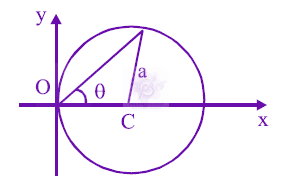
A spring of unstretched length 1 has a mass $m$ with one end fixed to a rigid support. Assuming spring to be made of a uniform wire, the kinetic energy possessed by it if its free end is pulled with uniform velocity $v$ is:
A bob of mass m attached to an inextensible string of length $l$ is suspended from a vertical support. The bob rotates in a horizontal circle with an angular speed $\omega$ rad/s about the vertical. About the point of suspension :
A bullet loses ${(\frac{1}{n})}^{\mathrm{th}}$ of its velocity passing through one plank. Considering uniform retardation, the number of such planks that are required to stop the bullet can be:
An air bubble of radius $0.1 \mathrm{~cm}$ is in a liquid having surface tension $0.06 \mathrm{~N} / \mathrm{m}$ and density $10^3 \mathrm{~kg} / \mathrm{m}^3$. The pressure inside the bubble is $1100 \mathrm{Nm}^{-2}$ greater than the atmospheric pressure. At what depth is the bubble below the surface of the liquid? $\left(\mathrm{g}=9.8 \mathrm{~ms}^{-2}\right)$
In materials like aluminium and copper, the correct order of magnitude of various elastic modulii is :
A bullet of mass $4 \mathrm{~g}$ is fired horizontally with a speed of $300 \mathrm{~m} / \mathrm{s}$ into $0.8 \mathrm{~kg}$ block of wood at rest on a table. If the coefficient of friction between the block and the table is $0.3$, how far will the block slide approximately?
An open glass tube is immersed in mercury in such a way that a length of $8\mathrm{cm}$ extends above the mercury level. The open end of the tube is then closed and sealed and the tube is raised vertically up by additional $46\mathrm{cm}$. What will be length of the air column above mercury in the tube now ? (Atmospheric pressure = $76\mathrm{cm}$ of Hg)
From a sphere of mass $M$ and radius $\mathrm{R}$, a smaller sphere of radius $\frac{\mathrm{R}}{2}$ is carved out such that the cavity made in the original sphere is between its centre and the periphery (See figure). For the configuration in the figure where the distance between the centre of the original sphere and the removed sphere is 3R, the gravitational force between the two sphere is: 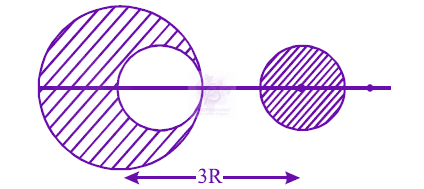
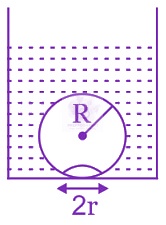
On heating water, bubbles being formed at the bottom of the vessel detatch and rise. Take the bubbles to be spheres of radius R and making a circular contact of radius r with the bottom of the vessel. If r << R, and the surface tension of water is T, value of r just before bubbles detatch is : (density of water is ${\rho }_{\text{w}}$)