τ=mg×lsinθ. (Direction parallel to plane of rotation of particle)
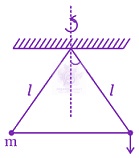
as τ is perpendicular to L, direction of L changes but magnitude remains same.
JEE Main 2014 — Physics Mechanics
A bob of mass m attached to an inextensible string of length l is suspended from a vertical support. The bob rotates in a horizontal circle with an angular speed ω rad/s about the vertical. About the point of suspension :
Held on 6 Apr 2014 · Verified 6 Jul 2026.
Angular momentum is conserved
Angular momentum changes in magnitude but not in direction
Angular momentum changes in direction but not in magnitude
Angular momentum changes both in direction and magnitude
Sign in to track your attempts and accuracy.
Sign in to keep a private note on this question. Nothing you write is ever public.
A small bob $A$ of mass $m$ is attached to a massless rigid rod of length 1 m pivoted at point $P$ and kept at an angle of $60^{\circ}$ with vertical as shown in figure. At distance of 1 m below point $P$, an identical bob $B$ is kept at rest on a smooth horizontal surface that extends to a circular track of radius $R$ as shown in figure. If bob $B$ just manages to complete the circular path of radius $R$ upto a point $Q$ after being hit elastically by $\operatorname{bob} A$, then radius $R$ is $\_\_\_\_$ m. 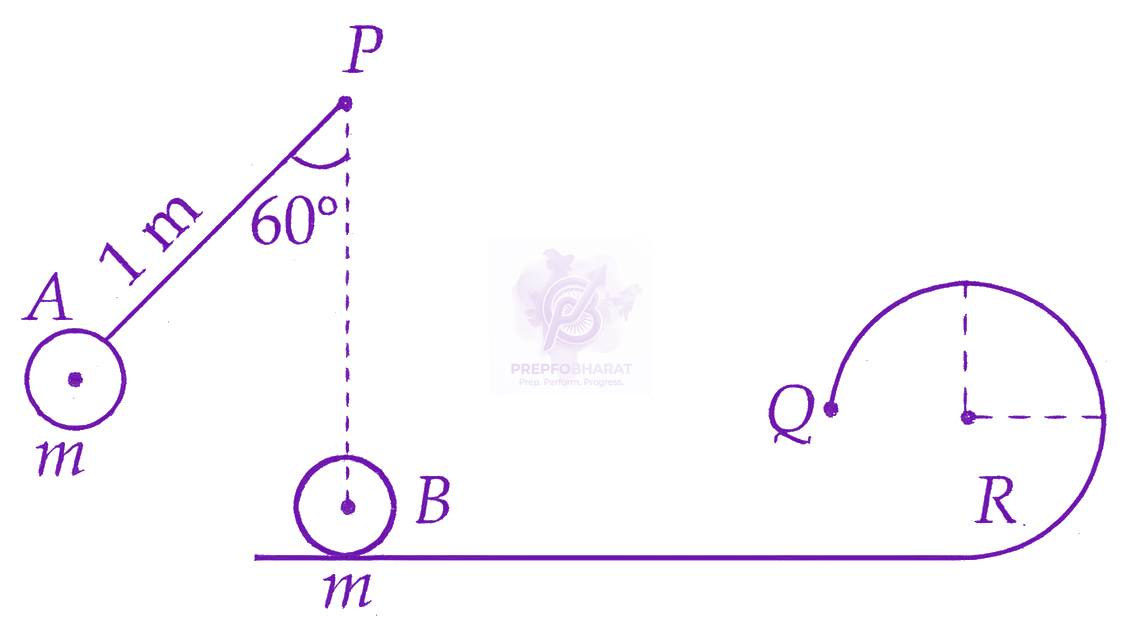
In a screw gauge the zero of main scale reference line coincides with the fifth division of the circular scale when two studs are in contact. There are $100$ divisions in circular scale and pitch of screw gauge is $0.1$ mm. When diameter of a sphere is measured, the reading of main scale is $5$ mm and $50^{\text{th}}$ division of circular scale coincides with the reference line of main scale. The diameter of sphere is _______ mm.
Two masses $m$ and 2 m are connected by a light string going over a pulley (disc) of mass 30 m with radius $r=0.1 \mathrm{~m}$. The pulley is mounted in a vertical plane and it is free to rotate about its axis. The 2 m mass is released from rest and its speed when it has descended through a height of 3.6 m is $\_\_\_\_$ $\mathrm{m} / \mathrm{s}$. (Assume string does not slip and $\mathrm{g}=10 \mathrm{~m} / \mathrm{s}^{2}$)
Water flows through a horizontal tube as shown in the figure. The difference in height between the water columns in vertical tubes is 5 cm and the area of cross-sections at $A$ and $B$ are $6 \mathrm{~cm}^{2}$ and $3 \mathrm{~cm}^{2}$ respectively. The rate of flow will be $\_\_\_\_$ $\mathrm{cm}^{3} / \mathrm{s}$. (take $g=10 \mathrm{~m} / \mathrm{s}^{2}$) 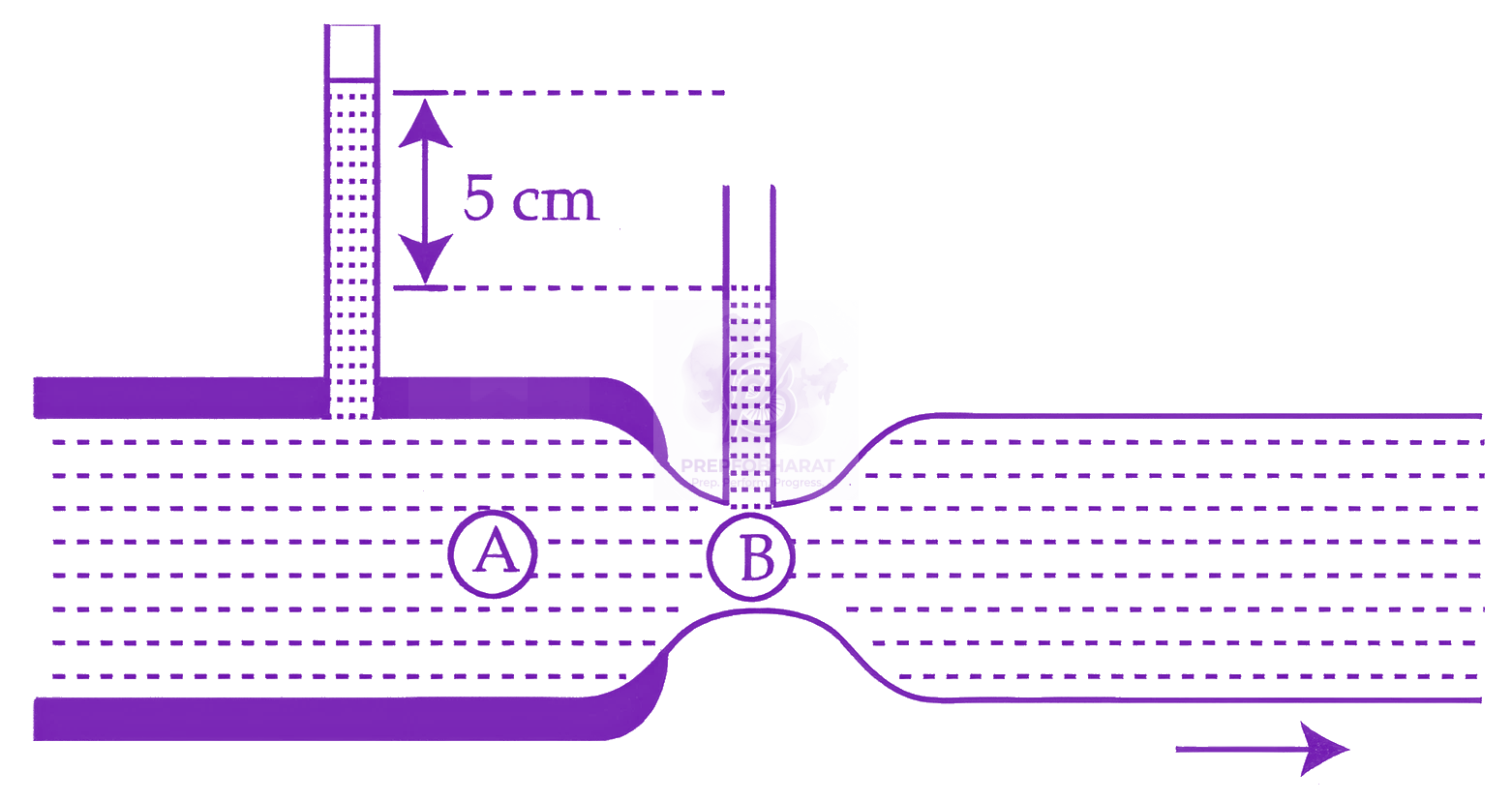
Two circular discs of radius each 10 cm are joined at their centres by a rod of length 30 cm and mass 600 gm as shown in figure. If the mass of each disc is 600 gm and applied torque between two discs is $43 \times 10^{5}$ dyne. cm, the angular acceleration of the discs about the given axis $A B$ is $\_\_\_\_$ $\mathrm{rad} / \mathrm{s}^{2}$. 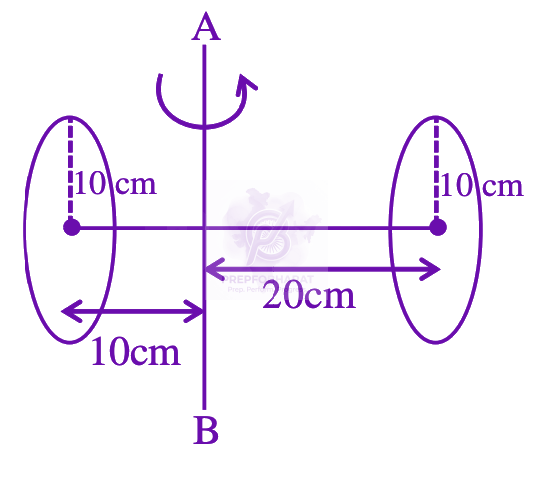
Work through every JEE Main Mechanics PYQ, year by year.