Optics PYQ
JEE Main Physics — Optics previous year questions with solutions.
Browse by Year
Optics at a glance
Questions per year
489 across 25 yearsDifficulty mix
489 total- easy161 · 33%
- medium241 · 49%
- hard87 · 18%
Subtopic-wise weightage
Breakdown of the 479 Optics questions tagged to a subtopic, by year — darker cells mean more questions.
| Subtopic | Weightage | Total | 2026 | 2025 | 2024 | 2023 | 2022 | 2021 | 2020 | 2019 | 2018 | 2017 | 2016 | 2015 | 2014 | 2013 | 2012 | 2011 | 2010 | 2009 | 2008 | 2007 | 2006 | 2005 | 2004 | 2003 | 2002 |
|---|---|---|---|---|---|---|---|---|---|---|---|---|---|---|---|---|---|---|---|---|---|---|---|---|---|---|---|
| Ray Optics & Instruments | 60.8% | 291 | 35 | 43 | 21 | 32 | 26 | 30 | 20 | 23 | 6 | 3 | 6 | 4 | 8 | 10 | 5 | 2 | 3 | 2 | 2 | 1 | 1 | 2 | 2 | 2 | 2 |
| Wave Optics | 39.2% | 188 | 23 | 19 | 22 | 18 | 15 | 16 | 14 | 12 | 6 | 3 | 3 | 5 | 6 | 8 | 7 | 1 | 1 | 1 | 4 | 2 | 1 | 1 | |||
| All subtopics | 479 | 58 | 62 | 43 | 50 | 41 | 46 | 34 | 35 | 12 | 6 | 9 | 9 | 14 | 18 | 12 | 3 | 3 | 3 | 2 | 2 | 1 | 6 | 4 | 3 | 3 |
All Optics Questions (489)
A parallel beam of light travelling in air (refractive index 1.0) is incident on a convex spherical glass surface of radius of curvature 50 cm. Refractive index of glass is 1.5. The rays converge to a point at a distance $x \mathrm{~cm}$ from the centre of the curvature of the spherical surface. The value of $x$ is $\_\_\_\_$ cm.
A thin biconvex lens is prepared from the glass ($\mu=1.5$) both curved surfaces of which have equal radii of $20$ cm each. Left side surface of the lens is silvered from outside to make it reflecting. To have the position of image and object at the same place, the object should be placed, from the lens at a distance of ________ cm.
A convex lens is made from glass material having refractive index of $1.4$ with same radius of curvature on both sides. The ratio of its focal length and radius of curvature is ______.
In single slit diffraction pattern, the wavelength of light used is $628$ nm and slit width is $0.2$ mm, the angular width of central maximum is $\alpha \times 10^{-2}$ degrees. The value of $\alpha$ is _______.
Refer the figure given below. $\mu_1$ and $\mu_2$ are refractive indices of air and lens material. The height of image will be _______ cm. 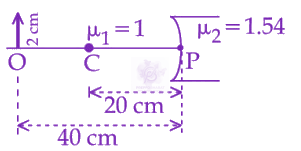
An unpolarized light of intensity $I_o$ passes through polarizer and then through a certain optically active solution and finally it goes to analyser. If the angle between analyser and polariser is $0°$ and intensity of light emerged from analyser is $\dfrac{3}{8}I_o$, the angle of rotation of the light by the solution with respect to analyser is _______ degrees.
As shown in the diagram, when the incident ray is parallel to base of the prism, the emergent ray grazes along the second surface. 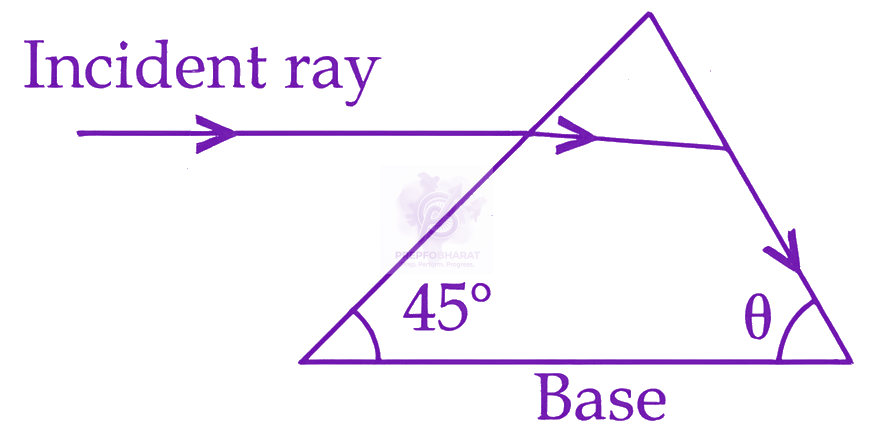 If refractive index of the material of prism is $\sqrt{2}$, the angle $\theta$ of prism is.
The exit surface of a prism with refractive index $n$ is coated with a material having refractive index $\frac{n}{2}$. When this prism is set for minimum angle of deviation, it exactly meets the condition of critical angle. The prism angle is $\_\_\_\_$.
The magnitudes of power of a biconvex lens (refractive index 1.5) and that of a plano-concave lens (refractive index $=1.7$) are same. If the curvature of planoconcave lens exactly matches with the curvature of back surface of the biconvex lens, then ratio of radius of curvature of front and back surface of the biconvex lens is $\_\_\_\_$.
In a microscope of tube length 10 cm two convex lenses are arranged with focal length of 2 cm and 5 cm. Total magnification obtained with this system for normal adjustment is $(5)^{k}$. The value of $k$ is $\_\_\_\_$.
In Young's double slit experiment, the fringe width of the interference pattern produced on the screen is $2.4$ $\mu$m. If the experiment is carried out in another medium having refractive index $1.2$, the fringe width will be _____ $\mu$m.
An unpolarized light of certain intensity passes through a combination of two polarizers whose transmission axes are at $30°$ and $90°$, respectively, with respect to the horizontal axis. A third polarizer with its transmission axis at $60°$ with the horizontal axis is placed between the two existing polarizers. The ratio of the output intensities with and without the third polarizer is ______.
Given below are two statements: Statement I: A plane wave after passing through prism remains as plane wave but passing through small pin hole may become spherical wave. Statement II: The curvature of a spherical wave emerging from a slit will increase for increasing slit width. In the light of the above statements, choose the correct answer from the options given below
A beam of light consisting of wavelengths 650 nm and 550 nm illuminates the Young's double slits with separation of 2 mm such that the interference fringes are formed on a screen, placed at a distance of 1.2 m from the slits. The least distance of a point from the central maximum, where the bright fringes due to both the wavelengths coincide, is $\_\_\_\_$ $\times 10^{-5} \mathrm{~m}$.
A ray of light passing through an equilateral prism is having velocity $2.12 \times 10^8$ m/s in the prism material, then the minimum angle of deviation is _________ degrees.
If sunlight is focused on a paper using convex lens, it starts burning the paper in shortest time when the lens is kept at $30$ cm above the paper. If the radius of curvature of the lens is $60$ cm then the refractive index of the lens material is $\dfrac{\alpha}{10}$. The value of $\alpha$ is _______.
A prism of angle $75^{\circ}$ and refractive index $\sqrt{3}$ is coated with thin film of refractive index 1.5 only at the back exit surface. To have total internal reflection at the back exit surface the incident angle must be $\_\_\_\_$ ($\sin 15^{\circ}=0.25$ and $\sin 25^{\circ}=0.43$)
In a Young's double slit experiment set up, the two slits are kept 0.4 mm apart and screen is placed at 1 m from slits. If a thin transparent sheet of thickness $20 \mu \mathrm{~m}$ is introduced in front of one of the slits then center bright fringe shifts by 20 mm on the screen. The refractive index of transparent sheet is given by $\frac{\alpha}{10}$, where $\alpha$ is $\_\_\_\_$.
A biconvex lens is formed by using two thin planoconvex lenses, as shown in the figure. The refractive index and radius of curved surfaces are also mentioned in figure. When an object is placed on the left side of lens at a distance of 30 cm from the biconvex lens, the magnification of the image will be : 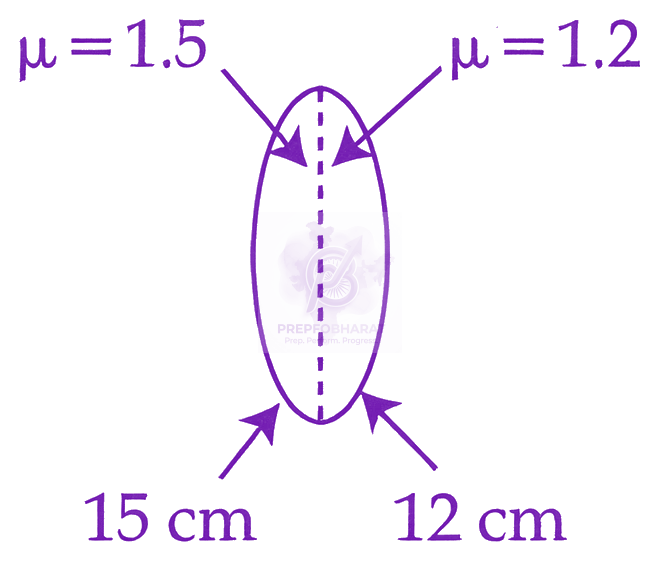
The maximum intensity in a Young's double slit experiment is $I_0$. Distance between the slits ($d$) is $5\lambda$, where $\lambda$ is the wavelength of light used. The intensity of the fringe, exactly opposite to one of the slits on the screen, placed at $D = 10d$ is _______.
When an unpolarized light falls at a particular angle on a glass plate (placed in air), it is observed that the reflected beam is linearly polarized. The angle of refracted beam with respect to the normal is $\_\_\_\_$. $\left(\tan ^{-1}(1.52)=57.7^{\circ}\right.$, refractive indices of air and glass are 1.00 and 1.52, respectively.)
In a Young's double slit experiment, the intensity at some point on the screen is found to be $\dfrac{3}{4}$ times of the maximum of the interference pattern. The path difference between the interfering waves at this point is $\dfrac{\lambda}{x}$ where $\lambda$ is wavelength of the incident light. The value of $x$ is _______.
Distance between an object and three times magnified real image is 40 cm. The focal length of the mirror used is $\_\_\_\_$ cm.
Some distant star is to be observed by some telescope of diameter of objective lens $a$, at an angular resolution of $3.0\times 10^{-7}$ radian. If the wavelength of light from the star reaching the telescope is $500$ nm, the minimum diameter of the objective lens of the telescope is ________ cm. (nearest integer)