JEE Main 2025 — Optics
Physics Optics questions from JEE Main 2025.
Other Years
62 Optics Questions from 2025
Two polarisers $P_1$ and $P_2$ are placed in such a way that the intensity of the transmitted light will be zero. A third polariser $P_3$ is inserted in between $P_1$ and $\mathrm{P}_2$, at the particular angle between $\mathrm{P}_2$ and $\mathrm{P}_3$. The transmitted intensity of the light passing the through all three polarisers is maximum. The angle between the polarisers $\mathrm{P}_2$ and $\mathrm{P}_3$ is :
A monochromatic light of frequency $5 \times 10^{14} \mathrm{~Hz}$ travelling through air, is incident on a medium of refractive index ' 2 '. Wavelength of the refracted light will be :
A photograph of a landscape is captured by a drone camera at a height of 18 km . The size of the camera film is $2 \mathrm{~cm} \times 2 \mathrm{~cm}$ and the area of the landscape photographed is $400 \mathrm{~km}^2$. The focal length of the lens in the drone camera is :
In the diagram given below, there are three lenses formed. Considering negligible thickness of each of them as compared to $\left|R_1\right|$ and $\left|R_2\right|$, i.e., the radii of curvature for upper and lower surfaces of the glass lens, the power of the combination is 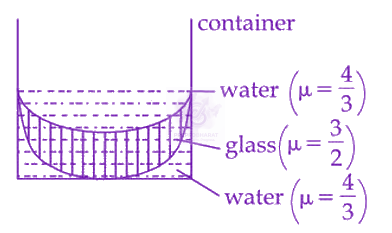
In a long glass tube, mixture of two liquids A and B with refractive indices 1.3 and 1.4 respectively, forms a convex refractive meniscus towards $A$. If an object placed at 13 cm from the vertex of the meniscus in A forms an image with a magnification of ' $-2^{\prime}$ then the radius of curvature of meniscus is :
The refractive index of the material of a glass prism is $\sqrt{3}$. The angle of minimum deviation is equal to the angle of the prism. What is the angle of the prism?
Given is a thin convex lens of glass (refractive index $\mu$ ) and each side having radius of curvature $R$. One side is polished for complete reflection. At what distance from the lens, an object be placed on the optic axis so that the image gets formed on the object itself ?
Two coherent monochromatic light beams of intensities 4I and 9I are superimposed. The difference between the maximum and minimum intensities in the resulting interference pattern is xI. The value of $x$ is ______.
If the measured angular separation between the second minimum to the left of the central maximum and the third minimum to the right of the central maximum is $30^{\circ}$ in a single slit diffraction pattern recorded using 628 nm light, then the width of the slit is _______ $\mu \mathrm{m}$.
The ratio of the power of a light source $S_1$ to that the light source $S_2$ is $2 . S_1$ is emitting $2 \times 10^{15}$ photons per second at 600 nm . If the wavelength of the source $S_2$ is 300 nm , then the number of photons per second emitted by $S_2$ is $\ldots\ldots$ $\times 10^{14}$.
A double slit interference experiment performed with a light of wavelength 600 nm forms an interference fringe pattern on a screen with 10 th bright fringe having its centre at a distance of 10 mm from the central maximum. Distance of the centre of the same 10th bright fringe from the central maximum when the source of light is replaced by another source of wavelength 660 nm would be _________ mm .
A thin plano convex lens made of glass of refractive index 1.5 is immersed in a liquid of refractive index 1.2. When the plane side of the lens is silver coated for complete reflection, the lens immersed in the liquid behaves like a concave mirror of focal length 0.2 m . The radius of curvature of the curved surface of the lens is
Distance between object and its image $\left( \text{magnified by } -\frac{1}{3}\right)$ is 30 cm. The focal length of the mirror used is $\left(\frac{x}{4}\right) \mathrm{cm}$, where magnitude of value of $x$ is _________.
A ray of light suffers minimum deviation when incident on a prism having angle of the prism equal to $60^{\circ}$. The refractive index of the prism material is $\sqrt{2}$. The angle of incidence (in degrees) is ______.
A convex lens of focal length 30 cm is placed in contact with a concave lens of focal length 20 cm. An object is placed at 20 cm to the left of this lens system. The distance of the image from the lens in cm is ________
Which of the following phenomena can not be explained by wave theory of light?
Width of one of the two slits in a Young's double slit interference experiment is half of the other slit. The ratio of the maximum to the minimum intensity in the interference pattern is :
A finite size object is placed normal to the principal axis at a distance of 30 cm from a convex mirror of focal length 30 cm. A plane mirror is now placed in such a way that the image produced by both the mirrors coincide with each other. The distance between the two mirrors is :
What is the lateral shift of a ray refracted through a parallel-sided glass slab of thickness ' $h$ ' in terms of the angle of incidence ' $i$ ' and angle of refraction ' $r$ ', if the glass slab is placed in air medium?
In a Young's double slit experiment, the slits are separated by 0.2 mm. If the slits separation is increased to 0.4 mm , the percentage change of the fringe width is:
Two identical symmetric double convex lenses of focal length $f$ are cut into two equal parts $L_1, L_2$ by $A B$ plane and $L_3, L_4$ by $X Y$ plane as shown in figure respectively. The ratio of focal lengths of lenses $L_1$ and $L_3$ is 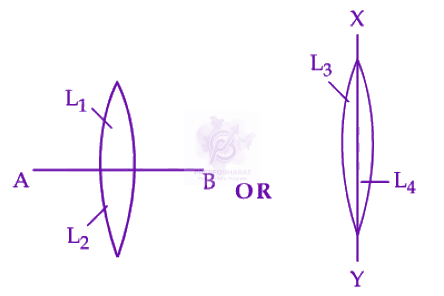
A spherical surface of radius of curvature $R$, separates air from glass (refractive index $=1.5$ ). The centre of curvature is in the glass medium. A point object ' $O$ ' placed in air on the optic axis of the surface, so that its real image is formed at ' $I$ ' inside glass. The line OI intersects the spherical surface at P and $\mathrm{PO}=\mathrm{PI}$. The distance PO equals to
Young's double slit inteference apparatus is immersed in a liquid of refractive index 1.44. It has slit separation of 1.5 mm . The slits are illuminated by a parallel beam of light whose wavelength in air is 690 nm . The fringe-width on a screen placed behind the plane of slits at a distance of 0.72 m , will be :
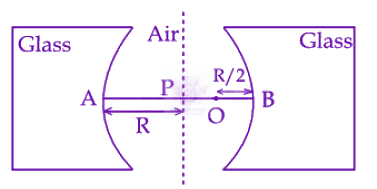 Two concave refracting surfaces of equal radii of curvature and refractive index 1.5 face each other in air as shown in figure. A point object O is placed midway, between P and B . The separation between the images of $O$, formed by each refracting surface is :
In a Young's double slit experiment, the source is white light. One of the slits is covered by red filter and another by a green filter. In this case
Light from a point source in air falls on a spherical glass surface (refractive index, $\mu=1.5$ and radius of curvature $=50 \mathrm{~cm}$). The image is formed at a distance of 200 cm from the glass surface inside the glass. The magnitude of distance of the light source from the glass surface is ____ m.
A transparent block A having refractive index $\mu=1.25$ is surrounded by another medium of refractive index $\mu=1.0$ as shown in figure. A light ray is incident on the flat face of the block with incident angle $\theta$ as shown in figure. What is the maximum value of $\theta$ for which light suffers total internal reflection at the top surface of the block? 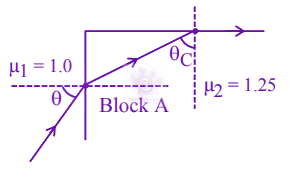
A bi-convex lens has radius of curvature of both the surfaces same as $1 / 6 \mathrm{~cm}$. If this lens is required to be replaced by another convex lens having different radii of curvatures on both sides $\left(R_1 \neq R_2\right)$, without any change in lens power then possible combination of $R_1$ and $R_2$ is :
In a Young's double slit experiment, two slits are located 1.5 mm apart. The distance of screen from slits is 2 m and the wavelength of the source is 400 nm. If the 20 maxima of the double slit pattern are contained within the centre maximum of the single slit diffraction pattern, then the width of each slit is $\mathrm{x} \times 10^{-3} \mathrm{~cm}$, where x -value is ________
A container contains a liquid with refractive index of 1.2 up to a height of 60 cm and another liquid having refractive index 1.6 is added to height H above first liquid. If viewed from above, the apparent shift in the position of bottom of container is 40 cm. The value of H is ______ cm. (Consider liquids are immisible)
A concave mirror of focal length $f$ in air is dipped in a liquid of refractive index $\mu$. Its focal length in the liquid will be:
A concave-convex lens of refractive index 1.5 and the radii of curvature of its surfaces are 30 cm and 20 cm , respectively. The concave surface is upwards and is filled with a liquid of refractive index 1.3. The focal length of the liquid-glass combination will be
Given below are two statements : one is labelled as Assertion (A) and the other is labelled as Reason (R). Assertion-(A) : If Young's double slit experiment is performed in an optically denser medium than air, then the consecutive fringes come closer. Reason-(R) : The speed of light reduces in an optically denser medium than air while its frequency does not change. In the light of the above statements, choose the most appropriate answer from the options given below :
Two thin convex lenses of focal length 30 cm and 10 cm are placed coaxially, 10 cm apart. The power of this combination is :
A mirror is used to produce an image with magnification of $\frac{1}{4}$. If the distance between object and its image is 40 cm , then the focal length of the mirror is ________
The width of one of the two slits in Young's double slit experiment is d while that of the other slit is $x \mathrm{~d}$. If the ratio of the maximum to the minimum intensity in the interference pattern on the screen is $9: 4$ then what is the value of $x$ ? (Assume that the field strength varies according to the slit width.)
A concave mirror produces an image of an object such that the distance between the object and image is 20 cm . If the magnification of the image is ' -3 ', then the magnitude of the radius of curvature of the mirror is :
Given below are two statements. One is labelled as Assertion (A) and the other is labelled as Reason (R). Assertion (A) : In Young's double slit experiment, the fringes produced by red light are closer as compared to those produced by blue light. Reason (R): The fringe width is directly proportional to the wavelength of light. In the light of the above statements, choose the correct answer from the options given below :
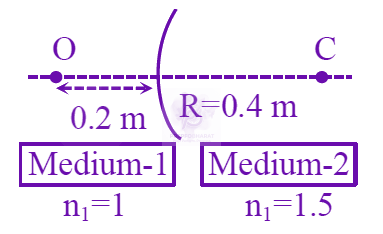 A spherical surface separates two media of refractive indices 1 and 1.5 as shown in figure. Distance of the image of an object ' O ', is : ( C is the center of curvature of the spherical surface and $R$ is the radius of curvature)
Let u and \(v\) be the distances of the object and the image from a lens of focal length \(f\). The correct graphical representation of \(\mathbf{u}\) and \(v\) for a convex lens when \(|\mathbf{u}|\gt f\), is
What is the relative decrease in focal length of a lens for an increase in optical power by 0.1 D from 2.5D ? ['D' stands for dioptre]
A symmetric thin biconvex lens is cut into four equal parts by two planes $A B$ and $C D$ as shown in figure. If the power of original lens is 4 D then the power of a part of the divided lens is 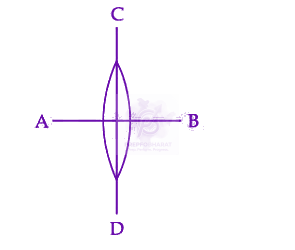
The driver sitting inside a parked car is watching vehicles approaching from behind with the help of his side view mirror, which is a convex mirror with radius of curvature $\mathrm{R}=2 \mathrm{~m}$. Another car approaches him from behind with a uniform speed of $90 \mathrm{~km} / \mathrm{hr}$. When the car is at a distance of 24 m from him, the magnitude of the acceleration of the image of the car in the side view mirror is ' a '. The value of 100 a is _______ $\mathrm{m} / \mathrm{s}^2$.
At the interface between two materials having refractive indices \(n_1\) and \(n_2\), the critical angle for reflection of an em wave is \(\theta_{1 C}\). The \(n_2\) material is replaced by another material having refractive index \(n_3\) such that the critical angle at the interface between \(n_1\) and \(n_3\) materials is \(\theta_{2 \mathrm{C}}\). If \(\mathrm{n}_3\gt\mathrm{n}_2\gt\mathrm{n}_1 ; \frac{\mathrm{n}_2}{\mathrm{n}_3}=\frac{2}{5}\) and \(\sin \theta_{2 \mathrm{C}}-\sin \theta_{1 \mathrm{C}}=\frac{1}{2}\), then \(\theta_{1 \mathrm{C}}\) is
When an object is placed 40 cm away from a spherical mirror an image of magnification $\frac{1}{2}$ is produced. To obtain an image with magnification of $\frac{1}{3}$, the object is to be moved :
Two monochromatic light beams have intensities in the ratio 1:9. An interference pattern is obtained by these beams. The ratio of the intensities of maximum to minimum is
The radii of curvature for a thin convex lens are 10 cm and 15 cm respectively. The focal length of the lens is 12 cm. The refractive index of the lens material is
A plano-convex lens having radius of curvature of first surface 2 cm exhibits focal length of $f_1$ in air. Another plano-convex lens with first surface radius of curvature 3 cm has focal length of $\mathrm{f}_2$ when it is immersed in a liquid of refractive index 1.2 . If both the lenses are made of same glass of refractive index 1.5 , the ratio of $f_1$ and $f_2$ will be
A slanted object $A B$ is placed on one side of convex lens as shown in the diagram. The image is formed on the opposite side. Angle made by the image with principal axis is: 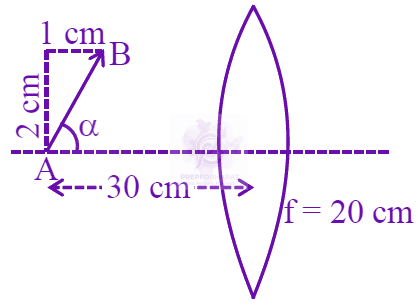
A convex lens made of glass (refractive index $=1.5$ ) has focal length 24 cm in air. When it is totally immersed in water (refractive index $=1.33$ ), its focal length changes to
The Young's double slit interference experiment is performed using light consisting of 480 nm and 600 nm wavelengths to form interference patterns. The least number of the bright fringes of 480 nm light that are required for the first coincidence with the bright fringes formed by 600 nm light is
In a Young's double slit experiment, three polarizers are kept as shown in the figure. The transmission axes of $P_1$ and $P_2$ are orthogonal to each other. The polarizer $P_3$ covers both the slits with its transmission axis at $45^{\circ}$ to those of $P_1$ and $P_2$. An unpolarized light of wavelength $\lambda$ and intensity $I_0$ is incident on $P_1$ and $P_2$. The intensity at a point after $P_3$ where the path difference between the light waves from $s_1$ and $s_2$ is $\frac{\lambda}{3}$, is 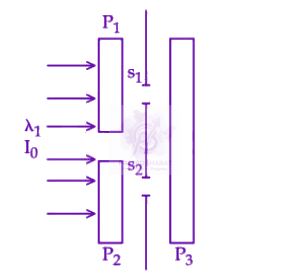
Two light beams fall on a transparent material block at point 1 and 2 with angle \(\theta_1\) and \(\theta_{2^{\prime}}\) respectively, as shown in figure. After refraction, the beams intersect at point 3 which is exactly on the interface at other end of the block. Given : the distance between 1 and 2, \(\mathrm{d}=4 \sqrt{3} \mathrm{~cm}\) and \(\theta_1=\theta_2=\cos ^{-1}\left(\frac{\mathrm{n}_2}{2 \mathrm{n}_1}\right)\), where refractive index of the block \(\mathrm{n}_2\gt\) refractive index of the outside medium \(\mathrm{n}_1\), then the thickness of the block is ________ cm. 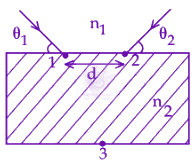
Given below are two statements : one is labelled as Assertion (A) and the other is labelled as Reason (R) Assertion (A) : Refractive index of glass is higher than that of air. Reason ( $\mathrm{R}$) : Optical density of a medium is directly proportionate to its mass density which results in a proportionate refractive index. In the light of the above statements, choose the most appropriate answer from the options given below :
A transparent film of refractive index, 2.0 is coated on a glass slab of refractive index, 1.45. What is the minimum thickness of transparent film to be coated for the maximum transmission of Green light of wavelength 550 nm . [Assume that the light is incident nearly perpendicular to the glass surface.]
Consider following statements for refraction of light through prism, when angle of deviation is minimum. (A) The refracted ray inside prism becomes parallel to the base. (B) Larger angle prisms provide smaller angle of minimum deviation. (C) Angle of incidence and angle of emergence becomes equal. (D) There are always two sets of angle of incidence for which deviation will be same except at minimum deviation setting. (E) Angle of refraction becomes double of prism angle. Choose the correct answer from the options given below.
A hemispherical vessel is completely filled with a liquid of refractive index $\mu$. A small coin is kept at the lowest point $(\mathrm{O})$ of the vessel as shown in figure. The minimum value of the refractive index of the liquid so that a person can see the coin from point E (at the level of the vessel) is 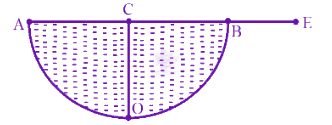
A thin prism $\mathrm{P}_1$ with angle $4^{\circ}$ made of glass having refractive index 1.54 , is combined with another thin prism $\mathrm{P}_2$ made of glass having refractive index 1.72 to get dispersion without deviation. The angle of the prism $P_2$ in degrees is
A light wave is propagating with plane wave fronts of the type $x+y+z=$ constant. The angle made by the direction of wave propagation with the $x$-axis is:
A lens having refractive index 1.6 has focal length of 12 cm , when it is in air. Find the focal length of the lens when it is placed in water. (Take refractive index of water as 1.28)
Two identical objects are placed in front of convex mirror and concave mirror having same radii of curvature of 12 cm , at same distance of 18 cm from the respective mirrors. The ratio of sizes of the images formed by convex mirror and by concave mirror is :
Given a thin convex lens (refractive index $\mu_2$ ), kept in a liquid (refractive index $\mu_1, \mu_1 \lt \mu_2$ ) having radii of curvatures $\left|R_1\right|$ and $\left|R_2\right|$. Its second surface is silver polished. Where should an object be placed on the optic axis so that a real and inverted image is formed at the same place?