ΔW=d⋅μλD=1.5×10−3×1.44690×10−9×0.72⇒ΔW=2.3×10⁻⁴ m=0.23 mm
Young's double slit inteference apparatus is immersed in a liquid of refractive index 1.44. It has slit separation of 1.5 mm . The slits are…
JEE Main 2025 — Physics Optics
2025mcqmedium
Young's double slit inteference apparatus is immersed in a liquid of refractive index 1.44. It has slit separation of 1.5 mm . The slits are illuminated by a parallel beam of light whose wavelength in air is 690 nm . The fringe-width on a screen placed behind the plane of slits at a distance of 0.72 m , will be :
Official previous-year question
Held on 24 Jan 2025 · Verified 6 Jul 2026.
Options
- A
0.23 mm
- B
0.33 mm
- C
0.63 mm
- D
0.46 mm
Did you get this right?
Sign in to track your attempts and accuracy.
Your note
Sign in to keep a private note on this question. Nothing you write is ever public.
JEE Main Optics in other years
More JEE Main Optics questions
A parallel beam of light travelling in air (refractive index 1.0) is incident on a convex spherical glass surface of radius of curvature 50 cm. Refractive index of glass is 1.5. The rays converge to a point at a distance $x \mathrm{~cm}$ from the centre of the curvature of the spherical surface. The value of $x$ is $\_\_\_\_$ cm.
2026medium
A thin biconvex lens is prepared from the glass ($\mu=1.5$) both curved surfaces of which have equal radii of $20$ cm each. Left side surface of the lens is silvered from outside to make it reflecting. To have the position of image and object at the same place, the object should be placed, from the lens at a distance of ________ cm.
2026medium
A concave mirror of focal length $10$ cm forms an image which is double the size of object when the object is placed at two different positions. The distance between the two positions of the object is __________ cm.
2026medium
Consider light travelling from a medium $A$ to medium $B$ separated by a plane interface. If the light undergoes total internal reflection during its travel from medium $A$ to $B$ and the speed of light in media $A$ and $B$ are $2.4 \times 10^{8} \mathrm{~m} / \mathrm{s}$ and $2.7 \times 10^{8} \mathrm{~m} / \mathrm{s}$, respectively, then the value of critical angle is :
2026medium
In a Young double slit experiment, the wavelength of incident light is $6000$ Å, the separation between slits $S_1$ and $S_2$ is $5$ cm and the distance between slits plane and screen is $50$ cm, as shown in the figure below. If the resultant intensity at $P$ is equal to the intensity due to individual slits, the path difference between interfering waves is __________ Å. 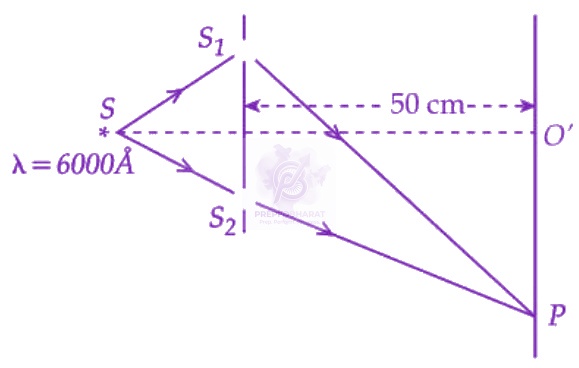
2026medium
Other Physics topics for JEE Main
Keep practicing Optics
Work through every JEE Main Optics PYQ, year by year.