JEE Main 2015 — Optics
Physics Optics questions from JEE Main 2015.
Other Years
9 Optics Questions from 2015
In a Young's double slit experiment with light of wavelength $\lambda ,$ the separation of slits is $d$ and distance of screen is $D$ such that $D\gg d\gg \lambda$ . If the Fringe width is $\beta$ , the distance from point of maximum intensity to the point where intensity falls to half of the maximum intensity on either side is:
Assuming that the human pupil has a radius of $0.25 \mathrm{cm}$ and a comfortable viewing distance of $25\mathrm{cm}$. The minimum separation between two point objects that the human eye can resolve for the light of wavelength $500\mathrm{nm}$ is
You are asked to design a shaving mirror assuming that a person keeps it at $10\mathrm{cm}$ from his face and views the magnified image of the face at the closest comfortable distance of $25\mathrm{cm}$. The radius of curvature of the mirror would then be:
Monochromatic light is incident on a glass prism of angle A. If the refractive index of the material of the prism is $\mu$ , a ray, incident at an angle $\theta$ , on the face AB would get transmitted through the face AC of the prism provided: 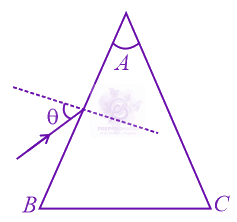
A telescope has an objective lens of focal length $150\mathrm{cm}$ and an eyepiece of focal length $5\mathrm{cm}$. If a $50m$ tall tower at a distance of $1\mathrm{km}$ is observed through this telescope in a normal setting, the angle formed by the image of the tower is $\theta$, then $\theta$ is close to
A thin convex lens of focal length $f$ is put on a plane mirror as shown in the figure. When an object is kept at a distance $a$ from the lens-mirror combination, its image is formed at a distance $\frac{a}{3}$ in front of the combination. The value of $a$ is: 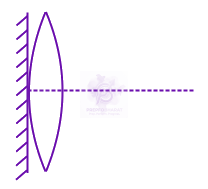
Unpolarized light of intensity ${I}_{0}$ is incident on surface of a block of glass at Brewster's angle. In that case, which one of the following statements is true?
On a hot summer night, the refractive index of air is the smallest near the ground and increases with a height from the ground. When a light beam is directed horizontally, the Huygens' principle leads us to conclude that as it travels, the light beam,
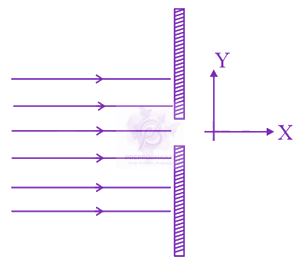
A parallel beam of electrons travelling in x - direction falls on a slit of width d (see figure). If after passing the slit, an electron acquires momentum ${p}_{y}$ in the y - direction then for a majority of electrons passing through the slit (h is Planck's constant):