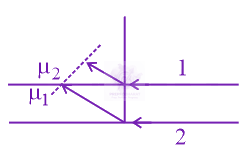
Every point on the horizontal ray of light behaves as a source of light. Thus, the secondary rays which are directed towards denser medium would bend towards the normal. These phenomena cause the bending of the rays upwards.
JEE Main 2015 — Physics Optics
On a hot summer night, the refractive index of air is the smallest near the ground and increases with a height from the ground. When a light beam is directed horizontally, the Huygens' principle leads us to conclude that as it travels, the light beam,
Held on 4 Apr 2015 · Verified 6 Jul 2026.
bends upward.
becomes narrower.
goes horizontally without any deflection.
bends downward.
Sign in to track your attempts and accuracy.
Sign in to keep a private note on this question. Nothing you write is ever public.
In a microscope of tube length 10 cm two convex lenses are arranged with focal length of 2 cm and 5 cm. Total magnification obtained with this system for normal adjustment is $(5)^{k}$. The value of $k$ is $\_\_\_\_$.
In Young's double slit experiment, the fringe width of the interference pattern produced on the screen is $2.4$ $\mu$m. If the experiment is carried out in another medium having refractive index $1.2$, the fringe width will be _____ $\mu$m.
The magnitudes of power of a biconvex lens (refractive index 1.5) and that of a plano-concave lens (refractive index $=1.7$) are same. If the curvature of planoconcave lens exactly matches with the curvature of back surface of the biconvex lens, then ratio of radius of curvature of front and back surface of the biconvex lens is $\_\_\_\_$.
The exit surface of a prism with refractive index $n$ is coated with a material having refractive index $\frac{n}{2}$. When this prism is set for minimum angle of deviation, it exactly meets the condition of critical angle. The prism angle is $\_\_\_\_$.
An unpolarized light of certain intensity passes through a combination of two polarizers whose transmission axes are at $30°$ and $90°$, respectively, with respect to the horizontal axis. A third polarizer with its transmission axis at $60°$ with the horizontal axis is placed between the two existing polarizers. The ratio of the output intensities with and without the third polarizer is ______.
Work through every JEE Main Optics PYQ, year by year.