JEE Main 2018 — Optics
Physics Optics questions from JEE Main 2018.
Other Years
12 Optics Questions from 2018
A plano-convex lens becomes an optical system of $28\mathrm{cm}$ focal length when its plane surface is silvered and illuminated from left to right as shown in fig$-A$ If the same lens is instead silvered on the curved surface and illuminated from another side as in fig-$B$, it acts as an optical system of focal length $10\mathrm{cm}$. The refractive index of the material of the lens is: 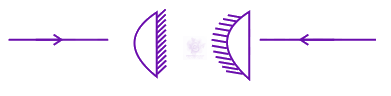
A particle is oscillating on the $\mathrm{X}$-axis with an amplitude $2 \mathrm{~cm}$ about the point $x_0=10 \mathrm{~cm}$ with a frequency $\omega$. A concave mirror of focal length 5 $\mathrm{cm}$ is placed at the origin (see figure) Identify the correct statements: (A) The image executes periodic motion (B) The image executes non-periodic motion (C) The turning points of the image are asymmetric w.r.t the image of the point at $x$ $=10 \mathrm{~cm}$ (D) The distance between the turning points of the oscillation of the image is $\frac{100}{21}$ 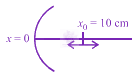
A particle is oscillating on the $x$-axis with an amplitude $2\mathrm{cm}$ about the point ${x}_{0}=10 \mathrm{cm}$ with a frequency. A concave mirror of focal length $5\mathrm{cm}$ is placed at the origin (see figure). 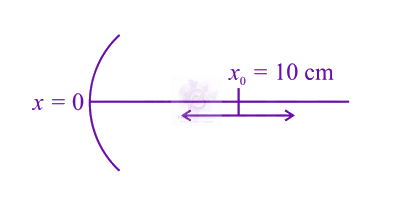 Identify the correct statements? (i) The image executes periodic motion. (ii) The image executes non-periodic motion. (iii) The turning points of the image are asymmetric with respect to the image of the point at $X=10 \mathrm{cm}$. (iv) The distance between the turning points of the oscillation of the image is $\frac{100}{21} \mathrm{cm}$.
Light of wavelength $550 \mathrm{~nm}$ falls normally on a slit of width $22.0 \times 10^{-5} \mathrm{~cm}$. The angular position of the second minima from the central maximum will be (in radians)
A ray of light is incident at an angle of ${ 60}^{\circ }$ on one face of a prism of angle ${ 30}^{\circ }$. The emergent ray of light makes an angle of ${ 30}^{\circ }$ with incident ray. The angle made by the emergent ray with second face of prism will be:
Light of wavelength $550\mathrm{nm}$ falls normally on a slit of width $22.0\times {10}^{-5}\mathrm{cm}$. The angular position of the second minima from the central maximum will be (in radians):
A planoconvex lens becomes an optical system of $28 \mathrm{~cm}$ focal length when its plane surface is silvered and illuminated from left to right as shown in Fig-A. If the same lens is instead silvered on the curved surface and illuminated from other side as in Fig. B, it acts like an optical system of focal length $10 \mathrm{~cm}$. The refractive index of the material of lens is 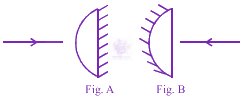
Unpolarized light of intensity $I$ is incident on a system of two polarizers, $A$ followed by $B$. The intensity of emergent light is $\frac{I}{2}$ . If a third the polarizer $C$ is placed between $A$ and $B$ the intensity of emergent light is reduced to $\frac{I}{3}$ . The angle between the polarizers $A$ and $C$ is $\theta$ , then
The angular width of the central maximum in a single slit diffraction pattern is $60^{\circ}$ . The width of the slit is $1\mu m$. The slit is illuminated by monochromatic plane waves. If another slit of the same width is made near it, Young's fringes can be observed on a screen placed at a distance $50 \mathrm{cm}$ from the slits. If the observed fringe width is $1 \mathrm{cm}$, what is slit separation distance? (i.e., the distance between the centres of each slit.)
A plane polarized light is incident on a polariser with its pass axis making angle $\theta$ with $\mathrm{x}$-axis, as shown in the figure. At four different values of $\theta, \theta=8^{\circ}, 38^{\circ}, 188^{\circ}$ and $218^{\circ}$, the observed intensities are same. What is the angle between the direction of polarization and $\mathrm{x}$-axis 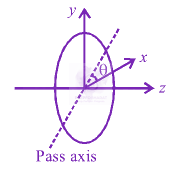
A convergent doublet of separated lenses, corrected for spherical aberration, has resultant focal length of $10 \mathrm{~cm}$. The separation between the two lenses is $2 \mathrm{~cm}$. The focal lengths of the component lenses
Unpolarized light of intensity $I$ passes through an ideal polariser $A$. Another identical polariser $B$ is placed behind $A$. The intensity of light beyond B is found to be $\frac{I}{2}$. Now another identical polariser $C$ is placed between $A$ and $B$. The intensity beyond B is now found to be $\frac{I}{8}$ . The angle between polariser $A$ and $C$ is