JEE Main 2024 — Optics
Physics Optics questions from JEE Main 2024.
Other Years
45 Optics Questions from 2024
The thin lens formula is:
The critical angle for total internal reflection from a medium to air is 30°...
A convex lens of focal length $40\mathrm{cm}$ forms an image of an extended source of light on a photoelectric cell. A current $I$ is produced. The lens is replaced by another convex lens having the same diameter but focal length $20\mathrm{cm}$. The photoelectric current now is
An effective power of a combination of 5 identical convex lenses which are kept in contact along the principal axis is $25 \mathrm{D}$. Focal length of each of the convex lens is :
In Young's double slit experiment, light from two identical sources are superimposing on a screen. The path difference between the two lights reaching at a point on the screen is $\frac{7\lambda }{4}$. The ratio of intensity of fringe at this point with respect to the maximum intensity of the fringe is:
Given below are two statements : Statement I : When the white light passed through a prism, the red light bends lesser than yellow and violet. Statement II : The refractive indices are different for different wavelengths in dispersive medium. In the light of the above statements, chose the correct answer from the options given below:
For the thin convex lens, the radii of curvature are at $15 \mathrm{~cm}$ and $30 \mathrm{~cm}$ respectively. The focal length the lens is $20 \mathrm{~cm}$. The refractive index of the material is :
The distance between object and its two times magnified real image as produced by a convex lens is $45\mathrm{cm}$. The focal length of the lens used is ________$\mathrm{cm}$.
The refractive index of a prism with apex angle $A$ is $cot\frac{A}{2}$. The angle of minimum deviation is :
The refractive index of prism is $\mu=\sqrt{3}$ and the ratio of the angle of minimum deviation to the angle of prism is one. The value of angle of prism is _______.
In Young's double slit experiment, carried out with light of wavelength $5000 \AA$, the distance between the slits is $0.3 \mathrm{~mm}$ and the screen is at $200 \mathrm{~cm}$ from the slits. The central maximum is at $x=0 \mathrm{~cm}$. The value of $x$ for third maxima is _____$\mathrm{mm}$.
Monochromatic light of wavelength $500 \mathrm{~nm}$ is used in Young's double slit experiment. An interference pattern is obtained on a screen. When one of the slits is covered with a very thin glass plate (refractive index $=1.5$ ), the central maximum is shifted to a position previously occupied by the $4^{\text {th }}$ bright fringe. The thickness of the glass-plate is ______ $\mu \mathrm{m}$.
The width of one of the two slits in a Young's double slit experiment is 4 times that of the other slit. The ratio of the maximum of the minimum intensity in the interference pattern is:
Two coherent monochromatic light beams of intensities I and $4 \mathrm{I}$ are superimposed. The difference between maximum and minimum possible intensities in the resulting beam is $x \mathrm{I}$. The value of $x$ is $_________.
Two waves of intensity ratio $1:9$ cross each other at a point. The resultant intensities at the point, when (a) Waves are incoherent is ${I}_{1}(b)$ Waves are coherent is ${I}_{2}$ and differ in phase by ${60}^{o}$. If $\frac{{I}_{1}}{{I}_{2}}=\frac{10}{x}$, then $x=$ _________.
In an experiment to measure the focal length $(f)$ of a convex lens, the magnitude of object distance$(x)$ and the image distance$(y)$ are measured with reference to the focal point of the lens. The $y-x$ plot is shown in figure. The focal length of the lens is $_____\mathrm{cm}.$ 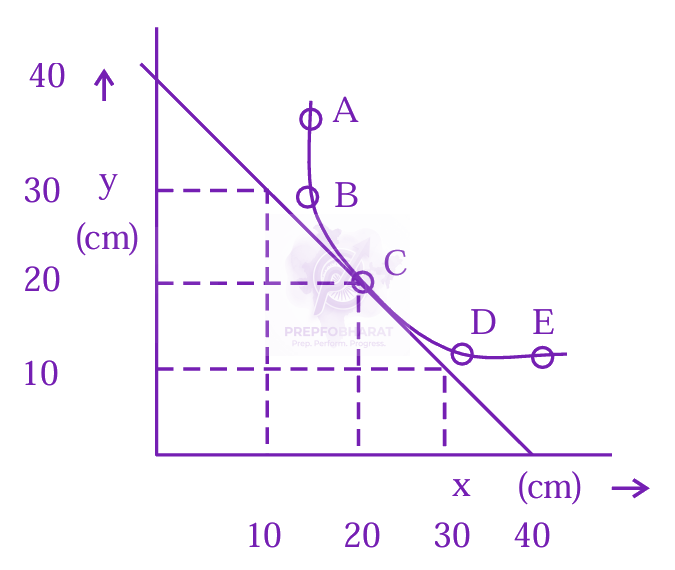
The diffraction pattern of a light of wavelength $400\mathrm{nm}$ diffracting from a slit of width $0.2\mathrm{mm}$ is focused on the focal plane of a convex lens of focal length $100\mathrm{cm}$. The width of the ${1}^{\text{st }}$ secondary maxima will be :
The following figure represents two biconvex lenses $L_1$ and $L_2$ having focal length $10 \mathrm{~cm}$ and $15 \mathrm{~cm}$ respectively. The distance between $L_1 \& L_2$ is : 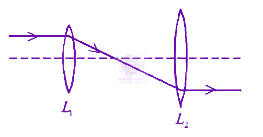
In a single slit experiment, a parallel beam of green light of wavelength $550 \mathrm{~nm}$ passes through a slit of width $0.20 \mathrm{~mm}$. The transmitted light is collected on a screen $100 \mathrm{~cm}$ away. The distance of first order minima from the central maximum will be $x \times 10^{-5} \mathrm{~m}$. The value of $x$ is :
A beam of unpolarised light of intensity ${I}_{0}$ is passed through a polaroid $A$ and then through another polaroid $B$ which is oriented so that its principal plane makes an angle of $45^{\circ}$ relative to that of $A$. The intensity of emergent light is :
In Young's double slit experiment, monochromatic light of wavelength $5000\overset{\circ }{A}$ is used. The slits are $1.0\mathrm{mm}$ apart and screen is placed at $1.0m$ away from slits. The distance from the centre of the screen where intensity becomes half of the maximum intensity for the first time is ______$\times {10}^{-6}m.$
Given below are two statements : Statement (I) : When an object is placed at the centre of curvature of a concave lens, image is formed at the centre of curvature of the lens on the other side. Statement (II) : Concave lens always forms a virtual and erect image. In the light of the above statements, choose the correct answer from the options given below :
Critical angle of incidence for a pair of optical media is $45^{\circ}$. The refractive indices of first and second media are in the ratio:
A microwave of wavelength $2.0\mathrm{cm}$ falls normally on a slit of width $4.0\mathrm{cm}.$ The angular spread of the central maxima of the diffraction pattern obtained on a screen $1.5m$ away from the slit, will be:
When a polaroid sheet is rotated between two crossed polaroids then the transmitted light intensity will be maximum for a rotation of :
Light from a point source in air falls on a convex curved surface of radius $20\mathrm{cm}$ and refractive index $1.5$. If the source is located at $100\mathrm{cm}$ from the convex surface, the image will be formed at ______ $\mathrm{cm}$ from the object.
In a Young's double slit experiment, the intensity at a point is $\left(\frac{1}{4}\right)^{\text {th }}$ of the maximum intensity, the minimum distance of the point from the central maximum is ________ $\mu \mathrm{m}$. (Given : $\lambda=600 \mathrm{~nm}, \mathrm{~d}=1.0 \mathrm{~mm}, \mathrm{D}=1.0 \mathrm{~m}$ )
Two slits are $1 \mathrm{~mm}$ apart and the screen is located $1 \mathrm{~m}$ away from the slits. A light of wavelength $500 \mathrm{~nm}$ is used. The width of each slit to obtain 10 maxima of the double slit pattern within the central maximum of the single slit pattern is _____$\times 10^{-4} \mathrm{~m}$
A biconvex lens of refractive index $1.5$ has a focal length of $20\mathrm{cm}$ in air. Its focal length when immersed in a liquid of refractive index $1.6$ will be:
The distance between object and its $3$ times magnified virtual image as produced by a convex lens is $20\mathrm{cm}.$ The focal length of the lens used is ________ $\mathrm{cm}.$
In a single slit diffraction pattern, a light of wavelength $6000\overset{o}{A}$ is used. The distance between the first and third minima in the diffraction pattern is found to be $3\mathrm{mm}$ when the screen is placed $50\mathrm{cm}$ away from slits. The width of the slit is ____$\times {10}^{-4}m$.
A monochromatic light of wavelength $6000\overset{o}{A}$ is incident on the single slit of width $0.01\mathrm{mm}$. If the diffraction pattern is formed at the focus of the convex lens of focal length $20\mathrm{cm}$, the linear width of the central maximum is :
In finding out refractive index of glass slab the following observations were made through travelling microscope 50 vernier scale division $=49 \mathrm{MSD} ; 20$ divisions on main scale in each $\mathrm{cm}$ For mark on paper $\mathrm{MSR}=8.45 \mathrm{~cm}, \mathrm{VC}=26$ For mark on paper seen through slab MSR $=7.12 \mathrm{~cm}, V C=41$ For powder particle on the top surface of the glass slab $\mathrm{MSR}=4.05 \mathrm{~cm}, \mathrm{VC}=1$ (MSR $=$ Main Scale Reading, VC $=$ Vernier Coincidence) Refractive index of the glass slab is :
The position of the image formed by the combination of lenses is : 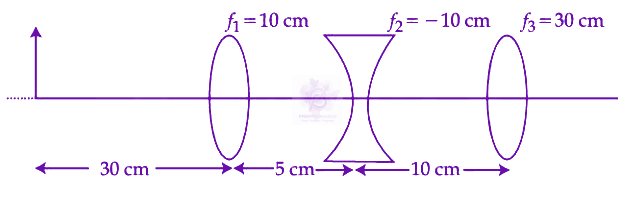
Light emerges out of a convex lens when a source of light kept at its focus. The shape of wavefront of the light is :
A convex mirror of radius of curvature $30\mathrm{cm}$ forms an image that is half the size of the object. The object distance is :
A parallel beam of monochromatic light of wavelength $600 \mathrm{~nm}$ passes through single slit of $0.4 \mathrm{~mm}$ width. Angular divergence corresponding to second order minima would be ______ $\times 10^{-3} \mathrm{rad}$.
When unpolarized light is incident at an angle of $60^{\circ}$ on a transparent medium from air. The reflected ray is completely polarized. The angle of refraction in the medium is
Two wavelengths $\lambda_1$ and $\lambda_2$ are used in Young's double slit experiment. $\lambda_1=450 \mathrm{~nm}$ and $\lambda_2=650 \mathrm{~nm}$. The minimum order of fringe produced by $\lambda_2$ which overlaps with the fringe produced by $\lambda_1$ is $n$. The value of $n$ is _____.
A light ray is incident on a glass slab of thickness $4 \sqrt{3} \mathrm{~cm}$ and refractive index $\sqrt{2}$ . The angle of incidence is equal to the critical angle for the glass slab with air. The lateral displacement of ray after passing through glass slab is _____ $\mathrm{cm}$. $\left(\right.$ Given $\left.\sin 15^{\circ}=0.25\right)$
Two immiscible liquids of refractive indices $\frac{8}{5}$ and $\frac{3}{2}$ respectively are put in a beaker as shown in the figure. The height of each column is $6\mathrm{cm}$. A coin is placed at the bottom of the beaker. For near normal vision, the apparent depth of the coin is $\frac{\alpha }{4}\mathrm{cm}$. The value of $\alpha$ is _______. 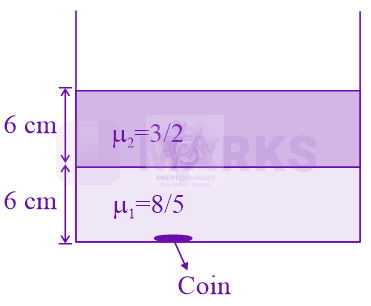
If the refractive index of the material of a prism is $\mathrm{cot}(\frac{A}{2})$, where $A$ is the angle of prism then the angle of minimum deviation will be
In a double slit experiment shown in figure, when light of wavelength $400\mathrm{nm}$ is used, dark fringe is observed at $P$. If $D=0.2m$, the minimum distance between the slits ${S}_{1}$ and ${S}_{2}$ is $\alpha \mathrm{mm}$. Write the value of $10\alpha$ to the nearest integer. 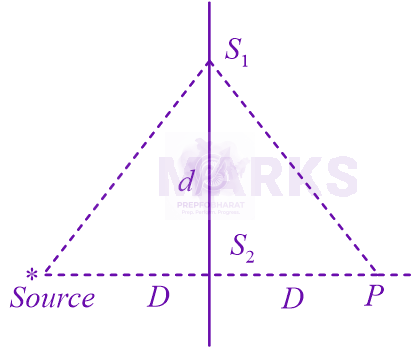
A parallel beam of monochromatic light of wavelength $5000\overset{o}{A}$ is incident normally on a single narrow slit of width $0.001\mathrm{mm}$. The light is focused by convex lens on screen, placed on its focal plane. The first minima will be formed for the angle of diffraction of ______ (degree).
If the distance between object and its two times magnified virtual image produced by a curved mirror is $15\mathrm{cm}$, the focal length of the mirror must be :