JEE Main 2019 — Optics
Physics Optics questions from JEE Main 2019.
Other Years
35 Optics Questions from 2019
A thin convex lens $L$ (refractive index $=1.5$ ) is placed on a plane mirror $M$. When a pin is placed at $A$, such that $OA=18 cm,$ its real inverted image is formed at $A$ itself, as shown in figure. When liquid of refractive index ${\mu }_{l}$ is put between the lens and the mirror, the pin has to be moved to ${A}^{'},$ such that $O{A}^{'}=27 cm,$ to get its inverted real image at $A'$ itself. The value of ${\mu }_{l}$ will be 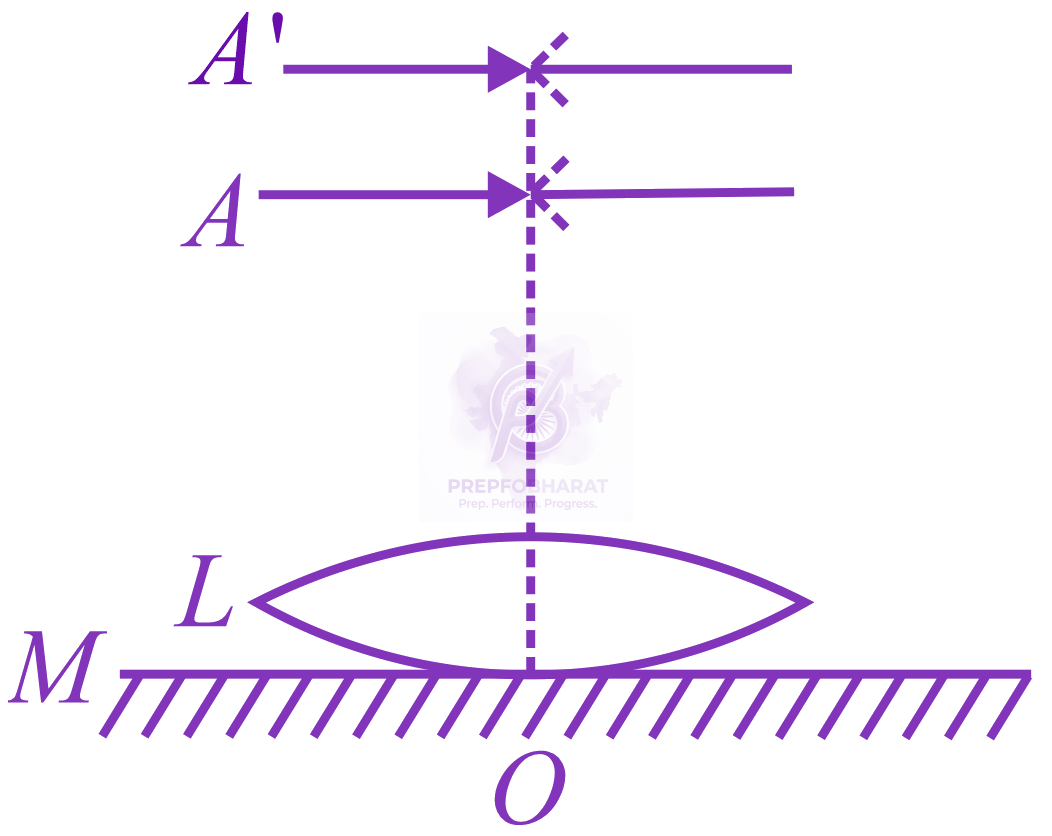
In a double slit experiment, when a thin film of thickness $t$ having refractive index $\mu$ is introuduced in front of one of the slits, the maximum at the centre of the fringe pattern shifts by one fringe width. The value of $t$ is $(\lambda$ is the wavelength of the light used):
A convex lens of focal length $20 cm$ produces images of the same magnification 2 when an object is kept at two distances ${x}_{1}$ and ${x}_{2}({x}_{1}>{x}_{2})$ from the lens. The ratio of ${x}_{1}$ and ${x}_{2}$ is:
What is the position and nature of image formed by lens combination shown in figure? ( ${f}_{1}, {f}_{2}$ are focal lengths) 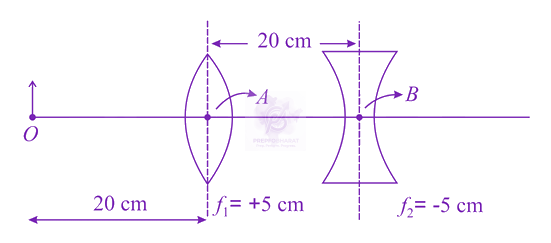
The variation of refractive index of a crown glass thin prism with wavelength of the incident light is shown. Which of the following graphs is the correct one, if $D_{m}$ is the angle of minimum deviation? 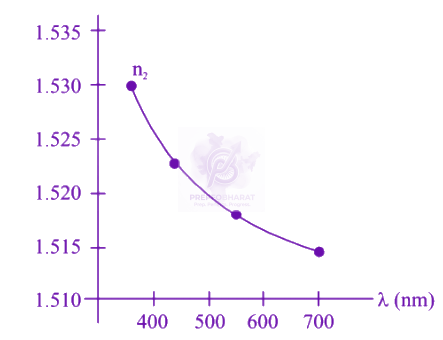
A convex lens is put $10 cm$ from a light source and it makes a sharp image on a screen, kept $10 cm$ from the lens. Now a glass block (refractive index 1.5) of $1.5 cm$ thickness is placed in between the light source and the lens. To get the sharp image again, the screen is shifted by a distance $d.$ Then $d$ is: 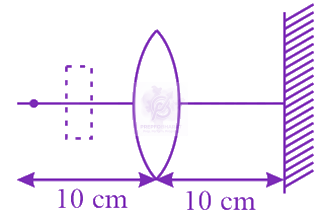
In a Young's double slit experiment slit separation $0.1 mm,$ one observes a bright fringe at angle $\frac{1}{40} rad$ by using light of wavelength ${\lambda }_{1}.$ When the light of wavelength ${\lambda }_{2}$ is used a bright fringe is seen at the same angle in the same set up. Given that ${\lambda }_{1}$ and ${\lambda }_{2}$ are in visible range $(380 nm to 740 nm),$ their values are:
The figure shows a Young's double slit experimental setup. It is observed that when a thin transparent sheet of thickness t and refractive index $\mu$ is put in front of one of the slits, the central maximum gets shifted by a distance equal to n fringe width. If the wavelength of light used is $\lambda$ then $t$ will be: 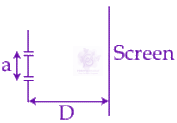
Two plane mirrors are inclined to each other such that a ray of light incident on the first mirror $({M}_{1})$ and parallel to the second mirror $({M}_{2})$ is finally reflected from the second mirror $({M}_{2})$ and parallel to the first mirror $({M}_{1}).$ The angle between the two mirrors will be:
A concave mirror for face viewing has a focal length of $0.4 m$. The distance at which you hold the mirror from your face in order to see your image upright with a magnification of $5$ is
In a double-slit experiment, green light $(5303 \mathrm{~A})$ falls on a double slit having a separation of $19.44 \mu \mathrm{m}$ and a width of $4.05 \mu \mathrm{m}$. The number of bright fringes between the first and the second diffraction minima is
Consider a tank made of glass (refractive index $1.5$ ) with a thick bottom. It is filled with a liquid of refractive index $\mu .$ A student finds that, irrespective of what the incident angle $i$ (see figure) is for a beam of light entering the liquid, the light reflected from the liquid glass interface is never completely polarized. For this to happen, the minimum value of $\mu$ is: 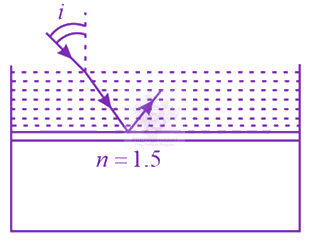
Formation of real image using a biconvex lens is shown below: 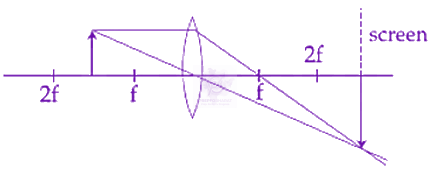 If the whole set up is immersed in water without disturbing the object and the screen positions, what will one observe on the screen?
Two coherent sources produce waves of different intensities which interfere. After interference, the ratio of the maximum intensity to the minimum intensity is $16.$ The intensity of the waves are in the ratio:
In a Young's double slit experiment, the path difference, at a certain point on the screen, betwen two interfering waves is $\frac{1}{8}$ th of wavelength. The ratio of the intensity at this point to that at the centre of a bright fringe is close to:
A plano - convex lens (focal length ${f}_{2}$ , refractive index ${\mu }_{2},$ radius of curvature R) fits exactly into a plano - concave lens (focal length ${f}_{1},$ refractive index ${\mu }_{1},$ radius of curvature R). Their plane surfaces are parallel to each other. Then, the focal length of the combination will be:
In a young's double slit experiment, the slits are placed $0.320 mm$ apart. Light of wavelength $\lambda =500 nm$ is incident on the slits. The total number of bright fringes that are observed in the angular range $-{30}^{o}\leq \theta \leq {30}^{o}$ is:
A ray of light $AO$ in vacuum is incident on a glass slab at angle $60^{\circ}$ and refracted at angle $30^{\circ}$ along $OB$ as shown in the figure. The optical path length of light ray from $A$ to $B$ is: 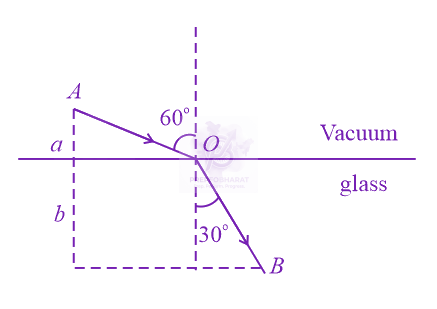
The graph shows how the magnification $m$ produced by a thin lens varies with image distance $v$. The focal length of the lens used is 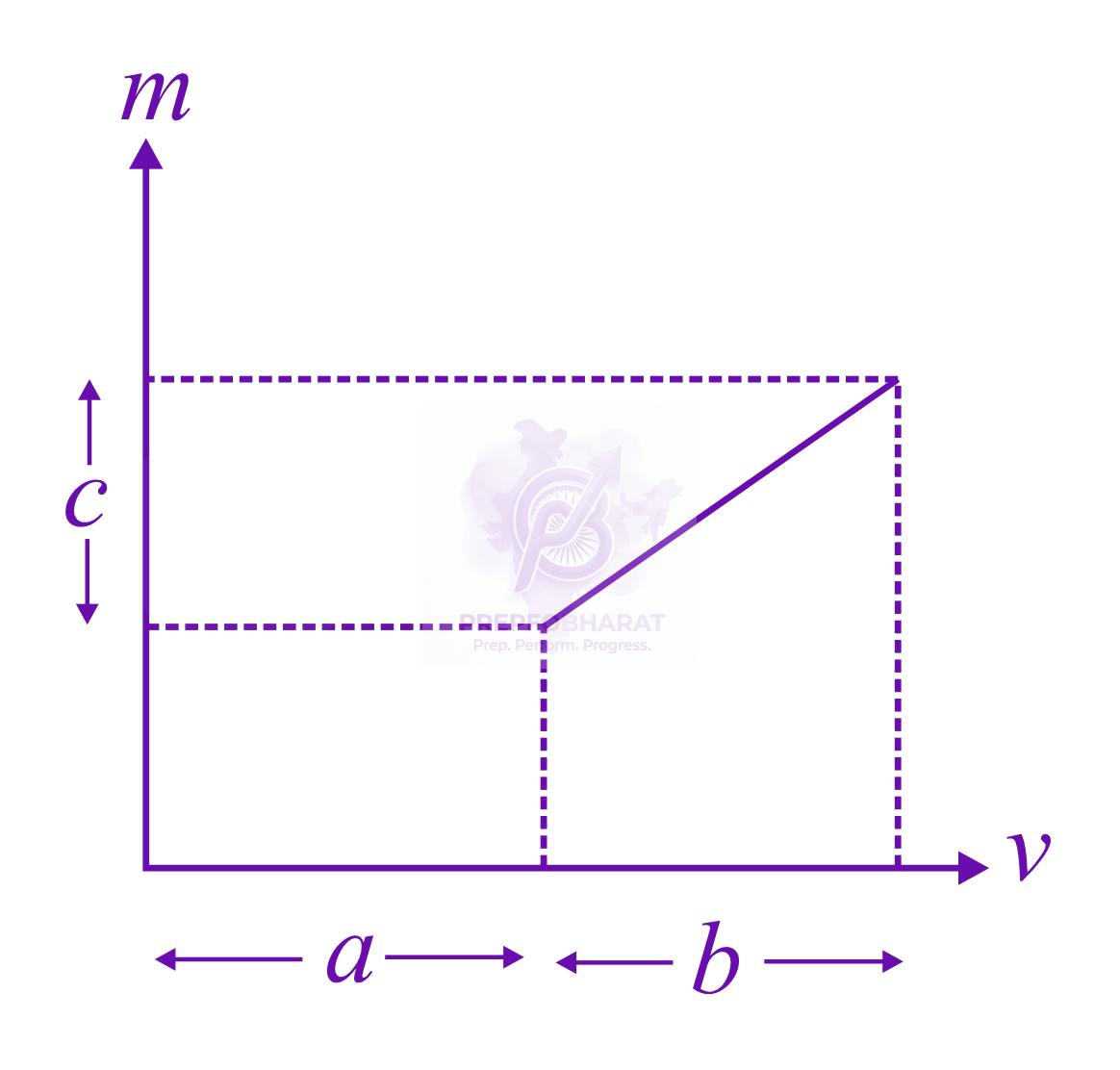
A plano-convex lens of refractive index ${\mu }_{1}$ and focal length ${f}_{1}$ is kept in contact with another plano-concave lens of refractive index ${\mu }_{2}$ and focal length ${f}_{2}.$ If the radius of curvature of their spherical faces is $R$ each and ${f}_{1}=2{f}_{2},$ the ${\mu }_{1}$ and ${\mu }_{2}$ are related as:
A convex lens (of focal length $20 cm$ ) and a concave mirror, having their principal axes along the same lines, are kept $80 cm$ apart from each other. The concave mirror is to the right of the convex lens. When an object is kept at a distance of $30 cm$ to the left of the convex lens, its image remains at the same position even if the concave mirror is removed. The maximum distance of the object for which this concave mirror, by itself would produce a virtual image would be:
A system of three polarizers ${P}_{1},{P}_{2},{P}_{3}$ is set up such that the pass axis of ${P}_{3}$ is crossed with respect to that of ${P}_{1}$ . The pass axis of ${P}_{2}$ is inclined at ${60}^{o}$ to the pass axis of ${P}_{3}.$ When a beam of unpolarized light of intensity ${I}_{o}$ is incident on ${P}_{1},$ the intensity of light transmitted by the three polarizers is $I$ . The ratio $({I}_{o}/I)$ equals (nearly):
A concave mirror has radius of curvature of $40 cm.$ It is at the bottom of a glass that has water filled up to $5 cm$ (see figure). If a small particle is floating on the surface of water, its image as seen, from directly above the glass, is at a distance $d$ from the surface of water. The value of $d$ is close to: (Refractive index of water $=1.33)$ 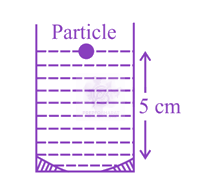
A transparent cube of side $d$, made of a material of refractive index ${\mu }_{2}$, is immersed in a liquid of refractive index ${\mu }_{1}({\mu }_{1}<{\mu }_{2})$. A ray is incident on the face $AB$ at an angle $\theta$ (shown in the figure). Total internal reflection takes place at the point $E$ on the face $BC.$ 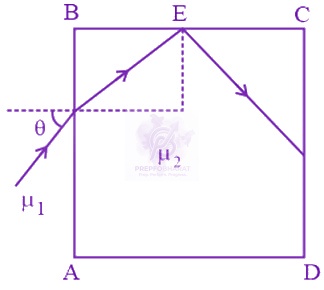 Then, $\theta$ must satisfy
One plano-convex and one plano-concave lens of the same radius of curvature $R$ but of different materials are joined side by side as shown in the figure. If the refractive index of the material of $1$ is ${\mu }_{1}$ and that of $2$ is${ \mu }_{2}$, then the focal length of the combination is: 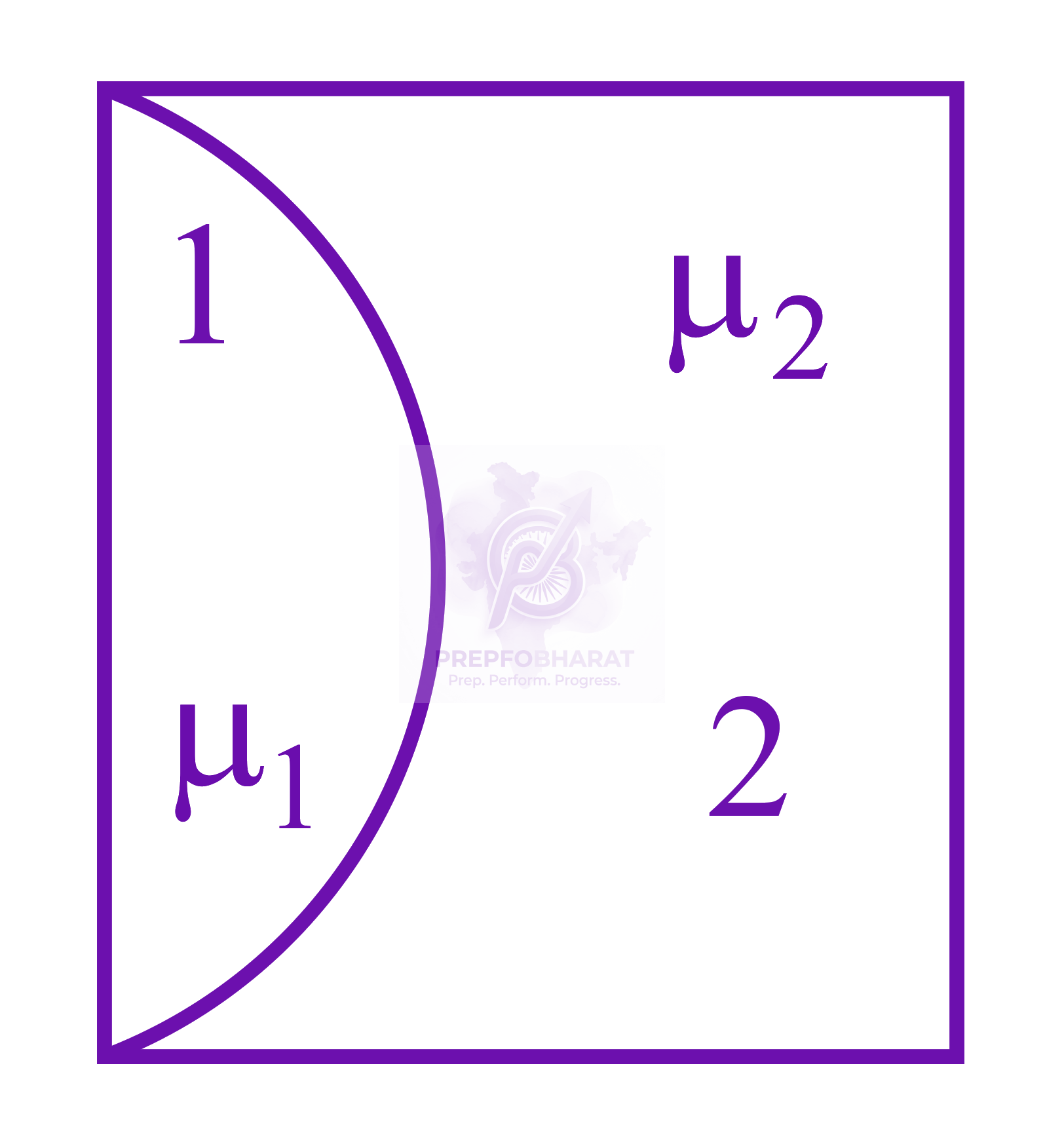
An upright object is placed at a distance of $40 cm$ in front of a convergent lens of focal length $20 cm.$ A convergent mirror of focal length $10 cm$ is placed at a distance of $60 cm$ on the other side of the lens. The position and size of the final image will be:
A monochromatic light is incident at a certain angle on an equilateral triangular prism and suffers minimum deviation. If the refractive index of the material of the prism is $\sqrt{3}$, then the angle of incidence is :
In a Young's double-slit experiment, the ratio of the slit's width is $4 :1$ . The ratio of the intensity of maxima to minima, close to the central fringe on the screen, will be
A light wave is incident normally on a glass slab of refractive index $1.5.$ If $4%$ of light gets reflected and the amplitude of the electric field of the incident light is $30\frac{V}{m},$ then the amplitude of the electric field for the wave propagating in the glass medium will be:
In an interference experiment the ratio of amplitudes of coherent waves is $\frac{{a}_{1}}{{a}_{2}}=\frac{1}{3}$ . The ratio of maximum and minimum intensities of fringes will be:
In figure, the optical fiber is $l=2 m$ long and has a diameter of $d=20 \mu m.$ If a ray of light is incident on one end of the fiber at angle ${\theta }_{1}=40^{\circ}$ , the number of reflections it makes before emerging from the other end is close to: (refractive index of fiber is $1.31$ , $sin 40^{\circ}=0.64$ and ${\mathrm{sin}}^{-1}0.49=30^{\circ}$ .) 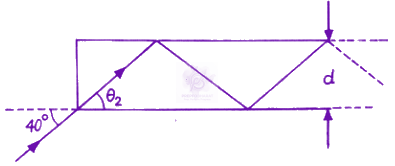
Consider a Young's double slit experiment as shown in figure. What should be the slit separation $d$ in terms of wavelength $\lambda$ such that the first minima occurs directly in front of the slit $({S}_{1})$ ? 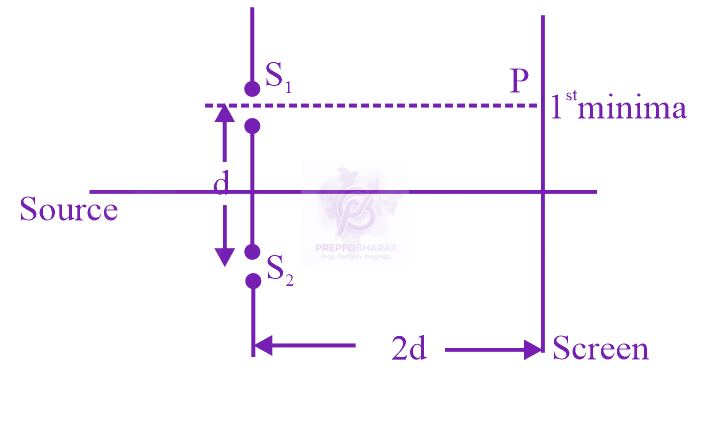
The eye can be regarded as a single refracting surface. The radius of curvature of this surface is equal to that of the cornea $(7.8 \mathrm{mm})$. This surface separates two media of refractive indices $1$ and $1.34$. Calculate the distance from the refracting surface at which a parallel beam of light will come to focus.
An object is at a distance of $20 \mathrm{~m}$ from a convex lens of focal length $0.3 \mathrm{~m}$. The lens forms an image of the object. If the object moves away from the lens at a speed of $5 \mathrm{~m} / \mathrm{s}$ the speed and direction of the image will be
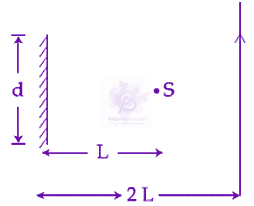
A point source of light, S is placed at a distance L in front of the center of plane mirror of width d which is hanging vertically on a wall. A man walks in front of the mirror along a line parallel to the mirror, at a distance 2L as shown below. The distance over which the man can see the image of the light source in the mirror is: