JEE Main 2016 — Optics
Physics Optics questions from JEE Main 2016.
Other Years
9 Optics Questions from 2016
A hemispherical glass body of radius 10 cm and refractive index 1.5 is silvered on its curved surface. A small air bubble is 6 cm below the flat surface inside it along the axis. The position of the image of the air bubble made by the mirror is seen : 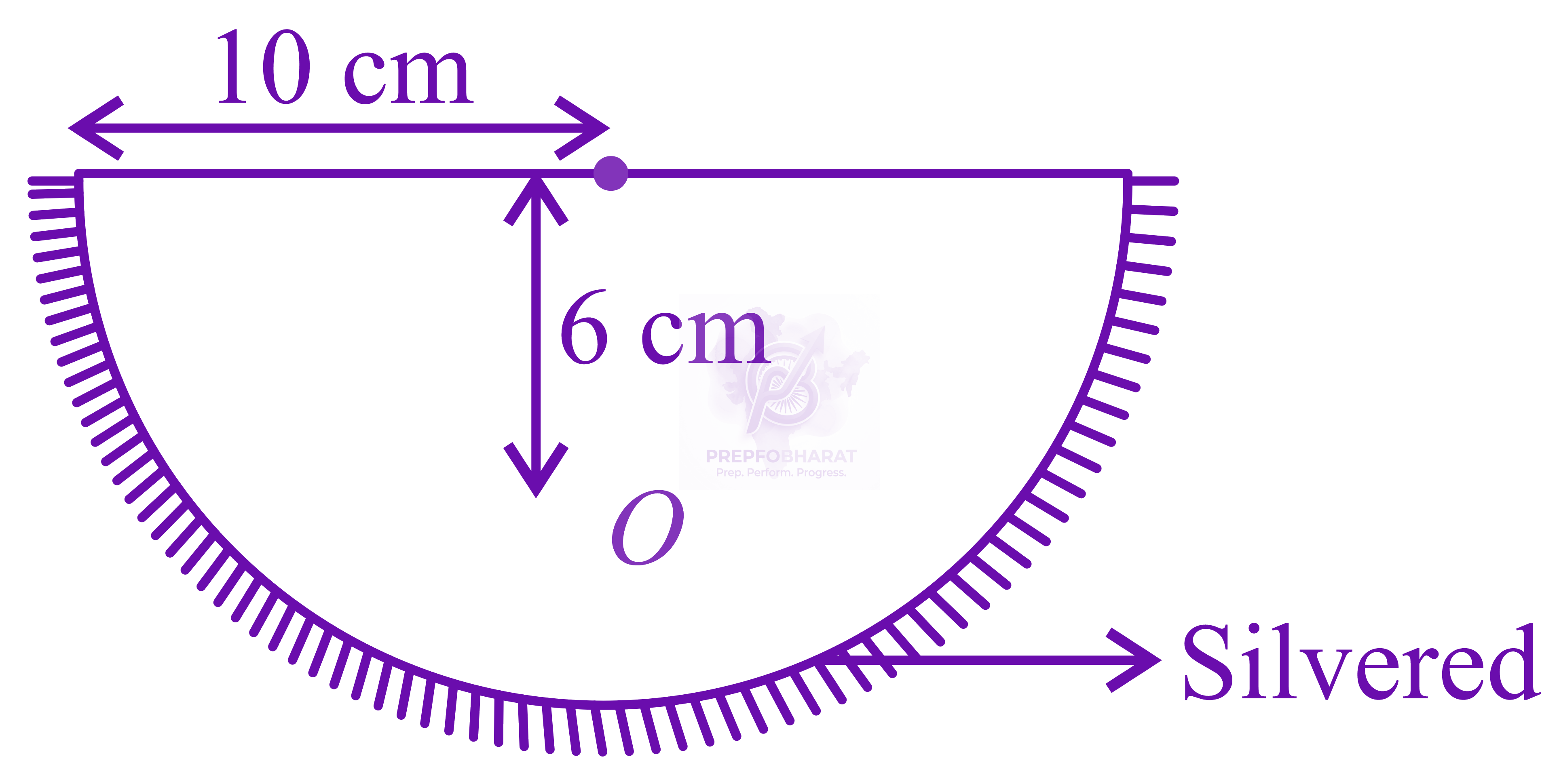
Two stars are 10 light years away from the earth. They are seen through a telescope of objective diameter 30 cm. The wavelength of light is 600nm. To see the stars just resolved by the telescope, the minimum distance between them should be $(1 light year=9.46\times {10}^{15}m)$ of the order of :
The box of a pin hole camera, of length L, has a hole of radius a. It is assumed that when the hole is illuminated by a parallel beam of light of wavelength $\lambda$ the spread of the spot (obtained on the opposite wall of the camera) is the sum of its geometrical spread and the spread due to diffraction. The spot would then have its minimum size (say ${b}_{min}$ ) when:
An observer looks at a distant tree of height $10m$ with a telescope of magnifying power of $20$. To the observer, the tree appears as
A convex lens, of focal length 30 cm, a concave lens of focal length 120 cm, and a plane mirror are arranged as shown. For an object kept at a distance of 60 cm from the convex lens, the final image, formed by the combination, is a real image, at a distance of: 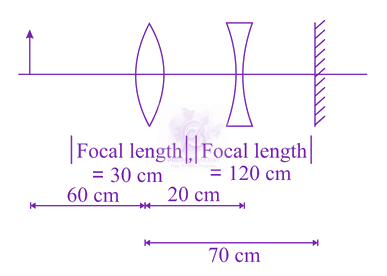
In Young's double-slit experiment, the distance between slits and the screen is $1m$ and monochromatic light of wavelength $600\mathrm{nm}$ is being used. A person standing near the slits is looking at the fringe pattern. When the separation between the slits is varied, the interference pattern disappears for a particular distance ${d}_{0}$ between the slits. If the angular resolution of the eye is $\frac{1}{60}^{\circ}$, then the value of ${d}_{0}$ is close to
To find the focal length of a convex mirror, a student records the following data:<table class="pyq-table"><tbody><tr><td>Object pin</td><td>Convex Lens</td><td>Convex Mirror</td><td>Image Pin</td></tr><tr><td>22.2 cm</td><td>32.2 cm</td><td>45.8 cm</td><td>71.2 cm</td></tr></tbody></table>The focal length of the convex lens is ${f}_{1}$ and that of mirror is ${f}_{2}$ . Then taking index correction to be negligibly small, ${f}_{1}$ and ${f}_{2}$ are close to:
In an experiment for determination of refractive index of glass of a prism by $i$ v/s $\delta$ plot, it was found that a ray incident at angle ${35}^{o}$ , suffers a deviation of ${40}^{o}$ and that it emerges at angle ${79}^{o}$ . In that case which of the following is closest to the maximum possible value of the refractive index?
To determine refractive index of glass slab using a travelling microscope, minimum number of readings required are :