JEE Main 2014 — Optics
Physics Optics questions from JEE Main 2014.
Other Years
14 Optics Questions from 2014
In a compound microscope the focal length of objective lens is $1.2 \mathrm{~cm}$ and focal length of eye piece is $3.0 \mathrm{~cm}$. When object is kept at $1.25 \mathrm{~cm}$ in front of objective, final image is formed at infinity. Magnifying power of the compound microscope should be:
A green light is incident from the water to the air - water interface at the critical angle $({\theta }_{c})$. Select the correct statement.
A thin convex lens made from crown glass $( \mu = \frac{ 3 }{ 2 } )$ has focal length $f$. When it is measured in two different liquids having refractive indices $\frac{ 4 }{ 3 }$ and $\frac{ 5 }{ 3 }$, it has the focal lengths ${ f }_{1}$ and ${ f }_{2}$ respectively. The correct relation between the focal lengths is :
In an experiment of single slit diffraction pattern, first minimum for red light coincides with first maximum of some other wavelength. If wavelength of red light is $6600 Å$, then wavelength of first maximum will be:
Two beams, A and B of plane polarized light with mutually perpendicular planes of polarization are seen through a polaroid. From the position when the beam A has maximum intensity (and beam B has zero intensity), a rotation of polaroid through 30$^{o}$ makes the two beams appear equally bright. If the initial intensities of the two beams are I$_{A}$ and I$_{B}$ respectively, then $\frac{ {\text{I}}_{\text{A}} }{ {\text{I}}_{\text{B}} }$ equals :
An object is located in a fixed position in front of a screen. Sharp image is obtained on the screen for two positions of a thin lens separated by 10 $\mathrm{cm}$. The size of the images in two situations are in the ratio $3: 3$. What is the distance between the screen and the object?
Using monochromatic light of wavelength $\lambda$, an experimentalist sets up the Young's double slit experiment in three ways as shown. If she observes that $y = {\beta }^{'}$, the wavelength of light used is : 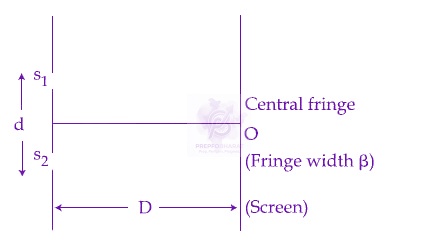 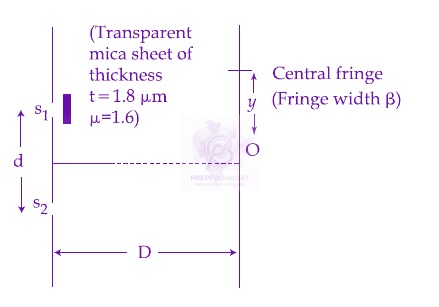 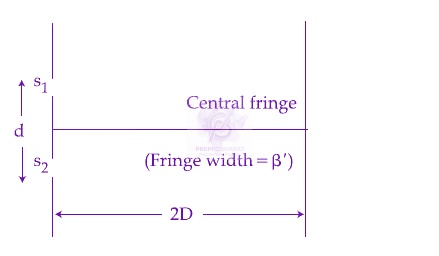
A ray of light is incident from a denser to a rarer medium. The critical angle for total internal reflection is ${\theta }_{\text{iC}}$ and Brewster's angle of incidence is ${\theta }_{\text{iB}}$, such that $\frac{\text{sin}{\theta }_{\text{iC}}}{\text{sin}{\theta }_{\text{iB}}}=\eta =1\text{.}28$. The relative refractive index of the two media is
A diver looking up through the water sees the outside world contained in a circular horizon. The refractive index of water is $\frac{ 4 }{ 3 }$, and the diver's eyes are $15\mathrm{cm}$ below the surface of the water. Then the radius of the circle is :
Two monochromatic light beams of intensity 16 and 9 units are interfering. The ratio of intensities of bright and dark parts of the resultant pattern is:
The focal lengths of objective lens and eye lens of a Galilean Telescope are respectively 30 cm and 3.0 cm. Telescope produces virtual, erect image of an object situated far away from it at least distance of distinct vision from the eye lens. In this condition the Magnifying Power of the Galilean Telescope should be :
The refractive index of the material of a concave lens is $\mu$. It is immersed in a medium of refractive index $\mu_1$. A parallel beam of light is incident on the lens. The path of the emergent rays when $\mu_1>\mu$ is:
Interference pattern is observed at ' $\mathrm{P}$ ' due to superimposition of two rays coming out from a source ' $S$ ' as shown in the figure. The value of ' $\mathrm{l}$ ' for which maxima is obtained at ' $\mathrm{P}$ ' is: ( $\mathrm{R}$ is perfect reflecting surface) 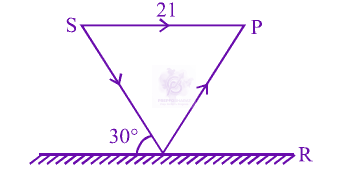
In Young’s double-slit experiment, the distance between the two identical slits is$6.1$ times larger than the slit width. Then the number of intensity maxima observed within the central maximum of the single-slit diffraction pattern is :