JEE Main 2009 — Optics
Physics Optics questions from JEE Main 2009.
Other Years
3 Optics Questions from 2009
In an optics experiment, with the position of the object fixed, a student varies the position of a convex lens and for each position, the screen is adjusted to get a clear image of the object. A graph between the object distance $u$ and the image distance $v$, from the lens, is plotted using the same scale for the two axes. A straight line passing through the origin and making an angle of $45^{\circ}$ with the x-axis meets the experimental curve at $P$. The coordinates of $P$ will be
A mixture of light, consisting of wavelength $590 \mathrm{~nm}$ and an unknown wavelength, illuminates Young's double slit and gives rise to two overlapping interference patterns on the screen. The central maximum of both lights coincide. Further, it is observed that the third bright fringe of known light coincides with the $4^{\text {th }}$ bright fringe of the unknown light. From this data, the wavelength of the unknown light is
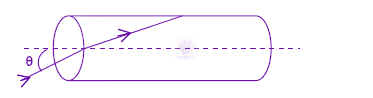
A transparent solid cylindrical rod has a refractive index of $\frac{2}{\sqrt{3}}$. It is surrounded by air. A light ray is incident at the mid point of one end of the rod as shown in the figure. The incident angle $\theta$ for which the light ray grazes along the wall of the rod is