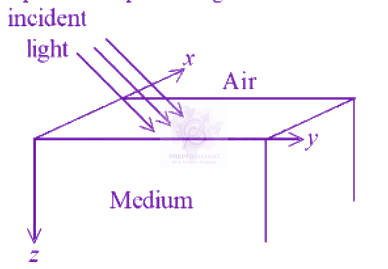
From the given figure, the incident light rays lie in the xz-plane. Therefore, the plane of incidence is the xz-plane.
The incident wave travels from the air (z<0) towards the medium (z>0), so it propagates in the +x and +z directions. The reflected wave will travel back into the air, meaning it propagates in the +x and −z directions.
The wave vector for the reflected wave can be written as kr=kxi^−kzk^.
The phase of the reflected wave is given by kr⋅r−ωt=kxx−kzz−ωt. This phase matches the expression in option (1).
According to Brewster's law, when unpolarized light is incident at the Brewster angle, the reflected light is completely polarized perpendicular to the plane of incidence. Since the plane of incidence is the xz-plane, the reflected electric field must be entirely along the y-axis (j^ direction).
Let us verify this with option (1), which gives the electric field as E=Exi^+Eyj^.
For an electromagnetic wave, the electric field must be perpendicular to the direction of propagation, so kr⋅E=0.
(kxi^−kzk^)⋅(Exi^+Eyj^)=0
kxEx=0
Since kx=0, we must have Ex=0. This leaves E=Eyj^, which means the wave is purely polarized along the y-axis. This perfectly satisfies the condition for reflection at the Brewster angle.
Thus, the correct expression representing the reflected wave is (Exi^+Eyj^)sin(kx−kz−ωt).
Answer: (Exi^+Eyj^)sin(kx−kz−ωt)