JEE Main 2012 — Optics
Physics Optics questions from JEE Main 2012.
Other Years
12 Optics Questions from 2012
A glass prism of refractive index $1.5$ is immersed in water (refractive index $\frac{4}{3}$ ) as shown in figure. A light beam incident normally on the face $A B$ is $$ \text { totally reflected to reach the face } B C \text {, if } $$ 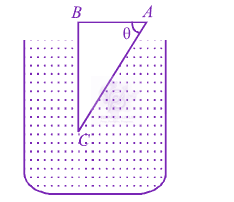
Which of the following processes play a part in the formation of a rainbow? (i) Refraction (ii) Total internal reflection (iii) Dispersion (iv) Interference
Two coherent plane light waves of equal amplitude makes a small angle $\alpha(< < 1)$ with each other. They fall almost normally on a screen. If $\lambda$ is the wavelength of light waves, the fringe width $\Delta x$ of interference patterns of the two sets of waves on the screen is
Two polaroids have their polarizing directions parallel so that the intensity of a transmitted light is maximum. The angle through which either polaroid must be turned if the intensity is to drop by one-half is
In Young's double slit interference experiment, the slit widths are in the ratio $1: 25$. Then the ratio of intensity at the maxima and minima in the interference pattern is
An object $2.4 \mathrm{~m}$ in front of a lens forms a sharp image on a film $12 \mathrm{~cm}$ behind the lens. A glass plate $1 \mathrm{~cm}$ thick, of refractive index $1.50$ is interposed between lens and film with its plane faces parallel to film. At what distance (from lens) should object be shifted to be in sharp focus on film?
We wish to make a microscope with the help of two positive lenses both with a focal length of 20 $\mathrm{mm}$ each and the object is positioned $25 \mathrm{~mm}$ from the objective lens. How far apart the lenses should be so that the final image is formed at infinity?
The maximum number of possible interference maxima for slit separation equal to $1.8 \lambda$, where $\lambda$ is the wavelength of light used, in a Young's double slit experiment is
In a Young's double slit experiment with light of wavelength $\lambda$, fringe pattern on the screen has fringe width $\beta$. When two thin transparent glass (refractive index $\mu$ ) plates of thickness $t_1$ and $t_2$ $\left(t_1>t_2\right)$ are placed in the path of the two beams respectively, the fringe pattern will shift by a distance
A beam of light consisting of red, green and blue colours is incident on a right-angled prism on face $A B$. The refractive indices of the material for the above red, green and blue colours are $1.39,1.44$ and $1.47$ respectively. A person looking on surface $A C$ of the prism will see 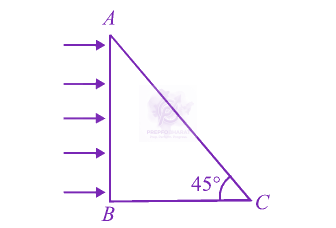
The first diffraction minimum due to the single slit diffraction is seen at $\theta=30^{\circ}$ for a light of wavelength $5000 Å$ falling perpendicularly on the slit. The width of the slit is
In Young's double slit experiment, one of the slit is wider than other, so that the amplitude of the light from one slit is double of that from other slit. If $I_m$ be the maximum intensity, the resultant intensity I when they interfere at phase difference $\phi$ is given by