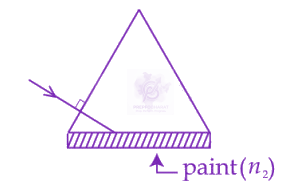
Given that the prism is an equilateral triangle, all its refracting angles are 60∘.
The incident ray falls normally on one of the faces of the prism. Therefore, the angle of incidence is 0∘ and the ray enters the prism undeviated.
From the geometry of the figure, the ray strikes the bottom painted face. In the right-angled triangle formed by the ray and the two faces of the prism, the angle between the left face and the bottom face is 60∘.
The angle the refracted ray makes with the bottom face is 90∘−60∘=30∘.
The angle of incidence i at the bottom painted face is the angle made with the normal to that face:
i=90∘−30∘=60∘
For total internal reflection to occur at the painted face, the angle of incidence must be greater than or equal to the critical angle θc for the prism-paint interface:
i≥θc
sini≥sinθc
The critical angle is given by sinθc=n1n2, where n1=1.6 is the refractive index of the prism and n2 is the refractive index of the paint.
Substituting the values:
sin60∘≥1.6n2
23≥1.6n2
n2≤1.6×23
n2≤0.83=543
The limiting value of n2 required for total internal reflection is 543.
Answer: 43/5