Optics PYQ — Page 2
JEE Main Physics — Optics previous year questions with solutions.
All Optics Questions (489)
Given below are two statements : Statement I : In a Young's double slit experiment, the angular separation of fringes will increase as the screen is moved away from the plane of the slits Statement II: In a Young's double slit experiment, the angular separation of fringes will increase when monochromatic source is replaced by another monochromatic source of higher wavelength. In the light of the above statements, choose the correct answer from the options given below :
A thin prism with angle $5^{\circ}$ of refractive index 1.72 is combined with another prism of refractive index 1.9 to produce dispersion without deviation. The angle of second prism is $\_\_\_\_$.
A thin convex lens and a thin concave lens are kept in contact and are co-axial. Which of the following statements is correct for this combination of two lenses ?
In interference experiment the path difference between two interfering waves at a point $A$ on the screen is $\lambda/3$, where $\lambda$ is the wavelength of these waves, and at another point $B$ the path difference is $\lambda/6$. The ratio of intensities at points $A$ and $B$ is _______.
An unpolarized light is incident on the plane interface of air-dielectric medium shown in figure. If the incident angle is equal to Brewster angle, identify the expression representing reflected wave. 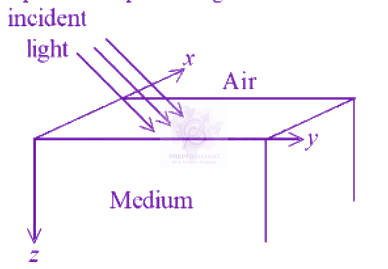
Angle of minimum deviation is equal to the half of the angle of prism in an equilateral prism. The refractive index of the prism is __________.
One side of an equilateral prism is painted by a transparent material of refractive index $n_2$. The refractive index of prism is $1.6$. The minimum value of $n_2$ required for total internal reflection from painted face is _______. 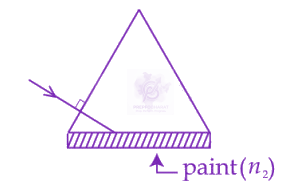
A compound microscope is designed with two symmetric biconvex lenses. The objective lens is cut vertically, creating two identical plano-convex lenses. One of them is used in place of original objective lens. To retain same magnification keeping the object distance unchanged, the tube length has to be
In a microscope the objective is having focal length $f_{o}=2 \mathrm{~cm}$ and eye-piece is having focal length $f_{e}=4 \mathrm{~cm}$. The tube length is 32 cm. The magnification produced by this microscope for normal adjustment is $\_\_\_\_$.
A convex lens of refractive index 1.5 and focal length $f=18 \mathrm{~cm}$ is immersed in water. The difference in focal lengths of the given lens when it is in water and in air is $\alpha \times \mathrm{f}$. The value of $\alpha$ is $\_\_\_\_$. (refractive index of water $=4 / 3$)
A rod of length $10$ cm lies along the principle axis of a concave mirror of focal length $10$ cm as shown in figure. The length of the image is _____ cm. 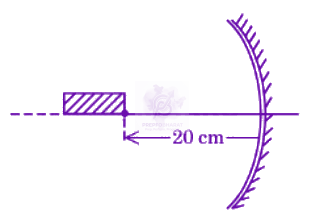
In a double slit experiment the distance between the slits is 0.1 cm and the screen is placed at 50 cm from the slits plane. When one slit is covered with a transparent sheet having thickness $t$ and refractive index $n(=1.5)$, the central fringe shifts by 0.2 cm. The value of $t$ is $\_\_\_\_$ cm.
A slit of width $a$ is illuminated by light of wavelength $\lambda$. The linear separation between $1^{st}$ and $3^{rd}$ minima in the diffraction pattern produced on a screen placed at a distance $D$ from the slit system is _____.
Light ray incident along a vector $\vec{AO}$ $(\vec{AO} = 2\hat{i}-3\hat{j})$ emerges out along vector $\vec{OB}$ $(\vec{OB} = C\hat{i}-4\hat{j})$ as shown in the figure below. The value of $C$ is ________. 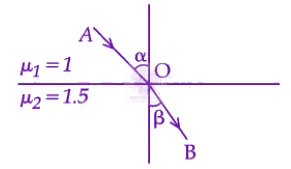
A collimated beam of light of diameter 2 mm is propagating along $x$-axis. The beam is required to be expanded in a collimated beam of diameter 14 mm using a system of two convex lenses. If first lens has focal length 40 mm, then the focal length of second lens is $\_\_\_\_$ mm.
Consider an equilateral prism (refractive index $\sqrt{2}$). A ray of light is incident on its one surface at a certain angle $i$. If the emergent ray is found to graze along the other surface then the angle of refraction at the incident surface is close to $\_\_\_\_$.
A telescope with objective diameter $R$ is used to observe a distant star emitting light of wavelength $500$ nm, at a resolution of $5 \times 10^{-7}$ radian. The value of $R$ is _____ cm.
In two separate Young's double-slit experimental set-ups and two monochromatic light sources of different wavelengths are used to get fringes of equal width. The ratios of the slits separations and that of the wavelengths of light used are $2: 1$ and $1: 2$ respectively. The corresponding ratio of the distances between the slits and the respective screens ($D_{1} / D_{2}$) is $\_\_\_\_$.
Which of the following are true for a single slit diffraction? A. Width of central maxima increases with increase in wavelength keeping slit width constant. B. Width of central maxima increases with decrease in wavelength keeping slit width constant. C. Width of central maxima increases with decrease in slit width at constant wavelength. D. Width of central maxima increases with increase in slit width at constant wavelength. E. Brightness of central maxima increases for decrease in wavelength at constant slit width.
A spherical interface lens of radius $R$ separates two media of refractive indices $1$ and $1.4$ respectively as shown in the figure below. A point source is placed at a distance of $4R$ in front of spherical interface. The magnitude of the magnification of point source image is _______. 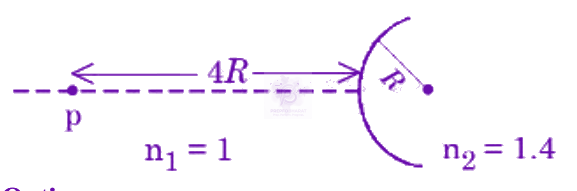
In a double slit experiment, when one of the slits is covered by a transparent mica sheet of refractive index $1.56$, the central fringe shifts to the position of $7^{th}$ bright fringe, obtained with both slits uncovered. If the light source wavelength is $450$ nm, the thickness of mica sheet is $\alpha \times 10^{-9}$ m. The value of $\alpha$ is ______.
The wavelength of light, while it is passing through water is 540 nm. The refractive index of water is $4 / 3$. The wavelength of the same light when it is passing through a transparent medium having refractive index of $3 / 2$ is $\_\_\_\_$ nm.
An object $AB$ is placed $15\text{ cm}$ on the left of a convex lens $P$ of focal length $10\text{ cm}$. Another convex lens $Q$ is now placed $15\text{ cm}$ right of lens $P$. If the focal length of lens $Q$ is $15\text{ cm}$, the final image is _______.
An unpolarised light is incident at an interface of two dielectric media having refractive indices of 2 (incident medium) and $2 \sqrt{3}$ (medium) respectively. To satisfy the condition that reflected and refracted rays are perpendicular to each other, the angle of incidence is $\_\_\_\_$.