Optics PYQ — Page 3
JEE Main Physics — Optics previous year questions with solutions.
All Optics Questions (489)
For a thin symmetric prism made of glass (refractive index $1.5$), the ratio of incident angle and minimum deviation will be _______.
Five persons $\mathrm{P}_{1}, \mathrm{P}_{2}, \mathrm{P}_{3}, \mathrm{P}_{4}$ and $\mathrm{P}_{5}$ recorded object distance $(\mathrm{u})$ and image distance (v) using same convex lens having power +5 D as $(25,96),(30,62),(35,37),(45,35)$ and $(50,32)$ respectively. Identify correct statement
In the Young's double slit experiment the intensity produced by each one of the individual slits is $I_{0}$. The distance between two slits is 2 mm. The distance of screen from slits is 10 m. The wavelength of light is $6000 \mathrm{~A}^{\circ}$. The intensity of light on the screen in front of one of the slits is $\_\_\_\_$.
For a transparent prism, if the angle of minimum deviation is equal to its refracting angle, the refractive index $n$ of the prism satisfies.
In Young's double slit experiment, the fringe width is β. If the wavelength of light is doubled and the slit separation is halved, the new fringe width is:
In parallax method for the determination of focal length of a concave mirror, the object should always be placed:
A concave mirror of focal length $10$ cm forms an image which is double the size of object when the object is placed at two different positions. The distance between the two positions of the object is __________ cm.
Consider light travelling from a medium $A$ to medium $B$ separated by a plane interface. If the light undergoes total internal reflection during its travel from medium $A$ to $B$ and the speed of light in media $A$ and $B$ are $2.4 \times 10^{8} \mathrm{~m} / \mathrm{s}$ and $2.7 \times 10^{8} \mathrm{~m} / \mathrm{s}$, respectively, then the value of critical angle is :
In a Young double slit experiment, the wavelength of incident light is $6000$ Å, the separation between slits $S_1$ and $S_2$ is $5$ cm and the distance between slits plane and screen is $50$ cm, as shown in the figure below. If the resultant intensity at $P$ is equal to the intensity due to individual slits, the path difference between interfering waves is __________ Å. 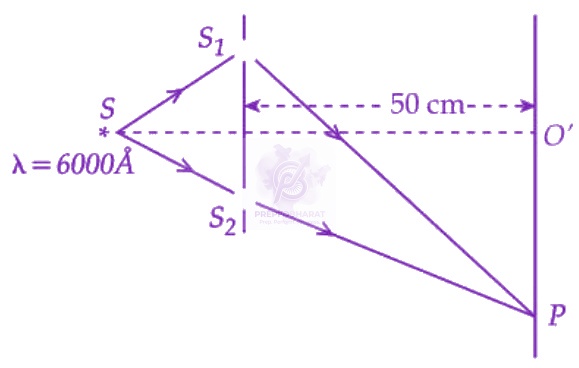
The size of the images of an object, formed by a thin lens are equal when the object is placed at two different positions 8 cm and 24 cm from the lens. The focal length of the lens is $\_\_\_\_$ cm.
A thin convex lens of focal length 5 cm and a thin concave lens of focal length 4 cm are combined together (without any gap) and this combination has magnification $m_{1}$ when an object is placed 10 cm before the convex lens. Keeping the positions of convex lens and object undisturbed a gap of 1 cm is introduced between the lenses by moving the concave lens away, which lead to a change in magnification of total lens system to $m_{2}$. The value of $\left|\frac{m_{1}}{m_{2}}\right|$ is $\_\_\_\_$.
Given a thin convex lens (refractive index $\mu_2$ ), kept in a liquid (refractive index $\mu_1, \mu_1 \lt \mu_2$ ) having radii of curvatures $\left|R_1\right|$ and $\left|R_2\right|$. Its second surface is silver polished. Where should an object be placed on the optic axis so that a real and inverted image is formed at the same place?
Two identical objects are placed in front of convex mirror and concave mirror having same radii of curvature of 12 cm , at same distance of 18 cm from the respective mirrors. The ratio of sizes of the images formed by convex mirror and by concave mirror is :
A lens having refractive index 1.6 has focal length of 12 cm , when it is in air. Find the focal length of the lens when it is placed in water. (Take refractive index of water as 1.28)
A light wave is propagating with plane wave fronts of the type $x+y+z=$ constant. The angle made by the direction of wave propagation with the $x$-axis is:
A thin prism $\mathrm{P}_1$ with angle $4^{\circ}$ made of glass having refractive index 1.54 , is combined with another thin prism $\mathrm{P}_2$ made of glass having refractive index 1.72 to get dispersion without deviation. The angle of the prism $P_2$ in degrees is
Two polarisers $P_1$ and $P_2$ are placed in such a way that the intensity of the transmitted light will be zero. A third polariser $P_3$ is inserted in between $P_1$ and $\mathrm{P}_2$, at the particular angle between $\mathrm{P}_2$ and $\mathrm{P}_3$. The transmitted intensity of the light passing the through all three polarisers is maximum. The angle between the polarisers $\mathrm{P}_2$ and $\mathrm{P}_3$ is :
A monochromatic light of frequency $5 \times 10^{14} \mathrm{~Hz}$ travelling through air, is incident on a medium of refractive index ' 2 '. Wavelength of the refracted light will be :
A photograph of a landscape is captured by a drone camera at a height of 18 km . The size of the camera film is $2 \mathrm{~cm} \times 2 \mathrm{~cm}$ and the area of the landscape photographed is $400 \mathrm{~km}^2$. The focal length of the lens in the drone camera is :
In the diagram given below, there are three lenses formed. Considering negligible thickness of each of them as compared to $\left|R_1\right|$ and $\left|R_2\right|$, i.e., the radii of curvature for upper and lower surfaces of the glass lens, the power of the combination is 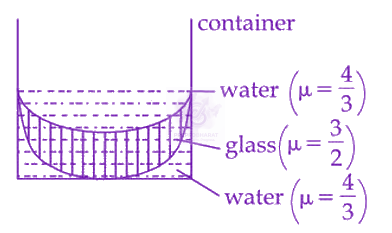
In a long glass tube, mixture of two liquids A and B with refractive indices 1.3 and 1.4 respectively, forms a convex refractive meniscus towards $A$. If an object placed at 13 cm from the vertex of the meniscus in A forms an image with a magnification of ' $-2^{\prime}$ then the radius of curvature of meniscus is :
The refractive index of the material of a glass prism is $\sqrt{3}$. The angle of minimum deviation is equal to the angle of the prism. What is the angle of the prism?
Given is a thin convex lens of glass (refractive index $\mu$ ) and each side having radius of curvature $R$. One side is polished for complete reflection. At what distance from the lens, an object be placed on the optic axis so that the image gets formed on the object itself ?
Two coherent monochromatic light beams of intensities 4I and 9I are superimposed. The difference between the maximum and minimum intensities in the resulting interference pattern is xI. The value of $x$ is ______.