JEE Main 2010 — Mechanics
Physics Mechanics questions from JEE Main 2010.
Other Years
10 Mechanics Questions from 2010
A point $\mathrm{P}$ moves in counter-clockwise direction on a circular path as shown in the figure. The movement of ' $\mathrm{P}$ ' is such that it sweeps out a length $s=t^3+5$, where $s$ is in metres and $t$ is in seconds. The radius of the path is $20 \mathrm{~m}$. The acceleration of ' $\mathrm{P}$ ' when $t=2 \mathrm{~s}$ is nearly 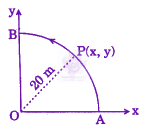
The potential energy function for the force between two atoms in a diatomic molecule is approximately given by $U(x)=\frac{a}{x^{12}}-\frac{b}{x^6}$, where a and $b$ are constants and $x$ is the distance between the atoms. If the dissociation energy of the molecule is $D=\left[U(x=\infty)-U_{\text {at equilbrium }}\right], D$ is
A ball is made of a material of density $\rho$ where $\rho_{\text {oil }} < \rho < \rho_{\text {water }}$ with $\rho_{\text {oil }}$ and $\rho_{\text {water }}$ representing the densities of oil and water, respectively. The oil and water are immiscible. If the above ball is in equilibrium in a mixture of this oil and water, which of the following pictures represents its equilibrium position?
Two fixed frictionless inclined plane making an angle $30^{\circ}$ and $60^{\circ}$ with the vertical are shown in the figure. Two block $A$ and $B$ are placed on the two planes. What is the relative vertical acceleration of $A$ with respect to $B$ ? 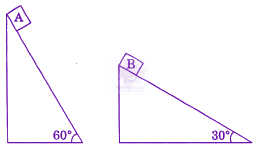
For a particle in uniform circular motion the acceleration $\vec{a}$ at a point $P(R, \theta)$ on the circle of radius $\mathrm{R}$ is (here $\theta$ is measured from the $x$-axis)
A particle is moving with velocity $\overrightarrow{\mathrm{v}}=\mathrm{K}(\mathrm{y} \hat{\mathrm{i}}+\mathrm{x} \hat{\mathrm{j}})$, where $\mathrm{K}$ is a constant. The general equation for its path is
Statement-1 : Two particles moving in the same direction do not lose all their energy in a completely inelastic collision. Statement-2 : Principle of conservation of momentum holds true for all kinds of collisions. Of the four choices given after the statements, choose the one that best describes the two statements. Of the four choices given after the statements, choose the one that best describes the two statements.
The respective number of significant figures for the numbers $23.023,0.0003$ and $2.1 \times 10^{-3}$ are
The figure shows the position - time $(x-t)$ graph of one-dimensional motion of a body of mass $0.4 \mathrm{~kg}$. The magnitude of each impulse is 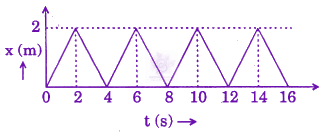
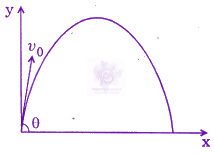
A small particle of mass $m$ is projected at an angle $\theta$ with the $\mathrm{x}$-axis with an initial velocity $\mathrm{v}_0$ in the $\mathrm{x}-\mathrm{y}$ plane as shown in the figure. At a time $t < \frac{v_0 \sin \theta}{g}$, the angular momentum of the particle is where $\hat{\mathrm{i}}, \hat{\mathrm{j}}$ and $\hat{\mathrm{k}}$ are unit vectors along $\mathrm{x}, \mathrm{y}$ and $\mathrm{z}$-axis respectively.