JEE Main 2005 — Mechanics
Physics Mechanics questions from JEE Main 2005.
Other Years
28 Mechanics Questions from 2005
The change in the value of $g$ at a height ' $h$ ' above the surface of the earth is the same as at a depth 'd' below the surface of earth. When both ' $d$ ' and ' $h$ ' are much smaller than the radius of earth, then which one of the following is correct?
A block is kept on a frictionless inclined surface with angle of inclination $\alpha$. The incline is given an acceleration a to keep the block stationary. Then a is equal to 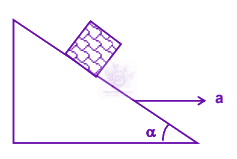
A particle is projected from a point $\mathrm{O}$ with velocity $u$ at an angle of $60^{\circ}$ with the horizontal. When it is moving in a direction at right angles to its direction at $O$, its velocity then is given by
A mass ' $m$ ' moves with a velocity $v$ and collides inelastically with another identical mass. After collision the $1^{\text {st }}$ mass moves with velocity $v / \sqrt{3}$ in a direction perpendicular to the initial direction of motion. Find the speed of the $2^{\text {nd }}$ mass after collision 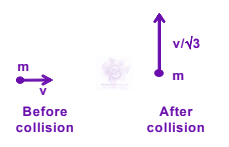
Average density of the earth
A body $A$ of mass $M$ while falling vertically downwards under gravity breaks into two parts; a body B of mass $1 / 3 \mathrm{M}$ and a body $\mathrm{C}$ of mass $2 / 3 \mathrm{M}$. The centre of mass of bodies $\mathrm{B}$ and $\mathrm{C}$ taken together shifts compared to that of body $\mathrm{A}$ towards
A parachutist after bailing out falls $50 \mathrm{~m}$ without friction. When parachute opens, it decelerates at $2 \mathrm{~m} / \mathrm{s}^2$. He reaches the ground with a speed of $3 \mathrm{~m} / \mathrm{s}$. At what height, did he bail out?
Out of the following pair, which one does NOT have identical dimensions is
A body of mass $m$ is accelerated uniformly from rest to a speed $v$ in a time $T$. The instantaneous power delivered to the body as a function time is given by
Consider a car moving on a straight road with a speed of $100 \mathrm{~m} / \mathrm{s}$. The distance at which car can be stopped is $\left[\mu_{\mathrm{k}}=0.5\right]$
The moment of inertia of a uniform semicircular disc of mass $M$ and radius $r$ about a line perpendicular to the plane of the disc through the centre is
The block of mass $M$ moving on the frictionless horizontal surface collides with a spring of spring constant $\mathrm{K}$ and compresses it by length $\mathrm{L}$. The maximum momentum of the block after collision is 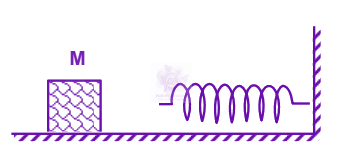
A bullet fired into a fixed target loses half of its velocity after penetrating $3 \mathrm{~cm}$. How much further it will penetrate before coming to rest assuming that it faces constant resistance to motion?
Two points $A$ and $B$ move from rest along a straight line with constant acceleration $f$ and $f$ ' respectively. If $A$ takes $m$ sec. more than $B$ and describes ' $n$ ' units more than $B$ in acquiring the same speed then
A particle of mass $10 \mathrm{~g}$ is kept on the surface of a uniform sphere of mass $100 \mathrm{~kg}$ and radius $10 \mathrm{~cm}$. Find the work to be done against the gravitational force between them to take the particle far away from the sphere (you may take $\mathrm{G}=6.67 \times 10^{-11} \mathrm{Nm}^2 / \mathrm{kg}^2$ )
If $S$ is stress and $Y$ is Young's modulus of material of a wire, the energy stored in the wire per unit volume is
$A$ and $B$ are two like parallel forces. A couple of moment $\mathrm{H}$ lies in the plane of $A$ and $B$ and is contained with them. The resultant of $A$ and $B$ after combining is displaced through a distance
A 'T' shaped object with dimensions shown in the figure, is lying on a smooth floor. A force $F$ is applied at the point $P$ parallel to $A B$, such that the object has only the translational motion without rotation. Find the location of $P$ with respect to $C$ 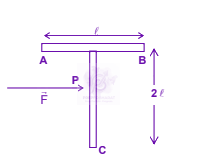
An annular ring with inner and outer radii $R_1$ and $R_2$ is rolling without slipping with a uniform angular speed. The ratio of the forces experienced by the two particles situated on the inner and outer parts of the ring, $F_1 / F_2$ is
A spherical ball of mass $20 \mathrm{~kg}$ is stationary at the top of a hill of height $100 \mathrm{~m}$. It rolls down a smooth surface to the ground, then climbs up another hill of height $30 \mathrm{~m}$ and finally rolls down to a horizontal base at a height of $20 \mathrm{~m}$ above the ground. The velocity attained by the ball is
A $20 \mathrm{~cm}$ long capillary tube is dipped in water. The water rises up to $8 \mathrm{~cm}$. If the entire arrangement is put in a freely falling elevator the length of water column in the capillary tube will be
A projectile can have the same range $\mathrm{R}$ for two angles of projection. If $\mathrm{t}_1$ and $\mathrm{t}_2$ be the times of flights in the two cases, then the product of the two time of flights is proportional to
A particle is moving eastwards with a velocity of $5 \mathrm{~m} / \mathrm{s}$ in 10 seconds the velocity changes to $5 \mathrm{~m} / \mathrm{s}$ northwards. The average acceleration in this time is
A smooth block is released at rest on a $45^{\circ}$ incline and then slides a distance d. The time taken to slide is $\mathrm{n}$ times as much to slide on rough incline than on a smooth incline. The coefficient of friction is
The upper half of an inclined plane with inclination $\phi$ is perfectly smooth while the lower half is rough. A body starting from rest at the top will again come to rest at the bottom if the coefficient of friction for the lower half is given by
The relation between time $t$ and distance $\mathrm{x}$ is $\mathrm{t}=a \mathrm{x}^2+\mathrm{bx}$ where $\mathrm{a}$ and $\mathrm{b}$ are constants. The acceleration is
A particle of mass $0.3 \mathrm{~kg}$ is subjected to a force $F=-k x$ with $k=15 \mathrm{~N} / \mathrm{m}$. What will be its initial acceleration if it is released from a point $20 \mathrm{~cm}$ away from the origin?
A car starting from rest accelerates at the rate $f$ through a distance $S$, then continues at constant speed for time $t$ and then decelerates at the rate $f / 2$ to come to rest. If the total distance traversed is $15 \mathrm{~S}$, then