JEE Main 2004 — Mechanics
Physics Mechanics questions from JEE Main 2004.
Other Years
25 Mechanics Questions from 2004
A particle moves in a straight line with retardation proportional to its displacement. Its loss of kinetic energy for any displacement $\mathrm{x}$ is proportional to
A body of mass $m$, accelerates uniformly from rest to $v_1$ in time $t_1$. The instantaneous power delivered to the body as a function of time $t$ is
If $t_1$ and $t_2$ are the times of flight of two particles having the same initial velocity $u$ and range $\mathrm{R}$ on the horizontal, then $\mathrm{t}_1^2+\mathrm{t}_2^2$ is equal to
A machine gun fires a bullet of mass $40 \mathrm{~g}$ with a velocity $1200 \mathrm{~ms}^{-1}$. The man holding it can exert a maximum force of $144 \mathrm{~N}$ on the gun. How many bullets can he fire per second at the most?
If $\vec{A} \times \vec{B}=\vec{B} \times \vec{A}$, then the angle between $A$ and $B$ is
A wire fixed at the upper end stretches by length by applying a force F. The work done in stretching is
If two soap bubbles of different radii are connected by a tube,
The time period of an earth satellite in circular orbit is independent of
Suppose the gravitational force varies inversely as the nth power of distance. Then the time period planet in circular orbit of radius $\mathrm{R}$ around the sun will be proportional to
A block rests on a rough inclined plane making an angle of $30^{\circ}$ with the horizontal. The coefficient of static friction between the block and the plane is $0.8$. If the frictional force on the block is $10 \mathrm{~N}$, the mass of the block (in $\mathrm{kg}$ ) is (take $\mathrm{g}=10 \mathrm{~m} / \mathrm{s}^2$ )
A projectile can have the same range $R$ for two angles of projection. If $T_1$ and $T_2$ be the time of flights in the two cases, then the product of the two time of flights is directly proportional to
Which one of the following represents the correct dimensions of the coefficient of viscosity?
A ball is thrown from a point with a speed $v_0$ at an angle of projection $\theta$. From the same point and at the same instant person starts running with a constant speed $v_0 / 2$ to catch the ball. Will the person be able to catch the ball? If yes, what should be the angle of projection?
Spherical balls of radius $R$ are falling in a viscous fluid of viscosity $\eta$ with a velocity $v$. The retarding viscous force acting on the spherical ball is
One solid sphere A and another hollow sphere B are of same mass and same outer radii. Their moment of inertia about their diameters are respectively $\mathrm{I}_{\mathrm{A}}$ and $\mathrm{I}_{\mathrm{B}}$ such that
If $\mathrm{g}$ is the acceleration due to gravity on the earth's surface, the gain in the potential energy of object of mass $m$ raised from the surface of the earth to a height equal to the radius $R$ of the earth is
A particle is acted upon by a force of constant magnitude which is always perpendicular to the velocity of the particle, the motion of the particle takes place in a plane. It follows that
A ball is released from the top of a tower of height $h$ metres. It takes $T$ seconds to reach the ground. What is the position of the ball in $\mathrm{T} / 3$ seconds?
Two masses $m_1=5 \mathrm{~kg}$ and $m_2=4.8 \mathrm{~kg}$ tied to a string are hanging over a light frictionless pulley. What is the acceleration of the masses when lift free to move $\left(\mathrm{g}=9.8 \mathrm{~m} / \mathrm{s}^2\right)$ 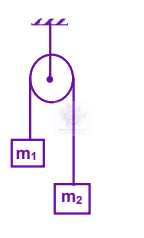
A solid sphere is rotating in free space. If the radius of the sphere is increased keeping mass same which one of the following will not be affected?
A satellite of mass $m$ revolves around the earth of radius $R$ at a height $x$ from its surface. If $g$ is the acceleration due to gravity on the surface of the earth, the orbital speed of the satellite is
A uniform chain of length $2 \mathrm{~m}$ is kept on a table such that a length of $60 \mathrm{~cm}$ hangs freely from the edge of the table. The total mass of the chain is $4 \mathrm{~kg}$. What is the work done in pulling the entire chain on the table?
Which of the following statements is false for a particle moving in a circle with a constant angular speed?
A force $\vec{F}=(5 \hat{i}+3 \hat{j}+2 \hat{k}) N$ is applied over a particle which displaces it from its origin to the point $\vec{r}=(2 \hat{i}-\hat{j}) m$. The work done on the particle in joules is
An automobile travelling with speed of $60 \mathrm{~km} / \mathrm{h}$, can brake to stop within a distance of $20 \mathrm{~cm}$. If the car is going twice as fast, i.e $120 \mathrm{~km} / \mathrm{h}$, the stopping distance will be