JEE Main 2008 — Mechanics
Physics Mechanics questions from JEE Main 2008.
Other Years
14 Mechanics Questions from 2008
A body is at rest at $x=0$. At $t=0$, it starts moving in the positive $x$-direction with a constant acceleration. At the same instant another body passes through $x=0$ moving in the positive $x$ direction with a constant speed. The position of the first body is given by $\mathrm{x}_1(\mathrm{t})$ after time ' $\mathrm{t}$ ' and that of the second body by $x_2(t)$ after the same time interval. Which of the following graphs correctly describes $\left(x_1-x_2\right)$ as a function of time ' $t$ '?
Two full turns of the circular scale of a screw gauge cover a distance of $1 \mathrm{~mm}$ on its main scale. The total number of divisions on the circular scale is 50 . Further, it is found that the screw gauge has a zero error of $-0.03 \mathrm{~mm}$ while measuring the diameter of a thin wire, a student notes the main scale reading of $3 \mathrm{~mm}$ and the number of circular scale divisions in line with the main scale as 35 . The diameter of the wire is
A thin rod of length ' $L$ ' is lying along the $x$-axis with its ends at $x=0$ and $x=L$. Its linear density (mass/length) varies with $x$ ask $\left(\frac{x}{L}\right)^n$, where $n$ can be zero or any positive number. If the position $x_{\mathrm{CM}}$ of the centre of mass of the rod is plotted against ' $n$ ', which of the following graphs best approximates the dependence of $x_{\mathrm{CM}}$ on $n$ ?
A block of mass $0.50 \mathrm{~kg}$ is moving with a speed of $2.00 \mathrm{~m} / \mathrm{s}$ on a smooth surface. It strikes another mass of $1.00 \mathrm{~kg}$ and then they move together as a single body. The energy loss during the collision is
Consider a uniform square plate of side ' $a$ ' and mass ' $m$ '. The moment of inertia of this plate about an axis perpendicular to its plane and passing through one of its corners is
A spherical solid ball of volume $V$ is made of a material of density $\rho_1$. It is falling through a liquid of density $\rho_2\left(\rho_2 < \rho_1\right)$. Assume that the liquid applies a viscous force on the ball that is proportional to the square of its speed v, i.e., $F_{\text {viscous }}=-k v^2(k>0)$. The terminal speed of the ball is
An athlete in the olympic games covers a distance of $100 \mathrm{~m}$ in $10 \mathrm{~s}$. His kinetic energy can be estimated to be in the range
A planet in a distant solar system is 10 times more massive than the earth and its radius is 10 times smaller. Given that the escape velocity from the earth is $11 \mathrm{kms}^{-1}$, the escape velocity from the surface of the planet would be
Shown in the figure below is a meter-bridge set up with null deflection in the galvanometer. 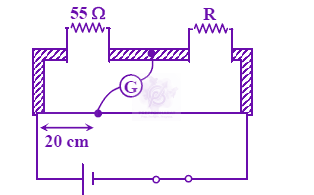 The value of the unknown resistor $R$ is
A body of mass $m=3.513 \mathrm{~kg}$ is moving along the $x$-axis with a speed of $5.00 \mathrm{~ms}^{-1}$. The magnitude of its momentum is recorded as
This question contains Statement $-1$ and Statement-2. Of the four choices given after the statements, choose the one that best describes the two statements. Statement - I: For a mass $M$ kept at the centre of a cube of side ' $a$ ', the flux of gravitational field passing through its sides is $4 \pi$ GM. and Statement - II If the direction of a field due to a point source is radial and its dependence on the distance ' $r$ ' for the source is given as $1 / r^2$, its flux through a closed surface depends only on the strength of the source enclosed by the surface and not on the size or shape of the surface
A capillary tube $(\mathrm{A})$ is dropped in water. Another identical tube $(\mathrm{B})$ is dipped in a soap water solution. Which of the following shows the relative nature of the liquid columns in the two tubes? 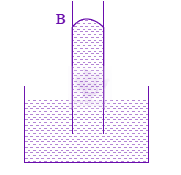
A jar filled with two non mixing liquids 1 and 2 having densities $\rho_1$ and $\rho_2$ respectively. A solid ball, made of a material of density $\rho_3$, is dropped in the jar. It comes to equilibrium in the position shown in the figure. Which of the following is true for $\rho_1, \rho_2$ and $\rho_3$ ? 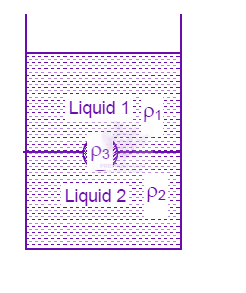
The dimension of magnetic field in $\mathrm{M}, \mathrm{L}, \mathrm{T}$ and $\mathrm{C}$ (Coulomb) is given as