JEE Main 2012 — Mechanics
Physics Mechanics questions from JEE Main 2012.
Other Years
48 Mechanics Questions from 2012
A student measured the diameter of a wire using a screw gauge with the least count $0.001 \mathrm{~cm}$ and listed the measurements. The measured value should be recorded as
The amount of heat produced in an electric circuit depends upon the current $(I)$, resistance $(R)$ and time $(t)$. If the error made in the measurements of the above quantities are $2 \%, 1 \%$ and $1 \%$ respectively then the maximum possible error in the total heat produced will be
A spring is compressed between two blocks of masses $m_1$ and $m_2$ placed on a horizontal frictionless surface as shown in the figure. When the blocks are released, they have initial velocity of $v_1$ and $v_2$ as shown. The blocks travel distances $x_1$ and $x_2$ respectively before coming to rest. The ratio $\left(\frac{x_1}{x_2}\right)$ is 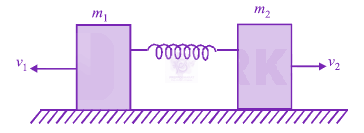
A circular hole of diameter $\mathrm{R}$ is cut from a disc of mass $M$ and radius $R$; the circumference of the cut passes through the centre of the disc. The moment of inertia of the remaining portion of the disc about an axis perpendicular to the disc and passing through its centre is
This question has Statement 1 and Statement 2. Of the four choices given after the Statements, choose the one that best describes the two Statements. Statement 1: When moment of inertia $I$ of a body rotating about an axis with angular speed $\omega$ increases, its angular momentum $L$ is unchanged but the kinetic energy $K$ increases if there is no torque applied on it. Statement 2: $L=I \omega$, kinetic energy of rotation $=\frac{1}{2} I \omega^2$
Which graph correctly presents the variation of acceleration due to gravity with the distance from the centre of the earth (radius of the earth $=R_E$ )?
The load versus elongation graphs for four wires of same length and made of the same material are shown in the figure. The thinnest wire is represented by the line 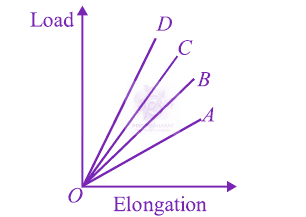
An engine pumps water continuously through a hose. Water leaves the hose with velocity $v$ and $m$ is mass per unit length of the water jet. If this jet hits a surface and came to rest instantaneously, the force on the surface is
A ball is dropped vertically downwards from a height $h$ above the ground. It hits the ground inelastically and bounces up vertically. Neglecting subsequent motion and air resistance, which of the following graph represents variation between speed $(v)$ and height $(h)$ correctly?
The graph of an object's motion (along the $x-$ axis) is shown in the figure. The instantaneous velocity of the object at points $A$ and $B$ are $v_A$ and $v_B$ respectively. Then 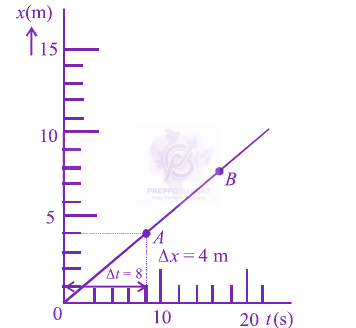
Two point masses of mass $m_1=f M$ and $m_2=(1-f) M(f < 1)$ are in outer space (far from gravitational influence of other objects) at a distance $R$ from each other. They move in circular orbits about their centre of mass with angular velocities $\omega_1$ for $m_1$ and $\omega_2$ for $m_2$. In that case
Resistance of a given wire is obtained by measuring the current flowing in it and the voltage difference applied across it. If the percentage errors in the measurement of the current and the voltage difference are $3 \%$ each, then error in the value of resistance of the wire is
Sand is being dropped on a conveyer belt at the rate of $2 \mathrm{~kg}$ per second. The force necessary to keep the belt moving with a constant speed of $3 \mathrm{~ms}^{-1}$ will be
A steel wire can sustain $100 \mathrm{~kg}$ weight without breaking. If the wire is cut into two equal parts, each part can sustain a weight of
Two cars of masses $m_1$ and $m_2$ are moving in circles of radii $r_1$ and $r_2$, respectively. Their speeds are such that they make complete circles in the same time $t$. The ratio of their centripetal acceleration is
An insect crawls up a hemispherical surface very slowly. The coefficient of friction between the insect and the surface is $1 / 3$. If the line joining the centre of the hemispherical surface to the insect makes an angle $\alpha$ with the vertical, the maximum possible value of $\alpha$ so that the insect does not slip is given by 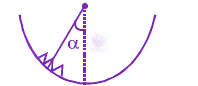
A stone of mass $m$, tied to the end of a string, is whirled around in a circle on a horizontal frictionless table. The length of the string is reduced gradually keeping the angular momentum of the stone about the centre of the circle constant. Then, the tension in the string is given by $T=A r^n$, where $A$ is a constant, $r$ is the instantaneous radius of the circle. The value of $n$ is equal to
$N$ divisions on the main scale of a vernier calliper coincide with $(N+1)$ divisions of the vernier scale. If each division of main scale is ' $a$ ' units, then the least count of the instrument is
A point particle is held on the axis of a ring of mass $m$ and radius $r$ at a distance $r$ from its centre $C$. When released, it reaches $C$ under the gravitational attraction of the ring. Its speed at $C$ will be
The mass of a spaceship is $1000 \mathrm{~kg}$. It is to be launched from the earth's surface out into free space. The value of ' $\mathrm{g}$ ' and ' $R$ ' (radius of earth) are $10 \mathrm{~m} / \mathrm{s}^2$ and $6400 \mathrm{~km}$ respectively. The required energy for this work will be ;
This question has statement $1$ and statement $2$. Of the four choices given after the statements, choose the one that best describes the two statements. If two springs $\mathrm{S_1}$ and $\mathrm{S_2}$ of force constants $k_1$ and $k_2$, respectively, are stretched by the same force, it is found that more work is done on spring $\mathrm{S_1}$ than on spring $\mathrm{S_2}$. Statement $1$ : If stretched by the same amount, work done on $\mathrm{S}_1$, will be more than that on $\mathrm{S}_2$ Statement $2: k_1 < k_2$
A structural steel rod has a radius of $10 \mathrm{~mm}$ and length of $1.0 \mathrm{~m}$. A $100 \mathrm{kN}$ force stretches it along its length. Young's modulus of structural steel is $2 \times 10^{11} \mathrm{Nm}^{-2}$. The percentage strain is about
A goods train accelerating uniformly on a straight railway track, approaches an electric pole standing on the side of track. Its engine passes the pole with velocity $u$ and the guard's room passes with velocity $v$. The middle wagon of the train passes the pole with a velocity.
A square hole of side length $\ell$ is made at a depth of $\mathrm{h}$ and a circular hole of radius $\mathrm{r}$ is made at a depth of $4 \mathrm{~h}$ from the surface of water in a water tank kept on a horizontal surface. If $\ell< < h, r< < h$ and the rate of water flow from the holes is the same, then $r$ is equal to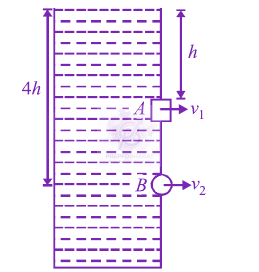
A thick-walled hollow sphere has outside radius $R_0$. It rolls down an incline without slipping and its speed at the bottom is $v_0$. Now the incline is waxed, so that it is practically frictionless and the sphere is observed to slide down (without any rolling). Its speed at the bottom is observed to be $5 v_0 / 4$. The radius of gyration of the hollow sphere about an axis through its centre is
Given that $K=$ energy, $V=$ velocity, $T=$ time. If they are chosen as the fundamental units, then what is dimensional formula for surface tension?
The terminal velocity of a small sphere of radius $a$ in a viscous liquid is proportional to
A car of mass $1000 \mathrm{~kg}$ is moving at a speed of 30 $\mathrm{m} / \mathrm{s}$. Brakes are applied to bring the car to rest. If the net retarding force is $5000 \mathrm{~N}$, the car comes to stop after travelling $d \mathrm{~m}$ in $t \mathrm{~s}$. Then
Two bodies $A$ and $B$ of mass $m$ and $2 m$ respectively are placed on a smooth floor. They are connected by a spring of negligible mass. $A$ third body $C$ of mass $m$ is placed on the floor. The body $C$ moves with a velocity $v_0$ along the line joining $A$ and $B$ and collides elastically with $A$. At a certain time after the collision it is found that the instantaneous velocities of $A$ and $B$ are same and the compression of the spring is $x_0$. The spring constant $k$ will be
A projectile moving vertically upwards with a velocity of $200 \mathrm{~ms}^{-1}$ breaks into two equal parts at a height of $490 \mathrm{~m}$. One part starts moving vertically upwards with a velocity of $400 \mathrm{~ms}^{-1}$. How much time it will take, after the break up with the other part to hit the ground?
Water is flowing through a horizontal tube having cross-sectional areas of its two ends being $A$ and $A^{\prime}$ such that the ratio $A / A^{\prime}$ is 5 . If the pressure difference of water between the two ends is $3 \times$ $10^5 \mathrm{~N} \mathrm{~m}^{-2}$, the velocity of water with which it enters the tube will be (neglect gravity effects)
A satellite moving with velocity $v$ in a force free space collects stationary interplanetary dust at a rate of $\frac{d M}{d t}=\alpha v$ where $M$ is the mass (of satellite + dust) at that instant. The instantaneous acceleration of the satellite is
This question has Statement 1 and Statement 2 . Of the four choices given after the Statements, choose the one that best describes the two Statements. Statement 1: If you push on a cart being pulled by a horse so that it does not move, the cart pushes you back with an equal and opposite force. Statement 2: The cart does not move because the force described in statement 1 cancel each other.
Assuming the earth to be a sphere of uniform density, the acceleration due to gravity inside the earth at a distance of $r$ from the centre is proportional to
A solid sphere is rolling on a surface as shown in figure, with a translational velocity $v \mathrm{~m} \mathrm{~s}^{-1}$. If it is to climb the inclined surface continuing to roll without slipping, then minimum velocity for this to happen is 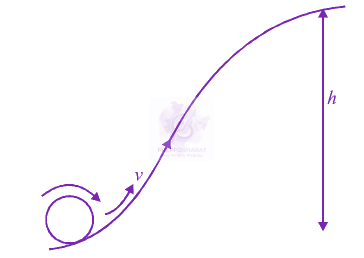
A particle of mass $\mathrm{m}$ is at rest at the origin at time $\mathrm{t}=0$. It is subjected to a force $\mathrm{F}(\mathrm{t})=\mathrm{F}_0 \mathrm{e}^{-\mathrm{bt}}$ in the $x$ direction. Its speed $v(t)$ is depicted by which of the following curves?
A particle gets displaced by $\Delta \bar{r}=(2 \hat{i}+3 \hat{j}+4 \hat{k}) \mathrm{m}$ under the action of a force $\vec{F}=(7 \hat{i}+4 \hat{j}+3 \hat{k})$. The change in its kinetic energy is
A large number of droplets, each of radius, $r$ coalesce to form a bigger drop of radius, $R$. An engineer designs a machine so that the energy released in this process is converted into the kinetic energy of the drop. Velocity of the drop is ( $T=$ surface tension, $\rho=$ density)
A thin liquid film formed between a U-shaped wire and a light slider supports a weight of $1.5 \times 10^{-2} \mathrm{~N}$ (see figure). The length of the slider is $30 \mathrm{~cm}$ and its weight negligible. The surface tension of the liquid film is 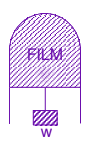
The force $\vec{F}=F \hat{i}$ on a particle of mass $2 \mathrm{~kg}$, moving along the $x$-axis is given in the figure as a function of its position $x$. The particle is moving with a velocity of $5 \mathrm{~m} / \mathrm{s}$ along the $x$-axis at $x=0$. What is the kinetic energy of the particle at $x=8 \mathrm{~m} ?$ 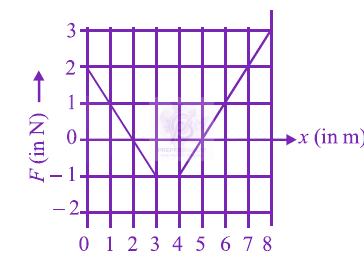
The electrical resistance $R$ of a conductor of length $l$ and area of cross section $a$ is given by $R=\frac{\rho l}{a}$ where ' $\rho$ ' is the electrical resistivity. What is the dimensional formula for electrical conductivity ' $\sigma$ ' which is reciprocal of resistivity?
A solid sphere having mass $m$ and radius $r$ rolls down an inclined plane. Then its kinetic energy is
A spectrometer gives the following reading when used to measure the angle of a prism. Main scale reading: $58.5$ degree Vernier scale reading : $09$ divisions Given that $1$ division on main scale corresponds to $0.5$ degree. Total divisions on the vernier scale is $30$ and match with $29$ divisions of the main scale. The angle of the prism from the above data
A boy can throw a stone up to a maximum height of $10 \mathrm{~m}$. The maximum horizontal distance that the boy can throw the same stone up to will be
A moving particle of mass $m$, makes a head on elastic collision with another particle of mass $2 m$, which is initially at rest. The percentage loss in energy of the colliding particle on collision, is close to
A block of weight $W$ rests on a horizontal floor with coefficient of static friction $\mu$. It is desired to make the block move by applying minimum amount of force. The angle $\theta$ from the horizontal at which the force should be applied and magnitude of the force $F$ are respectively.
In a cylindrical water tank, there are two small holes $A$ and $B$ on the wall at a depth of $h_1$, from the surface of water and at a height of $h_2$ from the bottom of water tank. Surface of water is at height of $h_2$ from the bottom of water tank. Surface of water is at heigh $H$ from the bottom of water tank. Water coming out from both holes strikes the ground at the same point $S$. Find the ratio of $h_1$ and $h_2$ 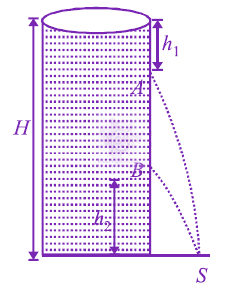
The distance travelled by a body moving along a line in time $t$ is proportional to $t^3$. The acceleration-time $(a, t)$ graph for the motion of the body will be