JEE Main 2007 — Mechanics
Physics Mechanics questions from JEE Main 2007.
Other Years
10 Mechanics Questions from 2007
A circular disc of radius $\mathrm{R}$ is removed from a bigger circular disc of radius $\mathrm{2R}$ such that the circumferences of the discs coincide. The centre of mass of the new disc is $\mathrm{\alpha / R}$ from the centre of the bigger disc. The value of $\mathrm{\alpha}$ is
A round uniform body of radius $\mathrm{R}$, mass $\mathrm{M}$ and moment of inertia '$\mathrm{I}$', rolls down (without slipping) an inclined plane making an angle $\theta$ with the horizontal. Then its acceleration is
Angular momentum of the particle rotating with a central force is constant due to
A particle is projected at $60^{\circ}$ to the horizontal with a kinetic energy $\mathrm{K}$. The kinetic energy at the highest point is
The velocity of a particle is $\mathrm{v}=\mathrm{v}_0+\mathrm{gt}+\mathrm{ft}^2$. If its position is $\mathrm{x}=0$ at $\mathrm{t}=0$, then its displacement after unit time $(t=1)$ is
A block of mass ' $\mathrm{m}$ ' is connected to another block of mass ' $\mathrm{M}$ ' by a spring (massless) of spring constant ' $\mathrm{k}$ '. The blocks are kept on a smooth horizontal plane. Initially the blocks are at rest and the spring is unstretched. Then a constant force '$\mathrm{F}$' starts acting on the block of mass '$\mathrm{M}$' to pull it. Find the force on the block of mass '$\mathrm{m}$'
A body weighing $13 \mathrm{~kg}$ is suspended by two strings $5 \mathrm{~m}$ and $12 \mathrm{~m}$ long, their other ends being fastened to the extremities of a rod $13 \mathrm{~m}$ long. If the rod be so held that the body hangs immediately below the middle point. The tensions in the strings are
A particle just clears a wall of height $b$ at distance $a$ and strikes the ground at a distance $c$ from the point of projection. The angle of projection is
A $2 \mathrm{~kg}$ block slides on a horizontal floor with a speed of $4 \mathrm{~m} / \mathrm{s}$. It strikes a uncompressed spring, and compresses it till the block is motionless. The kinetic friction force is $15 \mathrm{~N}$ and spring constant is $10,000 . \mathrm{N} / \mathrm{m}$. The spring compresses by
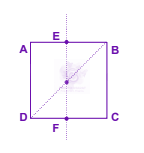
For the given uniform square lamina $\mathrm{A B C D}$, whose centre is $\mathrm{O}$,