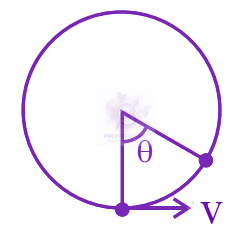
At the lowermost point, there is no tangential force on the ball. Thus, there exists no tangential acceleration at the bottommost point, only the centripetal acceleration survives.
On the other hand, in the extreme position of the ball, there is no centripetal acceleration as the ball becomes momentarily at rest at that position. Here, only tangential acceleration survives.
Thus, with respect to the figure above, equating the kinetic energy at the bottommost point to the potential energy at the extreme point, we have
21mv2=mgl(1−cosθ)⇒lv2=2g(1−cosθ)...(1)
Now, the net acceleration (at) at the extreme point can be written as
at=gsinθ...(2)
According to the given problem, it follows that for the two positions of the ball,
at=lv2...(3)
Equations (1), (2) and (3) imply that
gsinθ=2g(1−cosθ)⇒2sin2θcos2θ=4sin22θ⇒tan2θ=21⇒θ=2tan−1(21)