It is known that
ω=T2π⇒ω∝T1
As,
Tmoon ≈27 days
Tearth ≈365 days
⇒ωmoon >ωearth
Hence, Both the assertion and the reason are correct and the reason is the correct explanation for the assertion.
JEE Main 2024 — Physics Mechanics
Given below are two statements : one is labelled as Assertion (A) and the other is labelled as Reason (R).
Assertion (A) : The angular speed of the moon in its orbit about the earth is more than the angular speed of the earth in its orbit about the sun.
Reason (R): The moon takes less time to move around the earth than the time taken by the earth to move around the sun.
In the light of the above statements, choose the most appropriate answer from the options given below :
Held on 27 Jan 2024 · Verified 6 Jul 2026.
(A) is correct but (R) is not correct
Both (A) and (R) are correct and (R) is the correct explanation of A.
Both (A) and (R) are correct but (R) is not the correct explanation of A.
(A) is not correct but (R) is correct
Sign in to track your attempts and accuracy.
Sign in to keep a private note on this question. Nothing you write is ever public.
If $\epsilon, E$ and $t$ represent the free space permittivity, electric field and time respectively, then the unit of $\frac{\epsilon E}{t}$ will be :
When a part of a straight capillary tube is placed vertically in a liquid, the liquid raises upto certain height $h$. If the inner radius of the capillary tube, density of the liquid and surface tension of the liquid decrease by $1 \%$ each, then the height of the liquid in the tube will change by $\%$.
The velocity of a particle is given as $\vec{v} = -x\hat{i} + 2y\hat{j} - z\hat{k}$ m/s. The magnitude of acceleration at point $(1, 2, 4)$ is _______ m/s$^2$.
Suppose there is a uniform circular disc of mass $M \mathrm{~kg}$ and radius $r \mathrm{~m}$ shown in figure. The shaded regions are cut out from the disc. The moment of inertia of the remainder about the axis $A$ of the disc is given by $\frac{x}{256} M r^{2}$. The value of $x$ is $\_\_\_\_$. 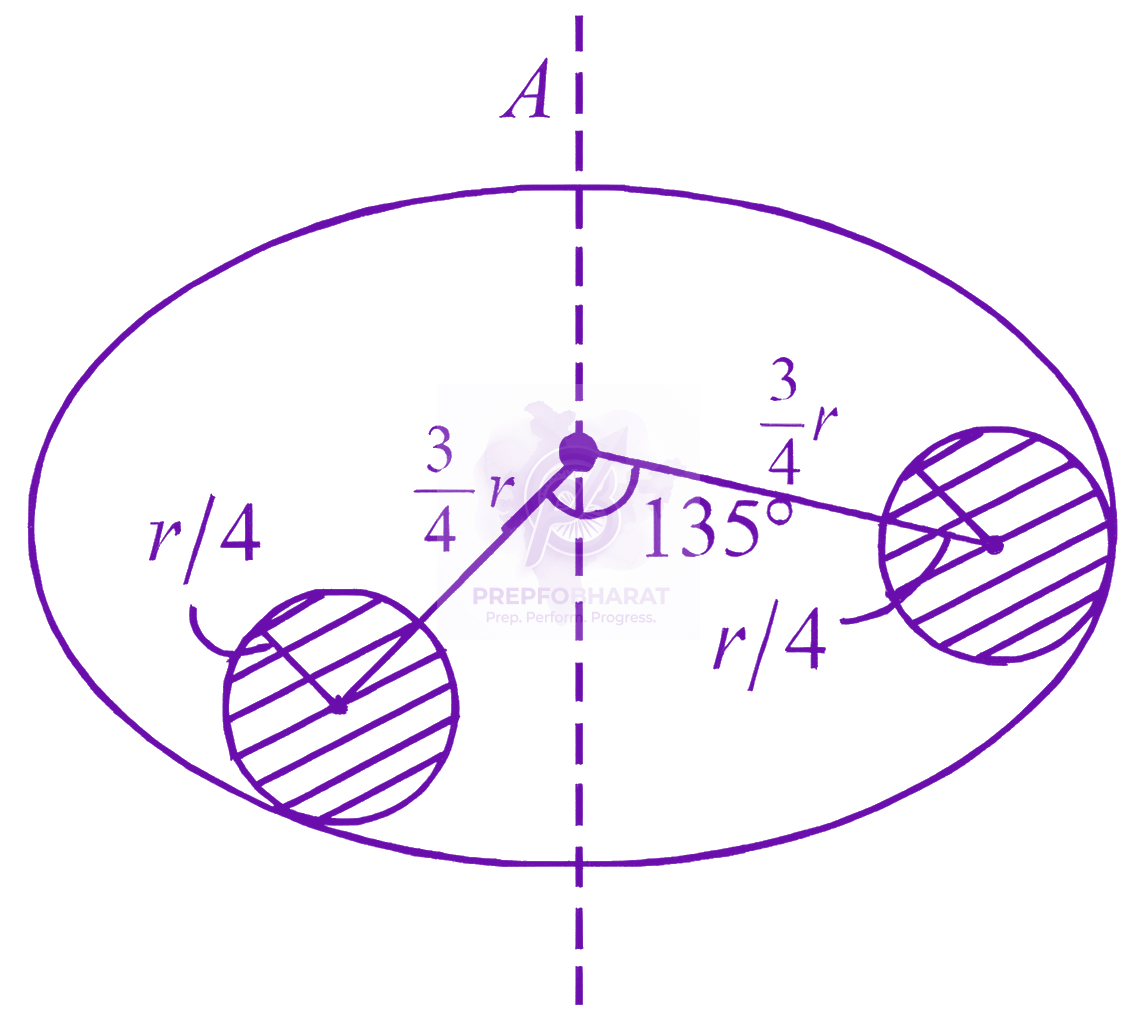
A soap bubble of surface tension $0.04 \mathrm{~N} / \mathrm{m}$ is blown to a diameter of 7 cm. If $(15000-x) \mu \mathrm{J}$ of work is done in blowing it further to make its diameter 14 cm, then the value of $x$ is $\_\_\_\_$. ($\pi=22 / 7$)
Work through every JEE Main Mechanics PYQ, year by year.