Consider a small steel ball as shown below:
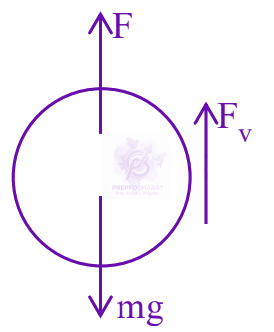
As shown in diagram, buoyancy force FB=F.
Applying Newton's second law, we get
mg−FB−Fv=ma
⇒(ρ34πr3)g−(ρL34πr3)g−6πηrv=mdtdv
Let 3m4πR3g(ρ−ρL)=K1 and m6πηr=K2, then we get
⇒dtdv=K1−K2v
Integrating both sides, we get
⇒∫0vK1−K2vdv=∫0tdt
⇒−K21ln[K1−K2v]0v=t
⇒ln(K1K1−K2v)=−K2t
⇒K1−K2v=K1e−K2t
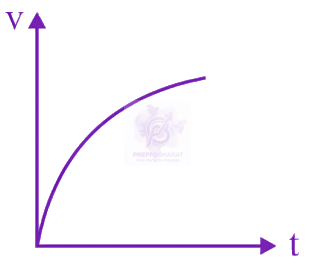
⇒v=K2K1[1−e−K2t]
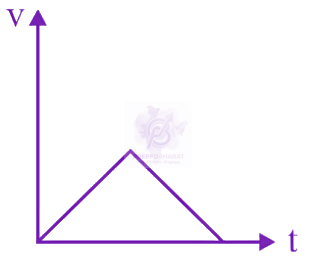
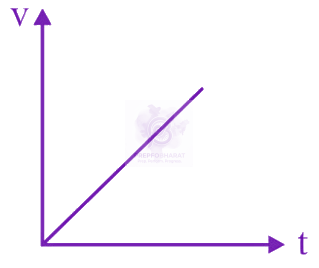
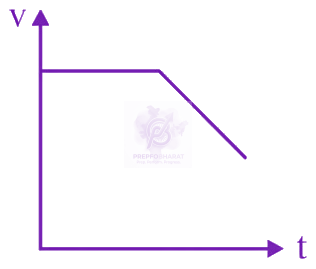
Clearly, option B matches with the given variation of velocity with time.