a=(1+mR2I)gsinθ
Iring>Isolidcylinder>Isolidsphere
⇒aring<asolidcylinder<asolidsphere
⇒vring<vsolidcylinder<vsolidsphere
JEE Main 2021 — Physics Mechanics
Consider a situation in which a ring, a solid cylinder and a solid sphere roll down on the same inclined plane without slipping. Assume that they start rolling from rest and having identical diameter. The correct statement for this situation is
Held on 22 Jul 2021 · Verified 6 Jul 2026.
The sphere has the greatest and the ring has the least velocity of the centre of mass at the bottom of the inclined plane.
The ring has the greatest and the cylinder has the least velocity of the centre of mass at the bottom of the inclined plane.
All of them will have same velocity.
The cylinder has the greatest and the sphere has the least velocity of the centre of mass at the bottom of the inclined plane.
Sign in to track your attempts and accuracy.
Sign in to keep a private note on this question. Nothing you write is ever public.
If $\epsilon, E$ and $t$ represent the free space permittivity, electric field and time respectively, then the unit of $\frac{\epsilon E}{t}$ will be :
When a part of a straight capillary tube is placed vertically in a liquid, the liquid raises upto certain height $h$. If the inner radius of the capillary tube, density of the liquid and surface tension of the liquid decrease by $1 \%$ each, then the height of the liquid in the tube will change by $\%$.
The velocity of a particle is given as $\vec{v} = -x\hat{i} + 2y\hat{j} - z\hat{k}$ m/s. The magnitude of acceleration at point $(1, 2, 4)$ is _______ m/s$^2$.
Suppose there is a uniform circular disc of mass $M \mathrm{~kg}$ and radius $r \mathrm{~m}$ shown in figure. The shaded regions are cut out from the disc. The moment of inertia of the remainder about the axis $A$ of the disc is given by $\frac{x}{256} M r^{2}$. The value of $x$ is $\_\_\_\_$. 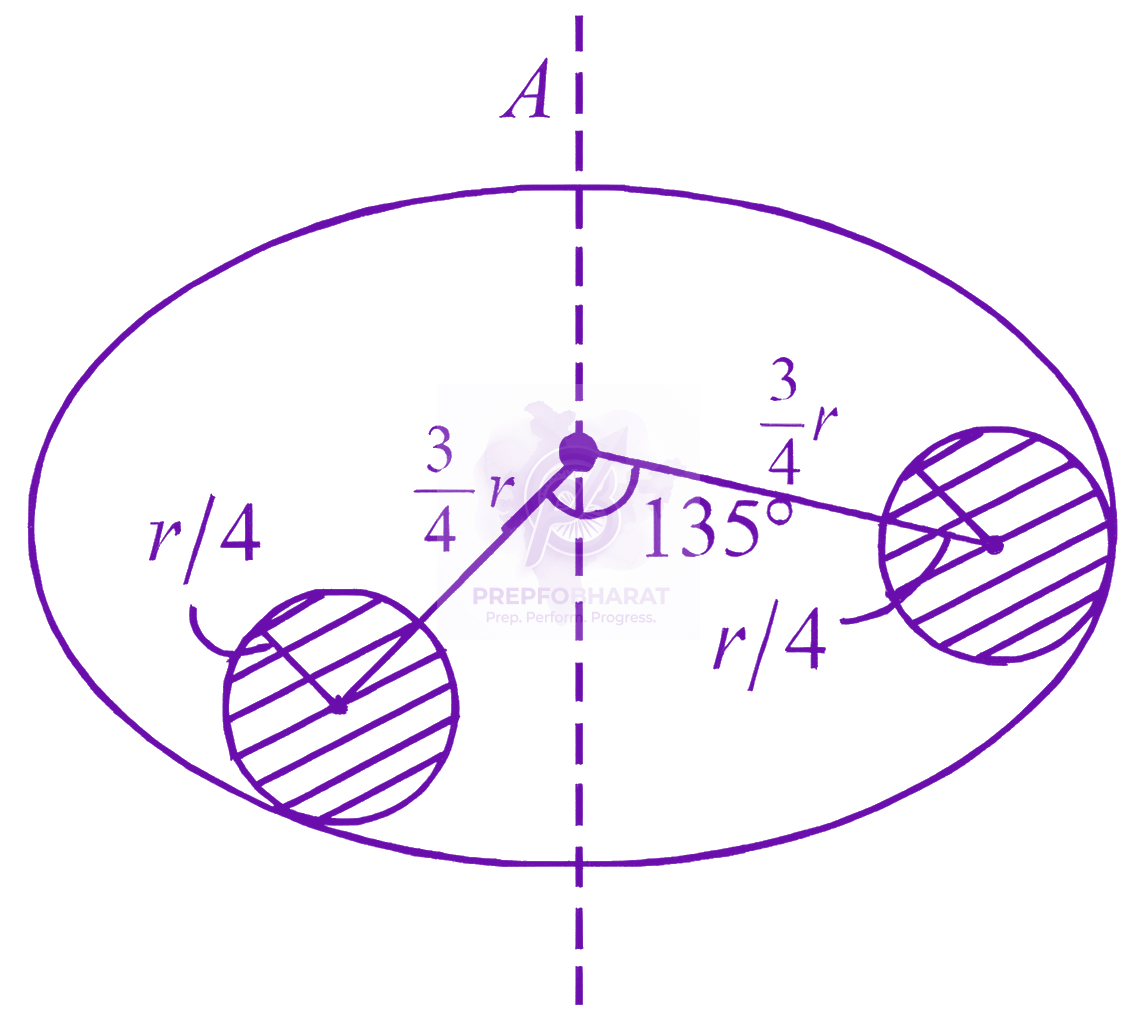
A soap bubble of surface tension $0.04 \mathrm{~N} / \mathrm{m}$ is blown to a diameter of 7 cm. If $(15000-x) \mu \mathrm{J}$ of work is done in blowing it further to make its diameter 14 cm, then the value of $x$ is $\_\_\_\_$. ($\pi=22 / 7$)
Work through every JEE Main Mechanics PYQ, year by year.