α=Iτ=mR2/2F.R.=mR2F
α=20×(0.2)2×200=10rad/s2
ω2=ω02+2αΔθ
(50)2=02+2(10)Δθ⇒Δθ=202500
Δθ=125rad
No. of =2π125≈20 revolution
JEE Main 2021 — Physics Mechanics
Consider a 20kg uniform circular disk of radius 0.2m. It is pin supported at its center and is at rest initially. The disk is acted upon by a constant force F=20N through a massless string wrapped around its periphery as shown in the figure.
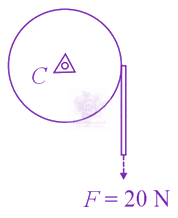
Suppose the disk makes n number of revolutions to attain an angular speed of 50rads−1. The value of n, to the nearest integer, is _______ .
[Given : In one complete revolution, the disk rotates by 6.28rad]
Held on 16 Mar 2021 · Verified 6 Jul 2026.
Sign in to track your attempts and accuracy.
Sign in to keep a private note on this question. Nothing you write is ever public.
If $\epsilon, E$ and $t$ represent the free space permittivity, electric field and time respectively, then the unit of $\frac{\epsilon E}{t}$ will be :
When a part of a straight capillary tube is placed vertically in a liquid, the liquid raises upto certain height $h$. If the inner radius of the capillary tube, density of the liquid and surface tension of the liquid decrease by $1 \%$ each, then the height of the liquid in the tube will change by $\%$.
The velocity of a particle is given as $\vec{v} = -x\hat{i} + 2y\hat{j} - z\hat{k}$ m/s. The magnitude of acceleration at point $(1, 2, 4)$ is _______ m/s$^2$.
Suppose there is a uniform circular disc of mass $M \mathrm{~kg}$ and radius $r \mathrm{~m}$ shown in figure. The shaded regions are cut out from the disc. The moment of inertia of the remainder about the axis $A$ of the disc is given by $\frac{x}{256} M r^{2}$. The value of $x$ is $\_\_\_\_$. 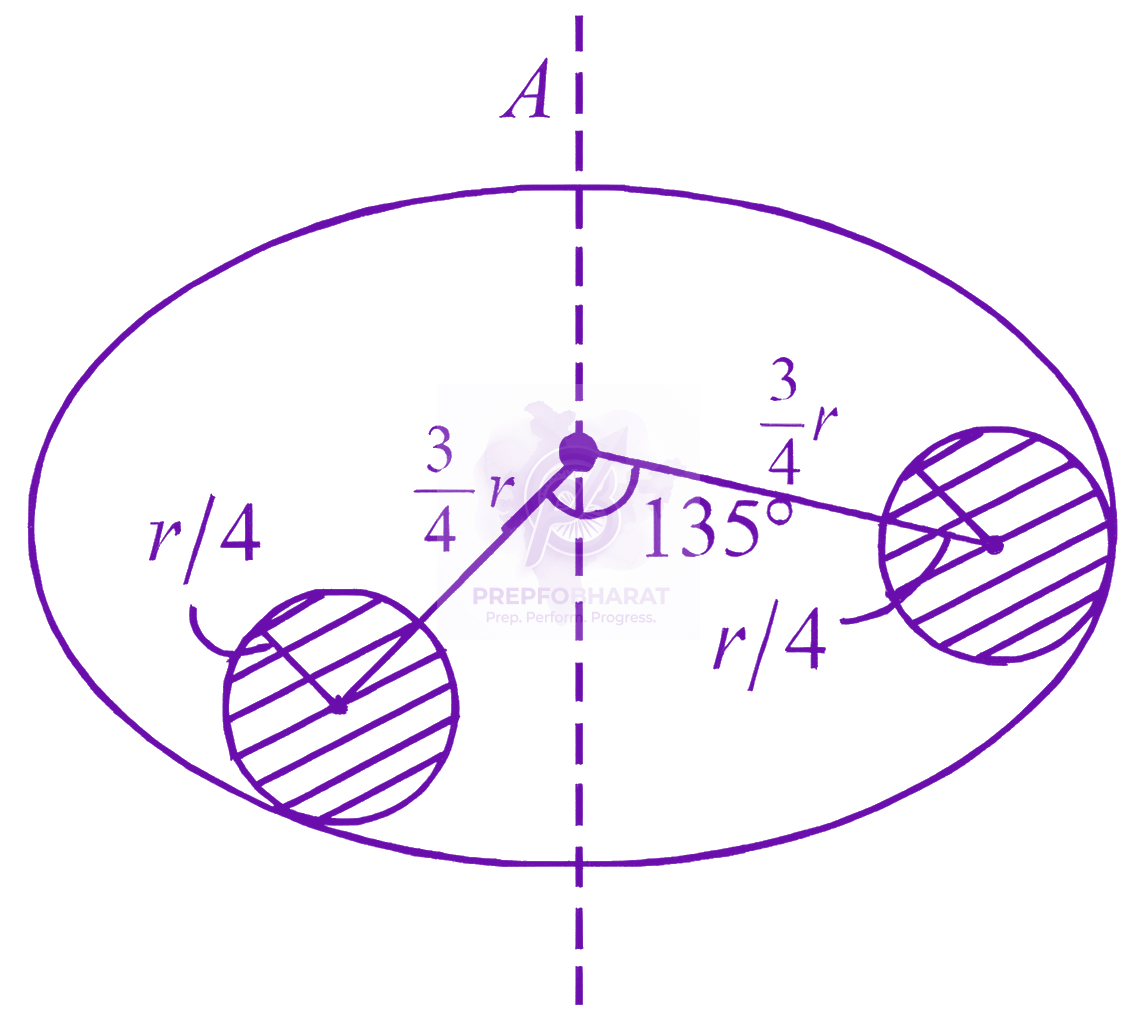
A soap bubble of surface tension $0.04 \mathrm{~N} / \mathrm{m}$ is blown to a diameter of 7 cm. If $(15000-x) \mu \mathrm{J}$ of work is done in blowing it further to make its diameter 14 cm, then the value of $x$ is $\_\_\_\_$. ($\pi=22 / 7$)
Work through every JEE Main Mechanics PYQ, year by year.