The particle experiences downward gravitational force (mg) and upward resistive force (-kv).
The equation of motion is mdtdv=mg−kv.
Initially at t=0, v=0 gives maximum acceleration a0=g.
As velocity increases, the resistive force increases, reducing the net acceleration.
Eventually the particle reaches terminal velocity vt=kmg when acceleration becomes zero.
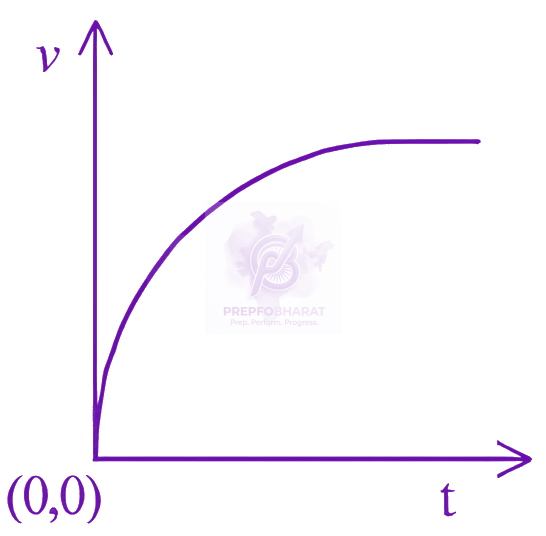
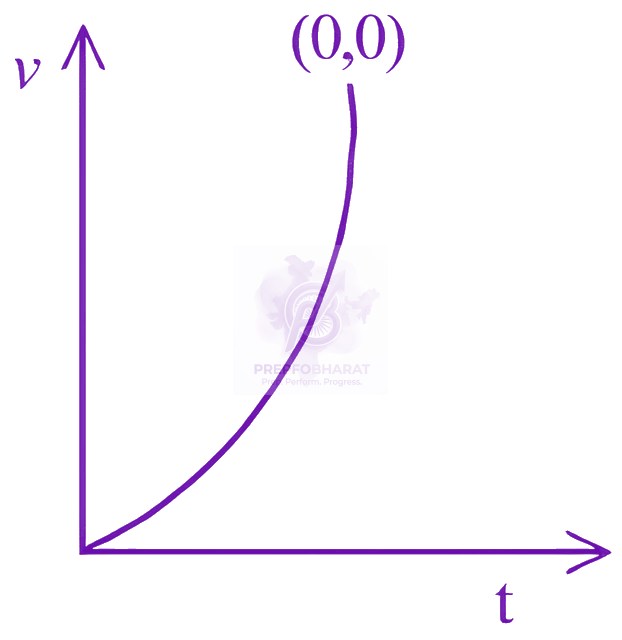
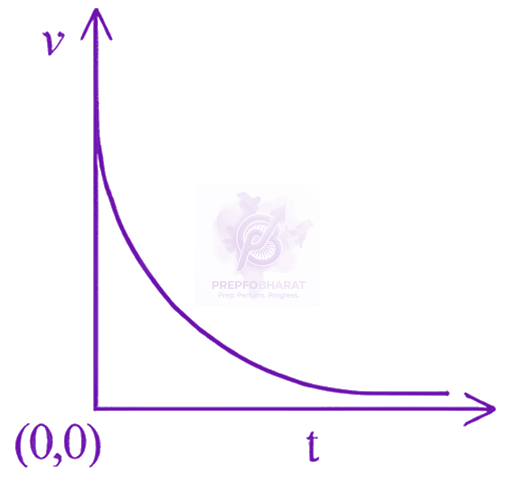
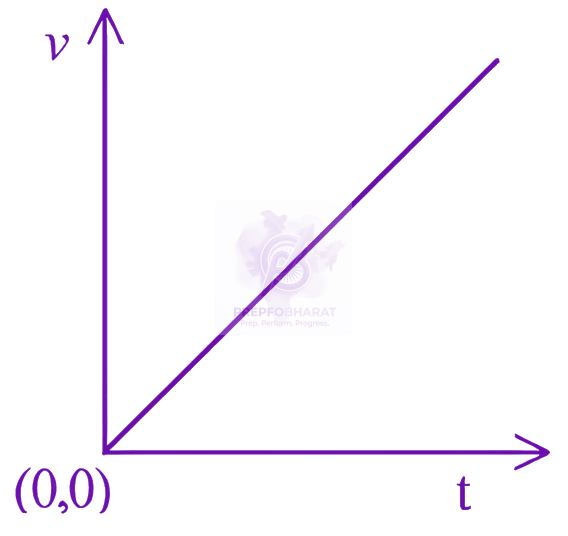
The velocity-time graph shows an increasing curve starting from origin with decreasing slope, asymptotically approaching the terminal velocity.
This behavior matches option (1), which displays a curve starting at (0,0) with steep initial slope that gradually flattens.