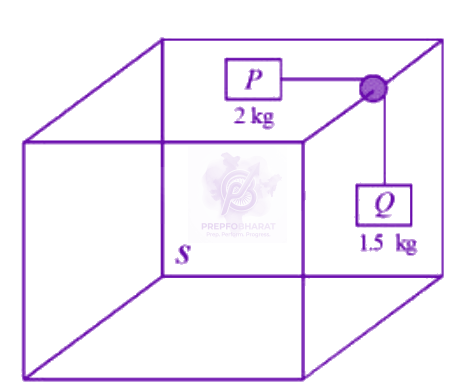
Let us analyze the forces acting on blocks P and Q in the non-inertial frame of reference of the cube S, which is moving to the right with an acceleration a=2g=5 m/s2.
In this frame, a pseudo force acts on both blocks towards the left.
For block P (mass mP=2 kg):
The forces in the horizontal direction are the tension T in the string (acting towards the right) and the pseudo force FpP (acting towards the left). Since block P is stationary relative to the cube and there is no friction on the top surface:
T=mPa=2×5=10 N
For block Q (mass mQ=1.5 kg):
The horizontal forces are the normal reaction N from the side surface of the cube (acting towards the right) and the pseudo force FpQ (acting towards the left). Since block Q is stationary horizontally relative to the cube:
N=mQa=1.5×5=7.5 N
The vertical forces acting on block Q are the downward gravitational force mQg, the upward tension T, and the frictional force f.
The downward force is mQg=1.5×10=15 N.
Since mQg>T (15 N>10 N), the block has a tendency to slide downwards, so the static friction f must act upwards.
For vertical equilibrium of block Q:
T+f=mQg
10+f=15⇒f=5 N
To keep the block stationary, the required friction must be less than or equal to the maximum static friction (f≤μN). Assuming the limiting case to find the value of μ:
μN=f
μ(7.5)=5
μ=7.55=32≈0.67
Answer: 0.67