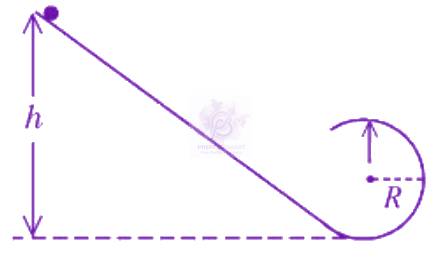
Let v be the velocity of the body at the highest point of the circular loop.
At the highest point, the forces acting on the body are its weight mg (downwards) and the normal reaction N (downwards). The net downward force provides the necessary centripetal acceleration:
N+mg=Rmv2
Given that the body exerts a force equal to three times its weight on the track at the highest point, we have N=3mg. Substituting this into the equation:
3mg+mg=Rmv2
4mg=Rmv2⇒v2=4gR
Applying the principle of conservation of mechanical energy between the point of release and the highest point of the loop (which is at a height of 2R from the bottom):
mgh=mg(2R)+21mv2
Substituting v2=4gR into the energy equation:
mgh=2mgR+21m(4gR)
mgh=2mgR+2mgR=4mgR
Therefore, h=4R.
Comparing this with the given relation h=αR, we get α=4.
Answer: 4