JEE Main 2026 — Organic Chemistry
Chemistry Organic Chemistry questions from JEE Main 2026.
Other Years
178 Organic Chemistry Questions from 2026
Given below are two statements: Statement I: Benzene is nitrated to give nitrobenzene, which on further treatment with $\mathrm{CH}_{3} \mathrm{COCl} / \mathrm{AlCl}_{3}$ will give 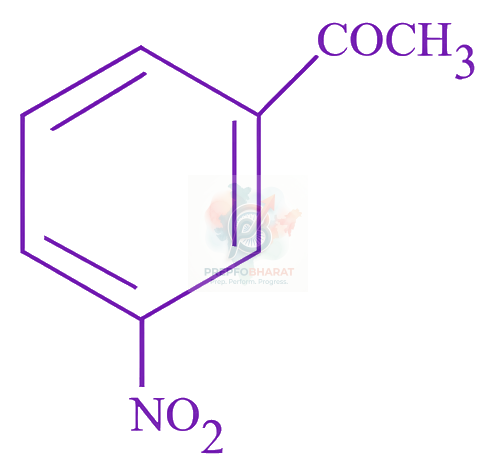 Statement II: $-\mathrm{NO}_{2}$ group is a $m$-directing, and deactivating group. In the light of the above statements, choose the most appropriate answer from the options given below
Given below are two statements: Statement I: $\left(\mathrm{CH}_{3}\right)_{3} \stackrel{\oplus}{\mathrm{C}}$ is more stable than $\stackrel{\oplus}{\mathrm{C}} \mathrm{H}_{3}$ as nine hyperconjugation interactions are possible in $\left(\mathrm{CH}_{3}\right)_{3} \stackrel{\oplus}{\mathrm{C}}$. Statement II: $\stackrel{\oplus}{\mathrm{C}} \mathrm{H}_{3}$ is less stable than $\left(\mathrm{CH}_{3}\right)_{3} \stackrel{\oplus}{\mathrm{C}}$ as only three hyperconjugation interactions are possible in $\stackrel{\oplus}{\mathrm{C}} \mathrm{H}_{3}$. In the light of the above statements, choose the correct answer from the options given below
Sucrose hydrolyses in acidic medium into glucose and fructose by first order rate law with $t_{1/2} = 3$ hour. The percentage of sucrose remaining after $6$ hours is _______. (Nearest integer) (Given: $\log 2 = 0.3010$ and $\log 3 = 0.4771$)
A hydroxy compound $(\mathrm{X})$ with molar mass $122 \mathrm{~g} \mathrm{~mol}^{-1}$ is acetylated with acetic anhydride, using a large excess of the reagent ensuring complete acetylation of all hydroxyl groups. The product obtained has a molar mass of $290 \mathrm{~g} \mathrm{~mol}^{-1}$. The number of hydroxyl groups present in compound (X) is:
Consider the following reaction sequence 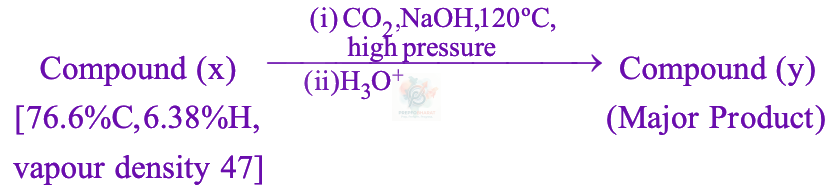 Compound $(\mathrm{y})$ develops characteristic colour with neutral $\mathrm{FeCl}_{3}$ solution. Identify the INCORRECT statement from the following for the above sequence.
Consider the following reaction :  The product Y formed is :
Consider the following sequence of reactions 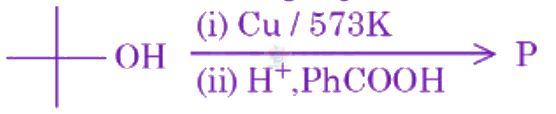 The major product P is:
In the given pentapeptide, find out an essential amino acid $(\mathrm{Y})$ and the sequence present in the pentapeptide:  Choose the correct answer from the options given below:
The incorrect statement from the following with respect to carbohydrates is:
The reactions which produce alcohol as the product are: A. $\mathrm{CH}_{4}+\mathrm{O}_{2} \xrightarrow[\Delta]{\mathrm{Mo}_{2} \mathrm{O}_{3}}$ B. $2 \mathrm{CH}_{3} \mathrm{CH}_{3}+3 \mathrm{O}_{2} \xrightarrow[\Delta]{\left(\mathrm{CH}_{3} \mathrm{COO}\right)_{2} \mathrm{Mn}}$ C. $\left(\mathrm{CH}_{3}\right)_{3} \mathrm{CH} \xrightarrow{\mathrm{KMnO}_{4}}$ D. $2 \mathrm{CH}_{4}+\mathrm{O}_{2} \xrightarrow{\mathrm{Cu} / 523 \mathrm{~K} / 100 \mathrm{~atm}.}$ E. $\mathrm{CH}_{3}-\mathrm{CH}=\mathrm{CH}-\mathrm{CH}_{3} \xrightarrow{\mathrm{KMnO}_{4} / \mathrm{H}^{+}}$ Choose the correct answer from the options given below :
Consider the following organic reaction sequence. Choose the final product $(X)$ from the following (consider the major product in all intermediate reactions) 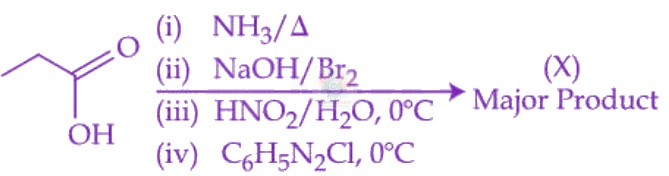
A mixed ether $(\mathrm{P})$, when heated with excess of hot concentrated hydrogen iodide produces two different alkyl iodides which when treated with aq. NaOH give compounds $(\mathrm{Q})$ and $(\mathrm{R})$. Both $(\mathrm{Q})$ and $(\mathrm{R})$ give yellow precipitate with NaOI. Identify the mixed ether $(\mathrm{P})$ :
Consider the following compounds 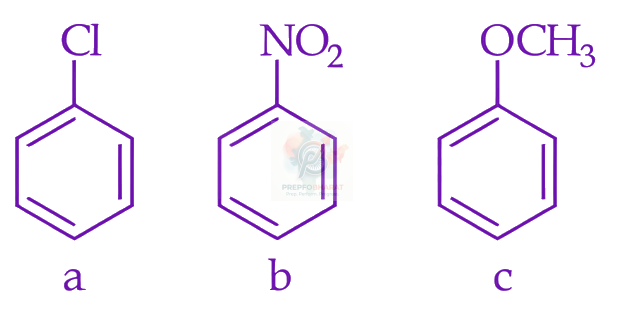 Arrange these compounds in the increasing order of reactivity with nitrating mixture.
Identify compounds A and E in the following reaction sequence. 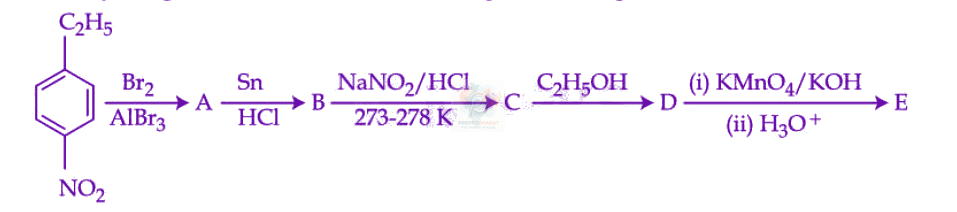
An alkene $(X)$ on ozonolysis followed by reduction gives following products: $H-CHO$ ($2$ moles), $H-CO-CO-CHO$, $CH_3-CO-CO-CH_3$. The alkene $(X)$ is:
Given below are two statements: Statement I: Vapours of the liquid with higher boiling point condense before vapours of the liquid with lower boiling points in fractional distillation. Statement II: The vapours rising up in the fractionating column become richer in high boiling component of the mixture. In the light of the above statements, choose the correct answer from the options given below:
Match List-I with List-II. <table class="pyq-table"><tbody><tr><th>List-I (Purification technique)</th><th>List-II (Used to separate)</th></tr><tr><td>A. Simple distillation</td><td>I. Steam volatile compound</td></tr><tr><td>B. Fractional distillation</td><td>II. Two liquids with large difference in boiling points</td></tr><tr><td>C. Steam distillation</td><td>III. Liquid decomposing at its boiling point</td></tr><tr><td>D. Distillation under reduced pressure</td><td>IV. Two liquids with close boiling points</td></tr></tbody></table> Choose the correct answer from the options given below :
Consider the following sequence of reactions to give the major product $(X)$ 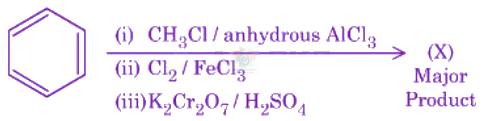 $P$ g of the major product $(X)$ formed is reacted with $NaHCO_3$ solution to liberate a gas which occupied $11.2$ dm$^3$ at STP. $P = $ _____ g. (Given molar mass in g mol$^{-1}$ H:$1$, C:$12$, O:$16$, Cl:$35.5$)
A molecule (X) with following structure under mild acidic condition is hydrolysed to produce (Y) and (Z). Identify the correct statements about (Y) and (Z). 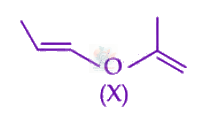 A. Both (Y) and (Z) have same molar mass. B. (Y) and (Z) can be distinguished from each other by $NaHCO_3$. C. (Y) and (Z) react with HCN with same rates. D. (Y) and (Z) undergo addition reaction with $2,4$-DNP. Choose the correct answer from the options given below:
Given below are two statements: Statement I: $2,6$-diethylcyclohexanone and $6$-methyl-$2$-n-propylcyclohexanone are metamers. Statement II: $2,2,6,6$-tetramethylcyclohexanone exhibits keto-enol tautomerism. In the light of the above statements, choose the correct answer from the options given below
0.53 g of an organic compound (x) when heated with excess of nitric acid (concentrated) and then with silver nitrate gave 0.75 g of silver bromide precipitate. 1.0 g of $(\mathrm{x})$ gave 1.32 g of $\mathrm{CO}_{2}$ gas on combustion. The percentage of hydrogen in the compound $(\mathrm{x})$ is $\_\_\_\_$%. [Nearest Integer] [Given: Molar mass in $\mathrm{g} \mathrm{mol}^{-1} \mathrm{H}: 1, \mathrm{C}: 12, \mathrm{Br}: 80, \mathrm{Ag}: 108, \mathrm{O}: 16$; Compound (x) : $\mathrm{C}_{\mathrm{x}} \mathrm{H}_{\mathrm{y}} \mathrm{Br}_{\mathrm{z}}$]
Given below are two statements: Statement I: There are several conformers for n -butane. Out of those conformers, 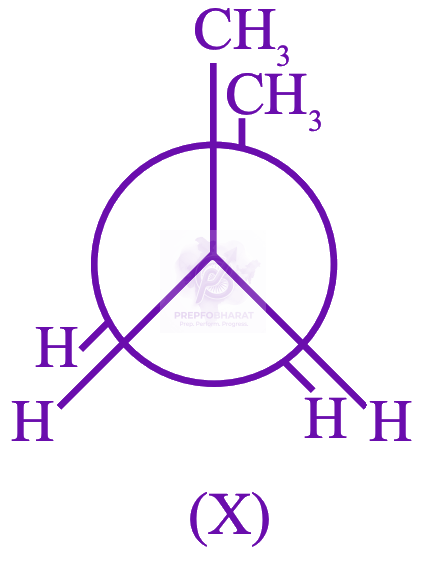 is the least stable and most stable conformer is 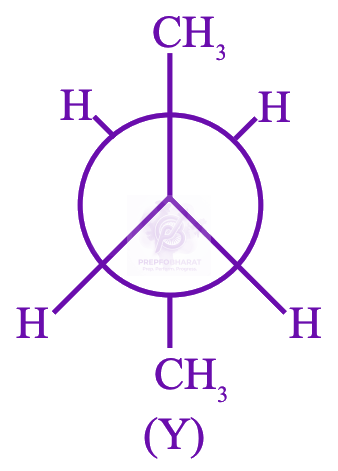 Statement II: As the dihedral angle increases, torsional strain decreases from (X) to $(\mathrm{Y})$. In the light of the above statements, choose the correct answer from the options given below
Consider the following reaction sequence 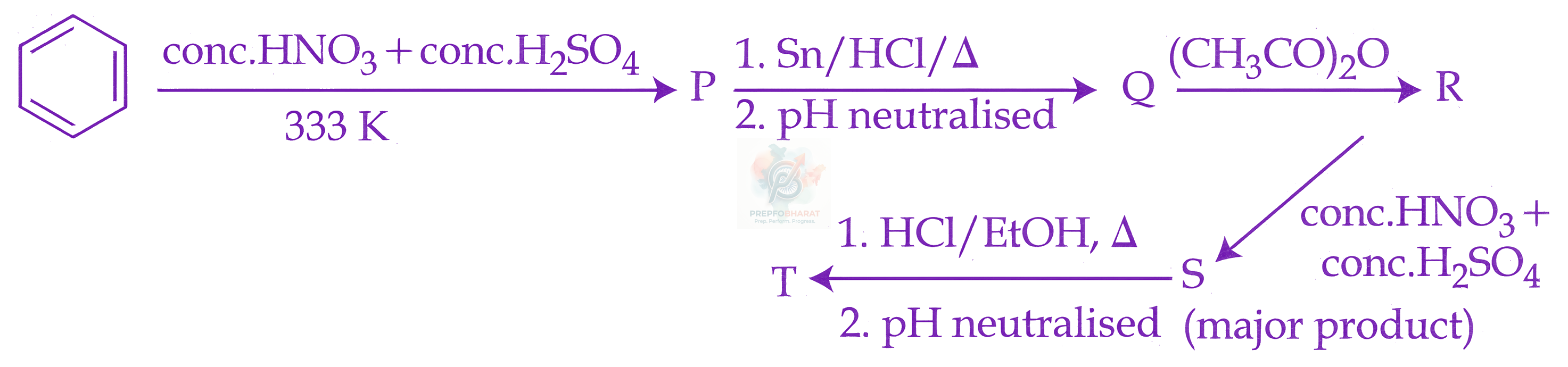 The percentage of nitrogen in product ' T ' formed is $\_\_\_\_$%. (Nearest integer) (Given molar mass in $\mathrm{g} \mathrm{mol}^{-1} \mathrm{H}: 1, \mathrm{C}: 12, \mathrm{~N}: 14, \mathrm{O}: 16$)
But-2-yne and hydrogen (one mole each) are separately treated with (i) $\mathrm{Pd} / \mathrm{C}$ and (ii) $\mathrm{Na} / \mathrm{liq}. \mathrm{NH}_{3}$ to give the products X and Y respectively. 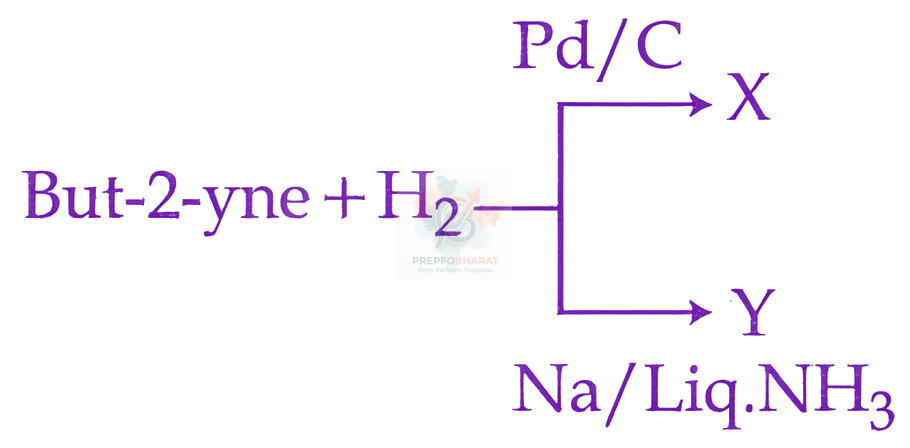 Identify the incorrect statements. A. $X$ and $Y$ are stereoisomers. B. Dipole moment of X is zero. C. Boiling point of $X$ is higher than $Y$. D. X and Y react with $\mathrm{O}_{3} / \mathrm{Zn}+\mathrm{H}_{2} \mathrm{O}$ to give different products. Choose the correct answer from the options given below :
An organic compound "$x$" where molar ratio of C, O and H are equal, on treatment with $50\%$ KOH under reflux followed by acidification produced "$y$". The most likely structure of "$y$" is: [Molar mass of '$x$' is $58$ g mol$^{-1}$]
Given below are two statements: Statement I: In $O_2 N$-$C_6 H_4$-$CH^{\oplus}$-$C_6 H_4$-$OCH_3$, the carbocation is stabilised by $+R$ effect of $-OCH_3$ group. Statement II: In $O_2 N$-$C_6 H_4$-$CH^{\ominus}$-$C_6 H_4$-$OCH_3$, the carbanion is stabilised by $-R$ effect of $-NO_2$ group. In the light of the above statements, choose the correct answer from the options given below:
$R_f$ value for $2$-methylpropene in a solvent system (Ethyl acetate + ether) is $0.42$. $2$-methylpropene is treated with dilute $\text{H}_2\text{SO}_4$ to give major organic product (X). $R_f$ value for (X) in the same solvent system under identical condition will be:
In Carius method, 0.75 g of an organic compound gave 1.2 g of barium sulphate, find percentage of sulphur (molar mass $32 \mathrm{~g} \mathrm{~mol}^{-1}$). Molar mass of barium sulphate is $233 \mathrm{~g} \mathrm{~mol}^{-1}$.
' $x$ ' is the product which is obtained from propanenitrile and stannous chloride in the presence of hydrochloric acid followed by hydrolysis. ' $y$ ' is the product which is obtained from the but-2-ene by the ozonolysis followed by hydrolysis. From the following, which product is not obtained when one mole of ' $x$ ' and one mole of ' $y$ ' react with each other in the presence of alkali followed by heating?
Identify the colour of compound $'X'$ in the sequence of the reaction. 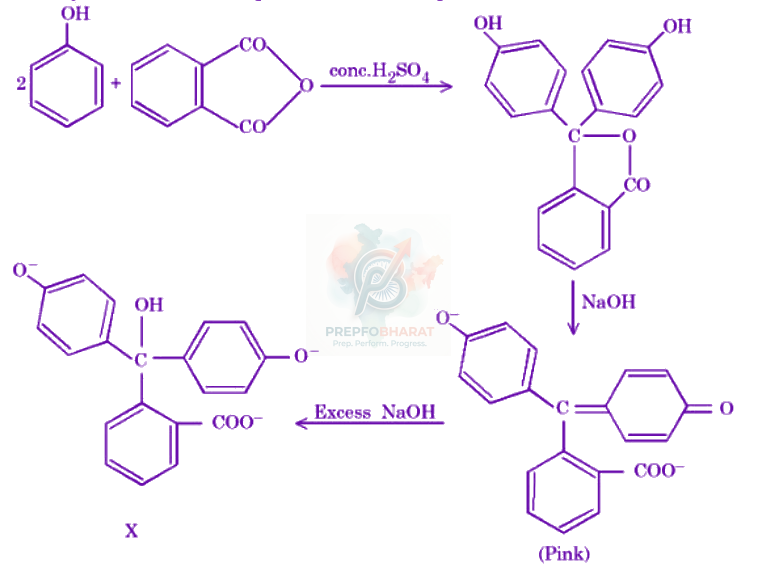
Increasing order of electron withdrawing power of following functional groups is: a. $-CN$ b. $-COOH$ c. $-NO_2$ d. $-I$
Match List - I with List - II. $\begin{array}{l} \text{List - I} & \text{List - II} \\ \text{Reaction of Glucose with} & \text{Product formed} \\ \text{A. Hydroxylamine} & \text{I. Gluconic acid} \\ \text{B. } \mathrm{Br}_{2} \text{ water} & \text{II. Glucose pentacetate} \\ \text{C. Excess acetic anhydride} & \text{III. Saccharic acid} \\ \text{D. Concentrated } \mathrm{HNO}_{3} & \text{IV. Glucoxime} \end{array}$ Choose the correct answer from the options given below :
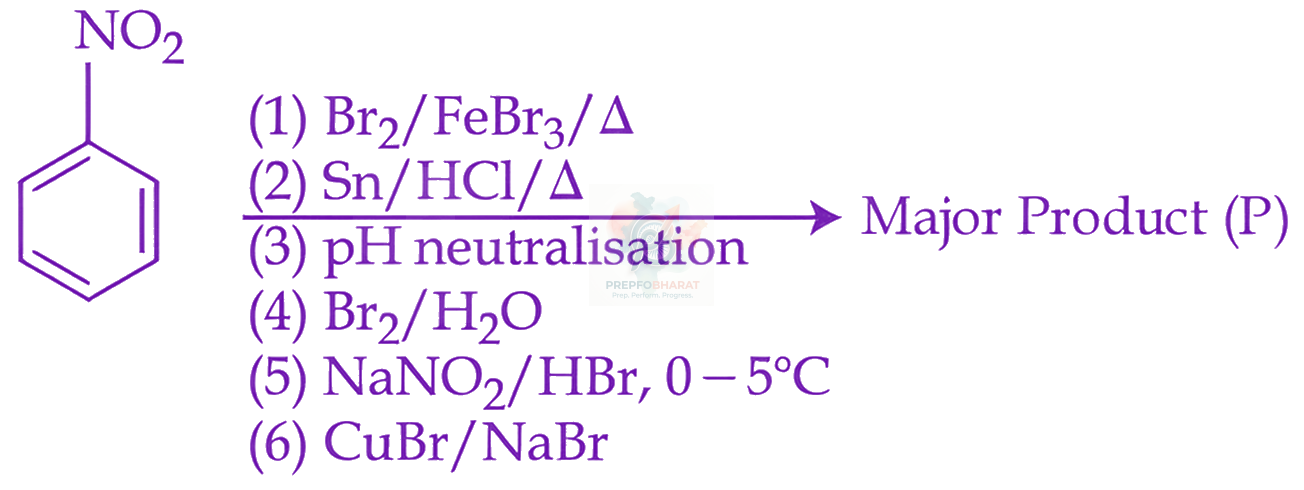 Consider the above sequence of reactions. The number of bromine atom(s) in the final product (P) will be :
Find out the statements which are not true. A. Resonating structures with more number of covalent bonds and lesser charge separation are more stable. B. In electromeric effect, an unsaturated system shows +E effect with nucleophile and -E effect with electrophile. C. Inductive effect is responsible for high melting point, boiling point and dipole moment of polar compounds. D. The greater the number of alkyl groups attached to the doubly bonded carbon atoms, higher is the heat of hydrogenation. E. Stability of carbanion increases with the increase in $\mathrm{s}-$ character of the carbon carrying the negative charge. Choose the correct answer from the options given below:
The number of compounds from the following which can undergo reaction with Br$_2$/KOH (alcoholic) to give respective products and these respective products can also be obtained separately by Gabriel phthalimide reaction is : 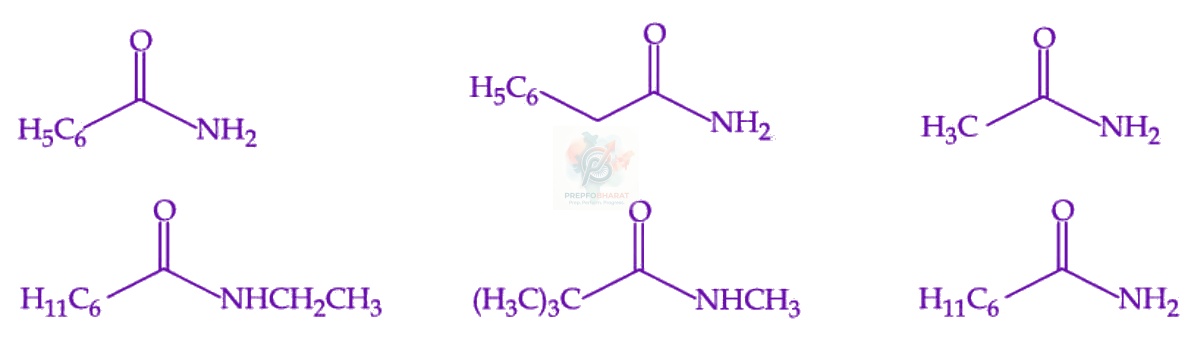
' A ' is a neutral organic compound ($\mathrm{M}. \mathrm{F}: \mathrm{C}_{8} \mathrm{H}_{9} \mathrm{ON}$). On treatment with aqueous $\mathrm{Br}_{2} / \mathrm{HO}^{(-)}$, ' A ' forms a compound ' B ' which is soluble in dilute acid. ' B ' on treatment with aqueous $\mathrm{NaNO}_{2} / \mathrm{HCl}\left(0-5^{\circ} \mathrm{C}\right)$ produces a compound ' C ' which on treatment with $\mathrm{CuCN} / \mathrm{NaCN}$ produces ' D '. Hydrolysis of ' D ' produces ' E ' which is also obtainable from the hydrolysis of ' A '. ' E ' on treatment with acidified $\mathrm{KMnO}_{4}$ produces ' $F$ '. ' $F$ ' contains two different types of hydrogen atoms. The structure of ' A ' is
Given below are two statements: Statement I: 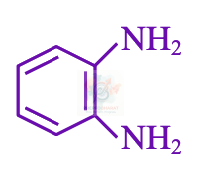 can be synthesized from 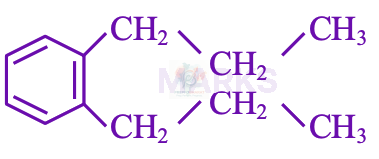 using simpler reagents in the order i) Acidic $\mathrm{KMnO}_{4}$, ii) Ammonia, iii) Bromine and alkali Statement II: 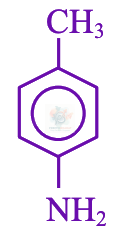 can be converted into 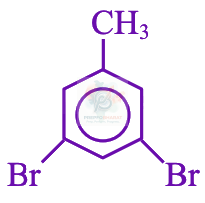 using reagents in the order i) Bromine- $\mathrm{H}_{2} \mathrm{O}$ ii) $\mathrm{NaNO}_{2} / \mathrm{HCl}\left(0-5^{\circ} \mathrm{C}\right)$ (iii) Aq. $\mathrm{H}_{3} \mathrm{PO}_{2}$. In the light of the above statements, choose the correct answer from the options given below
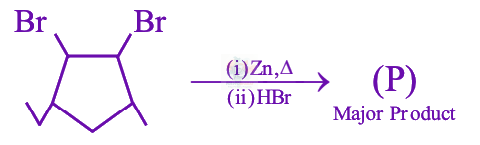 Identify (P)
Given below are two statements: Statement I: Methane can be prepared by decarboxylation of sodium ethanoate, Kolbe's electrolysis of sodium acetate and reaction of $\text{CH}_3\text{MgBr}$ with water. Statement II: Methane cannot be prepared from unsaturated hydrocarbons and by Wurtz reaction. In the light of the above statements, choose the correct answer from the options given below
Match the LIST-I with LIST-II <table class="pyq-table"><tbody><tr><th>List-I Deficiency Disease</th><th>List-II Vitamin</th></tr><tr><td>A. Scurvy</td><td>I. Pyridoxine</td></tr><tr><td>B. Convulsions</td><td>II. Vitamin A</td></tr><tr><td>C. Cheilosis</td><td>III. Ascorbic Acid</td></tr><tr><td>D. Xerophthalmia</td><td>IV. Riboflavin</td></tr></tbody></table> Choose the correct answer from the options given below:
'$x$' is the product which is obtained by the hydrolysis of prop-1-yne in the presence of mercuric sulphate under dilute acidic medium at $333$ K. '$y$' is the product which is obtained by the reaction of ethane nitrile with methyl magnesium bromide in dry ether followed by hydrolysis. IUPAC name of product obtained from '$x$' and '$y$' in the presence of barium hydroxide followed by heating is :
An alkane $(Y)$ requires $8$ moles of oxygen for complete combustion and on chlorination with Cl$_2$/h$\nu$, $(Y)$ gives only one monochlorinated product $(Z)$. The total number of primary carbon atoms in $(Y)$ is __________.
Match List - I with List - II. $\begin{array}{l} \text{List - I} & \text{List - II} \\ \text{Functional group (detection)} & \text{Change observed during detection} \\ \text{A. Unsaturation (Baeyer's test)} & \text{I. Red colour appears} \\ \text{B. Alcoholic group} \\ \text{(Ceric ammonium nitrate test)} & \text{II. Silver mirror appears} \\ \text{C. Aldehyde group (Tollen's reagent)} & \text{III. Violet colour appears} \\ \text{D. Phenolic group } \left(\mathrm{FeCl}_{3}\right. \text{ test)} & \text{IV. Discharge of pink colour} \end{array}$ Choose the correct answer from the options given below :
Identify the correct statements : The presence of $-\mathrm{NO}_{2}$ group in benzene ring A. activates the ring towards electrophilic substitutions. B. deactivates the ring towards electrophilic substitutions. C. activates the ring towards nucleophilic substitutions. D. deactivates the ring towards nucleophilic substitutions. Choose the correct answer from the options given below :
Consider the following sequence of reactions. 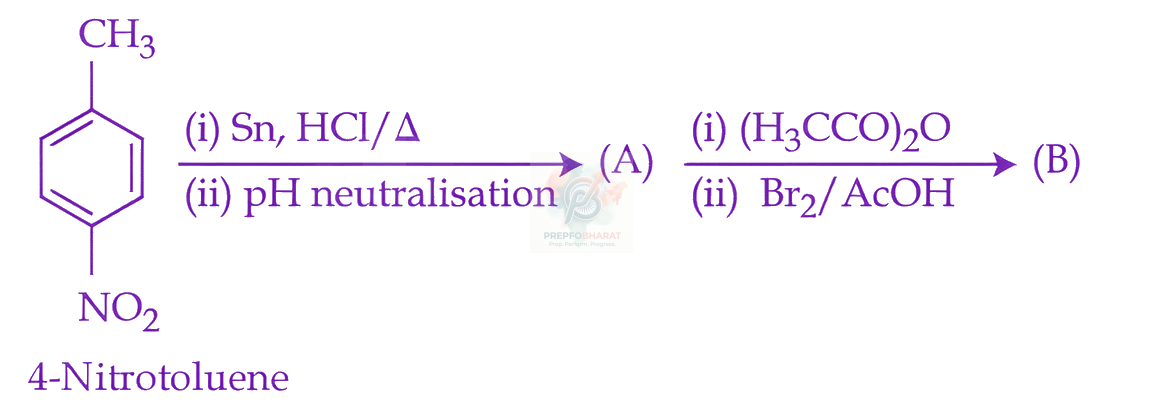 Assuming that the reaction proceeds to completion, then 137 mg of 4 -nitrotoluene will produce $\_\_\_\_$ mg of $B$. (Given molar mass in $\mathrm{g} \mathrm{mol}^{-1} \mathrm{H}: 1, \mathrm{C}: 12, \mathrm{~N}: 14, \mathrm{O}: 16, \mathrm{Br}: 80$)
Consider the three aromatic molecules (P, Q and R) whose structures have been given below : 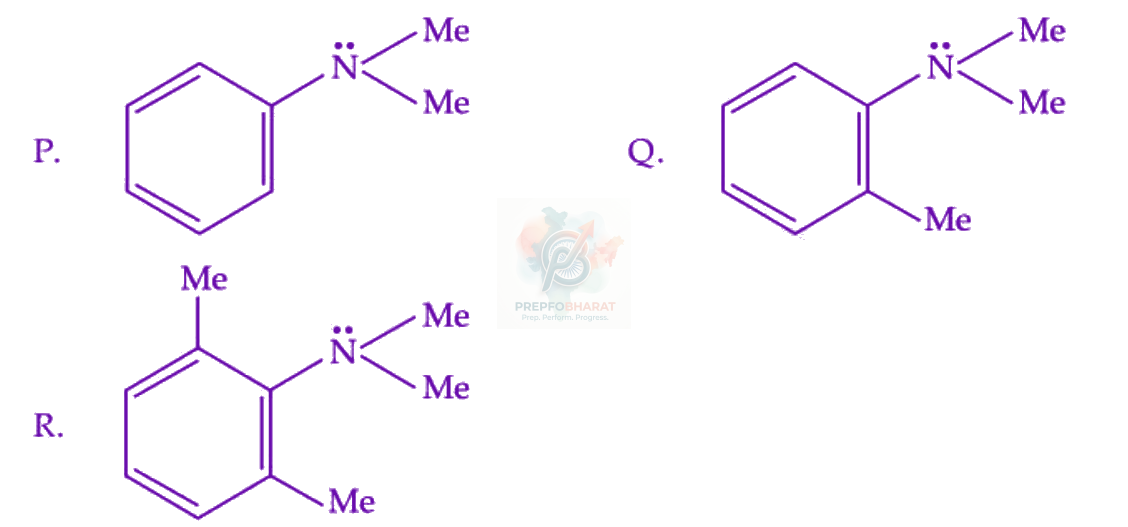 The correct order regarding the reactivity of these compounds with $Ph-N\equiv NCl^{(-)}_{(+)}$ under optimum but slightly acidic medium is :
Complete the following reaction sequence and give the name of major product 'P'. $CH_3-CH_2-C\equiv N \xrightarrow[\text{(ii) } H_3O^+]{\text{(i) } OH^-/H_2O/\Delta} \xrightarrow[\text{(iv) } H_2O]{\text{(iii) } Cl_2/\text{Red P}} P \text{ (Major product)}$
The following structures are 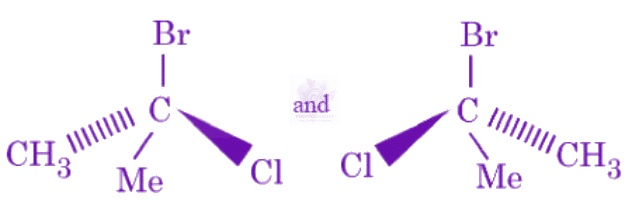
Match the LIST-I with LIST-II \(\begin{array}{|c|l|c|l|} \hline & \textbf{List-I (Reagents)} & & \textbf{List-II (Name of reaction} \\ & & & \textbf{involving carbonyl compounds)} \\ \hline A. & \mathrm{NH_2{-}NH_2,\ KOH} & I. & \text{Tollen's Test} \\ \hline B. & \mathrm{Ag(NH_3)_2OH} & II. & \text{Clemmensen Reduction} \\ \hline C. & \begin{array}{l} \text{Aq. } \mathrm{CuSO_4}, \\ \text{Sodium potassium} \\ \text{tartarate, KOH} \end{array} & III. & \text{Wolff--Kishner Reduction} \\ \hline D. & \mathrm{Zn{-}Hg,\ HCl} & IV. & \text{Fehling's Test} \\ \hline \end{array}\) Choose the correct answer from the options given below:
In Carius method 0.2425 g of an organic compound gave 0.5253 g silver chloride. The percentage of chlorine in the organic compound is
Identify the correct IUPAC name of hydrocarbon ($x$) containing three primary carbon atoms and with molar mass $72\text{ g mol}^{-1}$.
Consider the following reaction. 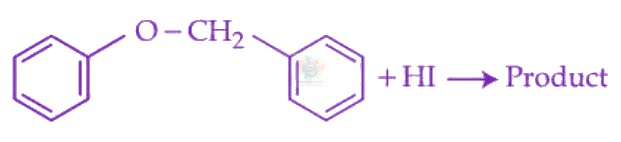 Statement I : In the above reaction, product formed will be a mixture of benzyl alcohol and iodobenzene. Statement II : In the above reaction, the $-\text{O}-\text{CH}_2-$ bond is cleaved to give the product. In the light of the above statements, choose the correct answer from the options given below :
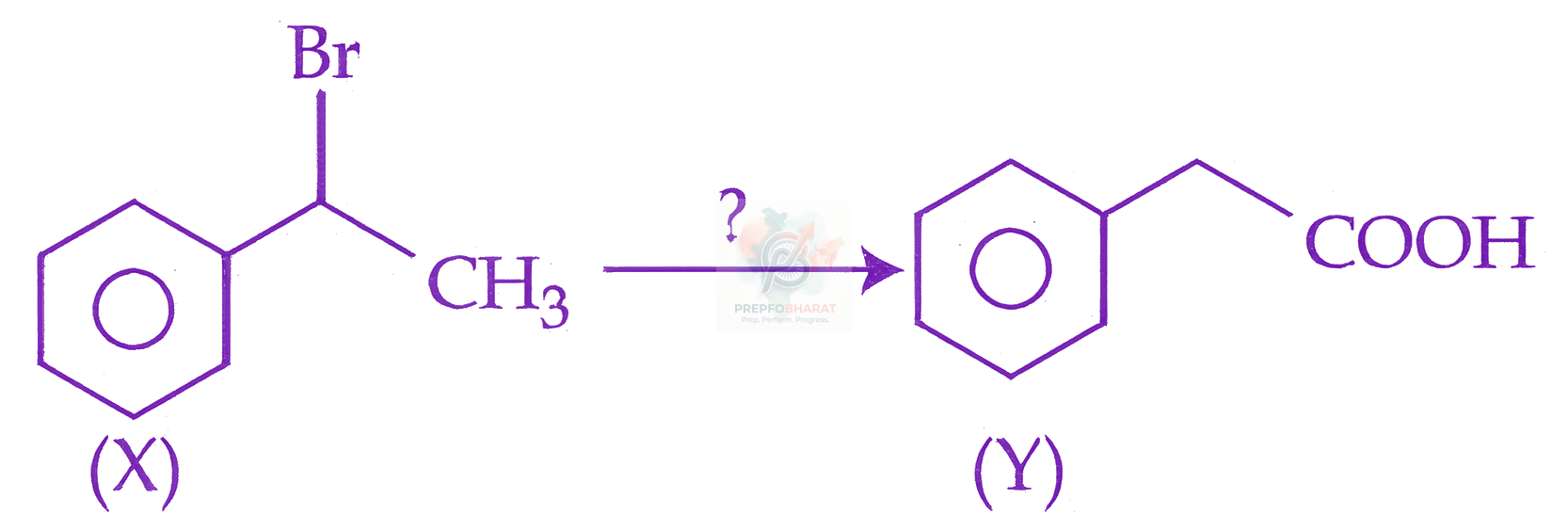 The correct sequence of reagents for the above conversion of X to Y is :
The compound (X) on (i) on heating in the presence of anhydrous $AlCl_3$ and HCl gas gives $2,4$-dimethyl pentane (ii) aromatization gives toluene and (iii) cyclisation gives methyl cyclohexane The correct name of compound (X) is:
When 1 g of compound $(\mathrm{X})$ is subjected to Kjeldahl's method for estimation of nitrogen, 15 mL 1 M $\mathrm{H}_{2} \mathrm{SO}_{4}$ was neutralized by ammonia evolved. The percentage of nitrogen in compound $(\mathrm{X})$ is :
The total number of aromatic compounds/species from the following is 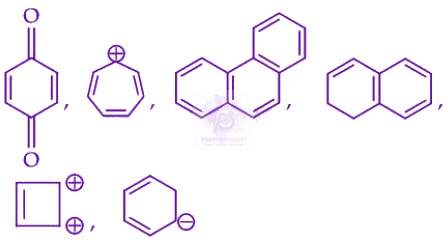
Compound ' P ' undergoes the following sequence of reactions :  ' $\mathrm{P}^{\prime}$ is :
Given below are two statements: Statement I: Cross aldol condensation between two different aldehydes will always produce four different products. Statement II: When semicarbazide reacts with a mixture of benzaldehyde and acetophenone under optimum pH, it forms a condensation product with acetophenone only. In the light of the above statements, choose the correct answer from the options given below
Given below are two statements for the following reaction sequence.  Statement I: Compound ' $Z$ ' will give yellow precipitate with NaOI. Statement II: Compound ' Q ' has two different types of ' H ' atoms (aromatic : aliphatic) in the ratio 1:3. In the light of the above statements, choose the correct answer from the options given below:
Given below are two statements : Statement I: The condensation reaction between $CH_3-CH=O$ and $H_2N-NH-C(=O)-NH_2$ under optimum pH will produce $CH_3-CH=N-N(H)-C(=O)-NH_2$. Statement II: The molecule, $Ph-CH(O-H)(O-CH_3)$ will generate $Ph-CH=O$ in the presence of dilute acid. In the light of the above statements, choose the correct answer from the options given below :
One mole of phenol is treated with dilute HNO$_3$ at $298$ K to give a mixture of products. The mixture is separated by steam distillation. The steam volatile compound (X) is separated. The increase in percentage of oxygen in (X) with respect to phenol is _____ $\times 10^{-1}$ % (Given molar mass in g mol$^{-1}$ H:$1$, C:$12$, N:$14$, O:$16$)
Consider the following reactions giving major product. Identify the correct reaction.
An optically active alkyl bromide C$_4$H$_9$Br, reacts with ethanolic KOH to form major compound [A] which reacts with bromine to give compound [B]. Compound [B] reacts with ethanolic KOH and sodamide to give compound [C]. One molecule of water adds to compound [C] on warming with mercuric sulphate and dilute sulphuric acid at $333$ K to form compound [D]. The functional group in compound D will be confirmed by :
Given below are two statements: Statement I: $3$-phenylpropene reacts with HBr and gives secondary alkyl bromide having a chiral carbon atom as the major product. Statement II: Aryl chlorides and aryl cyanides can be prepared by Sandmeyer reaction as well as Gattermann reaction. In the light of the above statements, choose the correct answer from the options given below
One mole of an alkane (x) requires $8$ mole oxygen for complete combustion. Sum of number of carbon and hydrogen atoms in the alkane (x) is _______.
The compound A, $\mathrm{C}_{8} \mathrm{H}_{8} \mathrm{O}_{2}$ reacts with acetophenone to form a single product via cross-Aldol condensation. The compound A on reaction with conc. NaOH forms a substituted benzyl alcohol as one of the two products. The compound A is :
The number of possible tripeptides formed involving alanine (ala), glycine (gly) and valine (val), where no amino acid has been used more than once is:
A D-aldotetrose on oxidation with concentrated $HNO_3$ resulted in optically inactive dicarboxylic acid. The structure of the D-aldotetrose is:
Given below are two statements : Statement (I) : Benzyl chloride reacts faster in $S_N1$ mechanism than ethyl chloride. Statement (II) : Ethyl carbocation intermediate is less stabilized by hyperconjugation than benzyl carbocation by resonance. In the light of the above statements, choose the correct answer from the options given below :
The correct order of acidic strength of the major products formed in the given reactions, is : A. 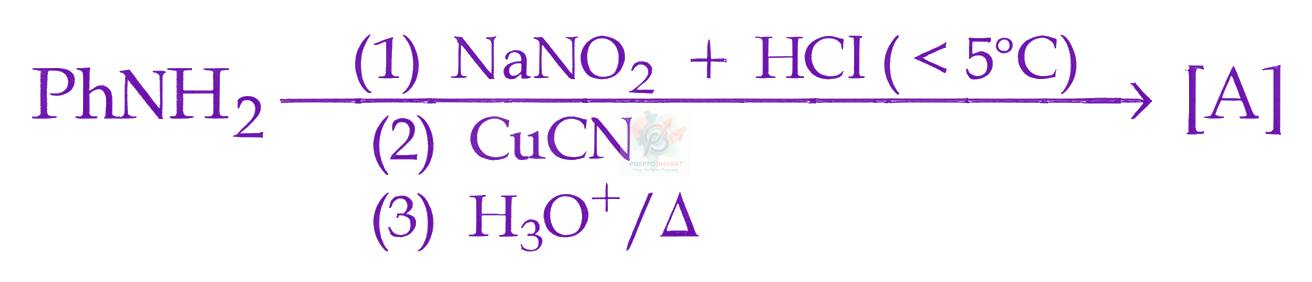 B. $\mathrm{CH}_{3} \mathrm{CH}_{2} \mathrm{CHO} \xrightarrow[\Delta]{\left[\mathrm{Ag}\left(\mathrm{NH}_{3}\right)_{2}\right]^{+}, \mathrm{OH}^{-}}[\mathrm{B}]$ C. $\mathrm{CH}_{4}+\mathrm{O}_{2} \xrightarrow[\text { (ii) } \mathrm{Na}_{2} \mathrm{Cr}_{2} \mathrm{O}_{7} / \mathrm{H}^{+}]{\text {(i) }}[\mathrm{C}]$ D. $\mathrm{PhCH}_{2} \mathrm{MgBr}+\mathrm{CO}_{2} \xrightarrow[\mathrm{H}_{3} \mathrm{O}^{+}]{\text {Dry ether }}[\mathrm{D}]$ Choose the correct answer from the options given below :
Given below are the four isomeric compounds $(\mathrm{P}, \mathrm{Q}, \mathrm{R}, \mathrm{S})$ 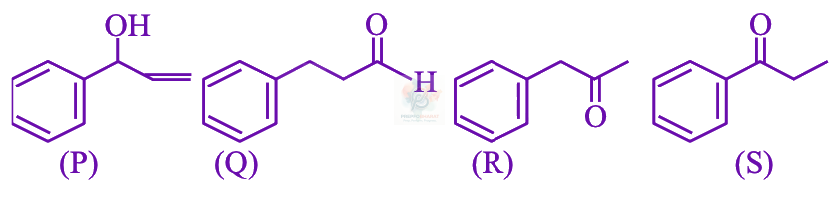 Identify correct statements from below. A. $\mathrm{Q}, \mathrm{R}$ and S will give precipitate with $2,4-\mathrm{DNP}$. B. P and Q will give positive Bayer's test. C. Q and R will give sooty flame. D. R and S will give yellow precipitate with $\mathrm{I}_{2} / \mathrm{NaOH}$. E. Q alone will deposit silver with Tollen's reagent Choose the correct option.
In IUPAC nomenclature, the correct order of decreasing priority of functional group is :
The IUPAC name of the following compound is : 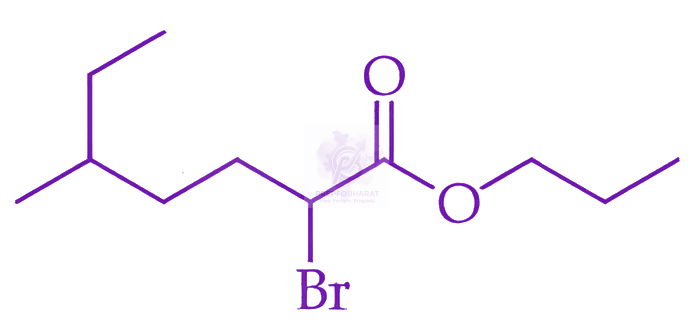
Identify the correct statements. A. Glucose exists in two anomeric forms. B. Anomers of glucose differ in configuration at C$-1$ in cyclic hemiacetal structure. C. Melting point of $\alpha$-anomer of glucose is greater than $\beta$-anomer. D. Specific rotation of $\alpha$-anomer is $+19°$ while for $\beta$-anomer is $+112°$ E. $\alpha$ and $\beta$-anomers of glucose are prepared by crystallization of saturated glucose solution at $303$ K and $371$ K respectively. Choose the correct answer from the options given below:
Iodoform test can differentiate between A. Methanol and Ethanol B. $\mathrm{CH}_{3} \mathrm{COOH}$ and $\mathrm{CH}_{3} \mathrm{CH}_{2} \mathrm{COOH}$ C. Cyclohexene and cyclohexanone D. Diethyl ether and Pentan-3-one E. Anisole and acetone Choose the correct answer from the options given below:
Given below are two statements : Statement I: The two cyclic forms of D-(+)-glucose (α and β anomers differing at C1 hydroxyl orientation) are two anomers of D-(+)-glucose. Statement II: The open chain forms of D-glucose and D-fructose contain three similar chiral carbons at $C_3$, $C_4$ and $C_5$. In the light of the above statements, choose the correct answer from the options given below :
Match List - I with List - II. $\begin{array}{l} \text{List - I} & \text{List - II} \\ \text{Pair of Compounds} & \text{Type of Isomers} \\ \text{A. 2-Methylpropene and but-1-ene} & \text{I. Stereoisomers} \\ \text{B. Cis-but-2-ene and trans-but-2-ene} & \text{II. Position isomers} \\ \text{C. 2-Butanol and diethyl ether} & \text{III. Chain isomers} \\ \text{D. But-1-ene and but-2-ene} & \text{IV. Functional group isomers} \end{array}$ Choose the correct answer from the options given below :
Match List - I with List - II. <table class="pyq-table"><tbody><tr><th>List - I Mixture of Compounds</th><th>List - II Reagent used to distinguish</th></tr><tr><td>A. Diethyl amine + Ethyl amine</td><td>I. Bromine water</td></tr><tr><td>B. Acetaldehyde + Acetone</td><td>II. $CHCl_3 + KOH, \Delta$</td></tr><tr><td>C. Ethanol + Phenol</td><td>III. Neutral $FeCl_3$</td></tr><tr><td>D. Benzoic acid + Cinnamic acid</td><td>IV. Ammonical silver nitrate</td></tr></tbody></table> Choose the correct answer from the options given below :
The dibromo compound $[\mathrm{P}]$ (molecular formula : $\mathrm{C}_{9} \mathrm{H}_{10} \mathrm{Br}_{2}$) when heated with excess sodamide followed by treatment with dilute HCl gives $[\mathrm{Q}]$. On warming $[\mathrm{Q}]$ with mercuric sulphate and dilute sulphuric acid yield $[R]$ which gives positive lodoform test but negative Tollen's test. The compound $[\mathrm{P}]$ is :
Match the LIST-I with LIST-II <table class="pyq-table"><tbody><tr><th>List-I (Chloro derivative)</th><th>List-II (Example)</th></tr><tr><td>A. Vinyl Chloride</td><td>I. $CH_2 = CH - CH_2Cl$</td></tr><tr><td>B. Benzyl chloride</td><td>II. $CH_3 = CH(Cl)CH_3$</td></tr><tr><td>C. Alkyl chloride</td><td>III. $CH_2 = CHCl$</td></tr><tr><td>D. Allyl chloride</td><td>IV. <img src="https://prepforbharat.s3.ap-south-1.amazonaws.com/exam/615f0e999476412f48314daf/Chemistry/images/Haloalkanes_and_Haloarenes/6983c1a28bfdbb243563972d/question_1__q_6983c1a28bfdbb243563972d__cdn-question-pool.getmarks.app__24S1_q_60_1_v2__1278b37ed2_final_ppt_sync.png" alt="JEE Main 2026 Chemistry, Haloalkanes and Haloarenes — question figure"></td></tr></tbody></table> Choose the correct answer from the options given below:
Given below are two statements: Statement I: ' $\mathrm{C}-\mathrm{Cl}^{\prime}$ bond is stronger in $\mathrm{CH}_{2}=\mathrm{CH}-\mathrm{Cl}$ than $\mathrm{CH}_{3}-\mathrm{CH}_{2}-\mathrm{Cl}$ Statement II: The given optically active molecule, 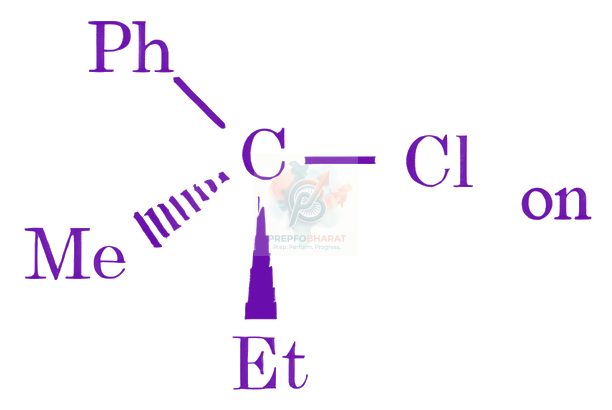 on hydrolysis gives a solution that can rotate the plane polarized light. In the light of the above statements, choose the correct answer from the options given below
The correct order of reactivity of $\mathrm{CH}_{3} \mathrm{Br}$ in methanol with the following nucleophiles is $\mathrm{F}^{-}, \mathrm{I}^{-}, \mathrm{C}_{2} \mathrm{H}_{5} \mathrm{O}^{-}$and $\mathrm{C}_{6} \mathrm{H}_{5} \mathrm{O}^{-}$
The correct order of the rate of the reaction for the following reaction with respect to nucleophiles is : $\mathrm{CH}_{3} \mathrm{Br}+\mathrm{Nu}^{\ominus} \longrightarrow \mathrm{CH}_{3} \mathrm{Nu}+\mathrm{Br}^{\ominus}$
Match the LIST-I with LIST-II <table class="pyq-table"><tbody><tr><th>List-I (Compound)</th><th>List-II (Test)</th></tr><tr><td>A. Cyclohexanol</td><td>I. Hinsberg's reagent test</td></tr><tr><td>B. Cyclohexylamine</td><td>II. Phthalein dye test</td></tr><tr><td>C. Cyclohexanecarbaldehyde</td><td>III. Lucas test</td></tr><tr><td>D. Phenol</td><td>IV. Tollen's test</td></tr></tbody></table> Choose the correct answer from the options given below:
Amongst the following, the total number of compounds soluble in aqueous $NaOH$ at room temperature is: 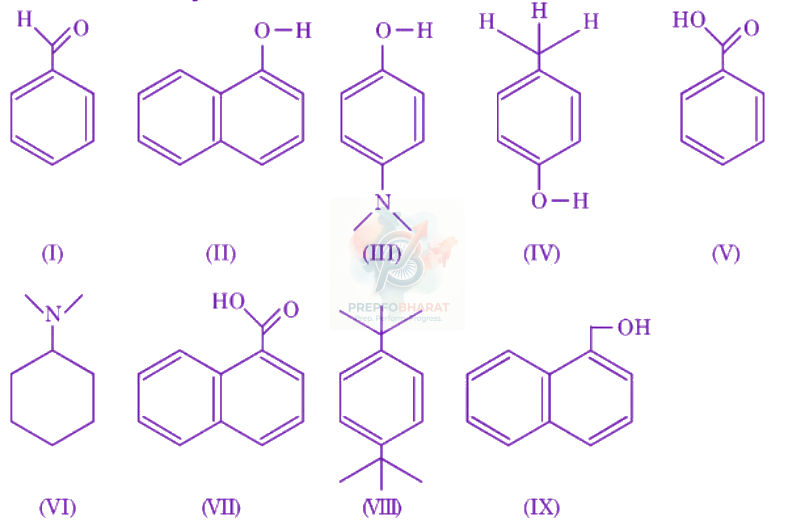
Consider the following two reactions A and B. 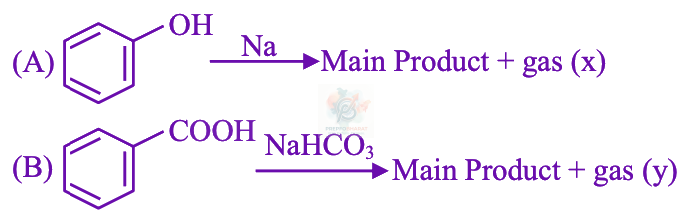 Numerical value of [molar mass of $x+$ molar mass of $y$] is $\_\_\_\_$.
'$x$' is the product which is obtained from benzene by reacting it with carbon monoxide and hydrogen chloride in the presence of cuprous chloride. '$y$' is the major product obtained from the benzene by reacting it with ethanoyl chloride in the presence of anhydrous AlCl$_3$. Product (major) obtained by heating $x$ and $y$ in the presence of alkali is $z$. Total number of $\pi$ (pi) electrons in $z$ is ________.
Consider the following reaction. 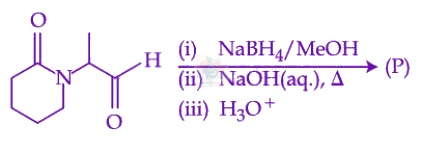 The major product (P) formed is:
A student performed analysis of aliphatic organic compound ' $X$ ' which on analysis gave $C=61.01 \%$, $\mathrm{H}=15.25 \%, \mathrm{~N}=23.74 \%$. This compound, on treatment with $\mathrm{HNO}_{2} / \mathrm{H}_{2} \mathrm{O}$ produced another compound ' Y ' which did not contain any nitrogen atom. However, the compound ' $Y$ ' upon controlled oxidation produced another compound ' $Z$ ' that responded to iodoform test. The structure of ' $X$ ' is :
Given below are two statements : Statement I: Heating benzamide with bromine in an ethanolic solution of sodium hydroxide will give benzylamine. Statement II: Nitration of aniline with $HNO_3/H_2SO_4$ at $288\text{ K}$ produces $m$-nitroaniline in higher amount than $o$-nitroaniline (pH adjusted). In the light of the above statements, choose the correct answer from the options given below :
A student is given one compound among the following compounds that gives positive test with Tollen's reagent. 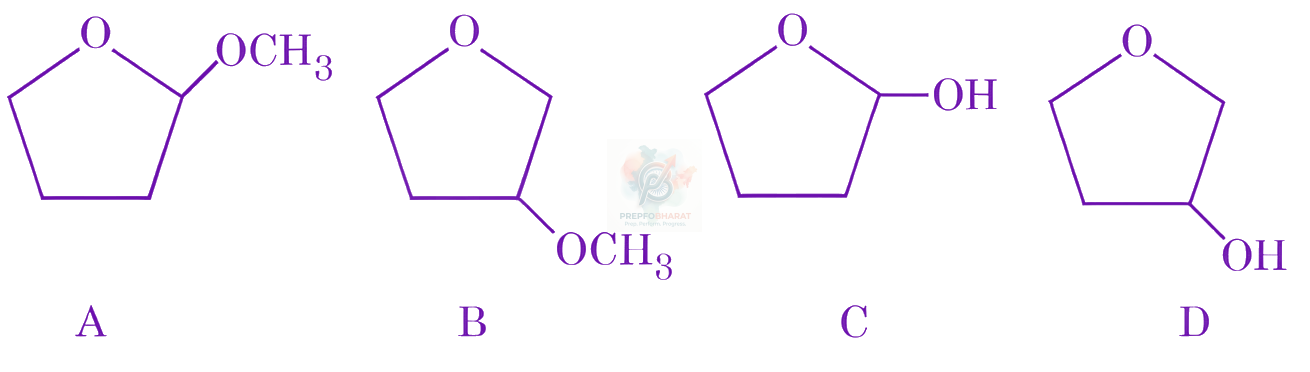 The compound is :
Match the LIST-I with LIST-II <table class="pyq-table"><tbody><tr><th>List-I Amino acid</th><th>List-II Positive reaction/Test for functional group present in side chain of amino acid</th></tr><tr><td>A. Glutamine</td><td>I. Hinsberg's test</td></tr><tr><td>B. Lysine</td><td>II. Neutral $\text{FeCl}_3$ test</td></tr><tr><td>C. Tyrosine</td><td>III. Ceric ammonium nitrate test</td></tr><tr><td>D. Serine</td><td>IV. Hoffman bromamide degradation</td></tr></tbody></table> Choose the correct answer from the options given below:
The unsaturated ether on acidic hydrolysis produces carbonyl compounds as shown below:- $\begin{aligned} \mathrm{CH}_{3}-\mathrm{CH}=\mathrm{CH}- & \mathrm{O}-\mathrm{CH}=\mathrm{CH}_{2} \\ & \downarrow \mathrm{H}_{3} \mathrm{O}^{(+)} \\ \mathrm{CH}_{3}-\mathrm{CH}_{2}-\mathrm{CH}= & \mathrm{O} \text { and } \mathrm{O}=\mathrm{CH}-\mathrm{CH}_{3} \end{aligned}$ Based on this, predict the solution/reagent that will help to distinguish " P " and " Q " obtained in the following reaction:- 
Given below are two statements: Statement I: Sucrose is dextrorotatory. However, sucrose upon hydrolysis gives a solution having mixture of products. This solution shows laevorotation. Statement II: Hydrolysis of sucrose gives glucose and fructose. Since the laevorotation of glucose is more than the dextrorotation of fructose, the resulting solution becomes laevorotatory. In the light of the above statements, choose the correct answer from the options given below
From the given following (A to D) cyclic structures, those which will not react with Tollen's reagent are : 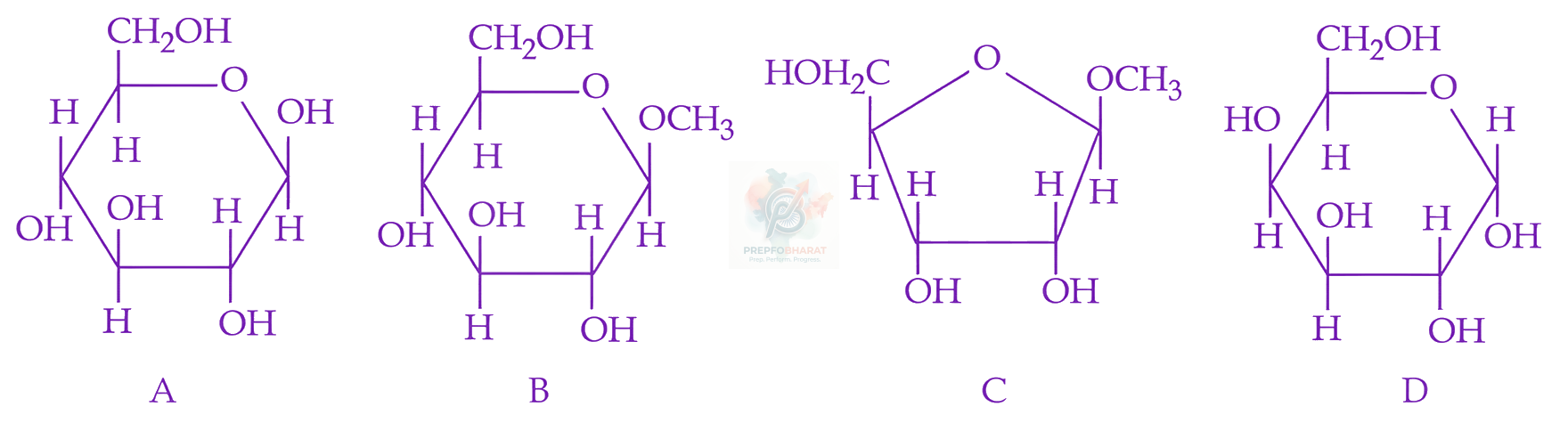
Identify the correct statements. A. Arginine and Tryptophan are essential amino acids. B. Histidine does not contain heterocyclic ring in its structure. C. Proline is a six membered cyclic ring amino acid. D. Glycine does not have chiral centre. E. Cysteine has characteristic feature of side chain as $\mathrm{MeS}-\mathrm{CH}_{2}-\mathrm{CH}_{2}-$. Choose the correct answer from the options given below :
As compared with chlorocyclohexane, which of the following statements correctly apply to chlorobenzene? A. The magnitude of negative charge is more on chlorine atom. B. The $\mathrm{C}-\mathrm{Cl}$ bond has partial double bond character. C. $\mathrm{C}-\mathrm{Cl}$ bond is less polar. D. $\mathrm{C}-\mathrm{Cl}$ bond is longer due to repulsion between delocalised electrons of the aromatic ring and lone pairs of electrons of chlorine. E. The $\mathrm{C}-\mathrm{Cl}$ bond is formed using $\mathrm{sp}^{2}$ hybridised orbital of carbon. Choose the correct answer from the options given below:
Consider compounds A, B and C with following structural formulae $A = $ CH$_3$ - CH$_2$ - CH$_2$ - CH$_2$ - CH$_2$ - OH $B = $ CH$_2 =$ CH - CH$_2$ - CH$_2$ - CH$_3$ $C = $ HO - CH$_2$ - CH$_2$ - CH(OH) - CH$_3$ For the conversion of B from A, reagent (D) required is _________ and structural formula of product (E) obtained when C undergoes same reaction using excess reagent (D) is _________.
Given below are two statements: Statement I: Due to increase in van der Waals forces, the order of boiling points is CH$_3$CH$_2$CH$_2$I > CH$_3$CH$_2$I > CH$_3$I. Statement II: As para-dichlorobenzene is more symmetric, its melting point is higher than ortho-dichlorobenzene, however its boiling point is lower than ortho-dichlorobenzene. In the light of the above statements, choose the correct answer from the options given below:
Match the LIST-I with LIST-II <table class="pyq-table"><tbody><tr><th>List-I Name of amino acid</th><th>List-II One letter symbol/type</th></tr><tr><td>A. Arginine</td><td>I. D/Non-essential</td></tr><tr><td>B. Aspartic acid</td><td>II. R/Essential</td></tr><tr><td>C. Lysine</td><td>III. E/Non-essential</td></tr><tr><td>D. Glutamic acid</td><td>IV. K/Essential</td></tr></tbody></table> Choose the correct answer from the options given below:
0.25 g of an organic compound " A " containing carbon, hydrogen and oxygen was analysed using the combustion method. There was an increase in mass of $\mathrm{CaCl}_{2}$ tube and potash tube at the end of the experiment. The amount was found to be 0.15 g and 0.1837 g, respectively. The percentage of oxygen in compound A is %. (Nearest integer) (Given: molar mass in $\mathrm{g} \mathrm{mol}^{-1} \mathrm{H}: 1, \mathrm{C}: 12, \mathrm{O}: 16$)
Match the LIST-I with LIST-II <table class="pyq-table"><tbody><tr><th>List-I Name of reaction</th><th>List-II Reagent or catalyst used</th></tr><tr><td>A. Finkelstein reaction</td><td>I. $SbF_3$</td></tr><tr><td>B. Swarts reaction</td><td>II. $Na$, dry ether</td></tr><tr><td>C. Sandmeyer's reaction</td><td>III. $NaI$</td></tr><tr><td>D. Fittig reaction</td><td>IV. $Cu_2Cl_2$</td></tr></tbody></table> Choose the correct answer from the options given below:
In Dumas method for estimation of nitrogen, 0.50 g of an organic compound gave 70 mL of nitrogen collected at 300 K and 715 mm pressure. The percentage of nitrogen in the organic compound is $\_\_\_\_$ \%. (Aqueous tension at 300 K is 15 mm).
In an estimation of sulphur by Carius method $0.2$ g of the substance gave $0.6$ g of BaSO$_4$. The percentage of sulphur in the substance is _____ %. (Given molar mass in g mol$^{-1}$ S : $32$, BaSO$_4$ : $233$)
Given below are two statements: Statement I: Griss-Ilosvay test is used for the detection of nitrite ion, which involves the use of sulphanilic acid and $\alpha$-naphthylamine reagent. Statement II: In the above test, sulphanilic acid is diazotized by the acidified nitrite ion, which on further coupling with $\alpha$-naphthylamine forms an azo-dye. In the light of the above statements, choose the correct answer from the options given below
Consider the following molecules/species: 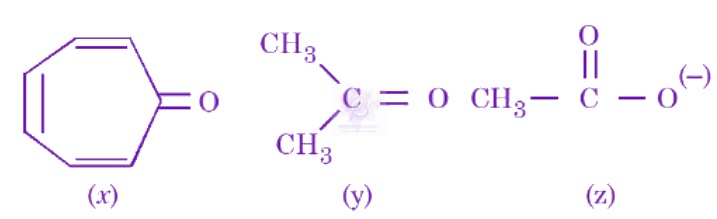 $(x)$ tropone, $(y)$ acetone, $(z)$ acetate ion The correct order of carbon – oxygen double bond length is:
From the following, how many compounds contain at least one secondary alcohol? 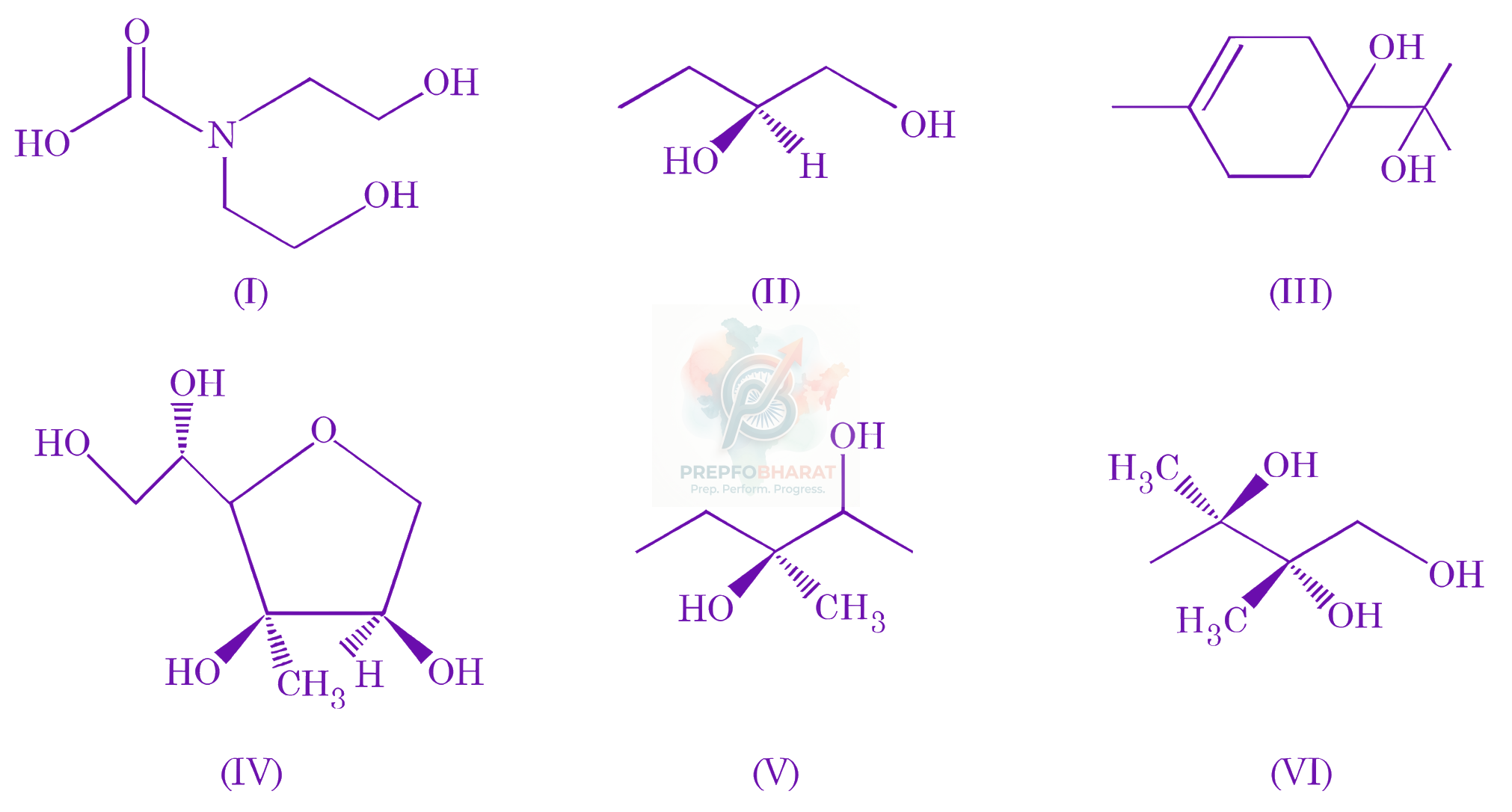 Choose the correct answer from the options given below:
Complete combustion of $X$ g of an organic compound gave $0.25$ g of $CO_2$ and $0.12$ g of $H_2 O$. If the % of carbon is $25\%$ and of hydrogen is $4.89\%$, then $X = $ _____ $\times 10^{-3}$ g. (Nearest integer) (Molar mass of C, H and O are $12, 1$ and $16$ g mol$^{-1}$ respectively.)
3, 3-Dimethyl-2-butanol cannot be prepared by : 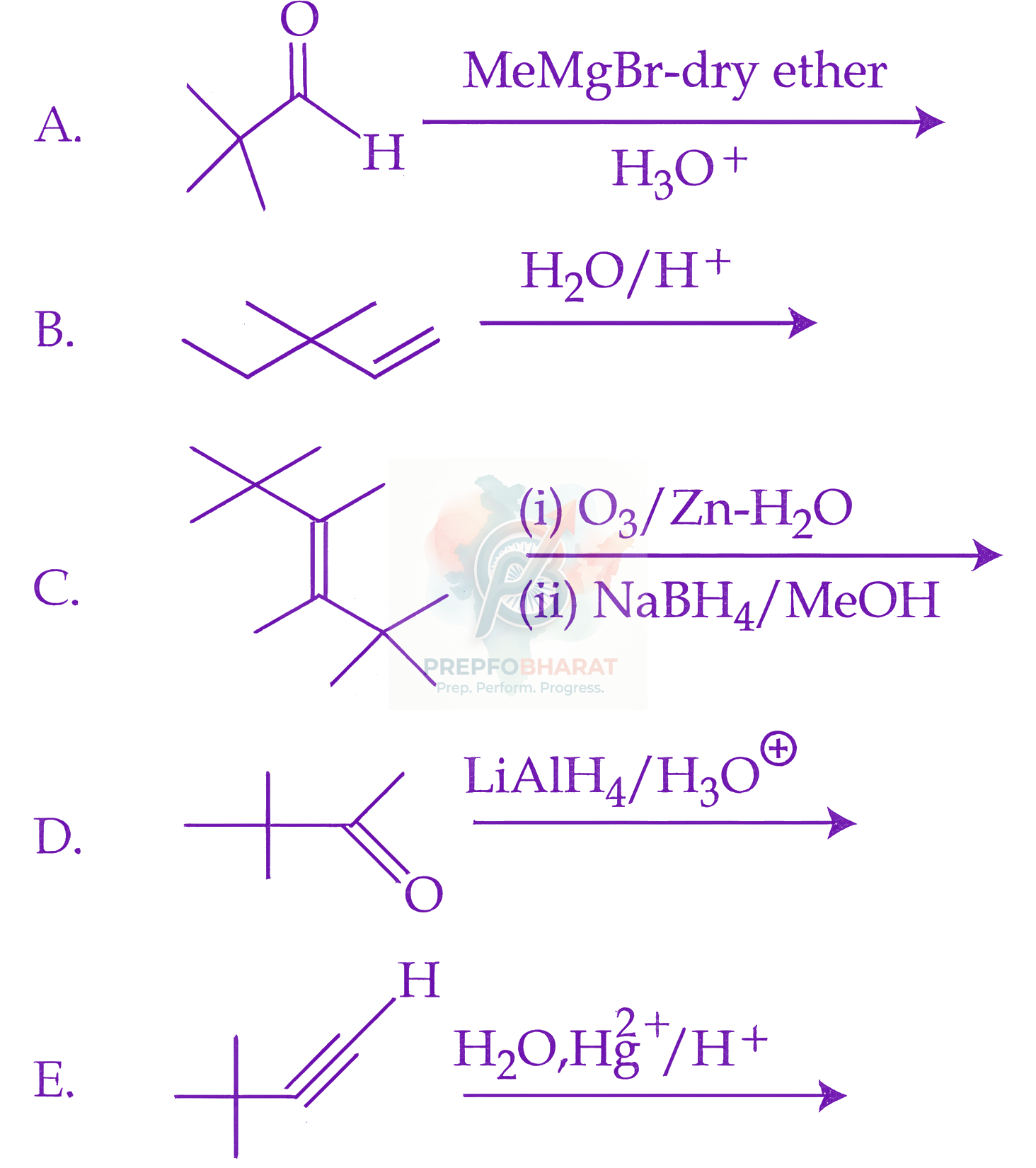 Choose the correct answer from the options given below :
Which of the following statements are TRUE about Haloform reaction?: A. Sodium hypochlorite reacts with KI to give KOI. B. KOI is a reducing agent. C. $\alpha, \beta$-unsaturated methylketone $\left(\mathrm{CH}_{3}-\mathrm{CH}=\mathrm{CH}-\stackrel{\mathrm{O}}{\mathrm{O}}-\mathrm{CH}_{3}\right)$ will give iodoform reaction. D. Isopropyl alcohol will not give iodoform test. E. Methanoic acid will give positive iodoform test. Choose the correct answer from the options given below:
$\mathrm{Ph}-\mathrm{CH}=\mathrm{CH}_{2} \xrightarrow[\mathrm{HBr}]{(\mathrm{PhCOO})_{2}}$ Product Consider the above reaction A. The reaction proceeds through a more stable radical intermediate. B. The role of peroxide is to generate $\mathrm{H}^{\circ}$ (Hydrogen radical). C. During this reaction, benzene is formed as a byproduct. D. 1-Bromo-2-phenylethane is formed as the minor product. E. The same reaction in absence of peroxide proceeds via carbocation intermediate. Identify the correct statements. Choose the correct answer from the options given below:
Sodium fusion extract of an organic compound $(\mathrm{Y})$ with $\mathrm{CHCl}_{3}$ and chlorine water gives violet color to the $\mathrm{CHCl}_{3}$ layer. 0.15 g of $(\mathrm{Y})$ gave 0.12 g of the silver halide precipitate in Carius method. Percentage of halogen in the compound $(\mathrm{Y})$ is $\_\_\_\_$. (Nearest integer) (Given : molar mass $\mathrm{g} \mathrm{mol}^{-1} \mathrm{C}: 12, \mathrm{H}: 1, \mathrm{Cl}: 35.5, \mathrm{Br}: 80, \mathrm{I}: 127$)
Which of the following reaction is NOT correctly represented?
A student has planned to prepare acetanilide from aniline using acetic anhydride. The student has started from 9.3 g of aniline. However, the student has managed to obtain 11 g of dry acetanilide. The % yield of this reaction is :-
Benzyl isocyanide can be obtained from 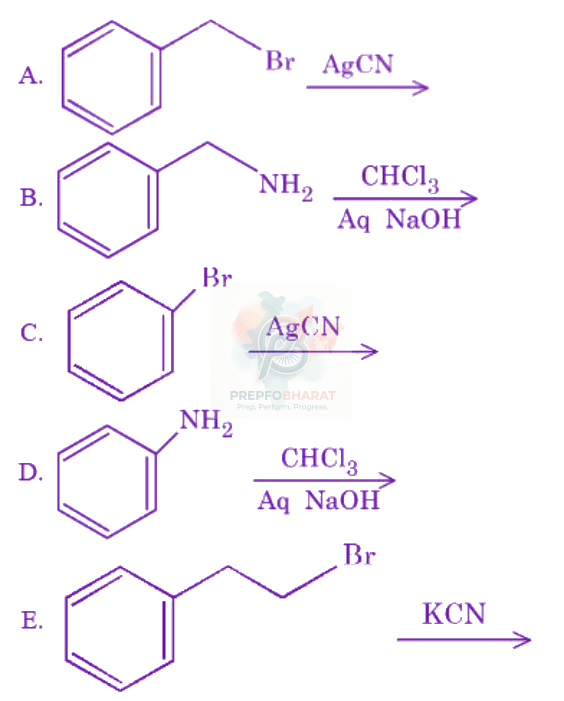 Choose the correct answer from the options given below:
Which of the following amino acid will give violet coloured complex with neutral ferric chloride solution?
Given below are two statements: Statement I: The structure of Maltose is given below: 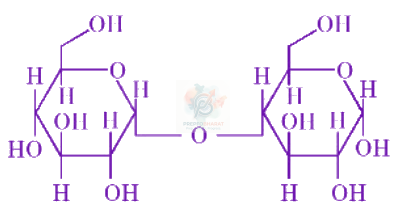 Maltose is a non-reducing sugar. Statement II: The structure of Lactose is given below: 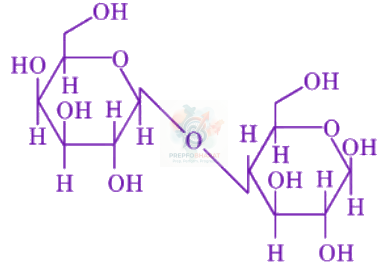 Lactose is a reducing sugar. In the light of the above statements, choose the correct answer from the options given below
An organic compound $(\mathrm{P})$ on treatment with aqueous ammonia under hot condition forms compound (Q) which on heating with $\mathrm{Br}_{2}$ and KOH forms compound (R) having molecular formula $\mathrm{C}_{6} \mathrm{H}_{7} \mathrm{~N}$. Names of P, Q and R respectively are.
Given below are two statements : Statement I : A mixture of C$_{12}$H$_{22}$O$_{11}$ (sugar) and NaCl can be separated by dissolving sugar in alcohol, due to differential solubility. Statement II : Rose essence from rose petals is seperated by steam distillation due to its high volatility and insolubility in H$_2$O. In the light of the above statements, choose the correct answer from the options given below :
IUPAC name of the some alkenes are given below. Find out the correct stability order. A. 2-Methylbut-2-ene B. cis-But-2-ene C. 2,3-Dimethylbut-2-ene D. Prop-1-ene Choose the correct answer from the options given below :
The correct order of reactivity of the following benzyl halides towards reaction with KCN is : 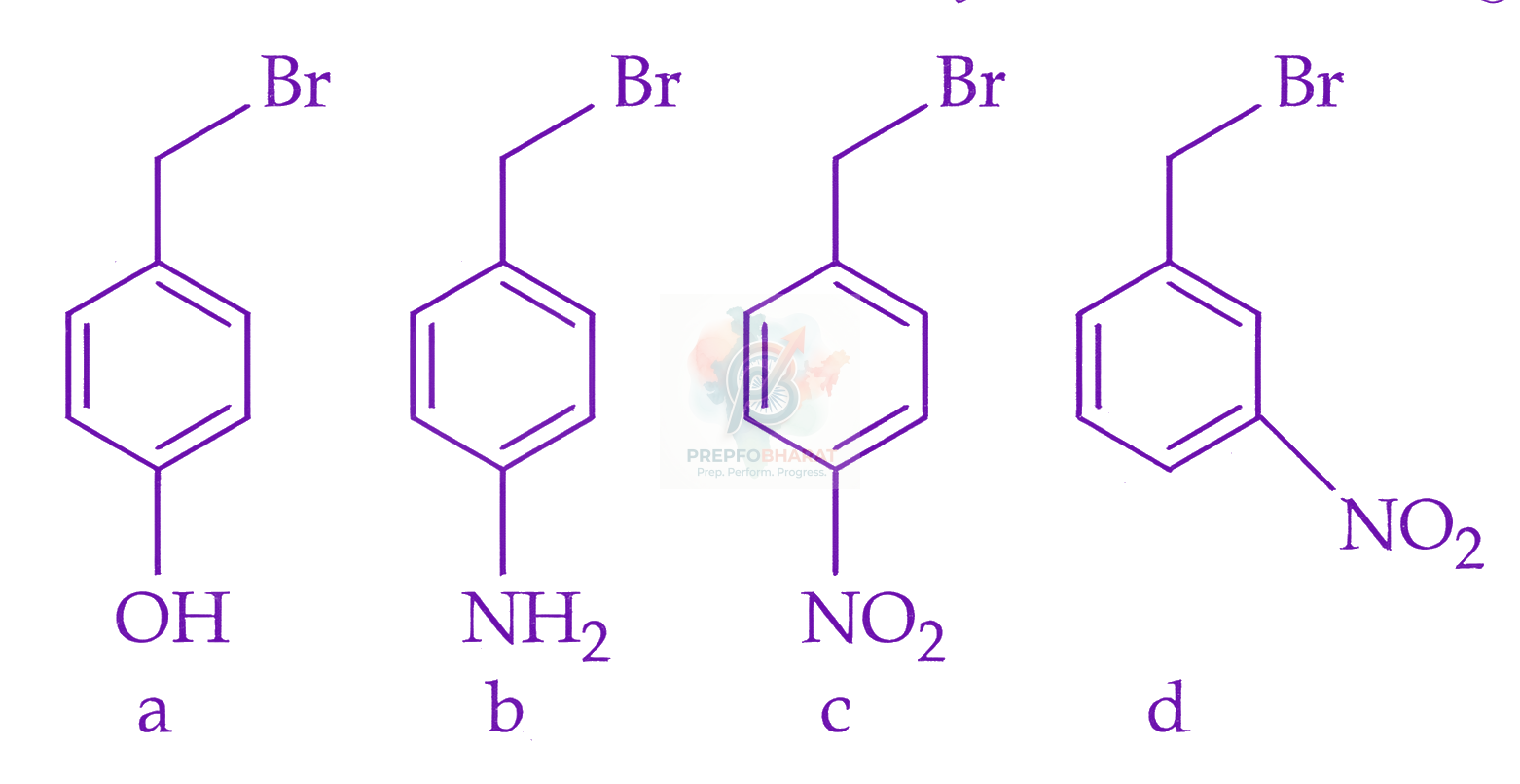
Given below are two statements : Statement I: Sublimation is used for the separation and purification of compounds with low melting point. Statement II: The boiling point of a liquid increases as the external pressure is reduced. In the light of the above statements, choose the correct answer from the options given below :
The major product of which of the following reaction is not obtained by rearrangement reaction?
"P" is a hydrocarbon of molecular formula: C$_8$H$_{14}$. On ozonolysis, "P" forms "Q". "Q" on treatment with alkali under reflux condition produces "R", which on treatment with I$_2$/NaOH gives a yellow precipitate. Acidification of the solution gives "S". The structure of "S" is given below: 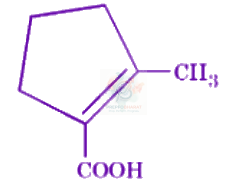 The correct structure of "P" is
Given below are two statements: Statement I: Phenol on treatment with $\mathrm{CHCl}_{3}$ /aq. KOH under refluxing condition, followed by acidification produces $p$-hydroxy benzaldehyde as the major product and $o$-hydroxy benzaldehyde as the minor product. Statement II: The mixture of $p$-hydroxybenzaldehyde and $o$ hydroxybenzaldehyde can be easily separated through steam distillation. In the light of the above statements, choose the correct answer from the options given below
Given below are two statements: Statement I: The dipole moment of R-CN is greater than R-NC and R-NC can undergo hydrolysis under acidic medium to produce 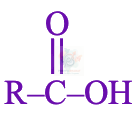. Statement II: R-CN hydrolyses under acidic medium to produce a compound which on treatment with $\mathrm{SOCl}_{2}$, followed by the addition of $\mathrm{NH}_{3}$ gives another compound $(\mathrm{x})$. This compound $(\mathrm{x})$ on treatment with $\mathrm{NaOCl} / \mathrm{NaOH}$ gives a product, that on treatment with $\mathrm{CHCl}_{3} / \mathrm{KOH} / \Delta$ produces R-NC. In the light of the above statements, choose the correct answer from the options given below
The correct stability order of the following diazonium salts is 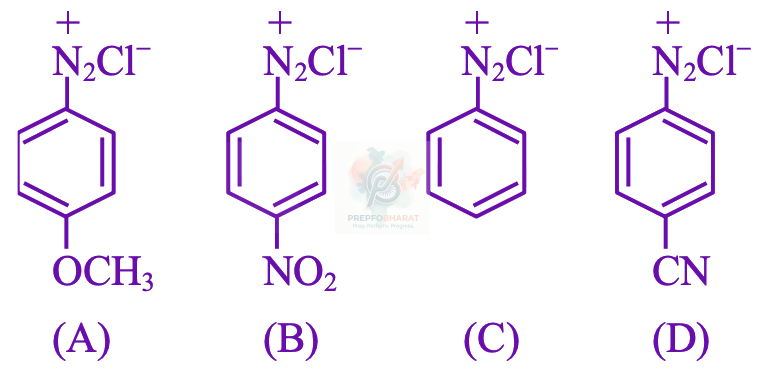
Grignard reagent $\mathrm{RMgBr}(\mathrm{P})$ reacts with water and forms a gas (Q). One gram of Q occupies $1.4 \mathrm{dm}^{3}$ at STP. (P) on reaction with dry ice in dry ether followed by $\mathrm{H}_{3} \mathrm{O}^{+}$forms a compound (Z). 0.1 mole of (Z) will weigh $\_\_\_\_$ g. (Nearest integer)
Identify the incorrect statement about tertiary structure of proteins.
Which statements are True? A. In Hoffmann bromamide degradation, $4$ moles of NaOH and $2$ moles of Br$_2$ are consumed per mole of an amide B. Hoffmann bromamide reaction is not given by alkyl amides. C. Primary amines can be synthesized by Hoffmann bromamide degradation. D. Secondary amide on reaction with Br$_2$ and NaOH will give secondary amine. E. The by-products of Hoffmann degradation are Na$_2$CO$_3$, NaBr and H$_2$O. Choose the correct answer from the options given below:
Consider the following reaction of benzene. 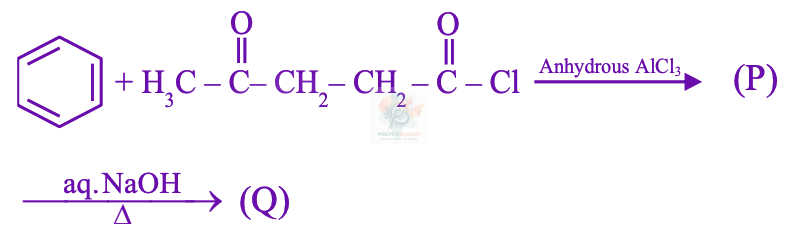 In compound (Q), the percentage of oxygen is $\_\_\_\_$ %. (Nearest integer)
Match List - I with List - II. $\begin{array}{l} \text{List - I} & \text{List - II} \\ \text{Reagents} & \text{Reaction Name (Involving aldehydes)} \\ \text{A. } \mathrm{H}_{2}, \mathrm{Pd}-\mathrm{BaSO}_{4} & \text{I. Etard Reaction} \\ \text{B. } \mathrm{SnCl}_{2}, \mathrm{HCl} & \text{II. Rosenmund Reduction} \\ \text{C. } \mathrm{CrO}_{2} \mathrm{Cl}_{2}, \mathrm{CS}_{2} & \text{III. Gatterman - Koch Reaction} \\ \text{D. } \mathrm{CO}, \mathrm{HCl}, \text{ Anhyd. } \mathrm{AlCl}_{3} & \text{IV. Stephen Reaction} \end{array}$ Choose the correct answer from the options given below :
Correct statements regarding alkyl halides $(R - X)$ among the following are: A. Alcohol being less polar solvent as compared to water, alcoholic KOH favours elimination reaction with $R - X$. B. Order of reactivity towards $S_N^1$ mechanism is $C_6 H_5 - CH_2 - Cl > C_6 H_5 - CHCl - C_6 H_5$. C. Non substituted aryl halides exhibit properties similar to alkyl halides. D. Vinyl chloride is an example of haloalkene and allyl chloride is an example of haloalkyne. E. $R - Cl$ can be prepared by reacting $R - OH$ with $SOCl_2$ but $Ar - Cl$ cannot be prepared by reacting $Ar - OH$ with $SOCl_2$. Choose the correct answer from the options given below:
Consider the isomers of hydrocarbon with molecular formula $C_5H_{10}$. These isomers do not decolourise $KMnO_4$ solution. These isomers are subjected to chlorination with chlorine in presence of light to give monochloro compounds. The total number of monochloro compounds (structural isomers only) formed is _______.
n-Butane on monochlorination under photochemical condition gives an optically active compound "P". "P" on further chlorination gives dichloro compounds. The number of dichloro compounds obtained (ignore stereoisomers) is:
The cyclic cations having the same number of hyperconjugation are : 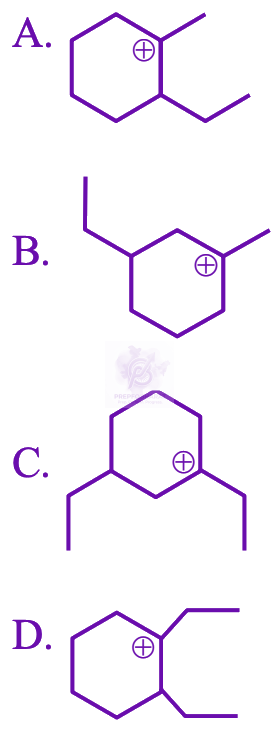 Choose the correct answer from the options given below :
Arrange the following compounds according to increasing order of boiling points. $n\text{-}\text{C}_4\text{H}_9\text{OH}$ (A), $n\text{-}\text{C}_4\text{H}_9\text{NH}_2$ (B), $n\text{-}\text{C}_4\text{H}_{10}$ (C) and $\text{C}_2\text{H}_5\text{NHC}_2\text{H}_5$ (D).
Given below are four compounds : (a) n-propyl chloride (b) iso-propyl chloride (c) sec-butyl chloride (d) neo-pentyl chloride Percentage of carbon in the one which exhibits optical isomerism is :
Method used for separation of mixture of products (B and C) obtained in the following reaction is 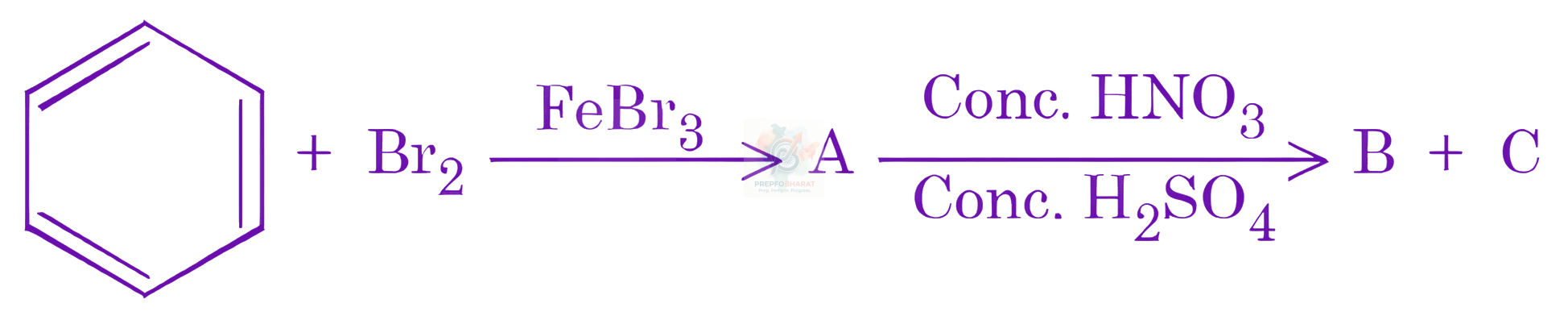
Structures of four disaccharides are given below. Among the given disaccharides, the non-reducing sugar is :
The strongest conjugate acid will result from:
Arrange the following carbanions in the decreasing order of stability. 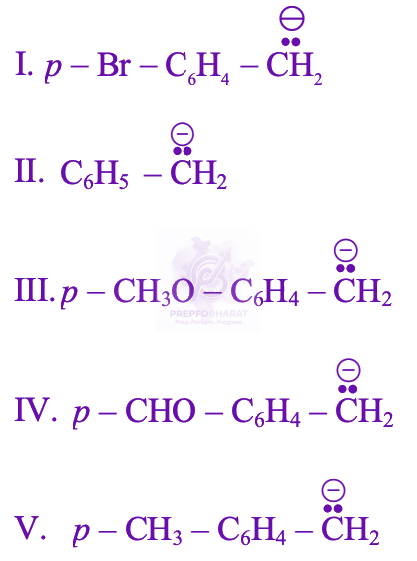 Choose the correct answer from the options given below:
Shown below is the structure of methyl acetate with three different $\alpha$, $\beta$ and $\gamma$ carbon - oxygen bonds. 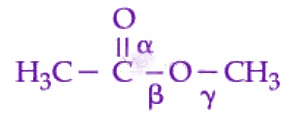 The correct order of bond lengths of these bonds is :
From the following, the least stable structure is:
Identify correct statements from the following : A. Propanal and propanone are functional isomers. B. Ethoxyethane and methoxypropane are metamers. C. But-2-ene shows optical isomerism. D. But-1-ene and but-2-ene are functional isomers. E. Pentane and 2, 2-dimethyl propane are chain isomers. Choose the correct answer from the options given below :
For the given molecule, "$x$", the preferred site for the attack of the electrophile is : 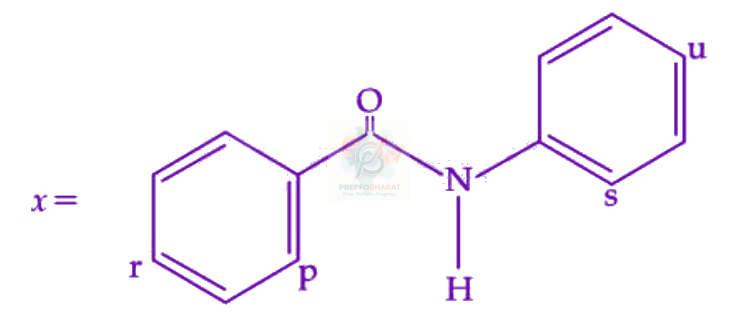
Consider the following reactions. Total number of electrons in the $\pi$ bonds and lone pair of electrons in the product $(X)$ is : 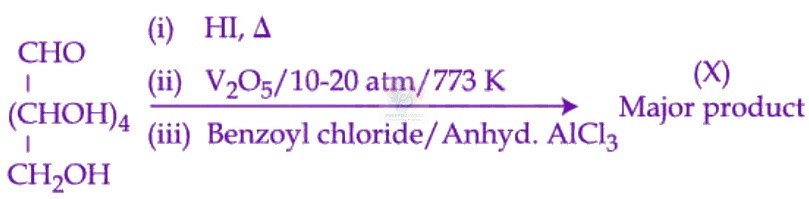
Total number of alkali insoluble solid sulphonamides obtained by reaction of given amines with Hinsberg's reagent is $\_\_\_\_$. Aniline, N-Methylaniline, Methanamine, N, N-Dimethylmethanamine, N-Methyl methanamine, Phenylmethanamine, N-propylaniline, N-phenylaniline, N, N-Dimethylaniline, Allyl amine, Isopropyl amine
A hydrocarbon ' $\mathrm{P}^{\prime}\left(\mathrm{C}_{4} \mathrm{H}_{8}\right)$ on reaction with HCl gives an optically active compound ' Q ' $\left(\mathrm{C}_{4} \mathrm{H}_{9} \mathrm{Cl}\right)$ which on reaction with one mole of ammonia gives compound ' $\mathrm{R}^{\prime}\left(\mathrm{C}_{4} \mathrm{H}_{11} \mathrm{~N}\right)$. ' $\mathrm{R}^{\prime}$ on diazotization followed by hydrolysis gives ' S '. Identify $\mathrm{P}, \mathrm{Q}, \mathrm{R}$ and S.
 The final product $[\mathrm{B}]$ is :
CORRECT order of stability for the following is $\mathrm{CH}_{2}=\mathrm{CH}^{-}, \mathrm{CH}_{3}-\mathrm{CH}_{2}^{-}, \mathrm{CH} \equiv \mathrm{C}^{-}$
Consider all the structural isomers with molecular formula $\mathrm{C}_{5} \mathrm{H}_{11} \mathrm{Br}$ are separately treated with $\mathrm{KOH}(\mathrm{aq})$ to give respective substitution products, without any rearrangement. The number of products which can exhibit optical isomerism from these is $\_\_\_\_$.
$2.0$ g of a bromo hydrocarbon $(X)$ was subjected to Carius analysis, gave $3.36$ g of $AgBr$. The percentage of carbon in the compound $(X)$ is $26.7\%$. Total number of carbon atoms in the empirical formula for compound $(X)$ is _____. (Given molar mass in g mol$^{-1}$ H:$1$, C:$12$, Br:$80$, Ag:$108$)
Given below are two statements: Statement I: On the basis of inductive effect, the order of stability of alkyl carbanions is CH$_3^- >$ CH$_3$-CH$_2^- >$ (CH$_3$)$_2$CH$^- >$ (CH$_3$)$_3$C$^-$. Statement II: Allyl and benzyl carbanions are more stabilised by inductive effect and not by resonance effect. In the light of the above statements, choose the correct answer from the options given below
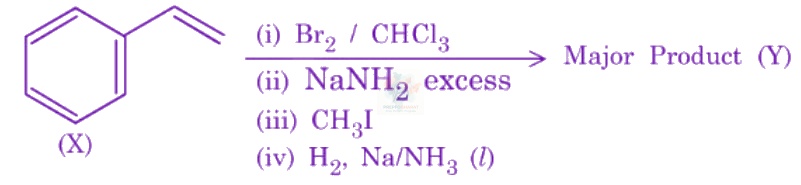 Compound (X) [styrene] is subjected to the sequence of reactions as shown above: (i) $Br_2/CHCl_3$ (ii) $NaNH_2$ excess (iii) $CH_3I$ (iv) $H_2$, $Na/NH_3$ $(l)$, giving Major Product (Y). Molar mass of the major product (Y) formed is ______ g mol$^{-1}$. (Given molar mass in g mol$^{-1}$ C:$12$, H: $1$, O: $16$)
Which of the following reactions is an example of Wurtz reaction?
The correct statements are : A. Activation energy for enzyme catalysed hydrolysis of sucrose is lower than that of acid catalysed hydrolysis. B. During denaturation, secondary and tertiary structures of a protein are destroyed but primary structure remains intact. C. Nucleotides are joined together by glycosidic linkage between $\mathrm{C}_{1}$ and $\mathrm{C}_{4}$ carbons of the pentose sugar. D. Quaternary structure of proteins represents overall folding of the polypeptide chain. Choose the correct answer from the options given below :
An organic compound " P " of molecular formula $\mathrm{C}_{6} \mathrm{H}_{12} \mathrm{O}_{3}$ gives positive Iodoform test but negative Tollen's test. When " P " is treated with dilute acid, it produces " Q ". " Q " gives positive Tollen's test and also iodoform test. The structure of " P " is :
$RMgI$ when treated with ice cold water liberated a gas which occupied $1.4\text{ dm}^3/\text{g}$ at STP. The gas produced is further reacted with iodine in presence of $HIO_3$ to give compound (X). Compound (X) in presence of Na and dry ether produced compound (Y). Molar mass of compound (Y) is _______ $\text{g mol}^{-1}$. (Nearest integer)
In sulphur estimation, $2.0 \times 10^{-3}$ mol of an organic compound (X) (molar mass $76$ g mol$^{-1}$) gave $0.4813$ g of barium sulphate (molar mass $233$ g mol$^{-1}$). The percentage of sulphur in the compound (X) is ______ $\times 10^{-1}$ % (Nearest integer)
Both human DNA and RNA are chiral molecules. The chirality in DNA and RNA arises due to the presence of
Arrange the following alkenes in decreasing order of stability. 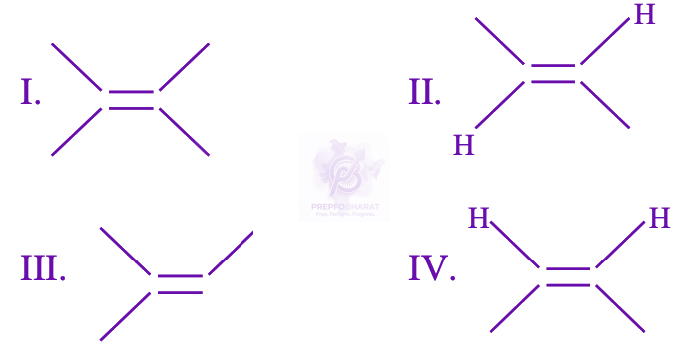 Choose the correct answer from the options given below:
Identify the correct pair having amino acid (A) and the hormone (B) that is iodinated derivative of the amino acid (A). (T and Y represent one letter code for amino acids) <table class="pyq-table"><tbody><tr><th>Amino acid (A)</th><th>Hormone (B)</th></tr></tbody></table>
Product $C$ of the following reaction sequence will be 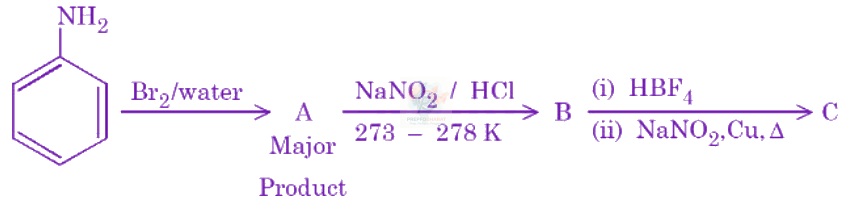
The correct order of the rate of reaction of the following reactants with nucleophile by SN1 mechanism is: (Given : Structure I and II are rigid) 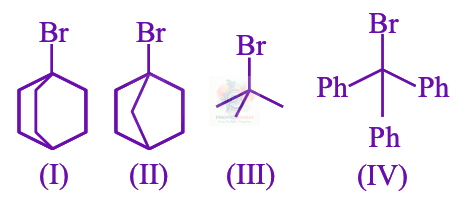
Identify the incorrect statements. 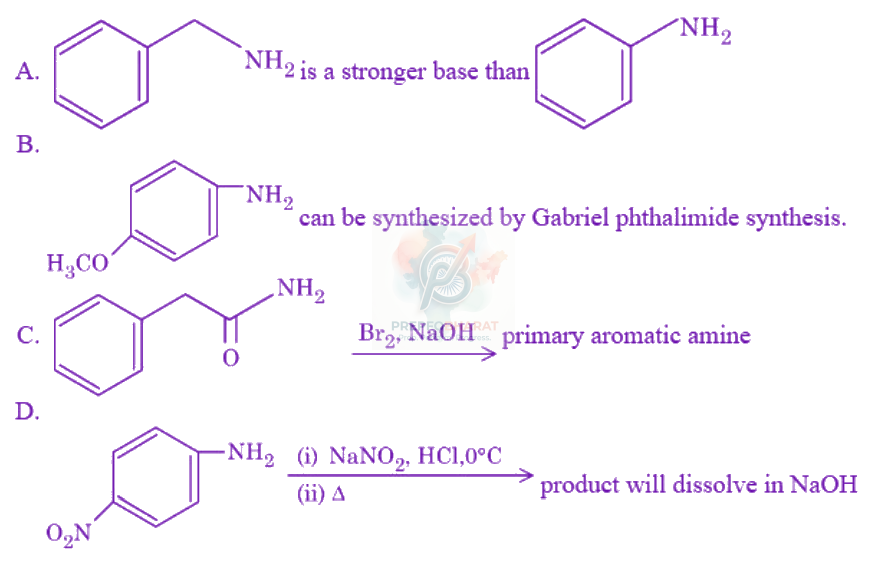 Choose the correct answer from the options given below:
For the following Friedel Craft's alkylation reaction, which of the statements are correct? 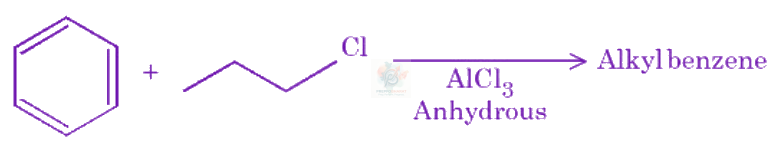 A. Major product is n-propyl benzene. B. iso-propyl carbocation intermediate is also generated. C. Multiple substitution is inevitable. D. Introducing electron-donating substituent on benzene will not produce any alkyl benzene. Choose the correct answer from the options given below:
Match the LIST-I with LIST-II <table class="pyq-table"><tbody><tr><th>List-I (Reaction)</th><th>List-II (Mechanism)</th></tr><tr><td>A. Williamson Synthesis</td><td>I. Electrophilic addition</td></tr><tr><td>B. Friedel Craft Reaction</td><td>II. Free radical substitution</td></tr><tr><td>C. Bromination of vinyl benzene</td><td>III. Nucleophilic substitution</td></tr><tr><td>D. Chlorination of toluene in light</td><td>IV. Electrophilic substitution</td></tr></tbody></table> Choose the correct answer from the options given below:
Consider the following reactions sequence 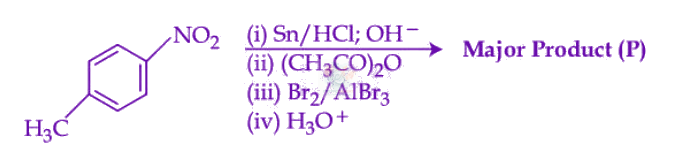 When the product (P) is subjected to Carius analysis using $AgNO_3$, $1.0$ g of the product (P) will produce _______ g of the precipitate of AgBr. (Nearest Integer) (Given: molar mass in g mol$^{-1}$ C : 12, H : 1, O : 16, N : 14, Br : 80, Ag : 108)
The cycloalkene $(\mathrm{X})$ on bromination consumes one mole of bromine per mole of $(\mathrm{X})$ and gives the product $(\mathrm{Y})$ in which $\mathrm{C}: \mathrm{Br}$ ratio is 3:1. The percentage of bromine in the product $(\mathrm{Y})$ is $\_\_\_\_$%. (Nearest integer) (Given : molar mass in $\mathrm{g} \mathrm{mol}^{-1} \mathrm{H}: 1, \mathrm{C}: 12, \mathrm{O}: 16, \mathrm{Br}: 80$)
The descending order of acidity among the following compounds is: A. Phenol B. $4$-nitrophenol C. $4$-methoxyphenol D. $4$-nitrobenzoic acid E. Benzoic acid 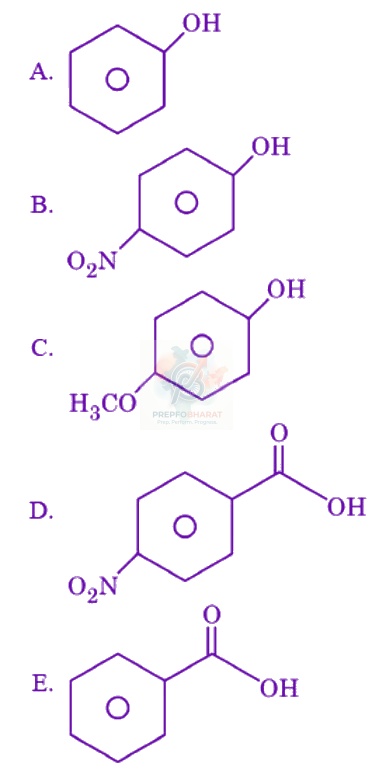 Choose the correct answer from the options given below:
Match List - I with List - II. <table class="pyq-table"><tbody><tr><th>List - I Vitamin</th><th>List - II Name</th></tr><tr><td>A. Vitamin $B_1$</td><td>I. Pyridoxine</td></tr><tr><td>B. Vitamin $B_2$</td><td>II. Ascorbic acid</td></tr><tr><td>C. Vitamin $B_6$</td><td>III. Thiamine</td></tr><tr><td>D. Vitamin C</td><td>IV. Riboflavin</td></tr></tbody></table> Choose the correct answer from the options given below :
Identify A in the following reaction. 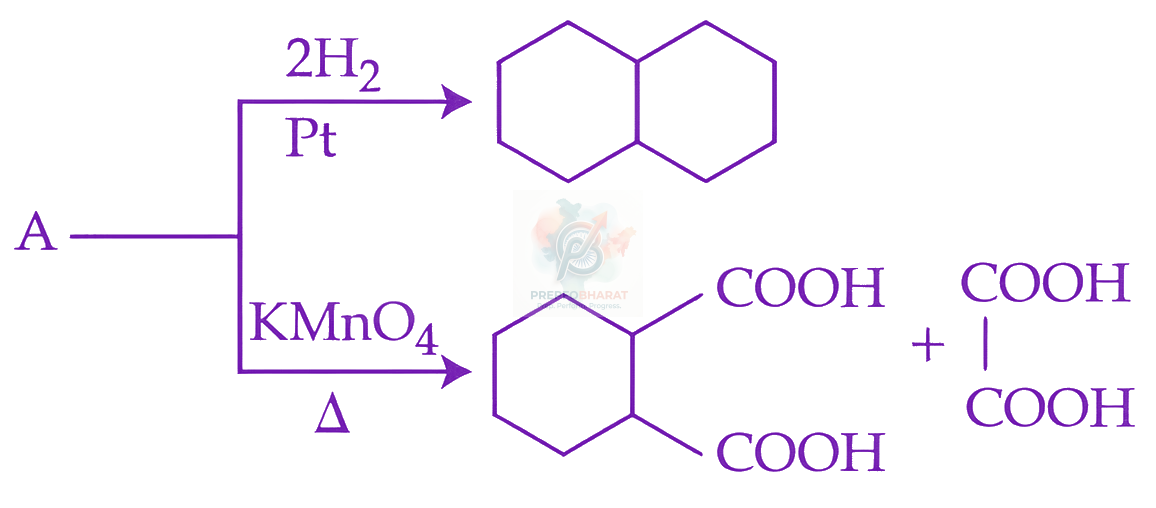
Consider the following sequence of reactions.  The percentage of nitrogen in the yellow product (X) formed is _______%. (Nearest Integer) (Given Molar mass in g mol$^{-1}$ H:1, C:12, N:14)
The mass of benzanilide obtained from the benzoylation reaction of 5.8 g of aniline, if yield of product is $82 \%$, is $\_\_\_\_$ g (nearest integer). (Given molar mass in $\mathrm{g} \mathrm{mol}^{-1} \mathrm{H}: 1, \mathrm{C}: 12, \mathrm{~N}: 14, \mathrm{O}: 16$)
$4.7$ g of phenol is heated with Zn to give product X. If this reaction goes to $60\%$ completion then the number of moles of compound X formed will be _______ $\times 10^{-2}$. (Nearest Integer) (Given molar mass in g mol$^{-1}$: H:1, C:12, O:16)
A student has been given a compound " $x$ " of molecular formula- $\mathrm{C}_{6} \mathrm{H}_{7} \mathrm{~N}$. ' $x$ ' is sparingly soluble in water. However, on addition of dilute mineral acid, ' $x$ ' becomes soluble in water. ' $x$ ' when treated with $\mathrm{CHCl}_{3}$ and $\mathrm{KOH}($ alc $)$, ' $y$ ' is produced. ' y ' has a specific unpleasant smell. On treatment with benzenesulphonyl chloride, ' $x$ ' gives a compound ' $z$ ' which is soluble in alkali. The number of different " $H$ " atoms present in ' $z$ ' is:-
Given below are two statements : Statement I: Compound $(X)$, shown below, dissolves in $\mathrm{NaHCO}_{3}$ solution and has two chiral carbon atoms 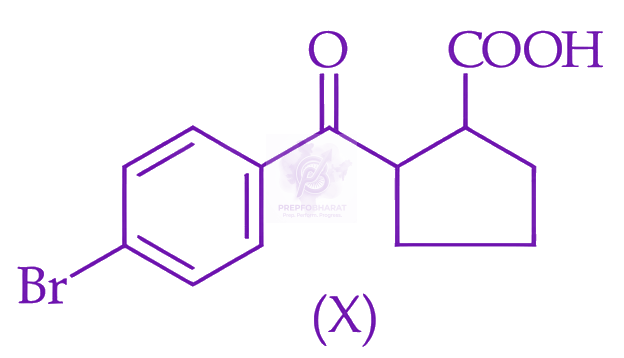 Statement II: Compound $(\mathrm{Y})$, shown below, has two carbons with $\mathrm{sp}^{3}$ hybridization, one carbon with $\mathrm{sp}^{2}$ and one carbon with sp hybridization 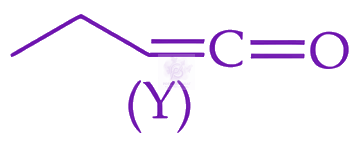 In the light of the above statements, choose the correct answer from the options given below :