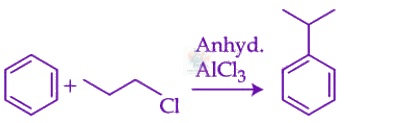
In option (A), the Friedel-Crafts alkylation of benzene with 1-chloropropane involves the formation of a primary carbocation, CH3CH2CH2+. This undergoes a 1,2-hydride shift to form a more stable secondary carbocation, CH3CH+CH3, which then attacks the benzene ring to yield cumene. Thus, rearrangement occurs.
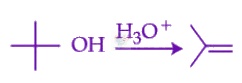
In option (B), the acid-catalyzed dehydration of tert-butyl alcohol proceeds via the formation of a tert-butyl carbocation, (CH3)3C+. Since it is already a highly stable tertiary carbocation, it does not undergo any rearrangement and directly loses a proton to form 2-methylpropene.
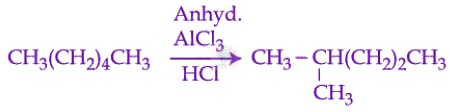
In option (C), the isomerization of n-hexane in the presence of anhydrous AlCl3 and HCl proceeds via the formation of carbocations that undergo skeletal rearrangements to form more stable branched isomers like 2-methylpentane.
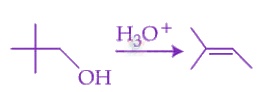
In option (D), the acid-catalyzed dehydration of neopentyl alcohol initially forms a primary neopentyl carbocation, (CH3)3CCH2+. This undergoes a 1,2-methyl shift to form a more stable tertiary carbocation, (CH3)2C+CH2CH3, which then loses a proton to yield 2-methyl-2-butene. Thus, rearrangement occurs.
Therefore, the reaction in option (B) is the only one where the major product is not obtained by a rearrangement reaction.
Answer: