JEE Main 2019 — Organic Chemistry
Chemistry Organic Chemistry questions from JEE Main 2019.
Other Years
142 Organic Chemistry Questions from 2019
The major product of the following reaction is : 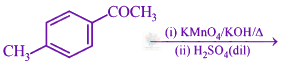
The products formed in the reaction of cumene with ${O}_{2}$ followed by treatment with dil $\mathrm{HCl}$ are:
Increasing rate of ${S}_{N}1$ reaction in the following compounds is: (I)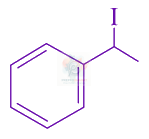 (II) 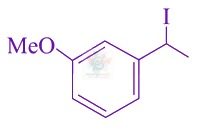 (III)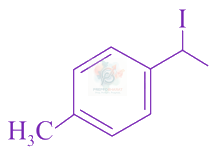 (IV) 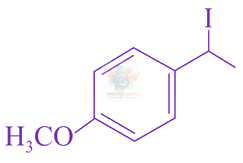
Which of the following compounds will show the maximum 'enol' content?
The peptide that gives positive ceric ammonium nitrate and carbylamine tests is:
The major product formed in the reaction given below will be : 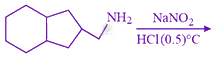
What will be the major product in the following mononitration reaction? 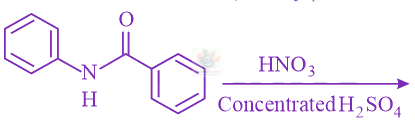
Among the following compounds, which one is found in RNA?
Among the following compounds most basic amino acid is:
An organic compound neither reacts with neutral ferric chloride solution nor with Fehling solution. It however, reacts with Grignard reagent and given positive iodoform test. The compound is:
In chromatography, which of the following statements is incorrect for ${R}_{f}$?
The correct sequence of amino acids present in the tripeptide given below is: 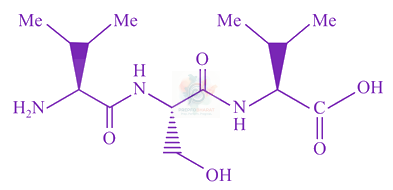
The increasing order of the reactivity of the following with $\text{L}\text{i}\text{A}\text{l}{\text{H}}_{4}$ is: $(A)$ 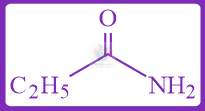 $(B)$ 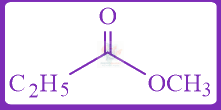 $(C)$ 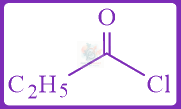 $(D)$ 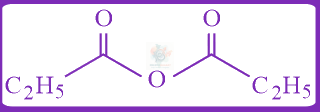
The aldehydes which will not form Grignard product with one equivalent of Grignard reagents are $(A)$ 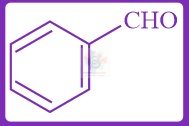 $(B)$ 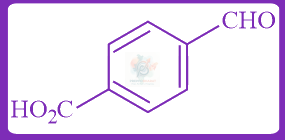 $(C)$ 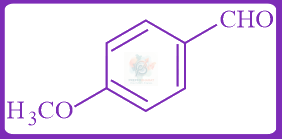 $(D)$ 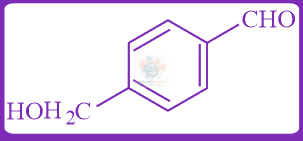
The highest value of the calculated spin only magnetic moment (in $\mathrm{BM}$) among all the transition metal complexes is
The increasing order of reactivity of the following compounds towards aromatic electrophilic substitution reaction is: 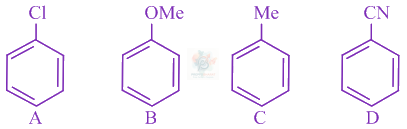
The major product (s) obtained in the following reaction is/are: 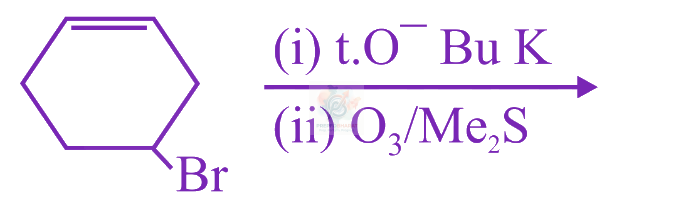
An organic compound is estimated through Dumas method and was found to evolve 6 moles of $\mathrm{CO}_{2}, 4$ moles of $\mathrm{H}_{2} \mathrm{O}$ and 1 mole of nitrogen gas. The formula of the compound is:
The increasing order of the ${pK}_{b}$ of the following compund is: $(A)$ 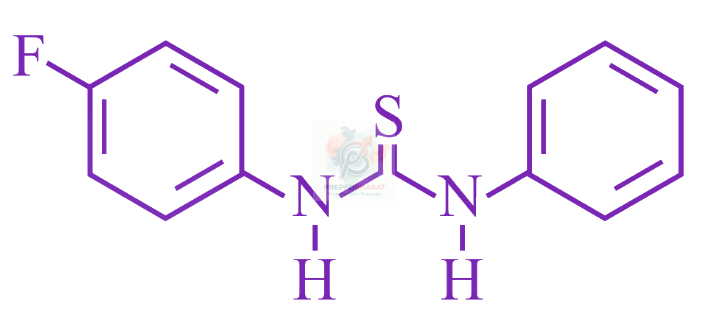 $(B)$ 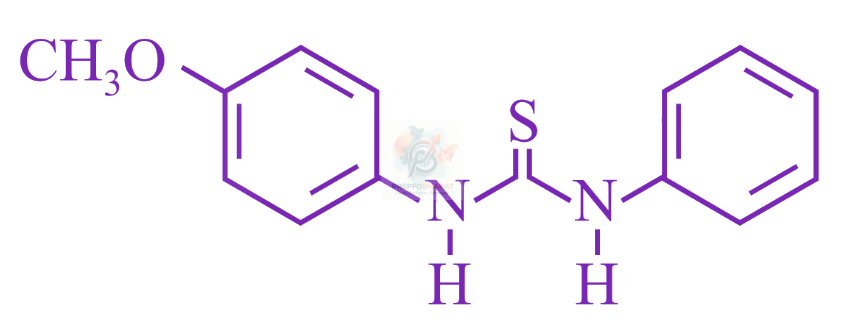 $(C)$ 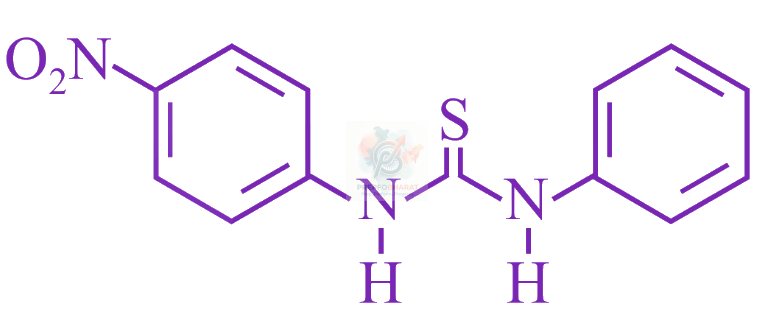 $(D)$ 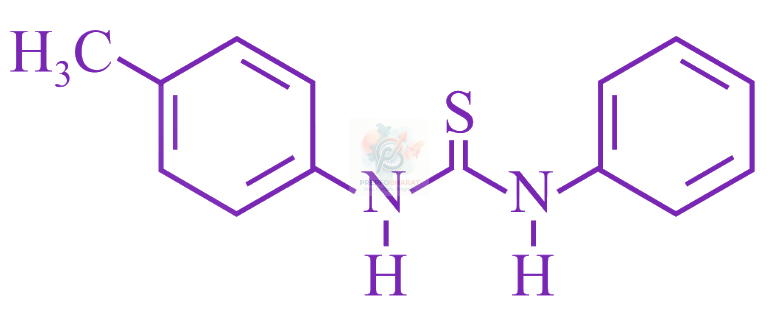
A compound 'X' on treatment with Br $/ \mathrm{NaOH}$, provided $\mathrm{C}_{3} \mathrm{H}_{9} \mathrm{~N},$ which gives positive carbylamine test. Compound $\mathrm{X}^{\prime}$ is:
The correct order for acid strength of compounds $\mathrm{CH}\equiv \mathrm{CH}, {\mathrm{CH}}_{3}-C\equiv \mathrm{CH}$ and ${\mathrm{CH}}_{2}={\mathrm{CH}}_{2}$ is as follows:
Which of the following potential energy $(P.E.)$ diagrams represents the ${\mathrm{SN}}_{1}$ reaction?
The major product of the following reaction is: 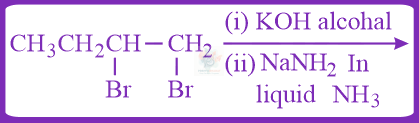
The major products of the following reaction are: 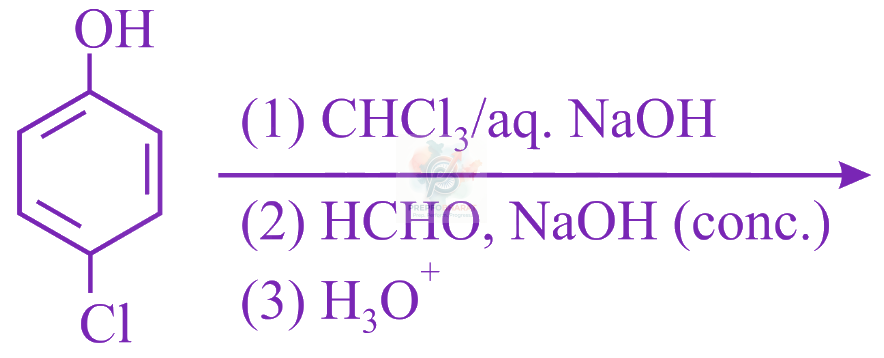
The increasing order of the reactivity of the following compounds towards electrophilic aromatic substitution reactions is: 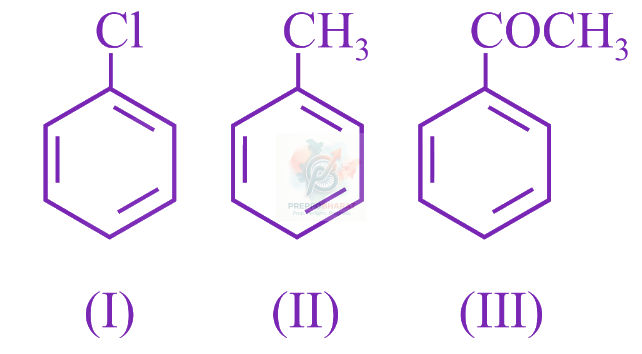
The major product formed in the following reaction is: 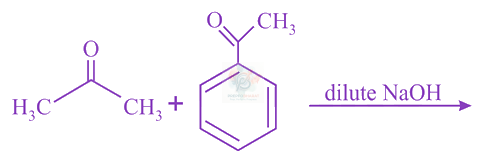
The major product of the following reaction is: 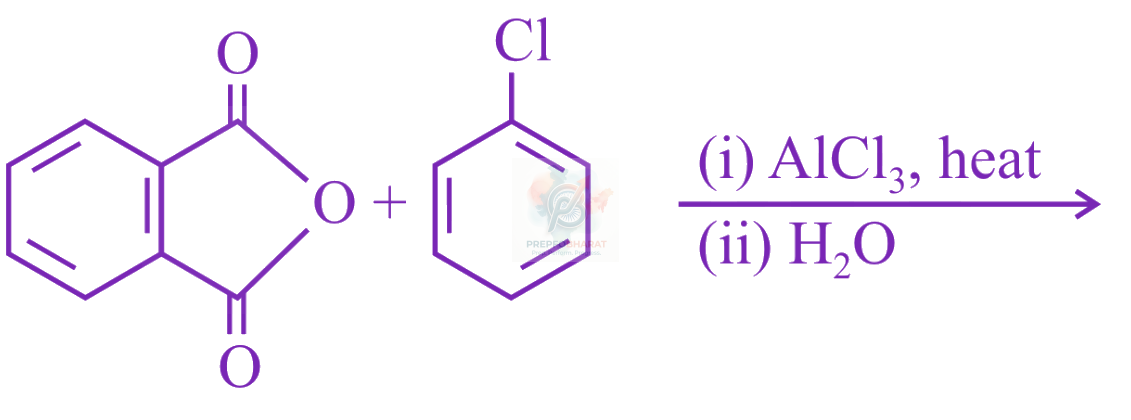
The major product of the following reaction is: 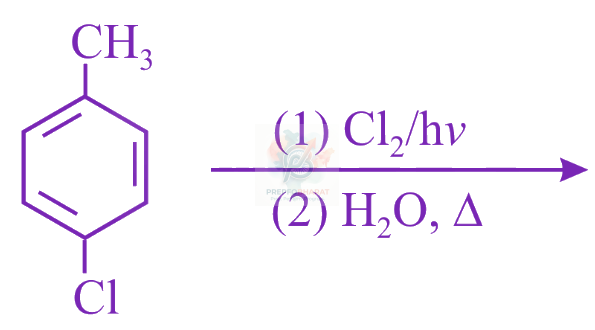
The major product of the following reaction is: 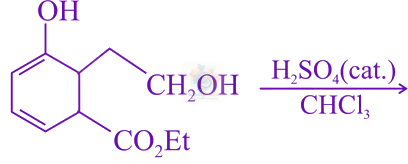
Which of these factors does not govern the stability of a conformation in acyclic compounds?
Major products of the following reaction are: 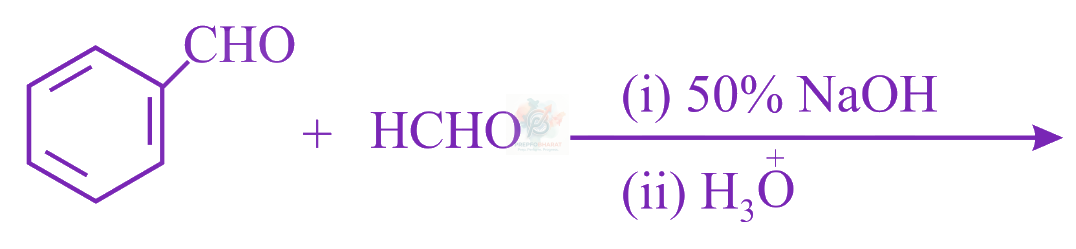
The major product obtained in the following reaction is: 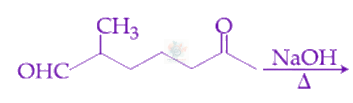
The major product of the following reaction is: 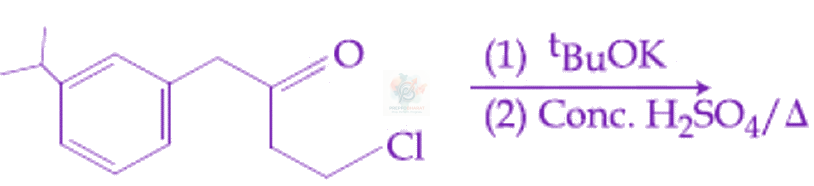
The major product obtained in the given reaction is: 
The major product of the following reaction is: 
The major product of the following reaction is: 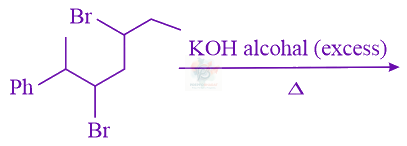
The major product of the following reaction is: 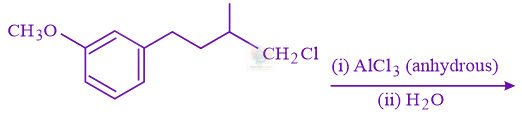
Which hydrogen in compound $(E)$ is easily replaceable during bromination reaction in presence of light ? 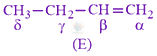
The correct match between Item I and Item II is: 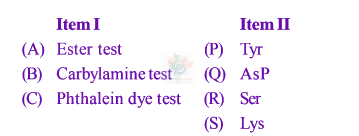
In the following reaction $\mathrm{Aldehyde}+\mathrm{Alcohol}\overset{\mathrm{HCl}}{\rightarrow }\mathrm{Acetal}$<table class="pyq-table"><tbody><tr><td>$Aldehyde$</td><td>$Alcohol$</td></tr><tr><td>$\mathrm{HCHO}$</td><td>$t-\mathrm{BuOH}$</td></tr><tr><td>${\mathrm{CH}}_{3}\mathrm{CHO}$</td><td>$\mathrm{MeOH}$</td></tr></tbody></table>The best combination is:
The major product of the following reaction is: 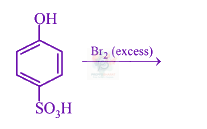
Increasing order of reactivity of the following compounds for ${S}_{N}1$ substitution is: 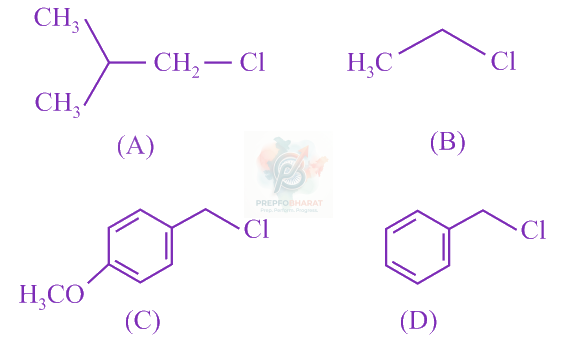
The major product of the following reaction is: 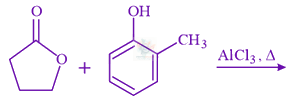
The major product of the following reaction is: 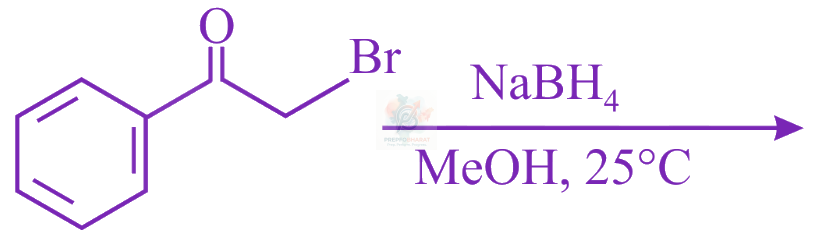
Consider the following reactions: 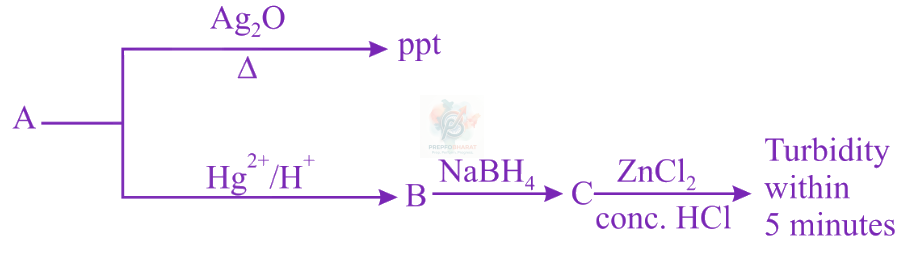 ‘A’ is:
The major product of the following reaction is: 
Which is the most suitable reagent for the following transformation? 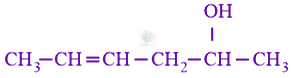 
Which of the following compounds will produce a precipitate with $\mathrm{AgNO}_{3} ?$
The major product obtained in the following reaction is: 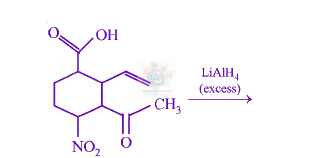
The major product of the following reaction is: 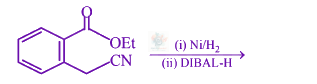
The major product of the following reaction is 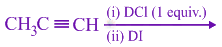
The major product of the following reaction is: 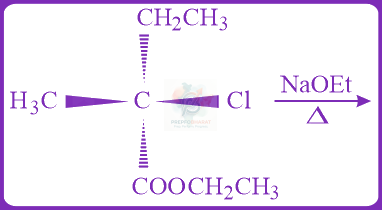
The major product $Y$ in the following reaction is: 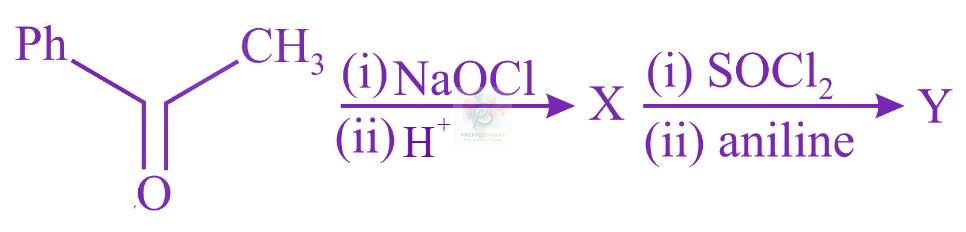
Coupling of benzene diazonium chloride with $1-naphthol$ in alkaline medium will give:
In the following compounds, the decreasing order of basic strength will be:
The correct structure of histidine in a strongly acidic solution $(\mathrm{pH}=2)$ is
The major products $A$ and $B$ for the following reactions are, respectively: 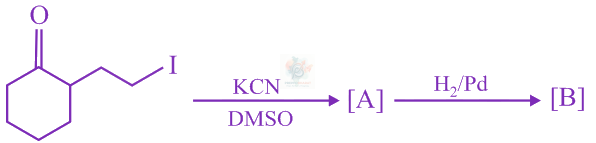
The major product of the following reaction is: 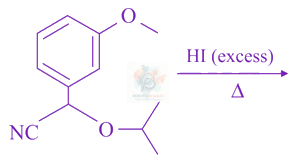
The major product of the following reaction is 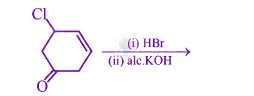
The major product of the following reaction is: 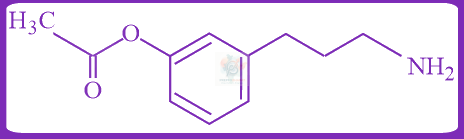 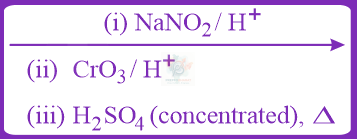
Which compound (s) out of the following is/are not aromatic? (A) (B) (C) (D)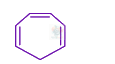
The major product obtained in the following reaction is: 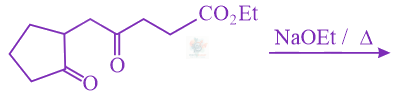
Which one of the following is likely to give a precipitate with $AgN{O}_{3}$ solution?
The major product of the following reaction is: 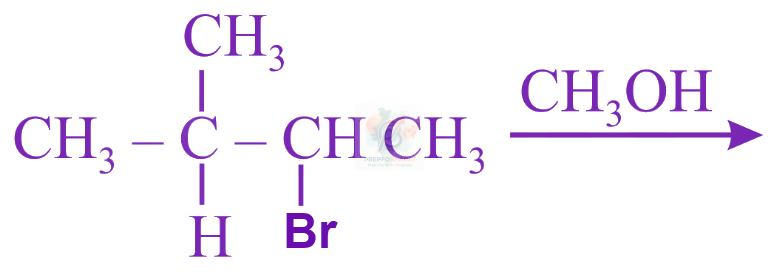
The major product of the following reaction is: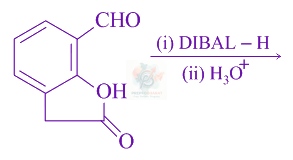
The major product of the following reaction is 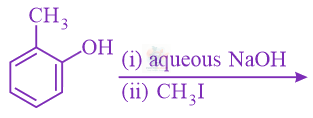
Amylopectin is composed of:
Which one of the following alkenes when treated with $HCl$ yields majorly an anti Markovnikov product?
The major product of the following reaction is: 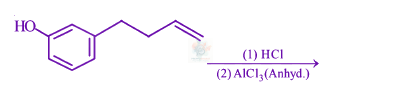
The major product of the following reaction is 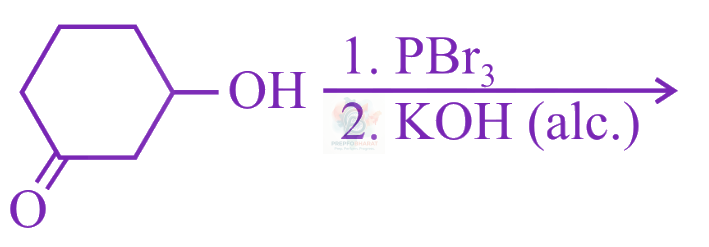
The major product of the following reaction is: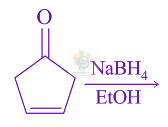
Benzene diazonium chloride on reaction with aniline in the presence of dilute hydrochloric acid gives:
The IUPAC name for the following compound is: 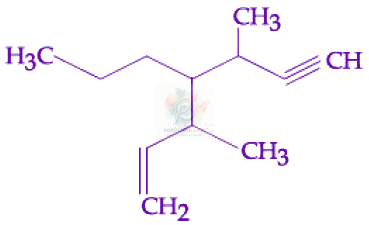
Which amongst the following is the strongest acid?
The major product obtained in the following conversion is: 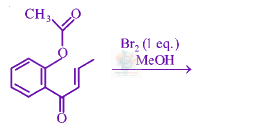
The major product in the following conversion is 
What will be the major product when m-cresol is reacted with propargyl bromide $(HC\equiv C-C{H}_{2}Br)$ in presence of ${K}_{2}C{O}_{3}$ in acetone?
p-Hydroxybenzophenone upon reaction with bromine in carbon tetrachloride gives:
Compound $A({C}_{9}{H}_{10}O)$ shows positive iodoform test. Oxidation of A with $KMn{O}_{4}/KOH$ gives acid $B({C}_{8}{H}_{6}{O}_{4})$ . Anhydride of B is used for the preparation of phenolphthalein. Compound A is:
The major product of the following reaction is: 
The major product of the following reaction is: 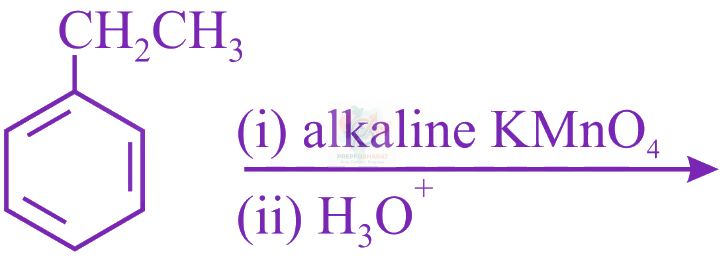
With dehydrating agent present which dicarboxylic acid is least reactive towards forming an anhydride?
Acid strength given below the correct decreasing order will be :
Which of the following is not a correct method of the preparation of benzyl amine from cyano benzene?
Aniline dissolved in dilute $HCl$ is reacted with sodium nitrite at $0^{\circ}C$. This solution was added dropwise to a solution containing an equimolar mixture of aniline and phenol in dilute $HCl$. The structure of the major product is
The major product in the following reaction is: 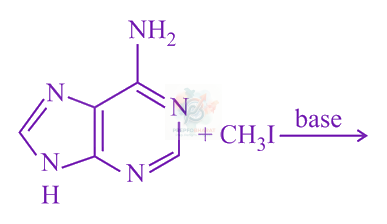
Hinsberg’s reagent is:
The major product obtained in the following reaction is: 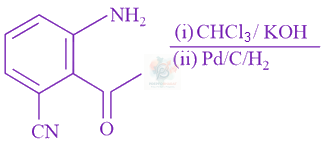
The increasing order of reactivity of the following compounds towards reaction with alkyl halides directly is: $(i)$ 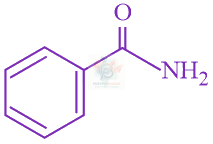 $(ii)$ 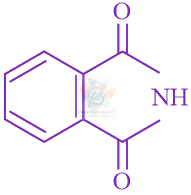 $(iii)$ 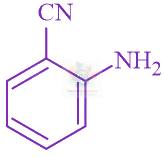 $(iv)$ 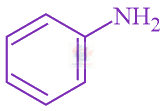
Glucose and Galactose are having identical configuration in all the positions except position.
The major product obtained in the following reaction is: 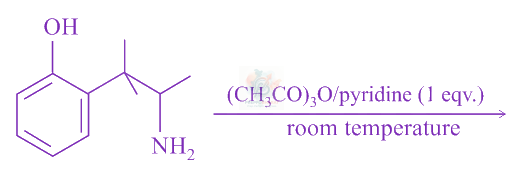
Which of the given statements is incorrect about glycogen?
If Dichloromethane (DCM) and water ${\text{H}}_{2}\text{O}$ are used for differential extraction, which one of the following statements is correct?
The principle of column chromatography is:
The major product of the following reaction is 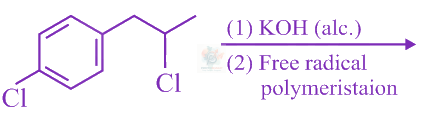
Ethylamine $({C}_{2}{H}_{5}N{H}_{2})$ can be obtained from N-ethylphthalimide on treatment with:
The compounds $A$ and $B$ in the following reaction are, respectively: 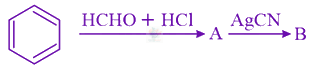
The major product of the following addition reaction is 
Maltose on treatment with dilute $HCl$ gives:
An organic compound $‘X’$ showing the following solubility profile is: 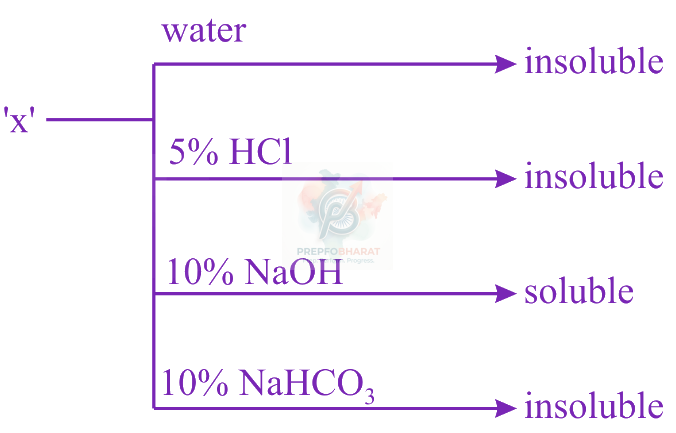
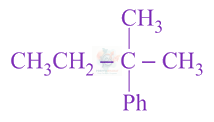 cannot be prepared by:
Which of the following amines can be prepared by Gabriel phthalimide reaction?
Heating of 2-chloro-1-phenylbutane with $EtOK/EtOH$ gives $X$ as the major product. Reaction $X$ with $Hg{(OAc)}_{2}/{H}_{2}O$ followed by $NaB{H}_{4}$ gives $Y$ as the major product. $Y$ is:
The increasing basicity order of the following compounds is: 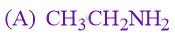  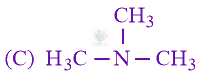 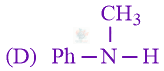
An ‘Assertion’ and a ‘Reason’ is given below. Choose the correct answer from the following options: Assertion $(A)$: Vinyl halides do not undergo nucleophilic substitution easily. Reason $(R)$: Even though the intermediate carbocation is stabilized by loosely held $\pi -$ electrons, the cleavage is difficult because of the strong bonding.
The correct structure of the product $‘P’$ in the following reaction is $\mathrm{Asn}-\mathrm{Ser}+\underset{(\mathrm{excess})}{{({\mathrm{CH}}_{3}\mathrm{CO})}_{2}O}\overset{{\mathrm{NEt}}_{3}}{\rightarrow }P$
Which of the following compounds is not aromatic?
The increasing order of the $pKa$ values of the following compounds is: 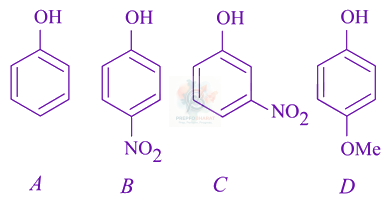
The decreasing order of ease of alkaline hydrolysis for the following esters is 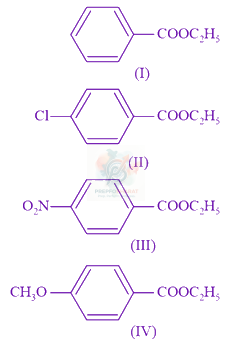
The $IUPAC$ name of the following compound is: 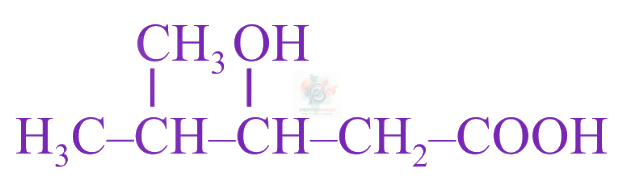
The organic compound that gives following qualitative analysis is:<table class="pyq-table"><tbody><tr><th></th><th>Test</th><th>Inference</th></tr><tr><td>$(a)$</td><td>$Dil.HCl$</td><td>Insoluble</td></tr><tr><td>$(b)$</td><td>$NaOH solution$</td><td>Soluble</td></tr><tr><td>$(c)$</td><td>$B{r}_{2}/water$</td><td>Decolourization</td></tr></tbody></table>
An aromatic compound $'A'$ having molecular formula ${C}_{7}{H}_{6}{O}_{2}$, on treating with aqueous ammonia and heating forms compound $'B'$. The compound $'B'$ on reaction with molecular bromine and potassium hydroxide provides compound $'C'$ having molecular formula ${C}_{6}{H}_{7}N$. The structure of $'A'$ is:
Which of the following tests cannot be used for identifying amino acids?
The increasing order of nucleophilicity of the following nucleophiles is; 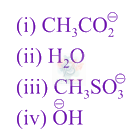
What is the IUPAC name of the following compound? 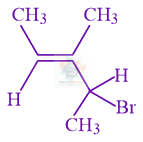
The major product of the following reaction is: 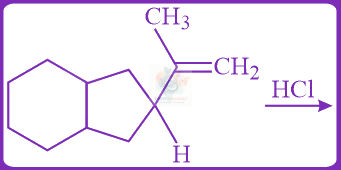
Polysubstitution is a major drawback in:
The major product $'Y'$ in the following reaction is: 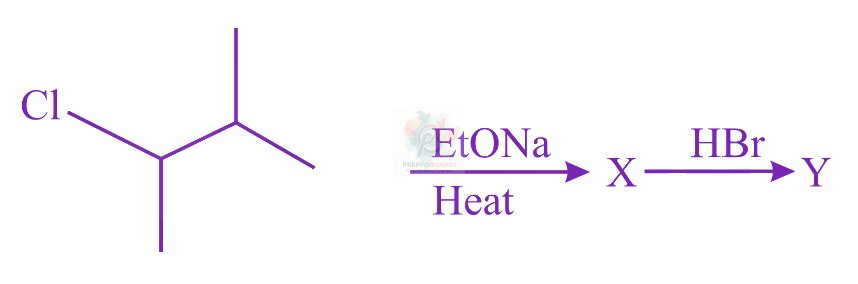
The correct match between item $I$ and item $\mathrm{II}$ is <table class="pyq-table"><tbody><tr><td colspan="2">Item $I$ (Compound)</td><td colspan="2">Item $\mathrm{II}$ (Reagent)</td></tr><tr><td>$a.$</td><td>Lysine</td><td>$p.$</td><td>$1-$naphthol</td></tr><tr><td>$b.$</td><td>Furfural</td><td>$q.$</td><td>Ninhydrin</td></tr><tr><td>$c.$</td><td>Benzyl alcohol</td><td>$r.$</td><td>${\mathrm{KMnO}}_{4}$</td></tr><tr><td>$d.$</td><td>Styrene</td><td>$s.$</td><td>Ceric ammonium nitrate</td></tr></tbody></table>
But-2-ene on reaction with alkaline $KMn{O}_{4}$ at elevated temperature followed by acidification will give:
In the following skew conformation of ethane, ${H}^{'}-C-C-{H}^{''}$ dihedral angle is: 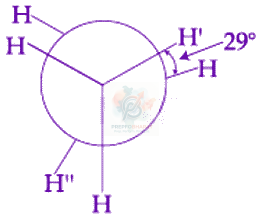
The major product of the following reaction 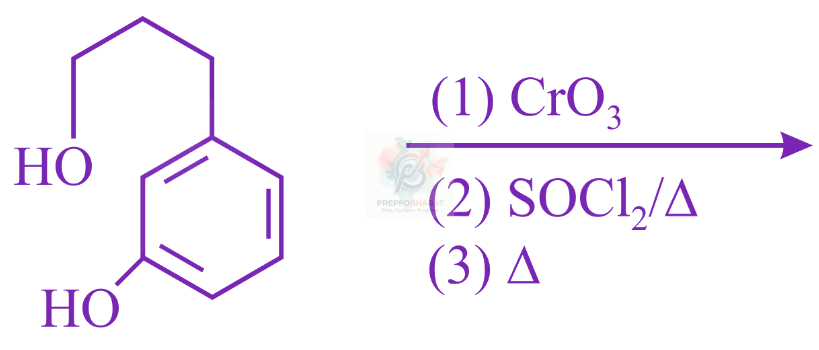
The major product of the following reaction is: 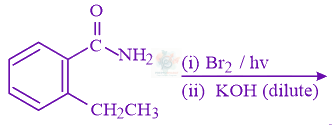
Number of stereo centers present in linear and cyclic structures of glucose are respectively:
Which of the following statements is not true about RNA?
Arrange the following amines in the decreasing order of basicity. 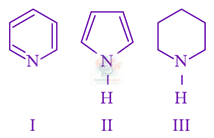
In the following reactions, products $A$ and $B$ are:  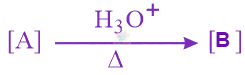
The increasing order of $\mathrm{pKa}$ of the following amino acids in aqueous solution is Glycine, Aspartate, Lysine, Arginine.
Fructose and glucose can be distinguished by:
The correct match between items I and II is : 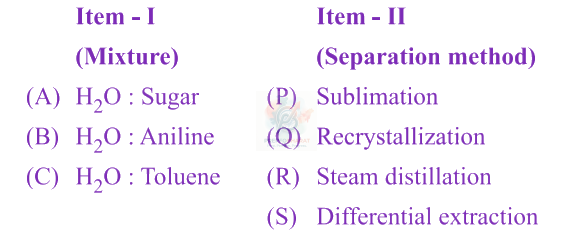
The major product of the f following reaction is: 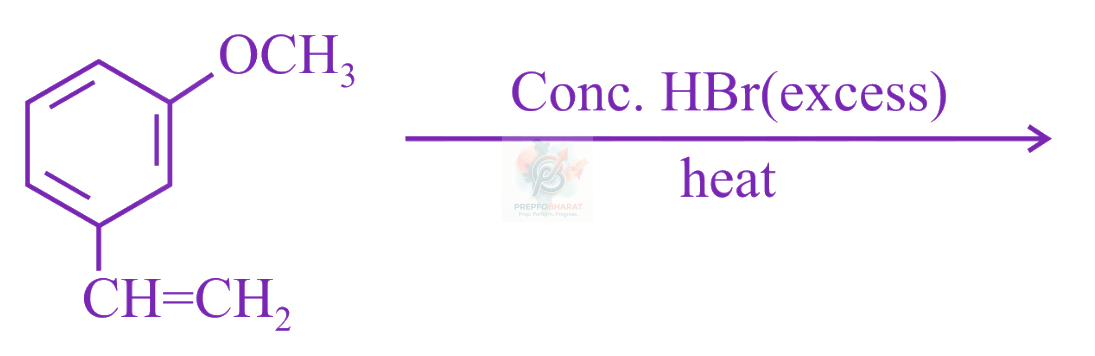
Major product of the given reaction is: 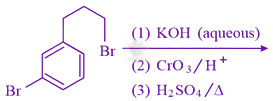
The correct IUPAC name of the following compound is: 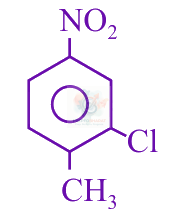
Which of the following compounds reacts with ethylmagnesium bromide and also decolourizes bromine water solution?
In the following compound, 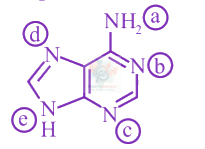 the favourable site/s for protonation is/are :
The test performed on compound $x$ and their inferences are: <table class="pyq-table"><tbody><tr><td>Test</td><td>Inference</td></tr><tr><td>$(a)$ $2, 4$ - $DNP$ test</td><td>Coloured precipitate yellow</td></tr><tr><td>$(b)$ Iodoform test</td><td>Yellow precipitate</td></tr><tr><td>$(c)$ Azo-dye test</td><td>No dye formation</td></tr></tbody></table>Compound $'x'$ is:
The major product of the following reaction is: $C{H}_{3}CH=CHC{O}_{2}C{H}_{3}\overset{LiAl{H}_{4}}{\rightarrow }$
Among the following four aromatic compounds, which one will have the lowest melting point?
Which of the following statements is not true about sucrose?
In the following reaction carbonyl compound $+MeOH\overset{HCl}{\rightleftharpoons }acetal$ Rate of the reaction is the highest for:
The major product 'X' formed in the following reaction is: 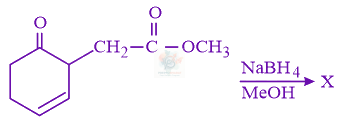
In the reaction given below what will be the major product at the end :