JEE Main 2024 — Organic Chemistry
Chemistry Organic Chemistry questions from JEE Main 2024.
Other Years
228 Organic Chemistry Questions from 2024
Which of the following compounds will show optical isomerism?
Given below are two statements: Statement I : Nitration of benzene involves the following step - 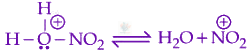 Statement II : Use of Lewis base promotes the electrophilic substitution of benzene. In the light of the above statements, choose the most appropriate answer from the options given below :
In qualitative test for identification of presence of phosphorous, the compound is heated with an oxidising agent. Which is further treated with nitric acid and ammonium molybdate respectively. The yellow coloured precipitate obtained is :
Match List - I with List - II. 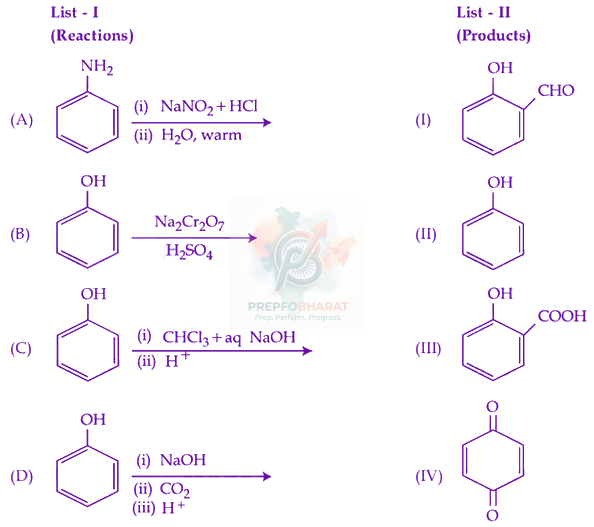 Choose the correct answer from the options given below :
Which of the following has highly acidic hydrogen?
Total number of isomeric compounds (including stereoisomers) formed by monochlorination of $2$-methylbutane is ______.
$3-$Methylhex-2-ene on reaction with $\mathrm{HBr}$ in presence of peroxide forms an addition product (A). The number of possible stereoisomers for ' $A$ ' is ________.
Chromatographic technique/s based on the principle of differential adsorption is/are A. Column chromatography B. Thin layer chromatography C. Paper chromatography Choose the most appropriate answer from the options given below:
The ascending order of acidity of $–\mathrm{OH}$ group in the following compounds is : (A) $\mathrm{Bu}–\mathrm{OH}$  Choose the correct answer from the options given below :
Total number of aromatic compounds among the following compounds is ______. 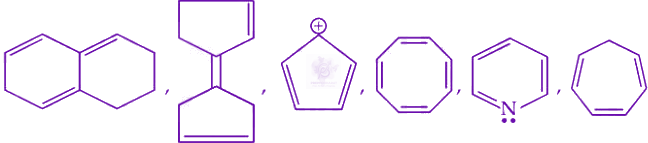
Number of amine compounds from the following giving solids which are soluble in \(\mathrm{NaOH}\) upon reaction with Hinsberg's reagent is _______ 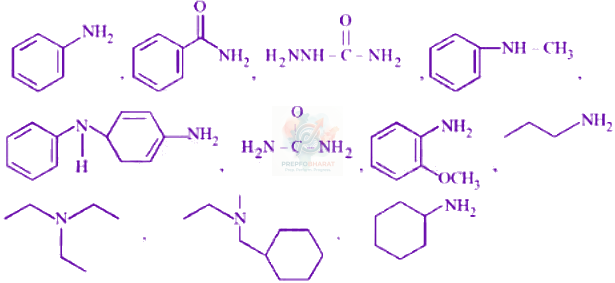
Example of vinylic halide is
Identify the major product in the following reaction. 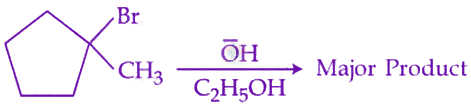
\(\mathrm{X} \mathrm{g}\) of ethanamine was subjected to reaction with \(\mathrm{NaNO}_2 / \mathrm{HCl}\) followed by hydrolysis to liberate \(\mathrm{N}_2\) and \(\mathrm{HCl}\). The \(\mathrm{HCl}\) generated was completely neutralised by 0.2 moles of \(\mathrm{NaOH} . X\) is ______ g.
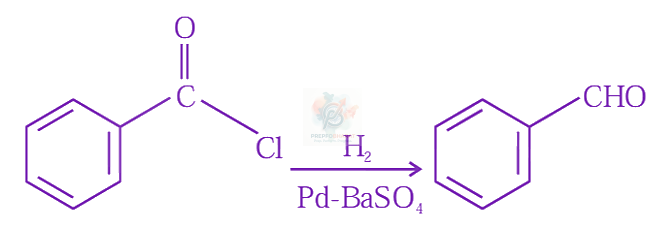 This reduction reaction is known as:
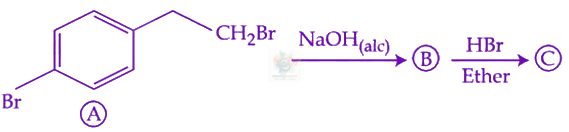 Identify (B) and (C) and how are (A) and (C) related ?
In Reimer - Tiemann reaction, phenol is converted into salicylaldehyde through an intermediate. The structure of intermediate is _____
Number of compounds among the following which contain sulphur as heteroatom is____. Furan,Thiophene, Pyridine, Pyrrole, Cysteine, Tyrosine
Consider the given chemical reaction : 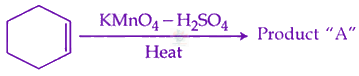 Product " \(\mathrm{A}\) " is :
Which of the following are aromatic? 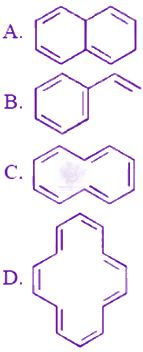
IUPAC name of following hydrocarbon \((X)\) is : 
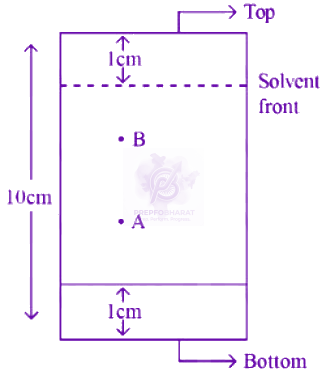 In the given TLC, the distance of spot A & B are \(5 \mathrm{~cm} ~\&~ 7 \mathrm{~cm}\), from the bottom of TLC plate, respectively. \(\mathrm{R}_{\mathrm{f}}\) value of \(\mathrm{B}\) is \(x \times 10^{-1}\) times more than \(\mathrm{A}\). The value of \(x\) is ______.
Among \(\mathrm{VO}_2^{+}, \mathrm{MnO}_4^{-}\)and \(\mathrm{Cr}_2 \mathrm{O}_7^{2-}\), the spin-only magnetic moment value of the species with least oxidising ability is ______ BM (Nearest integer). (Given atomic member \(\mathrm{V}=23, \mathrm{Mn}=25, \mathrm{Cr}=24\))
Which of the following is metamer of the given compound \((\mathrm{X})\) ? 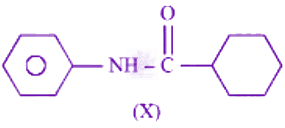
The correct stability order of carbocations is
Given below are two statement one is labeled as Assertion (A) and the other is labeled as Reason (R). Assertion (A): ${\mathrm{CH}}_{2}=\mathrm{CH}-{\mathrm{CH}}_{2}-\mathrm{Cl}$ is an example of allyl halide Reason (R): Allyl halides are the compounds in which the halogen atom is attached to ${\mathrm{sp}}^{2}$ hybridised carbon atom. In the light of the two above statements, choose the most appropriate answer from the options given below:
Total number of optically active compounds from the following is ______ 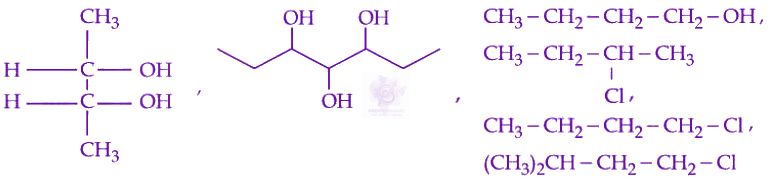
The incorrect statement regarding the geometrical isomers of 2-butene is :
The product (C) in the following sequence of reactions has ______ \(\pi\) bonds. 
Which one of the following will show geometrical isomerism?
Given below are two statements: Statements I: 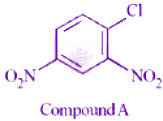 IUPAC name of Compound \(A\) is 4-chloro-1,3-dinitrobenzene. Statements II: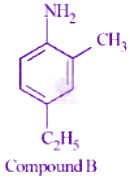 IUPAC name of Compound \(\mathrm{B}\) is 4-ethyl-2-methylaniline. In the light of the above statements, choose the most appropriate answer from the options given below:
The azo-dye $(Y)$ formed in the following reactions is Sulphanilic acid $+{\mathrm{NaNO}}_{2}+{\mathrm{CH}}_{3}\mathrm{COOH}\rightarrow X$ 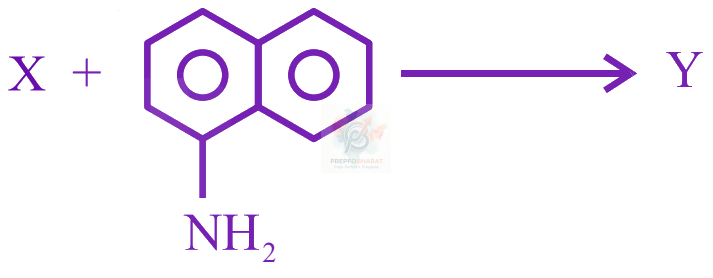
Identify the product in the following reaction : 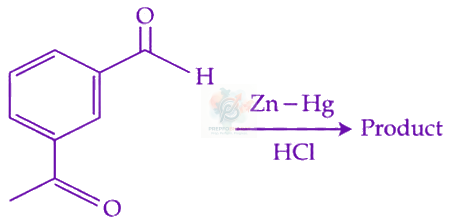
Type of amino acids obtained by hydrolysis of proteins is :
Major product of the following reaction is: 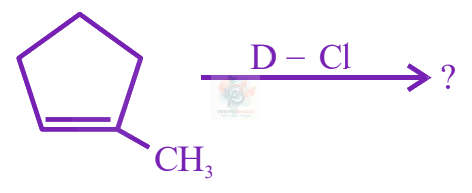
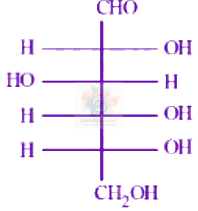 The incorrect statement regarding the given structure is
Identify the reagents used for the following conversion 
Phenol treated with chloroform in presence of sodium hydroxide, which further hydrolysed in presence of an acid results
The total number of correct statements, regarding the nucleic acids is _________. A. RNA is regarded as the reserve of genetic information. B. DNA molecule self-duplicates during cell division C. DNA synthesizes proteins in the cell. D. The message for the synthesis of particular proteins is present in DNA E. Identical DNA strands are transferred to daughter cells.
The number of the correct reaction(s) among the following is ______ 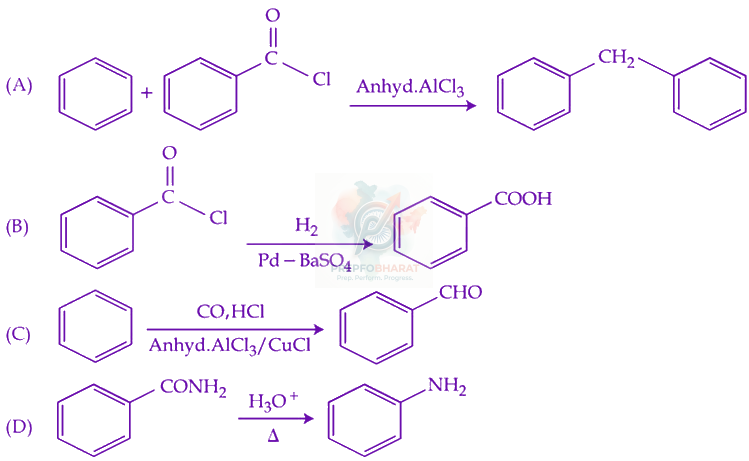
The total number of 'sigma' and 'Pi' bonds in 2-oxohex-4-ynoic acid is ______
If \(279 \mathrm{~g}\) of aniline is reacted with one equivalent of benzenediazonium chloride, the maximum amount of aniline yellow formed will be _______ g. (nearest integer) (consider complete conversion).
The correct sequence of acidic strength of the following aliphatic acids in their decreasing order is: \(\mathrm{CH}_3 \mathrm{CH}_2 \mathrm{COOH}, \mathrm{CH}_3 \mathrm{COOH}, \mathrm{CH}_3 \mathrm{CH}_2 \mathrm{CH}_2 \mathrm{COOH}, \mathrm{HCOOH}\)
Given below are two statements : one is labelled as Assertion (A) and the other is labelled as Reason (R). Assertion (A) : Cis form of alkene is found to be more polar than the trans form. Reason (R): Dipole moment of trans isomer of 2-butene is zero. In the light of the above statements, choose the correct answer from the options given below :
Match List I with List II : 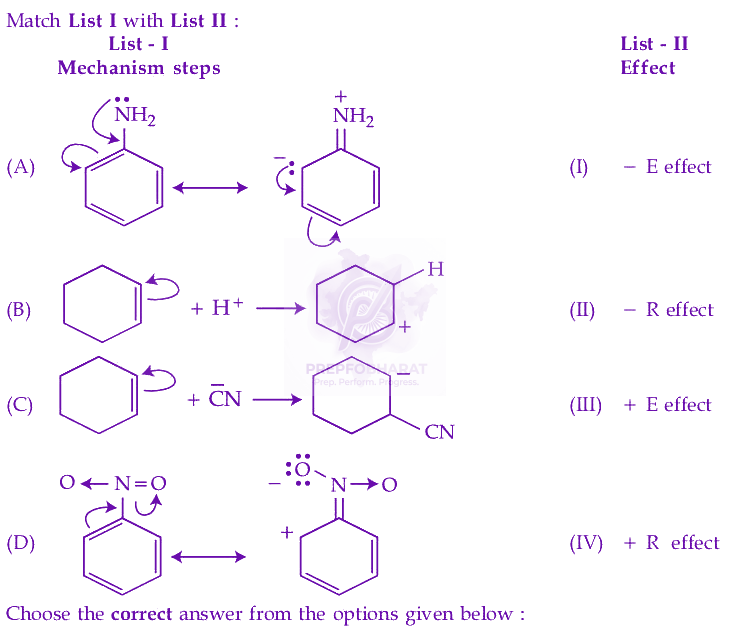 Choose the correct answer from the options given below :
Match List I with List II \(\begin{array}{llll} \text{List - I} & \text{List - II} \\ \text{(Pair of compounds)} & \text{(Isomerism)} \\ \text{(A) n-propanol and Isopropanol} & \text{(I) Metamerism} \\ \text{(B) Methoxypropane and ethoxyethane} & \text{(II) Chain Isomerism} \\ \text{(C) Propanone and propanal} & \text{(III) Position Isomerism} \\ \text{(D) Neopentane and Isopentane} & \text{(IV) Functional Isomerism} \\ \end{array}\) Choose the correct answer from the options given below :
\(9.3 \mathrm{~g}\) of pure aniline upon diazotisation followed by coupling with phenol gives an orange dye. The mass of orange dye produced (assume 100\% yield/conversion) is _______ g. (nearest integer)
Which of the following compound will most easily be attacked by an electrophile?
The major products formed : 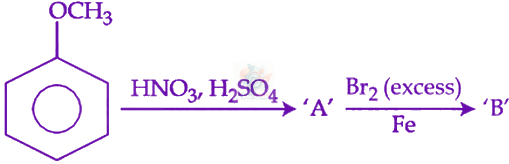 \(\mathrm{A}\) and \(\mathrm{B}\) respectively are:
Given below are two statements : one is labelled as Assertion $(A)$ and the other is labelled as Reason $(R).$ Assertion $(A):$ Haloalkanes react with $\mathrm{KCN}$ to form alkyl cyanides as a main product while with $\mathrm{AgCN}$ form isocyanide as the main product. Reason $(R):$ $\mathrm{KCN}$ and $\mathrm{AgCN}$ both are highly ionic compounds. In the light of the above statement, choose the most appropriate answer from the options given below.
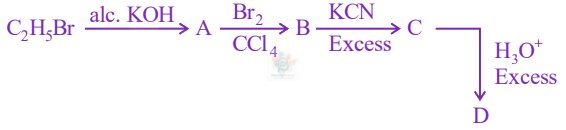 Acid $D$ formed in above reaction is:
Given below are two statements: Statement - I: High concentration of strong nucleophilic reagent with secondary alkyl halides which do not have bulky substituents will follow ${S}_{N}2$ mechanism. Statement - II: A secondary alkyl halide when treated with a large excess of ethanol follows ${S}_{N}1$ mechanism. In the the light of the above statements, choose the most appropriate from the questions given below:
Match List - I with List - II. <table class="pyq-table"><tbody><tr><td colspan="2" rowspan="1">List-I (Reactants)</td><td colspan="2" rowspan="1">List-II Products</td></tr><tr><td>(A)</td><td>Phenol, $\mathrm{Zn}/\Delta$</td><td>(I)</td><td>Salicylaldehyde</td></tr><tr><td>(B)</td><td>Phenol, ${\mathrm{CHCl}}_{3},\mathrm{NaOH},\mathrm{HCl}$</td><td>(II)</td><td>Salicylic acid</td></tr><tr><td>(C)</td><td>Phenol, ${\mathrm{CO}}_{2},\mathrm{NaOH},\mathrm{HCl}$</td><td>(III)</td><td>Benzene</td></tr><tr><td>(D)</td><td>Phenol, $\text{ Conc. }{\mathrm{HNO}}_{3}$</td><td>(IV)</td><td>Picric acid</td></tr></tbody></table>Choose the correct answer from the options given below.
Relative stability of the contributing structures is : 
Match List I with List II \(\begin{array}{|l|l|c|l|} \hline & \text{List - I} & & \text{List - II} \\ \hline \text { A. } & \alpha \text { - Glucose and } \alpha \text { - Galactose } & \text { I. } & \text { Functional isomers } \\ \hline \text { B. } & \alpha \text { - Glucose and } \beta \text { - Glucose } & \text { II. } & \text { Homologous } \\ \hline \text { C. } & \alpha \text { - Glucose and } \alpha \text { - Fructose } & \text { III. } & \text { Anomers } \\ \hline \text { D. } & \alpha \text { - Glucose and } \alpha \text { - Ribose } & \text { IV. } & \text { Epimers } \\ \hline \end{array}\) Choose the correct answer from the options given below:
Identify the product (A) in the following reaction. 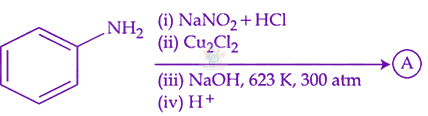
DNA molecule contains 4 bases whose structure are shown below. One of the structures is not correct, identify the incorrect base structure.
Number of carbocations from the following that are not stabilized by hyperconjugation is _______ 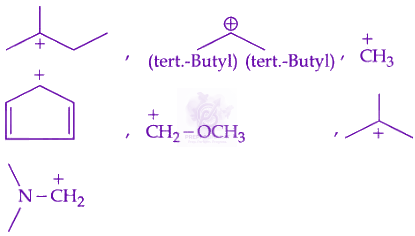
Given below are two statements : one is labelled as Assertion (A) and the other is labelled as Reason (R). Assertion (A): \(\mathrm{S}_{\mathrm{N}} 2\) reaction of \(\mathrm{C}_6 \mathrm{H}_5 \mathrm{CH}_2 \mathrm{Br}\) occurs more readily than the \(\mathrm{S}_{\mathrm{N}} 2\) reaction of \(\mathrm{CH}_3 \mathrm{CH}_2 \mathrm{Br}\). Reason (R) : The partially bonded unhybridized p-orbital that develops in the trigonal bipyramidal transition state is stabilized by conjugation with the phenyl ring. In the light of the above statements, choose the most appropriate answer from the options given below :
Identify the product \((\mathrm{P})\) in the following reaction: 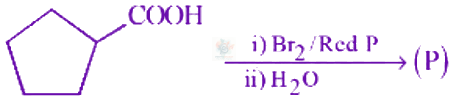
Given below are two statements: One is labelled as Assertion A and the other is labelled as Reason R: Assertion A: Alcohols react both as nucleophiles and electrophiles. Reason R: Alcohols react with active metals such as sodium, potassium and aluminum to yield corresponding alkoxides and liberate hydrogen. In the light of the above statements, choose the correct answer from the options given below:
Identify $A$ and $B$ in the following reaction sequence. 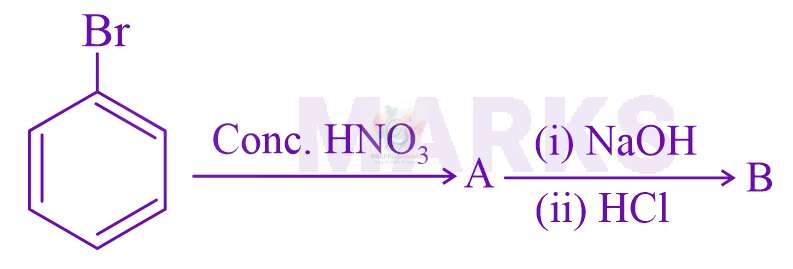
Among the following, total number of meta directing functional groups is (Integer based) $-{\mathrm{OCH}}_{3},-{\mathrm{NO}}_{2},-\mathrm{CN},-{\mathrm{CH}}_{3}-{\mathrm{NHCOCH}}_{3}$, $-\mathrm{COR},-\mathrm{OH},-\mathrm{COOH},-\mathrm{Cl}$
The adsorbent used in adsorption chromatography is/are - A. silica gel B. alumina C. quick lime D. magnesia Choose the most appropriate answer from the options given below :
Which among the following purification methods is based on the principle of “Solubility” in two different solvents?
Identify the major products \(\mathrm{A}\) and \(\mathrm{B}\) respectively in the following set of reactions. 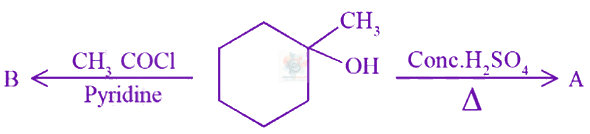
The arenium ion which is not involved in the bromination of Aniline is
The products A and B formed in the following reaction scheme are respectively 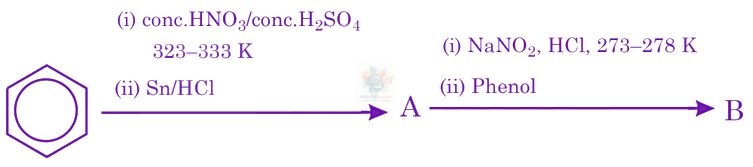
In the Claisen-Schmidt reaction to prepare \(351 \mathrm{~g}\) of dibenzalacetone using \(87 \mathrm{~g}\) of acetone, the amount of benzaldehyde required is ______ g. (Nearest integer)
Given below are two statements : Statement I : Piciric acid is 2,4,6 - trinitrotoluene. Statement II : Phenol - 2,4 - disulphonic acid is treated with Conc. \(\mathrm{HNO}_3\) to get picric acid. In the light of the above statements, choose the most appropriate answer from the options given below :
Methods used for purification of organic compounds are based on :
In Kjeldahl's method for estimation of nitrogen, ${\mathrm{CuSO}}_{4}$ acts as :
A compound $(x)$ with molar mass $108g{\mathrm{mol}}^{-1}$ undergoes acetylation to give product with molar mass $192g{\mathrm{mol}}^{-1}$. The number of amino groups in the compound $(x)$ is ________.
Given below are two statements: Statement I: IUPAC name of $\mathrm{HO}-{\mathrm{CH}}_{2}-({\mathrm{CH}}_{2}{)}_{3}-{\mathrm{CH}}_{2}-{\mathrm{COCH}}_{3}$ is $7$-hydroxyheptan-$2$-one. Statement II: $2$-oxoheptan-$7$-ol is the correct IUPAC name for the above compound. In the light of the above statements, Choose the most appropriate answer from the options given below:
The incorrect statement regarding conformations of ethane is:
Number of compounds from the following which cannot undergo Friedel-Crafts reactions is: ________. toluene, nitrobenzene, xylene, cumene, aniline, chlorobenzene, \(m\)-nitroaniline, \(m\)-dinitrobenzene
Identify $A$ and $B$ in the following sequence of reaction 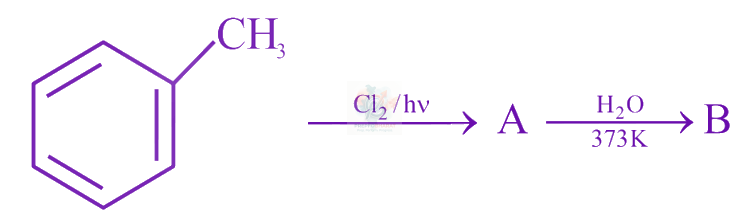
Given below are two statements : Statement (I) : Kjeldahl method is applicable to estimate nitrogen in pyridine. Statement (II) : The nitrogen present in pyridine can easily be converted into ammonium sulphate in Kjeldahl method. In the light of the above statements, choose the correct answer from the options given below
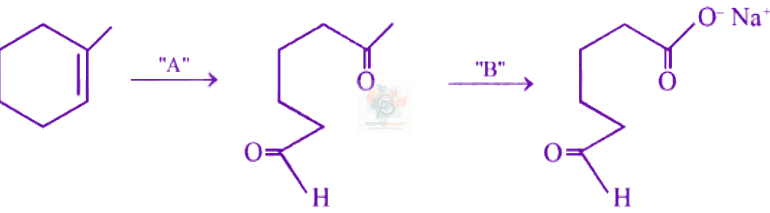 In the above chemical reaction sequence " \(\mathrm{A}\) " and " \(\mathrm{B}\) " respectively are
The technique used for purification of steam volatile water immiscible substance is:
Which among the following compounds will undergo fastest \(\mathrm{S}_{\mathrm{N}} 2\) reaction.
Identify the name reaction. 
Match List I with List II 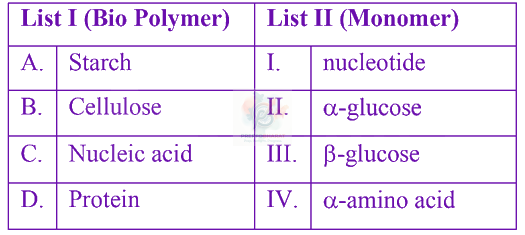 Choose the correct answer from the options given below :-
$\mathrm{IUPAC}$ name of following compound (P) is :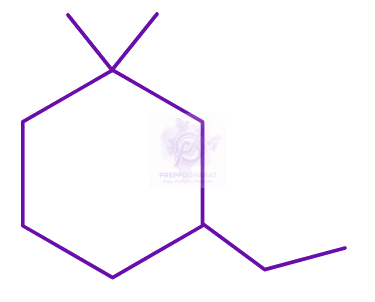
Compound $A$ formed in the following reaction reacts with $B$ gives the product $C$. Find out $A$ and $B.$ 
Identify major product ‘$P$’ formed in the following reaction. 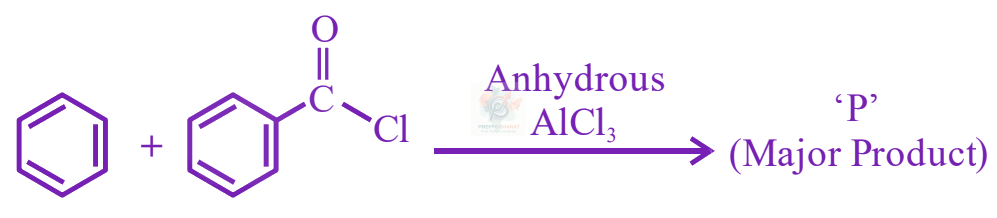
Given below are two statement: Statements I : Bromination of phenol in solvent with low polarity such as \(\mathrm{CHCl}_3\) or \(\mathrm{CS}_2\) requires Lewis acid catalyst. Statements II : The Lewis acid catalyst polarises the bromine to generate \(\mathrm{Br}^{+}\). In the light of the above statements, choose the correct answer from the options given below :
Using the given figure, the ratio of \(\mathrm{R}_f\) values of sample \(\mathrm{A}\) and sample \(\mathrm{C}\) is \(x \times 10^{-2}\). Value of \(x\) is ______ 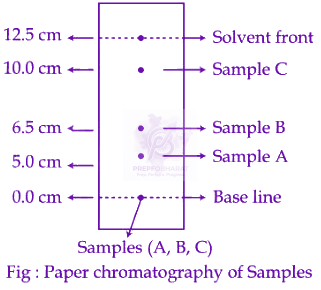
 Product \(\mathrm{P}\) is
The ascending acidity order of the following H atoms is 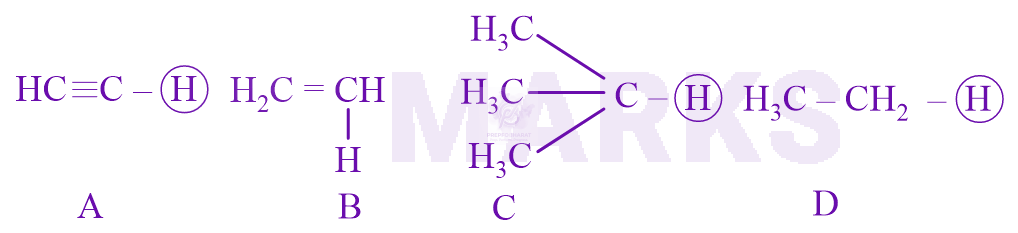
Identify major product " \(\mathrm{X}\) " formed in the following reaction : 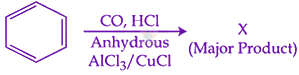
Find out the major product formed from the following reaction. \(\left[\mathrm{Me}:-\mathrm{CH}_3\right]\) 
The order of relative stability of the contributing structure is: 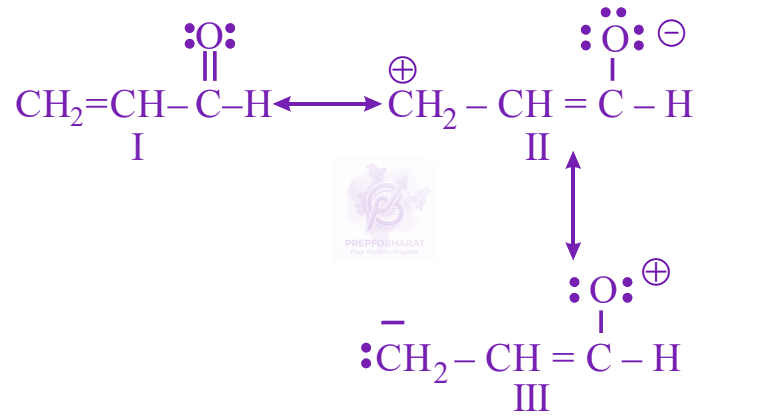 Choose the correct answer from the options given below:
How many compounds among the following compounds show inductive, mesomeric as well as hyperconjugation effects? 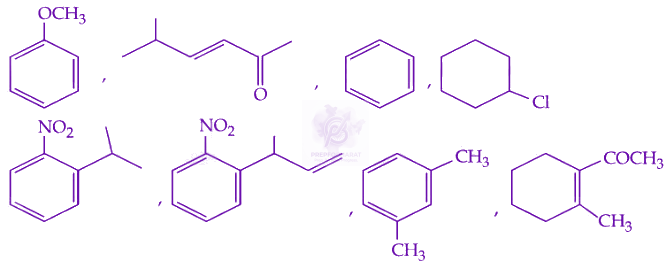
‘Adsorption’ principle is used for which of the following purification method?
Match List - I with List - II. \(\begin{array}{|c|c|c|c|} \hline & \text { (Test) } & & \text { (Identification) } \\ \hline \text { (A) } & \text { Bayer's test MARKS } & \text { (I) } & \text { Phenol VIARKS } \\ \hline \text { (B) } & \text { Ceric ammonium nitrate test } & \text { (II) } & \text { Aldehyde } \\ \hline \text { (C) } & \text { Phthalein dye test } R \mathrm{~K} & \text { (III) } & \text { Alcoholic-OH group } \\ \hline \text { (D) } & \text { Schiff's test } & \text { (IV) } & \text { Unsaturation } \\ \hline \end{array}\) Choose the correct answer from the options given below :
Given below are two statements : Statement (I) : All the following compounds react with p-toluenesulfonyl chloride. \(\mathrm{C}_6 \mathrm{H}_5 \mathrm{NH}_2 \quad\left(\mathrm{C}_6 \mathrm{H}_5\right)_2 \mathrm{NH} \quad\left(\mathrm{C}_6 \mathrm{H}_5\right)_3 \mathrm{~N}\) Statement (II) : Their products in the above reaction are soluble is aqueous \(\mathrm{NaOH}\). In the light of the above statements, choose the correct answer from the options given below
The compound formed by the reaction of ethanal with semicarbazide contains _______ number of nitrogen atoms.
Which among the following aldehydes is most reactive towards nucleophilic addition reactions?
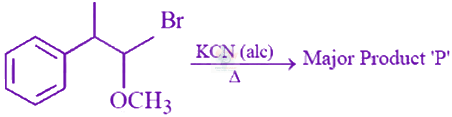 In the above reaction product ' \(\mathrm{P}\) ' is
Given below are two statements : Statement (I) : \(\mathrm{S}_{\mathrm{N}} 2\) reactions are 'stereospecific', indicating that they result in the formation of only one stereo-isomer as the product. Statement (II) : \(\mathrm{S}_{\mathrm{N}} 1\) reactions generally result in formation of product as racemic mixtures. In the light of the above statements, choose the correct answer from the options given below :
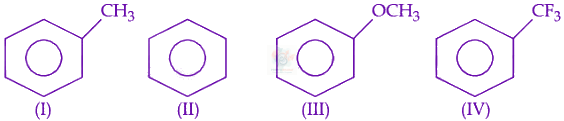 The correct arrangement for decreasing order of electrophilic substitution for above compounds is :
 The total number of hydrogen atoms in product $A$ and product $B$ is__________.
Identify B formed in the reaction. $\mathrm{Cl}-{({\mathrm{CH}}_{2})}_{4}-\mathrm{Cl}\overset{\mathrm{excess}{\mathrm{NH}}_{3}}{\rightarrow }A\overset{\mathrm{NaOH}}{\rightarrow }B+{H}_{2}O+\mathrm{NaCl}$
Given below are two statements : one is labelled as Assertion A and the other is labelled as Reason R : Assertion A : Aryl halides cannot be prepared by replacement of hydroxyl group of phenol by halogen atom. Reason R : Phenols react with halogen acids violently. In the light of the above statements, choose the most appropriate from the options given below:
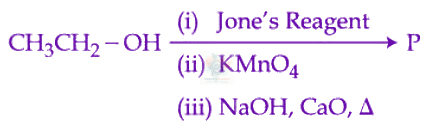 Consider the above reaction sequence and identify the major product \(P\).
Given below are two statements: One is labelled as Assertion A and the other is labelled as Reason R: Assertion A: $p{K}_{a}$ value of phenol is $10.0$ while that of ethanol is $15.9$. Reason R: Ethanol is stronger acid than phenol. In the light of the above statements, choose the correct answer from the options given below:
Salicylaldehyde is synthesized from phenol, when reacted with
Phenolic group can be identified by a positive:
Consider the given reaction, identify the major product \(P\). \(\mathrm{CH}_3-\mathrm{COOH} \xrightarrow[\text { (iv) } \mathrm{H}_2 \mathrm{O} / \overline{\mathrm{O}} \mathrm{H}, \Delta]{\text { (i) } \mathrm{LiAlH}_4 \text { (ii) } \mathrm{PCC} \text { (iii) } \mathrm{HCN} / \overline{\mathrm{O}} \mathrm{H}}\)"P"
Which of the following compounds will give silver mirror with ammoniacal silver nitrate? A. Formic acid B. Formaldehyde C. Benzaldehyde D. Acetone Choose the correct answer from the options given below :
Identify ' \(A\) ' in the following reaction: 
Given below are two statements : Statements I : Acidity of \(\alpha\)-hydrogens of aldehydes and ketones is responsible for Aldol reaction. Statement II : Reaction between benzaldehyde and ethanal will NOT give Cross - Aldol product. In the light of the above statements, choose the most appropriate answer from the options given below :
Major product \(B\) of the following reaction has _______ \(\pi\)-bond. 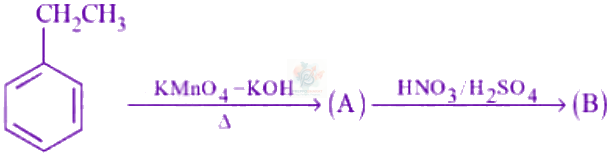
Phthalimide is made to undergo following sequence of reactions. 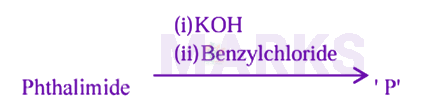 Total number of \(\pi\) bonds present in product 'P' is/are ______
\(\mathrm{X} \mathrm{g}\) of ethylamine is subjected to reaction with \(\mathrm{NaNO}_2 / \mathrm{HCl}\) followed by water; evolved dinitrogen gas which occupied \(2.24 \mathrm{~L}\) volume at STP. \(\mathrm{X}\) is \(\qquad\) \(\times 10^{-1} \mathrm{~g}\).
Given below are two statements : Statement I: Aniline reacts with con. ${H}_{2}{\mathrm{SO}}_{4}$ followed by heating at $453-473K$ gives p-aminobenzene sulphonic acid, which gives blood red colour in the 'Lassaigne's test'. Statement II: In Friedel - Craft's alkylation and acylation reactions, aniline forms salt with the ${\mathrm{AlCl}}_{3}$ catalyst. Due to this, nitrogen of aniline acquires a positive charge and acts as deactivating group. In the light of the above statements, choose the correct answer from the options given below :
The final product $A$, formed in the following multistep reaction sequence is: 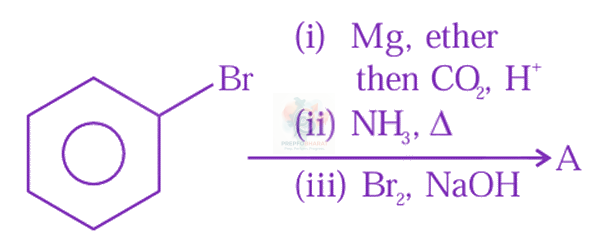
For the Compounds : (A) \(\mathrm{H}_3 \mathrm{C}-\mathrm{CH}_2-\mathrm{O}-\mathrm{CH}_2-\mathrm{CH}_2-\mathrm{CH}_3\) (B) \(\mathrm{H}_3 \mathrm{C}-\mathrm{CH}_2^2-\mathrm{CH}_2-\mathrm{CH}_2-\mathrm{CH}_3\) (C) 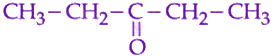 (D)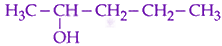 The increasing order of boiling point is : Choose the correct answer from the options given below :
The correct statement regarding nucleophilic substitution reaction in a chiral alkyl halide is ;
The total number of carbon atoms present in tyrosine, an amino acid, is _______
The incorrect statement about Glucose is :
Coagulation of egg, on heating is because of :
The number of tripeptides formed by three different amino acids using each amino acid once is _______.
Match List I with List II <table class="pyq-table"><tbody><tr><td></td><td>List-I</td><td></td><td>List-II</td></tr><tr><td>A.</td><td>Glucose/${\mathrm{NaHCO}}_{3}/\Delta$</td><td>I.</td><td>Gluconic acid</td></tr><tr><td>B.</td><td>Glucose/${\mathrm{HNO}}_{3}$</td><td>II.</td><td>No reaction</td></tr><tr><td>C.</td><td>Glucose/$\mathrm{HI}/\Delta$</td><td>III.</td><td>$n$-hexane</td></tr><tr><td>D.</td><td>Glucose/Bromine water</td><td>IV.</td><td>Saccharic acid</td></tr></tbody></table>Choose the correct answer from the options given below:
Two nucleotides are joined together by a linkage known as :
The correct nomenclature for the following compound is : 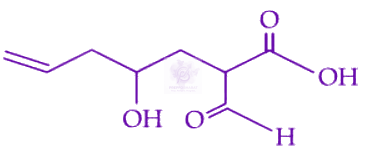
The correct statement among the following, for a "chromatography" purification method is :
The functional group that shows negative resonance effect is:
Product A and B formed in the following set of reactions are: 
The interaction between $\pi$ bond and lone pair of electrons present on an adjacent atom is responsible for
Total number of essential amino acid among the given list of amino acids is _______ Arginine, Phenylalanine, Aspartic acid, Cysteine, Histidine, Valine, Proline
Which among the following halide/s will not show ${S}_{N}1$ reaction:
Number of isomeric products formed by monochlorination of $2$-methylbutane in presence of sunlight is _______.
Structure of $4-\mathrm{Methylpent}-2-\mathrm{enal}$ is:
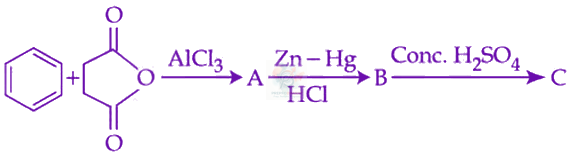 What is the structure of C
Following is a confirmatory test for aromatic primary amines. Identify reagent (A) and (B) 
Functional group present in sulphonic acids is :
Which of the following statements are correct? A. Glycerol is purified by vacuum distillation because it decomposes at its normal boiling point. B. Aniline can be purified by steam distillation as aniline is miscible in water. C. Ethanol can be separated from ethanol water mixture by azeotropic distillation because it forms azeotrope. D. An organic compound is pure, if mixed M.P. is remained same. Choose the most appropriate answer from the options given below :
The major product of the following reaction is \(P\). \(\mathrm{CH}_3 \mathrm{C}=\mathrm{C}-\mathrm{CH}_3 \xrightarrow[\substack{\text { (ii) dil. } \mathrm{KMnO}_4 \\ 273 \mathrm{~K}}]{\text { (i) } \mathrm{Na} / \text { ing } \mathrm{NH}_3} '^{\prime}\) Number of oxygen atoms present in product ' \(\mathrm{P}\) ' is _______ (nearest integer)
Identify compound \((\mathrm{Z})\) in the following reaction sequence. 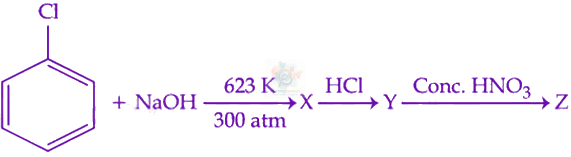
The major products from the following reaction sequence are product \(A\) and product B.  The total sum of \(\pi\) electrons in product \(A\) and product \(B\) are _______ (nearest integer)
The number of different chain isomers for \(\mathrm{C}_7 \mathrm{H}_{16}\) is \(\qquad\)
\(\mathrm{CH}_3-\mathrm{CH}_2-\mathrm{CH}_2-\mathrm{Br}+\mathrm{NaOH} \xrightarrow{\mathrm{C}_2 \mathrm{H}_5 \mathrm{OH}}\) Product 'A' 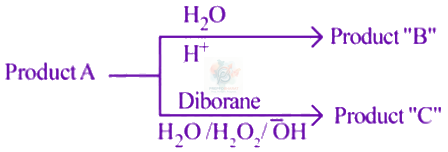 Consider the above reactions, identify product \(B\) and product \(C\).
Bond line formula of $\mathrm{HOCH}(\mathrm{CN}{)}_{2}$ is:
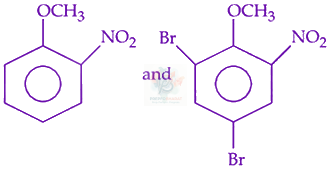 The incorrect statements regarding enzymes are : (A) Enzymes are biocatalysts. (B) Enzymes are non-specific and can catalyse different kinds of reactions. (C) Most Enzymes are globular proteins. (D) Enzyme - oxidase catalyses the hydrolysis of maltose into glucose. Choose the correct answer from the option given below :
The number of optical isomers in following compound is: ________ 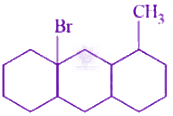
Identify the correct set of reagents or reaction conditions ' \(X\) ' and ' \(Y\) ' in the following set of transformation 
The molecular formula of second homologue in the homologous series of mono carboxylic acids is _________.
m-chlorobenzaldehyde on treatment with $50%$$\mathrm{KOH}$ solution yields
Following Kjeldahl's method, $1g$ of organic compound released ammonia, that neutralised $10\mathrm{mL}$ of $2{\mathrm{MH}}_{2}{\mathrm{SO}}_{4}.$ The percentage of nitrogen in the compound is _______ $%.$
From \(6.55 \mathrm{~g}\) of aniline, the maximum amount of acetanilide that can be prepared will be ______ \(\times 10^{-1} \mathrm{~g}\).
The product of the following reaction is $P$. 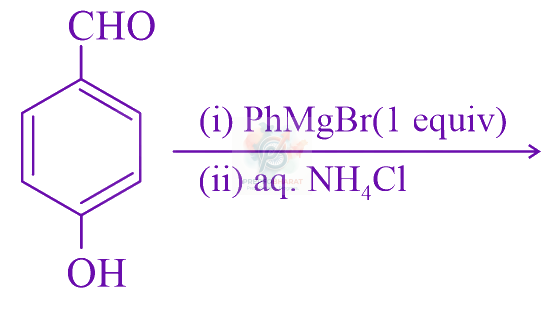 The number of hydroxyl groups present in the product $P$ is________.
Appearance of blood red colour, on treatment of the sodium fusion extract of an organic compound with ${\mathrm{FeSO}}_{4}$ in presence of concentrated ${H}_{2}{\mathrm{SO}}_{4}$ indicates the presence of element/s
Identify structure of $2,3$-dibromo-$1$-phenylpentane.
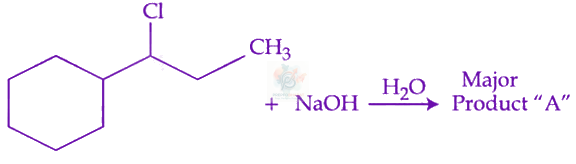 Consider the above chemical reaction. Product " \(\mathrm{A}\) " is :
Cyclohexene 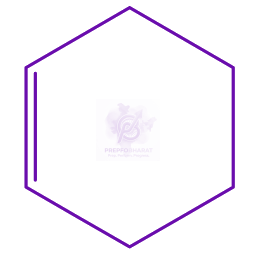 is _________ type of an organic compound.
The major product(P) in the following reaction is 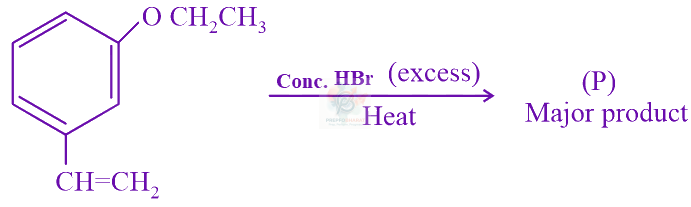
Given below are two statements: Statement (I) : The ${\mathrm{NH}}_{2}$ group in Aniline is ortho and para directing and a powerful activating group. Statement (II) : Aniline does not undergo FriedelCraft's reaction (alkylation and acylation). In the light of the above statements, choose the most appropriate answer from the options given below:
$2-\mathrm{chlorobutane}+{\mathrm{Cl}}_{2}\rightarrow {C}_{4}{H}_{8}{\mathrm{Cl}}_{2}$ (isomers) Total number of optically active isomers shown by ${C}_{4}{H}_{8}{\mathrm{Cl}}_{2}$, obtained in the above reaction is ________.
Number of compounds which give reaction with Hinsberg's reagent is _________. 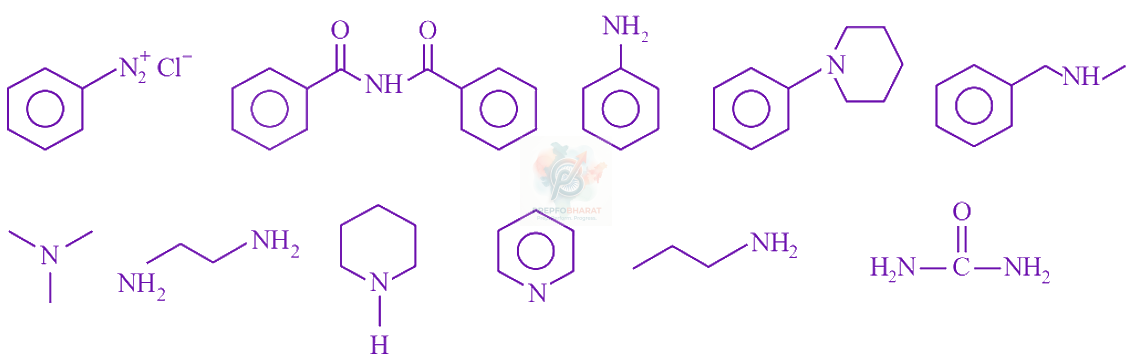
Total number of stereo isomers possible for the given structure : 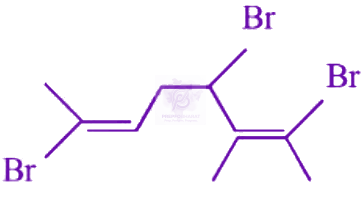
The difference in energy between the actual structure and the lowest energy resonance structure for the given compound is:
Which of the following molecule/species is most stable?
Match List I with List II <table class="pyq-table"><tbody><tr><td></td><td>LIST I (Technique)</td><td></td><td>LIST II (Application)</td></tr><tr><td>A.</td><td>Distillation</td><td>I.</td><td>Separation of glycerol from spent-lye</td></tr><tr><td>B.</td><td>Fractional distillation</td><td>II.</td><td>Aniline - Water mixture</td></tr><tr><td>C.</td><td>Steam distillation</td><td>III.</td><td>Separation of crude oil fractions</td></tr><tr><td>D.</td><td>Distillation under reduced pressure</td><td>IV.</td><td>Chloroform-Aniline</td></tr></tbody></table>Choose the correct answer from the options given below:
The fragrance of flowers is due to the presence of some steam volatile organic compounds called essential oils. These are generally insoluble in water at room temperature but are miscible with water vapour in the vapour phase. A suitable method for the extraction of these oils from the flowers is:
In the given compound, the number of \(2^{\circ}\) carbon atom \(/ \mathrm{s}\) is _______. 
Two moles of benzaldehyde and one mole of acetone under alkaline conditions using aqueous \(\mathrm{NaOH}\) after heating gives \(x\) as the major product. The number of \(\pi\) bonds in the product \(x\) is _______
From the vitamins $A,{B}_{1},{B}_{6},{B}_{12},C,D,E$ and $K$, the number vitamins that can be stored in our body is ______.
According to IUPAC system, the compound 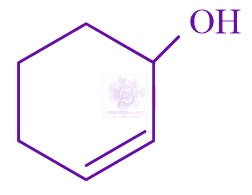 is named as:
The correct stability order of the following resonance structures of \(\mathrm{CH}_3-\mathrm{CH}=\mathrm{CH}-\mathrm{CHO}\) is 
Among the given organic compounds, the total number of aromatic compounds is 
Identify product A and product B 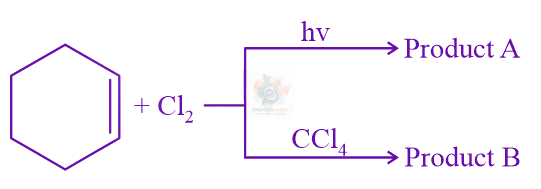
Which of the following reaction is correct?
Identify the product A and product B in the following set of reactions. 
Number of alkanes obtained on electrolysis of a mixture of ${\mathrm{CH}}_{3}\mathrm{COONa}$ and ${C}_{2}{H}_{5}\mathrm{COONa}$ is_____.
Highest enol content will be shown by :
Match List – I with List –II. 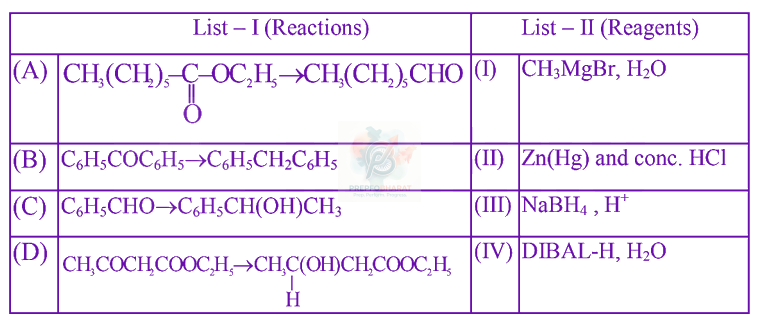 Choose the correct answer from options given below:
The correct order of reactivity in electrophilic substitution reaction of the following compounds is: 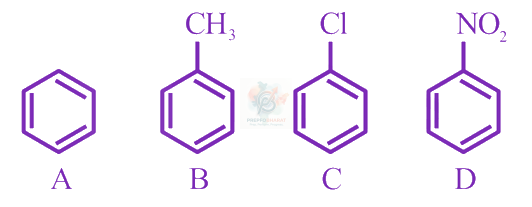
The final product A formed in the following multistep reaction sequence is 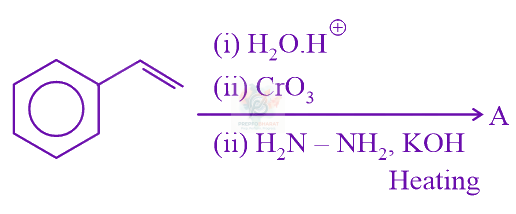
Which among the following has highest boiling point?
Which of the following gives a positive test with ninhydrin?
Match List I with List I <table class="pyq-table"><tbody><tr><td></td><td>List I (Substances)</td><td></td><td>List II (Element Present)</td></tr><tr><td>A.</td><td>Ziegler catalyst</td><td>I.</td><td>Rhodium</td></tr><tr><td>B.</td><td>Blood Pigment</td><td>II.</td><td>Cobalt</td></tr><tr><td>C.</td><td>Wilkinson catalyst</td><td>III.</td><td>Iron</td></tr><tr><td>D.</td><td>Vitamin B12</td><td>IV.</td><td>Titanium</td></tr></tbody></table>Choose the correct answer from the options given below:
Major product formed in the following reaction is a mixture of: 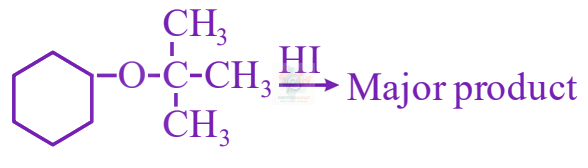
Which one the following compounds will readily react with dilute \(\mathrm{NaOH}\) ?
Match List I with List II \(\begin{array}{|l|l|l|l|} \hline & \text{ List - I (Test) } & & \text{List - II (Observation)} \\ \hline \text { A. } & \mathrm{Br}_2 \text { water test } & \text { I. } & \text { Yellow orange or orange red precipitate formed } \\ \hline \text { B. } & \text { Ceric ammonium nitrate test } & \text { II. } & \text { Reddish orange colour disappears } \\ \hline \text { C. } & \text { Ferric chloride test } & \text { III. } & \text { Red colour appears } \\ \hline \text { D. } & 2,4 \text { - DNP test } & \text { IV. } & \text { Blue, Green, Violet or Red colour appear } \\ \hline \end{array}\) Choose the correct answer from the options given below:
Consider the given chemical reaction sequence : 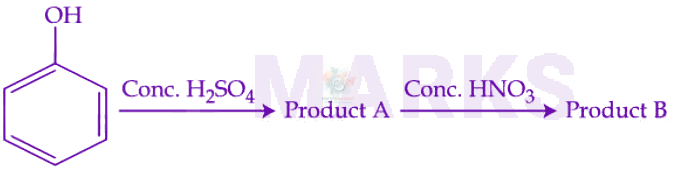 Total sum of oxygen atoms in Product A and Product B are _______
Sugar which does not give reddish brown precipitate with Fehling's reagent is:
The final product A, formed in the following reaction sequence is: 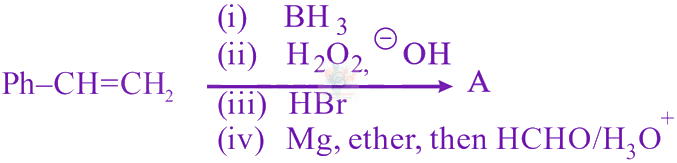
A species having carbon with sextet of electrons and can act as electrophile is called
Correct order of stability of carbanion is - 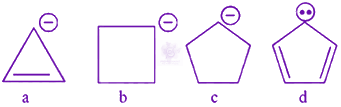
In the given reactions identify the reagent $A$ and reagent $B$ 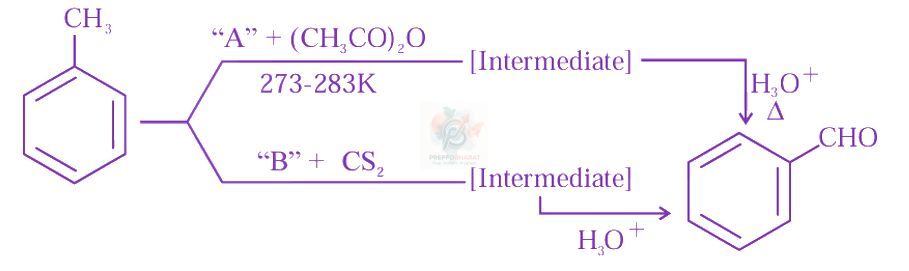
If one strand of a $\mathrm{DNA}$ has the sequence ATGCTTCA, sequence of the bases in complementary strand is:
The product $A$ formed in the following reaction is: 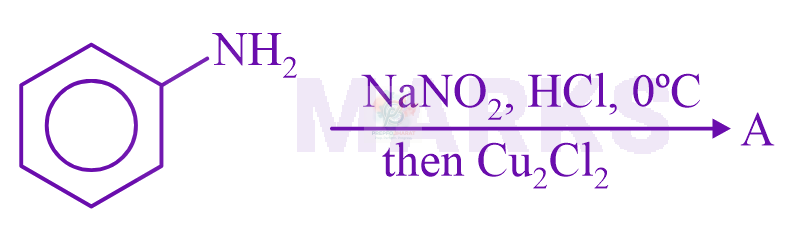
For the given compounds, the correct order of increasing \(\mathrm{pK}_{\mathrm{a}}\) value : 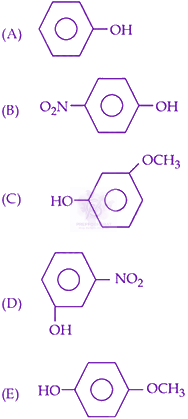 Choose the correct answer from the options given below :
Given below are two statements: Statement (I) : Aminobenzene and aniline are same organic compounds. Statement (II) : Aminobenzene and aniline are different organic compounds. In the light of the above statements, choose the most appropriate answer from the options given below:
Total number of compounds with Chiral carbon atoms from following is 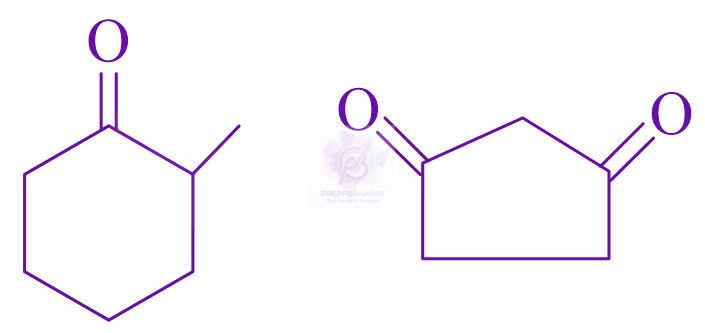 ${\mathrm{CH}}_{3}-{\mathrm{CH}}_{2}-\mathrm{CH}({\mathrm{NO}}_{2})-\mathrm{COOH}$ ${\mathrm{CH}}_{3}-\mathrm{CH}(I)-{\mathrm{CH}}_{2}-{\mathrm{NO}}_{2}$ ${\mathrm{CH}}_{3}-{\mathrm{CH}}_{2}-\mathrm{CHBr}-{\mathrm{CH}}_{2}-{\mathrm{CH}}_{3}$ ${\mathrm{CH}}_{3}-{\mathrm{CH}}_{2}-\mathrm{CH}(\mathrm{OH})-{\mathrm{CH}}_{2}\mathrm{OH}$ 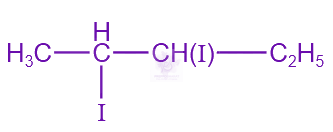
Which among the following is incorrect statement?
The set of meta directing functional groups from the following sets is:
Total number of deactivating groups in aromatic electrophilic substitution reaction among the following is 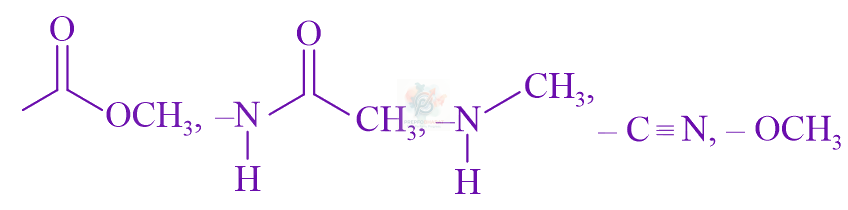
In the following sequence of reaction, the major products \(B\) and \(C\) respectively are : 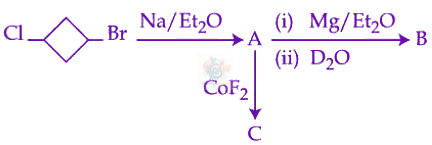
Which structure of protein remains intact after coagulation of egg white on boiling?
Alkyl halide is converted into alkyl isocyanide by reaction with
Match List-I with List-II. <table class="pyq-table"><tbody><tr><td></td><td>List I (Reaction)</td><td></td><td>List II (Reagent(s))</td></tr><tr><td>(A)</td><td><img src="https://prepforbharat.s3.ap-south-1.amazonaws.com/exam/615f0e999476412f48314daf/Chemistry/images/Alcohols_Phenols_and_Ethers/6682bd29ba0e94a3c4025ae7/question_1__q_6682bd29ba0e94a3c4025ae7__cdn-question-pool.getmarks.app__4ea85857-a940-4754-a3d4-a08de9c2b296__8f044bd179_final_ppt_sync.png" alt="JEE Main 2024 Chemistry, Alcohols Phenols and Ethers — question figure 1"></td><td>(I)</td><td>${\mathrm{Na}}_{2}{\mathrm{Cr}}_{2}{O}_{7}/{H}_{2}{\mathrm{SO}}_{4}$</td></tr><tr><td>(B)</td><td><img src="https://prepforbharat.s3.ap-south-1.amazonaws.com/exam/615f0e999476412f48314daf/Chemistry/images/Alcohols_Phenols_and_Ethers/6682bd29ba0e94a3c4025ae7/question_2__q_6682bd29ba0e94a3c4025ae7__cdn-question-pool.getmarks.app__befbe557-5214-4daf-a30c-b03d96e3a17e__ceab678820_final_ppt_sync.png" alt="JEE Main 2024 Chemistry, Alcohols Phenols and Ethers — question figure 2"></td><td>(II)</td><td>$\text{ (i) }\mathrm{NaOH}\text{ (ii) }{\mathrm{CH}}_{3}\mathrm{Cl}$</td></tr><tr><td>(C)</td><td><img src="https://prepforbharat.s3.ap-south-1.amazonaws.com/exam/615f0e999476412f48314daf/Chemistry/images/Alcohols_Phenols_and_Ethers/6682bd29ba0e94a3c4025ae7/question_3__q_6682bd29ba0e94a3c4025ae7__cdn-question-pool.getmarks.app__a3b21d23-d4c8-4c2f-b5fd-a315c904538d__0a115f3d40_final_ppt_sync.png" alt="JEE Main 2024 Chemistry, Alcohols Phenols and Ethers — question figure 3"></td><td>(III)</td><td>(i)$\mathrm{NaOH},{\mathrm{CHCl}}_{3}$ (ii) $\mathrm{NaOH}$ (iii) $\mathrm{HCl}$</td></tr><tr><td>(D)</td><td><img src="https://prepforbharat.s3.ap-south-1.amazonaws.com/exam/615f0e999476412f48314daf/Chemistry/images/Alcohols_Phenols_and_Ethers/6682bd29ba0e94a3c4025ae7/question_4__q_6682bd29ba0e94a3c4025ae7__cdn-question-pool.getmarks.app__4964f20f-70e7-48a0-b2fa-3c2be2c42805__0d15e338e8_final_ppt_sync.png" alt="JEE Main 2024 Chemistry, Alcohols Phenols and Ethers — question figure 4"></td><td>(IV)</td><td>(i) $\mathrm{NaOH}$ (ii) ${\mathrm{CO}}_{2}$ (iii) $\mathrm{HCl}$</td></tr></tbody></table>Choose the correct answer from the options given below:
Which of the following nitrogen containing compound does not give Lassaigne's test?
The product (C) in the below mentioned reaction is: ${\mathrm{CH}}_{3}-{\mathrm{CH}}_{2}-{\mathrm{CH}}_{2}-\mathrm{Br}\rightarrow _{\Delta }^{{\mathrm{KOH}}_{(\mathrm{alc})}}A\overset{\mathrm{HBr}}{\rightarrow }B\rightarrow _{{\mathrm{KOH}}_{(\mathrm{aq})}}^{\Delta }C$
IUPAC name of following compound is 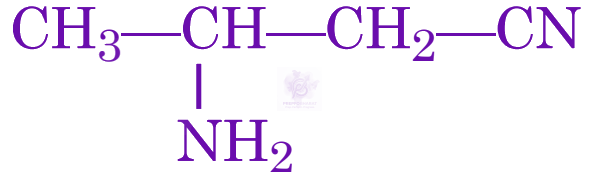
Given below are two statements : Statement (I) : p-nitrophenol is more acidic than m-nitrophenol and o-nitrophenol. Statement (II) : Ethanol will give immediate turbidity with Lucas reagent. In the light of the above statements, choose the correct answer from the options given below :
Identify \(A\) and \(B\) in the given chemical reaction sequence : 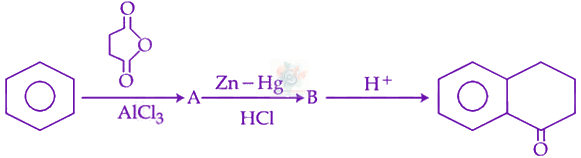
Which of the following is the correct structure of L-Glucose?
Ionic reactions with organic compounds proceed through: (A) Homolytic bond cleavage (B) Heterolytic bond cleavage (C) Free radical formation (D) Primary free radical (E) Secondary free radical Choose the correct answer from the options given below:
Number of optical isomers possible for $2$ – chlorobutane ........
From the compounds given below, number of compounds which give positive Fehling's test is Benzaldehyde, Acetaldehyde, Acetone, Acetophenone,Methanal, 4-nitrobenzaldehyde, cyclohexane carbaldehyde.
The number of halobenzenes from the following that can be prepared by Sandmeyer's reaction is _______ 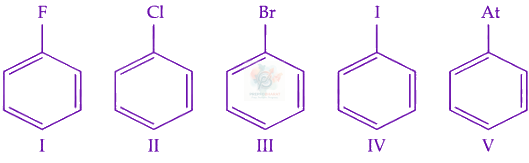
Correct order of basic strength of Pyrrole 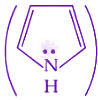 , Pyridine , and Piperidine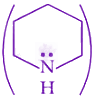 is:
Number of geometrical isomers possible for the given structure is/are _________. 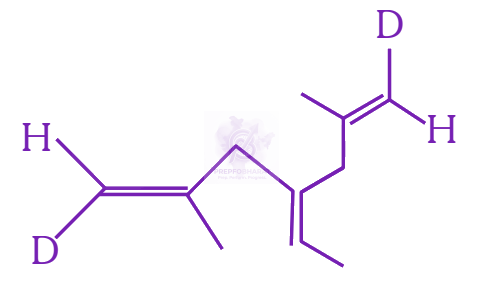
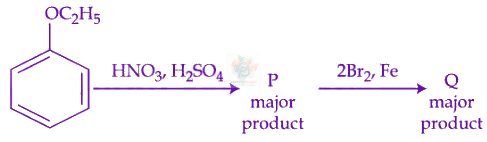 The ratio of number of oxygen atoms to bromine atoms in the product \(\mathrm{Q}\) is ______ \(\times 10^{-1}\).
Vanillin compound obtained from vanilla beans, has total sum of oxygen atoms and \(\pi\) electrons is ______
On a thin layer chromatographic plate, an organic compound moved by $3.5\mathrm{cm}$, while the solvent moved by $5\mathrm{cm}$. The retardation factor of the organic compound is _____________$\times {10}^{-1}$
Which one of the following reactions is NOT possible?
Lassaigne's test is used for detection of:
In the given reactions identify $A$ and $B.$ 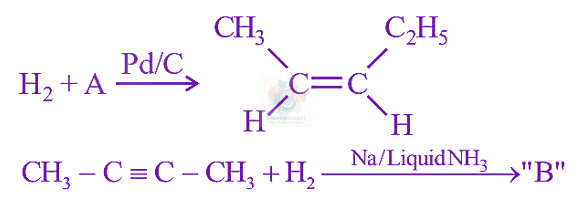
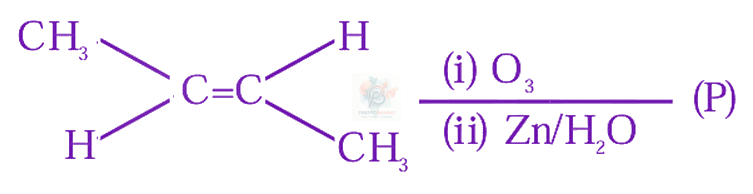 Consider the given reaction. The total number of oxygen atoms present per molecule of the product $(P)$ is _________.
Which of the following compound can give positive iodoform test when treated with aqueous \(\mathrm{KOH}\) solution followed by potassium hypoiodite.
Major product of the following reaction is 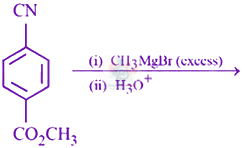
Common name of Benzene - 1, 2 - diol is -
Number of \(\sigma\) and \(\pi\) bonds present in ethylene molecule is respectively :
Match List I with List II 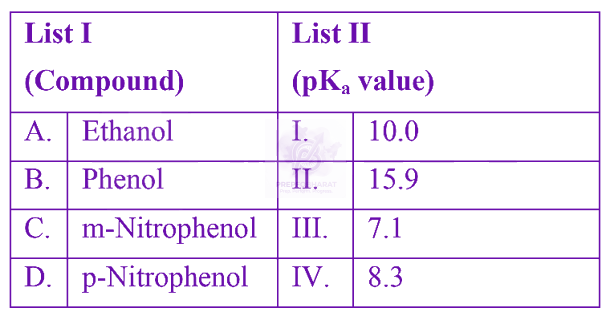 Choose the correct answer from the options given below: