The resonance effect definition can be given as a chemical phenomenon, observed in the characteristic compounds containing double bonds in the organic compounds. The organic compounds have these double bonds in the structures and have the overlapping of the p-orbitals, usually on the two adjacent sides of carbon atoms.
Negative Resonance Effect: The Negative resonance effect happens when the groups withdraw the electrons from the other molecules by the delocalisation process. Usually, the groups are denoted either by -R or -M. The molecular electron density is said to decrease in this process. The negative resonance effect examples are, C=O,−COOH,−C≡N and −NO2.
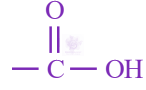
−COOH shows –R effect, while rest 3 groups shows +R effect via lone pair.